Have you ever been asked, "What did we see on our walk?" or "How do we know a plant is growing?" Sometimes the answer is already in your mind. Other times, the answer is in a book, a picture, a chart, or a video. Good learners know how to do both. They remember what happened, and they also look for facts in the right place.
A question asks something we want to know. An answer gives the information you need. Some questions are easy to answer right away. If someone asks, "What did you eat for lunch?" you can think about your day and tell what happened.
Other questions need more than memory. If someone asks, "What do caterpillars turn into?" you may need to look in a book or listen to a grown-up read information. That is called finding information from a source.
Experience means something that happened to you and that you remember. Source means a place where information comes from, such as a book, picture, chart, video, or a page your teacher gives you. Recall means to remember something you saw, did, or learned before.
When children answer questions, adults help them listen carefully, think carefully, and use information carefully. A teacher, parent, or another grown-up can help you choose the best way to find the answer.
There are two big ways to find an answer, as [Figure 1] shows. One way is to recall information from something you did or saw. The other way is to gather information from a source that a grown-up gives you.
If your class took a nature walk and the teacher asks, "What animals did we see?" you can think back to the walk. Maybe you remember a bird in a tree, an ant on the ground, and a squirrel near the fence. You are using your own experience.
If the teacher asks, "What do squirrels eat?" you may need help from a book, a picture card, or a short video. You are gathering information from a source. Both ways help you answer questions.
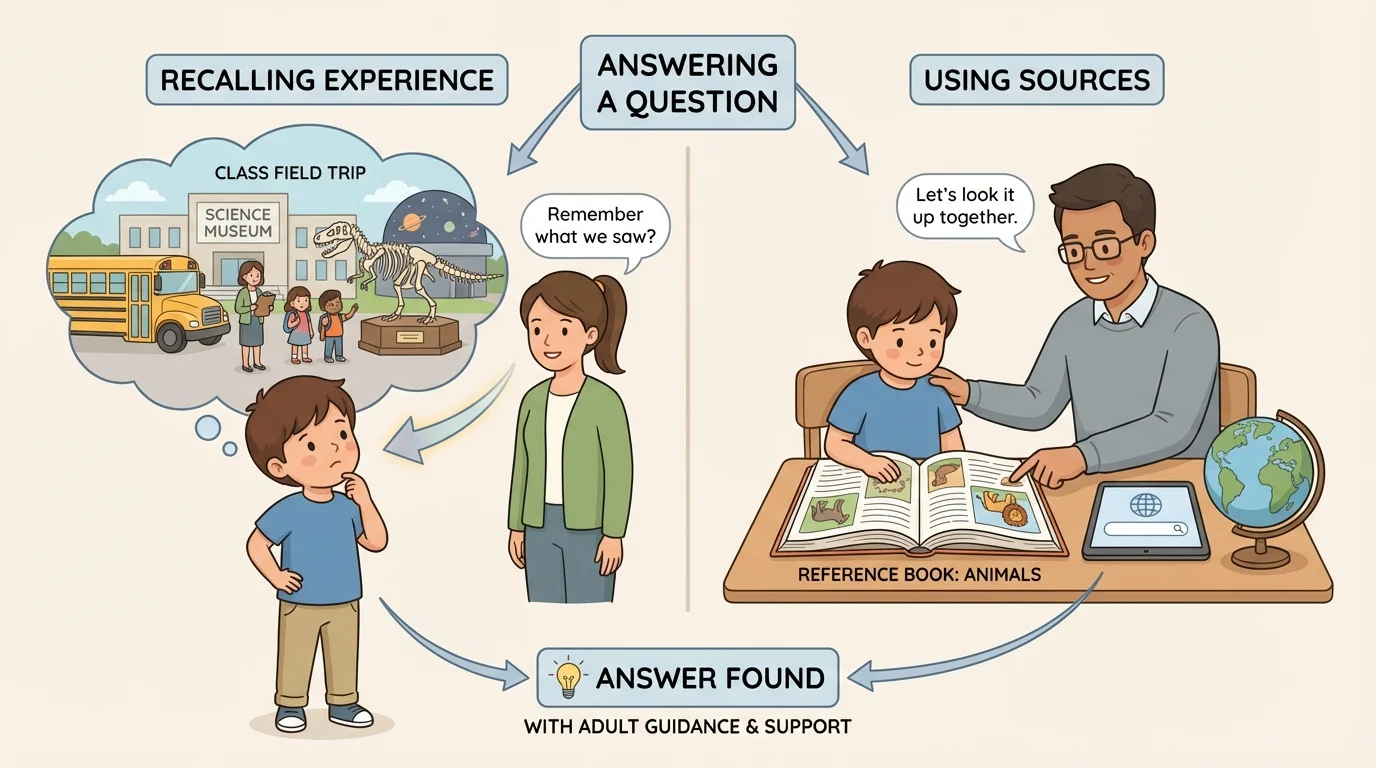
Sometimes students use both ways together. You might remember seeing a butterfly on the playground, and then you look at a picture book to learn its name. Remembering and researching can work like teammates.
Your brain stores many small memories from school days, such as what you saw in science or heard in a story. Looking at a picture or hearing a question can help those memories come back.
Adults support this work by asking helpful questions like, "What do you remember first?" or "Where can we look to check that?" These questions help you slow down and think.
A source can be many things. It might be a read-aloud book, a photo, a class chart, a science observation page, or a short video chosen by the teacher. These are sources of information because they help us learn facts.
When you use a source, look and listen for details that match the question. If the question is, "What color was the butterfly in the picture?" you look for color. If the question is, "Where do penguins live?" you listen for place words.
Adults help students stay focused on the question. They may point to a page, read a sentence aloud, or help a child notice an important picture. This kind of support helps students gather the right information instead of guessing.
| Question Type | Good Place to Find the Answer |
|---|---|
| What did we do in art? | Your memory of the class |
| What does a frog eat? | A book or picture source |
| What happened on our class trip? | Your memory and class photos |
| How did the seed change? | An observation chart |
Table 1. Examples of questions and the best place to find answers.
Later, when you answer a new question, you can think back to the idea in [Figure 1]: "Do I know this from my own experience, or do I need to look at a source?" That is a smart first step.
[Figure 2] Good researchers follow simple steps, and this diagram illustrates one easy path. First ask the question. Next, think about what you already know. Then look at a source if you need more information. After that, tell the answer. Last, check with an adult to make sure the answer fits the question.
These steps help students stay organized. They also help children remember that answers should come from real information, not just from random guesses.
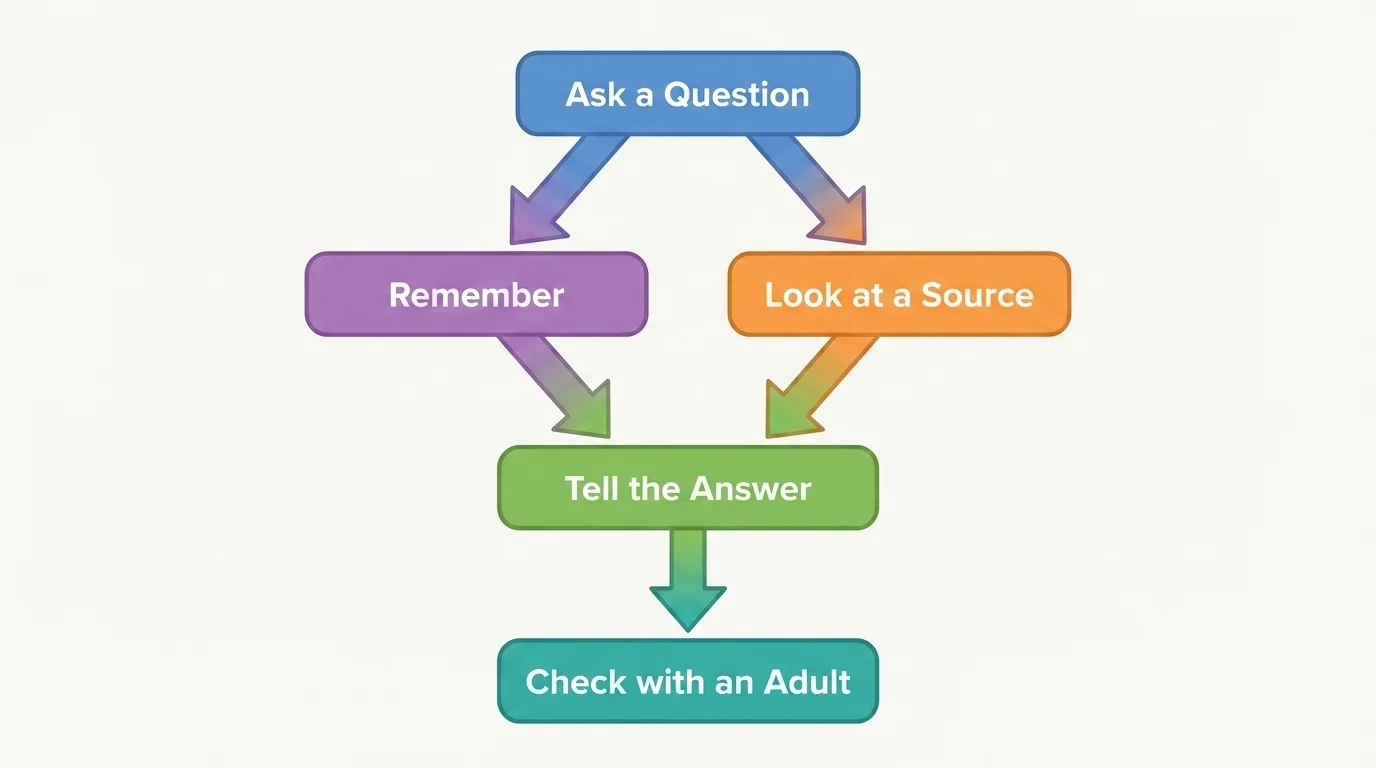
Ask, Think, Look, Tell, Check
This simple pattern helps young learners do shared research. Ask means listen to the question. Think means remember your own experience. Look means use a provided source when needed. Tell means share the answer clearly. Check means make sure the answer matches the question.
Suppose the question is, "What did we need to make applesauce?" First, ask: what is the question really about? It is asking about ingredients or things used. Next, think about the cooking activity. Maybe you remember apples and cinnamon. Then look at the recipe card with the teacher. Now you can tell the answer: "We used apples and cinnamon." Finally, check that your answer matches the question.
The same steps work in reading, science, social studies, and class projects. A child may remember a story event, then check the book to make sure the answer is correct.
[Figure 3] Let's look at real classroom examples. A teacher asks, "What happened when we put the seed in water?" A student may recall seeing the seed get bigger. Then the class can look at an observation chart to gather more details about how the plant changed over several days.
Using memory, a child might say, "I remember the seed coat looked different." Using the chart, the child can add, "On day one it was a seed, on day three there was a sprout, and on day seven the plant was taller." That answer is stronger because it uses remembered experience and a source.
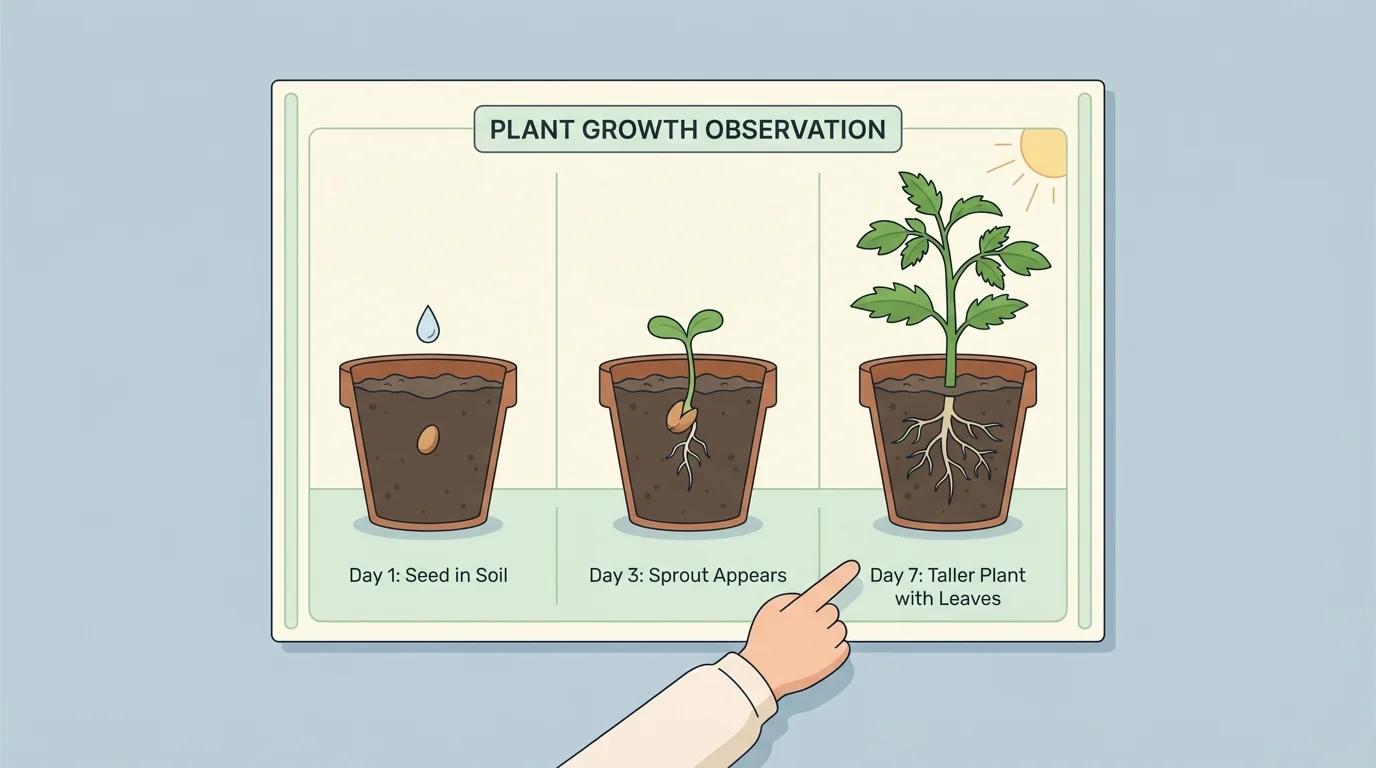
Example: Answering from an experience
Step 1: Hear the question.
The teacher asks, "What did we see at the fire station?"
Step 2: Recall the experience.
The student thinks about the visit and remembers a fire truck, helmets, and a hose.
Step 3: Tell the answer.
The student says, "We saw a fire truck, helmets, and a hose."
Now think about a story question. The teacher asks, "Where did the bear go at the end of the story?" A student may not remember, so the teacher opens the book to the last page. The child looks at the picture and listens to the sentence. Then the child answers, "The bear went back to the cave."
Another example comes from class rules. If the question is, "Why do we wash our hands before snack?" students may remember a health lesson and a poster. They can answer, "We wash our hands to help keep germs away."
Example: Answering with a provided source
Step 1: Hear the question.
The teacher asks, "What do penguins use to move in the water?"
Step 2: Use the source.
The class looks at a nonfiction page with a picture of penguins swimming.
Step 3: Gather the information.
The student notices that penguins use their flippers.
Step 4: Answer clearly.
The student says, "Penguins use their flippers to move in the water."
When students use charts and notes, they can gather information over time. A chart helps children answer questions with details, not just one quick memory.
After finding information, students share it. They may speak to a partner, tell the class, draw a picture, or write a sentence. A clear answer matches the question.
If the question is, "What did the class use to build the tower?" a clear answer is, "We used blocks." If the question is, "How did the tower fall?" the answer should tell how it fell, not what it was made of. Matching the answer to the question is important.
Adults may help students use sentence starters like "I remember...," "The book says...," or "The chart shows...." These starters help students explain where the information came from.
When you answer a question, listen for key words such as who, what, where, when, and why. These words help you know what kind of information to look for.
Even young writers can gather ideas first and then write one simple sentence. A child might write, "The seed grew a sprout." Another child might draw the sprout and label it. Both are ways to share learning.
Good learners try to tell what really happened. If you are recalling an experience, say what you truly remember. If you are using a source, tell what the source really says or shows. Do not add made-up details.
That is why adult support matters so much. A grown-up can help children check facts, look again at a page, or think back to an event more carefully. The checking step in [Figure 2] helps make answers stronger and more accurate.
When children practice remembering, looking, and answering, they become stronger learners. They learn that questions can be solved by thinking carefully and using information wisely.
