Have you ever heard someone talk and talk, but you still wonder, "What is this mostly about?" Good readers are like detectives. They look for the big idea first, and then they collect the important facts that match it. That helps them understand a text and talk about it clearly.
When we read an informational text, we think about what it is mostly about. Informational texts teach us about the world. They may teach about animals, weather, plants, people, places, or machines. A reader does not need to remember every single word. A reader needs to understand the big idea and the important details.
Sometimes a text has many facts, but those facts fit together like puzzle pieces. When the puzzle pieces match, they help us see the whole picture. The whole picture is the big idea of the text.
Main topic is what a text is mostly about.
Key details are the important facts that tell more about the main topic.
Retell means to tell the important parts again in your own words.
When readers can name the main topic and key details, they understand the text better. They can also explain what they learned to someone else.
The main topic is the one big thing the text tells about. If a text says, "Dogs can help people. Some dogs lead people who cannot see. Some dogs help police officers. Some dogs comfort people," the main topic is dogs that help people or simply helpful dogs.
A main topic is not every fact in the text. It is the big subject that holds the facts together. A text might be mostly about apples, rain, trains, or bees. Then the details tell more about those things.
Key details are the facts that matter most. They help answer the question, "What do I learn about the topic?" If a text is about butterflies, key details might be that butterflies begin as caterpillars, drink nectar, and have wings with colors and patterns.
Small details are not always key details. For example, if a text says, "A red ladybug sat on a leaf at noon," the key part may be that a ladybug sat on a leaf. The color red and the time of day might not be the most important part unless the text is teaching about colors or time.
Big idea and matching facts
Think of the main topic as a box. The key details are the things that belong inside the box. If a detail does not match the box, it is probably not a key detail for that text. Good readers keep asking, "Does this detail help explain the main topic?"
When a detail matches the topic, keep it in your retell. When a detail does not help much, you can leave it out.
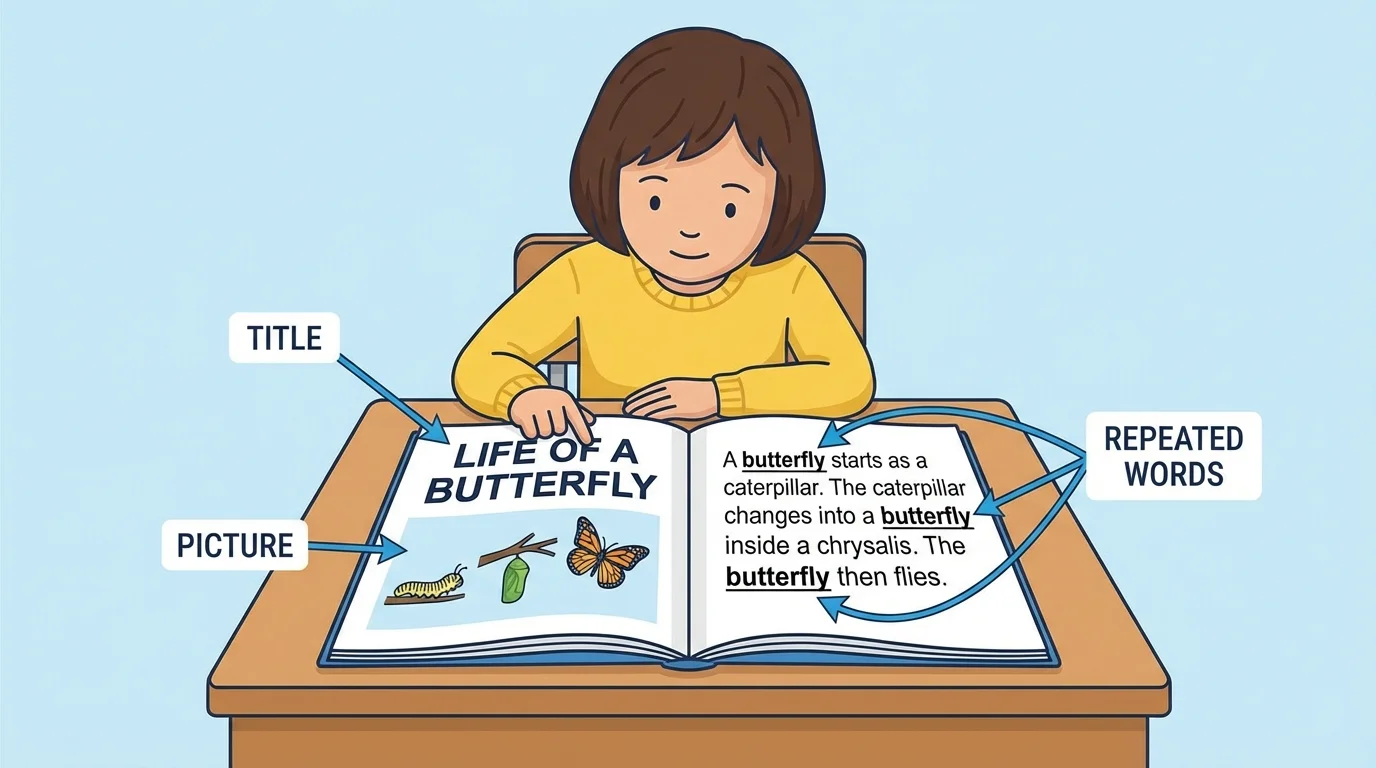
Readers use clues to find the main topic, as [Figure 1] shows with a title, picture, and repeated words. The title can give a strong hint. Pictures can show what the text is about. Words that appear again and again can also point to the big idea.
You can also listen to the first sentence and the last sentence. Often, those parts help tell what the text is mostly about. Ask yourself, "What am I hearing or reading about again and again?"
If the title is Rainy Days, and the text says rain fills puddles, helps plants grow, and makes people use umbrellas, the main topic is rainy days or rain. Many details all point to the same idea.
Sometimes the text is very short. Even then, you can still find the main topic. Listen for the subject that stays the same from beginning to end.
To retell a text, do not try to say every word again. Say the main topic first. Then tell the key details. This helps your retell sound clear and easy to understand.
You can use a simple pattern: "This text is about ____. One key detail is ____. Another key detail is ____. A third key detail is ____." That pattern helps you remember what to say.
Retell pattern
Step 1: Name the main topic.
"This text is about turtles."
Step 2: Tell one important detail.
"Turtles have shells."
Step 3: Tell more important details.
"Some turtles live in water, and some live on land."
Step 4: Finish with another key detail.
"Turtles move slowly."
That is a strong retell because it tells the topic and the important facts.
A good retell uses your own words. You may not say the exact same sentence from the text, and that is fine. What matters is telling the important ideas correctly.
Sometimes readers hear a detail that is interesting, but it is not one of the most important details. Good readers choose details that really teach about the topic.
Look at these examples. If the text is about penguins, a key detail might be "Penguins cannot fly." Another key detail might be "Penguins are strong swimmers." But if the text says one penguin in a picture stands near a shiny rock, that may not be an important detail.
| Text Topic | Key Detail | Less Important Detail |
|---|---|---|
| Bees | Bees help flowers by moving pollen. | One bee in a picture is near a fence. |
| Snow | Snow falls when the weather is very cold. | A child wears blue mittens. |
| Buses | Buses carry many people. | One bus has a small sticker. |
Table 1. Examples showing the difference between important key details and less important details.
When you retell, choose the details from the middle column, not the tiny extra parts. That keeps your retell focused.
Some nonfiction books repeat the same word many times on purpose. That repetition helps readers notice the topic more easily.
Repeated words can act like clues. If you hear "seeds," "plant," "grow," and "sunlight," the text may be mostly about plants growing.
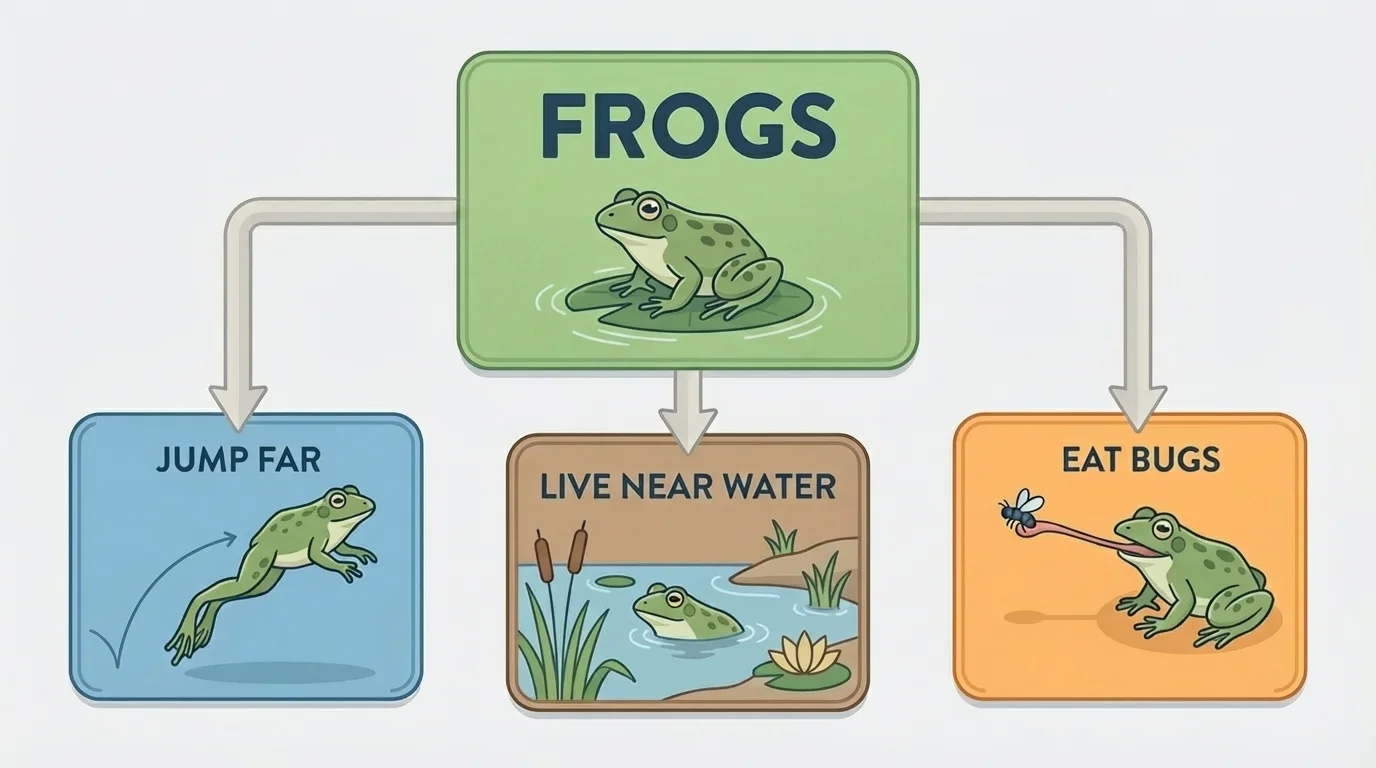
One big idea can connect to several details, as [Figure 2] illustrates with a short text about frogs. Listen to this text: "Frogs can jump far. Frogs live near ponds and streams. Frogs eat bugs." What is the main topic? The main topic is frogs.
What are the key details? Frogs can jump far. Frogs live near ponds and streams. Frogs eat bugs. Each detail tells more about frogs.
A retell could sound like this: "This text is about frogs. Frogs can jump far. They live near water. They eat bugs." That retell is short, clear, and correct.
Now listen to another text: "Wind moves air. Wind can blow leaves. Wind can make kites fly." The main topic is wind. The key details are that wind moves air, blows leaves, and helps kites fly.
Later, when you hear another text about animals, you can think back to [Figure 2]. Just like the frog details all match one topic, the details in any good retell should all match the same big idea.
Another modeled retell
Text: "The sun gives light. The sun gives heat. Plants need sunlight to grow."
Retell: "This text is about the sun. The sun gives light and heat. Plants need sunlight to grow."
Notice that the retell is a little shorter than the original text, but it still keeps the important ideas.
The main topic can be many kinds of things. It may be a person, such as a firefighter. It may be a place, such as a farm. It may be an animal, such as a whale. It may be a thing, such as a bicycle.
If the topic is a person, key details may tell what the person does. If the topic is a place, key details may tell what is there. If the topic is an animal, key details may tell how it looks, where it lives, or what it eats. If the topic is a thing, key details may tell what it does or how people use it.
This helps you know what kind of details to listen for. Different texts may sound different, but the job is the same: find the main topic and tell the key details.
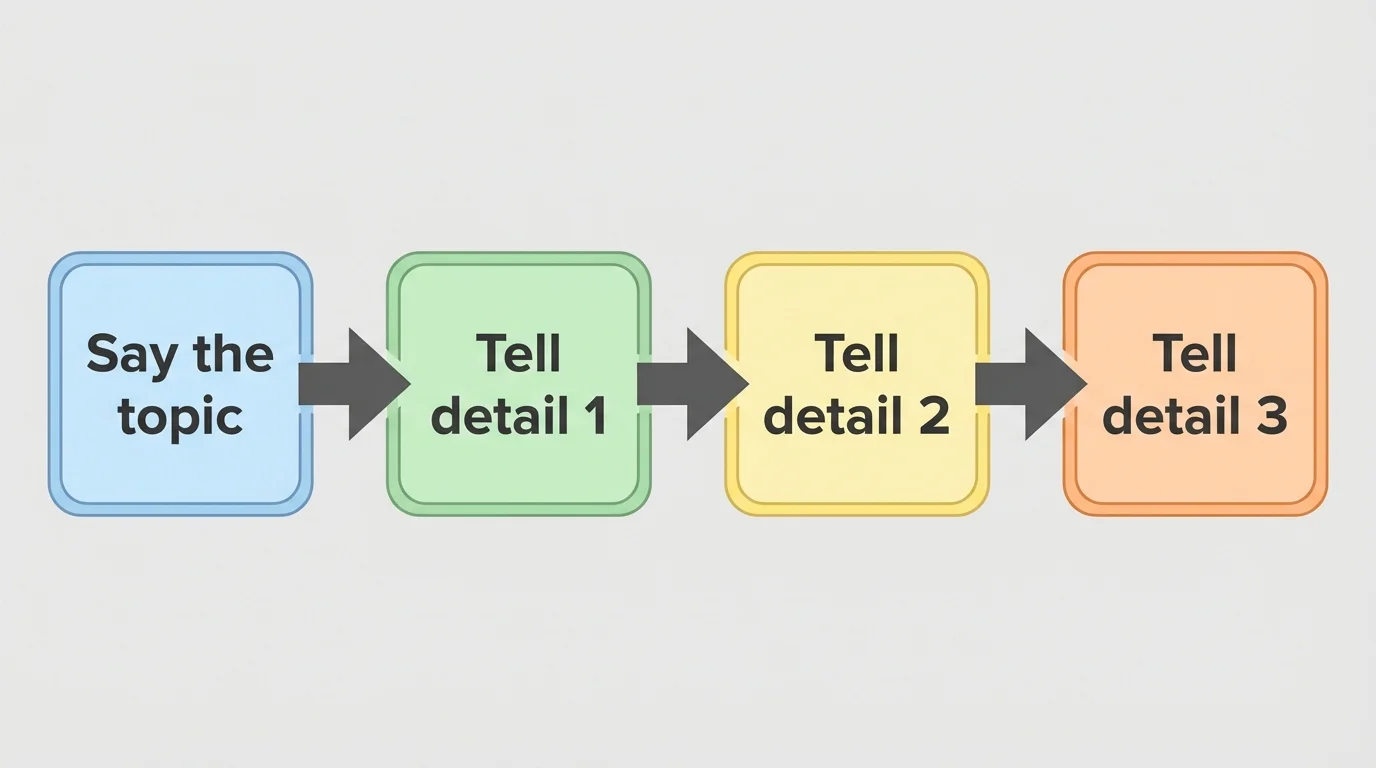
A strong retell has an order from the topic to the important details. First say the topic. Then say the details one by one. You do not need every tiny fact. You need the facts that matter most.
[Figure 3] Sentence starters can help. You can say, "The text is about ____." Then add, "One key detail is ____." Next say, "Another key detail is ____." These sentence starters help your ideas stay neat.
If you forget a detail, think back to the big idea. Ask, "Which facts match this topic?" That question helps you choose the right details.
As you grow as a reader, you will get faster at hearing the big idea. The order in [Figure 3] stays useful in many texts: topic first, then the important details that support it.
You already know how to listen carefully to words and sentences. Now you are using that same careful listening to understand what a whole text is mostly about.
When readers know the main topic and can retell key details, they do more than remember facts. They understand how ideas fit together. That is what strong readers do every time they read to learn.
