Have you ever looked at a page and known something before reading even one word? A picture can give your brain a quick clue. But the words on the page can tell you more. Good readers learn to look at both. That helps them understand a book, an article, or a page full of facts.
When you read an informational text, you may see illustrations, photos, labels, or diagrams. You also see sentences and other words. Both parts matter, but they do not do the same job.
The text is made of words. The words can tell names, facts, places, times, and actions. A picture can show what something looks like. It can show color, shape, size, or how something is happening.
Illustration means a picture that helps explain a text. Text means the words we read. Readers ask, "What do I learn from the picture?" and "What do I learn from the words?"
Sometimes the picture and the words tell the same thing. Sometimes each one gives new information. Strong readers notice which part gives each clue.
A picture clue can help a reader understand a page quickly, as [Figure 1] shows with a park scene. A picture may show the weather, what someone is wearing, what animals are nearby, or how a place looks.
For example, suppose a page has a picture of a girl at a park. In the picture, the sun is shining, the girl is wearing a jacket, a dog is running, and a kite is in the sky. From the picture, you can tell it is outdoors. You can tell it may be windy because of the kite. You can tell the girl is active and having fun.
A picture can also show feelings. If a boy is smiling, you may think he feels happy. If a turtle is hiding in its shell, you may think it is scared or safe. Pictures help readers notice these visual details.
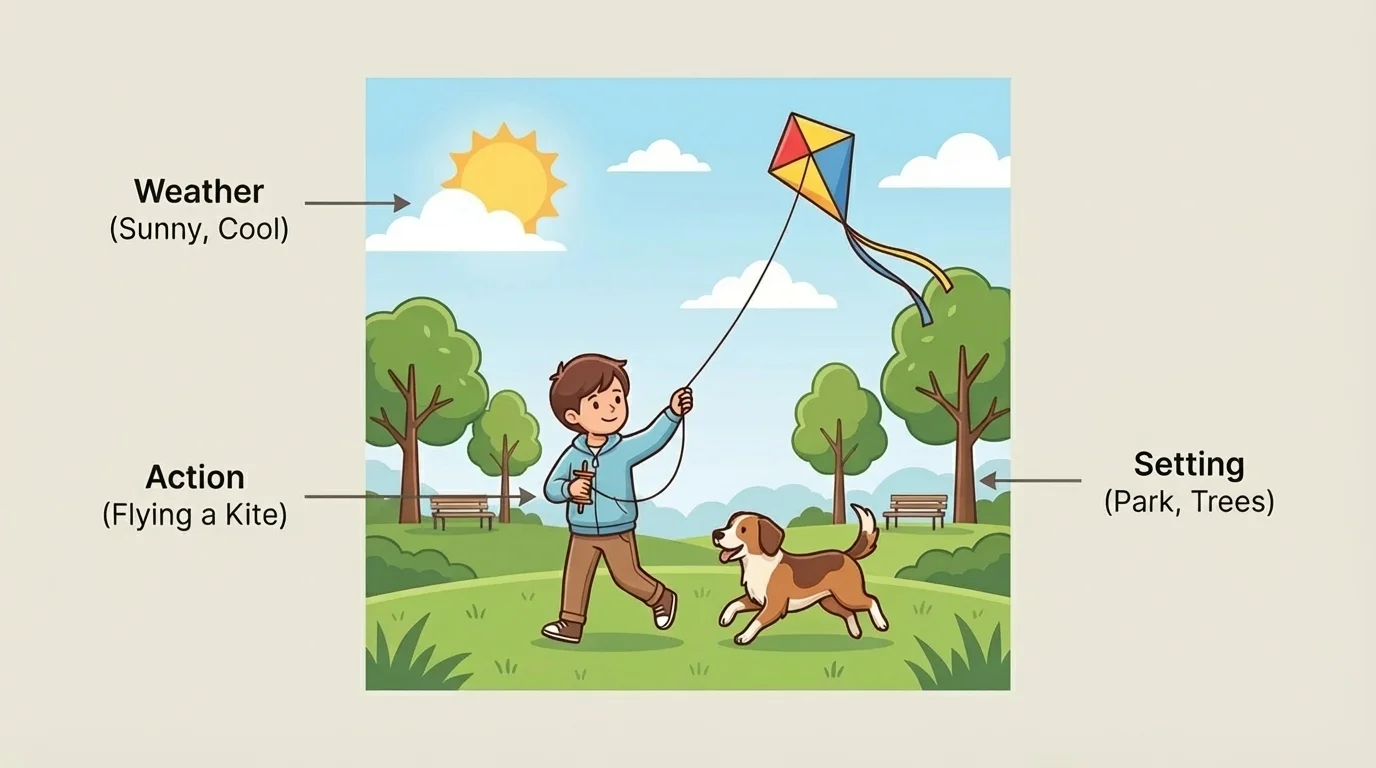
But a picture does not always tell everything. You may see a boy holding a seed, but the picture alone may not tell what kind of seed it is. It may not tell when he planted it or how long it takes to grow.
Some readers look at a picture first because their brains notice shapes, colors, and faces very fast. Then the words help them understand the exact meaning.
That is why readers should enjoy the picture, but they should also keep reading the words.
Words can tell exact facts. They can name things clearly. They can tell what happened first, next, and last. They can tell how many, where, and why.
Think about a page with a picture of a frog near water. The words might say, "Frogs lay eggs in water." The picture shows the frog and the pond. The words tell the fact that frogs lay eggs there. Without the words, you might not know what the frog is doing.
Words can also give details we cannot see. A picture may show a bear. The words may say, "Bears sleep for a long time in winter." You cannot see all of winter in one picture, but the words can tell you that.
Words are precise. Pictures are helpful for showing what something looks like, but words often give the exact information. They can explain facts, steps, reasons, and names that a picture may leave out.
Sometimes the words teach a new idea that is invisible. For example, a picture of bees shows flying insects and flowers. The words might explain that bees help plants make seeds by moving pollen. That important fact comes from the words.
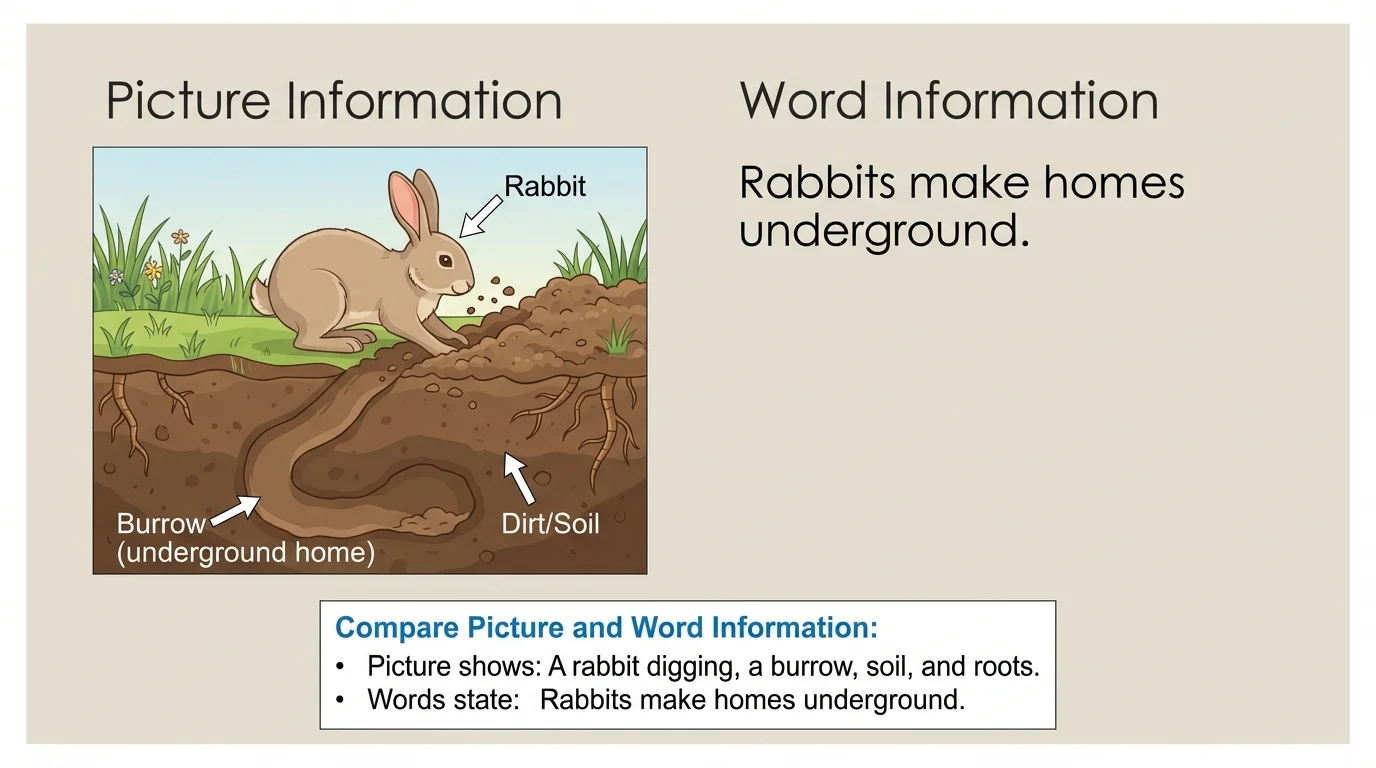
Good readers use both sources of information, as [Figure 2] shows on a page about rabbits. The picture and the words work like a team. One part helps with what we can see, and the other part helps with what we need explained.
Suppose a page shows a rabbit digging. The picture tells you the rabbit uses its paws and is close to the ground. The words say, "Rabbits dig burrows underground to make homes." Now you learn something important: the hole is called a burrow, and it is the rabbit's home.
When readers put both parts together, they understand more. The picture shows the action. The words explain the fact.
Example: What do I learn from each part?
Step 1: Look at the picture.
You see a penguin standing on ice with snow falling.
Step 2: Read the words.
The text says, "Penguins have thick feathers that help keep them warm."
Step 3: Sort the information.
The picture tells where the penguin is and what the place looks like. The words tell how the penguin stays warm.
Both parts help, but they give different information.
Later, when you read another page with animals, you can use the same thinking. As with the rabbit page, ask what you learned from looking and what you learned from reading.
Sometimes a picture gives one clue, and the words give another clue. That is not wrong. It just means each part is doing a different job.
For example, a picture might show a large red apple on a tree. The words might say, "Apples can be red, green, or yellow." The picture gives one example. The words give a bigger fact.
Or a picture may show one child planting one flower. The words may say, "People plant flowers in spring." The picture shows one moment. The words tell a more general idea.
You already know how to look for details in a picture and listen for details in a sentence. Now you are using both skills at the same time while reading.
If a picture and words seem different, stop and think: What does the picture show? What do the words tell? You do not have to choose only one. You can learn from both.
Informational texts use different kinds of visuals, as [Figure 3] shows with several ways to present a plant. Not every picture is the same. Different illustrations help readers in different ways.
A photo shows what something really looks like. A drawing can focus on important parts. A diagram can point to parts with labels. A labeled picture may show the roots, stem, leaves, and flower on a plant.
Some illustrations show change. A simple sequence of pictures can show a chick hatching or a seed growing. These visuals help readers understand order.
Other illustrations help explain parts. For example, a labeled drawing of a butterfly can point to wings, antennae, and body. The labels are words, but the drawing shows where each part is.
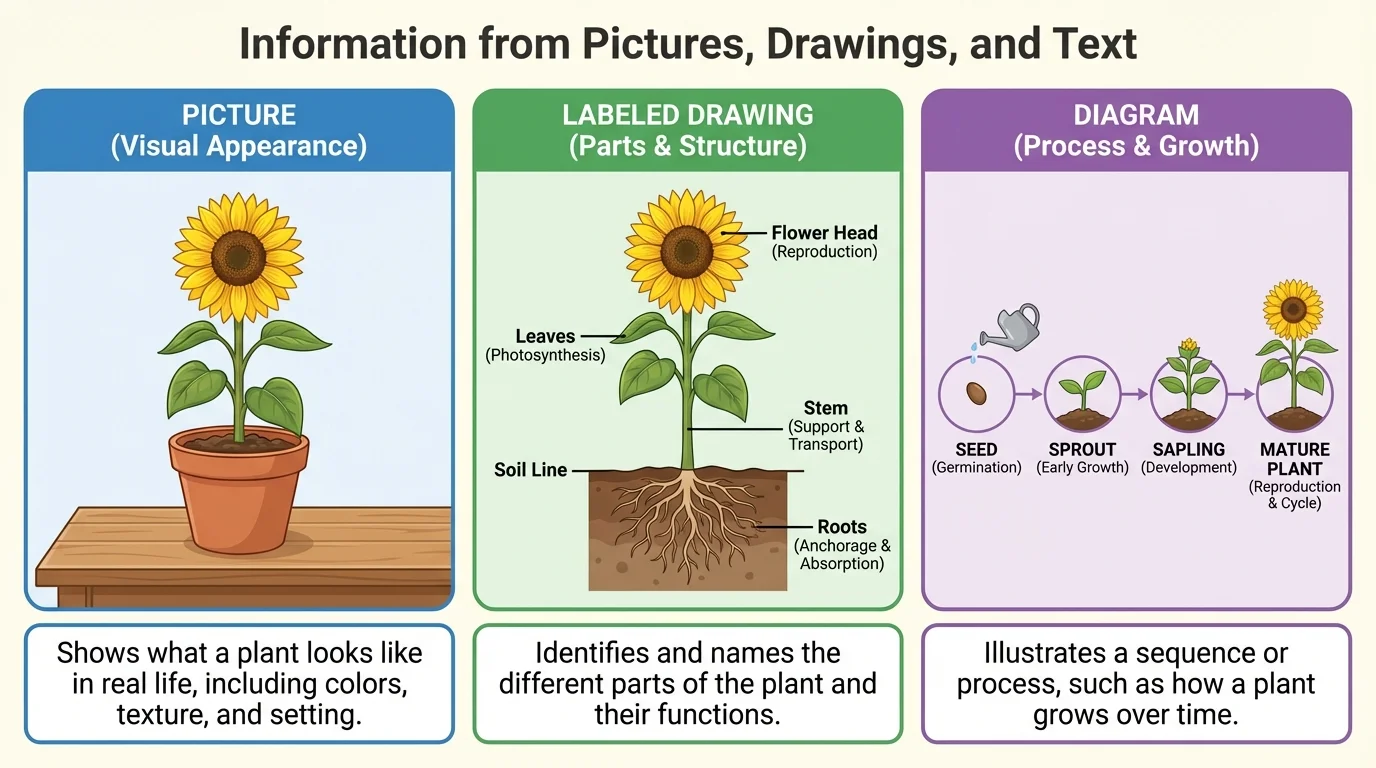
When you see these different visuals, think about what each one teaches. The plant comparison helps you notice that one visual may show what something looks like while another helps explain parts or change over time.
| What I See | What It Helps Me Learn |
|---|---|
| Photo | What something really looks like |
| Drawing | Main details the author wants me to notice |
| Diagram with labels | Parts and where they are |
| Words in the text | Facts, names, and explanations |
Table 1. Different parts of a page and the kind of information each one gives.
When you open a book page, start by looking closely. Notice the picture. Then read the words. Ask yourself simple questions. What can I see? What can I read? What does each part teach me?
If a picture shows a rainy day, that is information from the illustration. If the words say, "Rain helps plants grow," that is information from the text. One part shows the weather. The other part explains a fact.
Careful readers do not skip either part. They know pictures are helpful, and words are powerful. Together, they make understanding stronger.
