Have you ever read two texts about the same animal and noticed that one shows big bright pictures while the other gives more facts? That is what good readers do. They look at how two texts are alike and how they are different. When we compare texts, we learn even more.
A text is something we read. It can be a book, a page, or a short article. Sometimes two texts are about the same topic, such as rain, dogs, or how to plant a seed. Even when the topic is the same, the texts may not look or sound the same.
When readers compare two texts, they think about questions like these: What do both texts teach? What does only one text show? Do the pictures match? Do the words give the same details? Are the steps in the same order?
Similarity means something is the same in two texts. Difference means something is not the same in two texts. A topic is what a text is mostly about.
Comparing texts helps us become careful readers. We do not just say, "These are about bears." We look closely at the pictures, the facts, and the way the information is shared.
[Figure 1] Two texts can share the same topic. For example, both texts might be about apples. One text may show apples growing on a tree, and the other may show apples in a basket. Both are still about apples.
Two texts can also share some of the same facts. Both texts might say apples can be red or green. Both texts might say that apples grow on trees. These are similarities because the information matches.
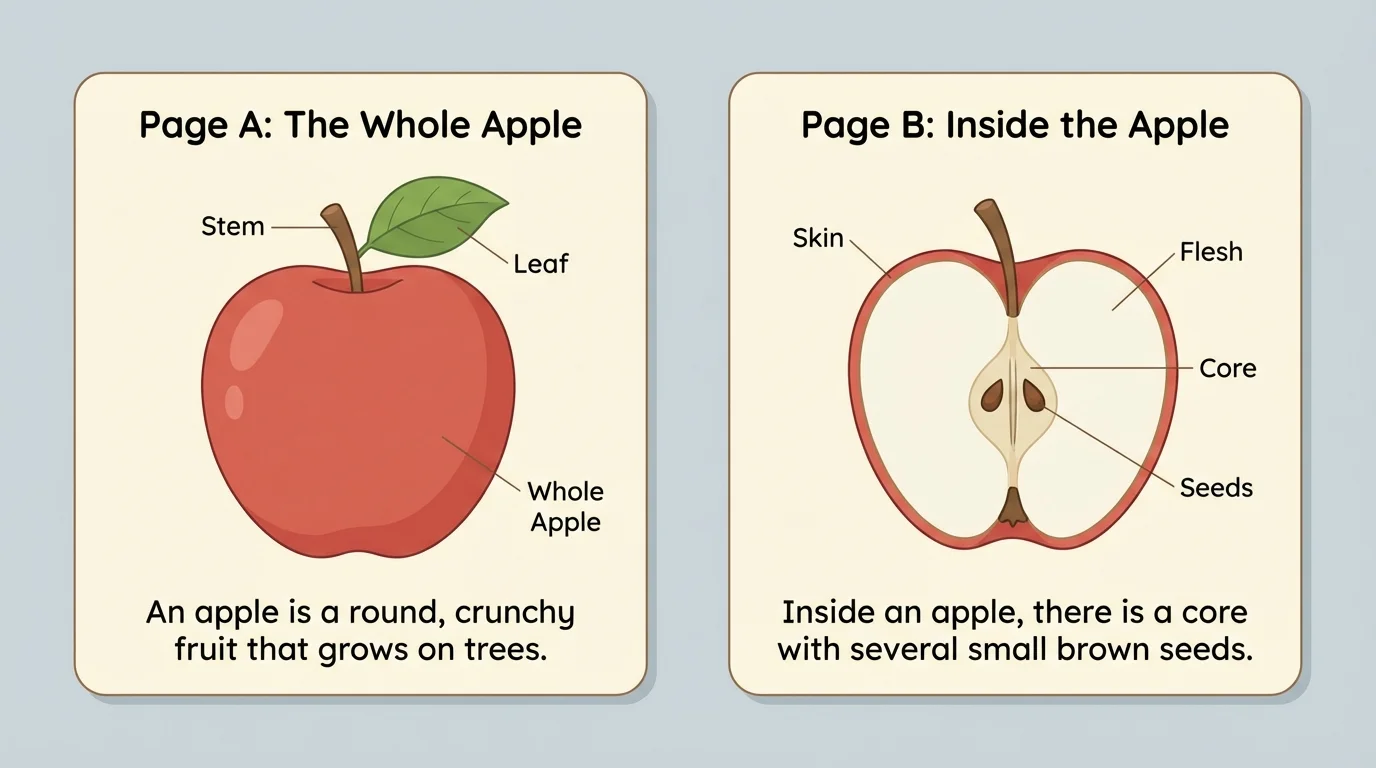
Sometimes the same idea is shown in different ways. One text may say, "Apples are fruit." Another may say, "People eat apples as a healthy snack." The words are not exactly the same, but both texts tell us apples are food we can eat.
Readers often learn more when they read more than one text on the same topic, because each text can add new details.
When you compare, listen for the word both. You might say, "Both texts are about apples," or "Both texts show apples growing." That tells a similarity.
[Figure 2] Two texts on the same topic can still have many differences. One may have a realistic picture, while another has a simple drawing. One may tell many facts, while another tells just a few. A reader notices these differences.
Think about two texts about frogs. The first text might say, "Frogs can jump and swim." The second text might say, "Frogs lay eggs in water." Both are about frogs, but they give different details. One tells about movement. The other tells about babies.
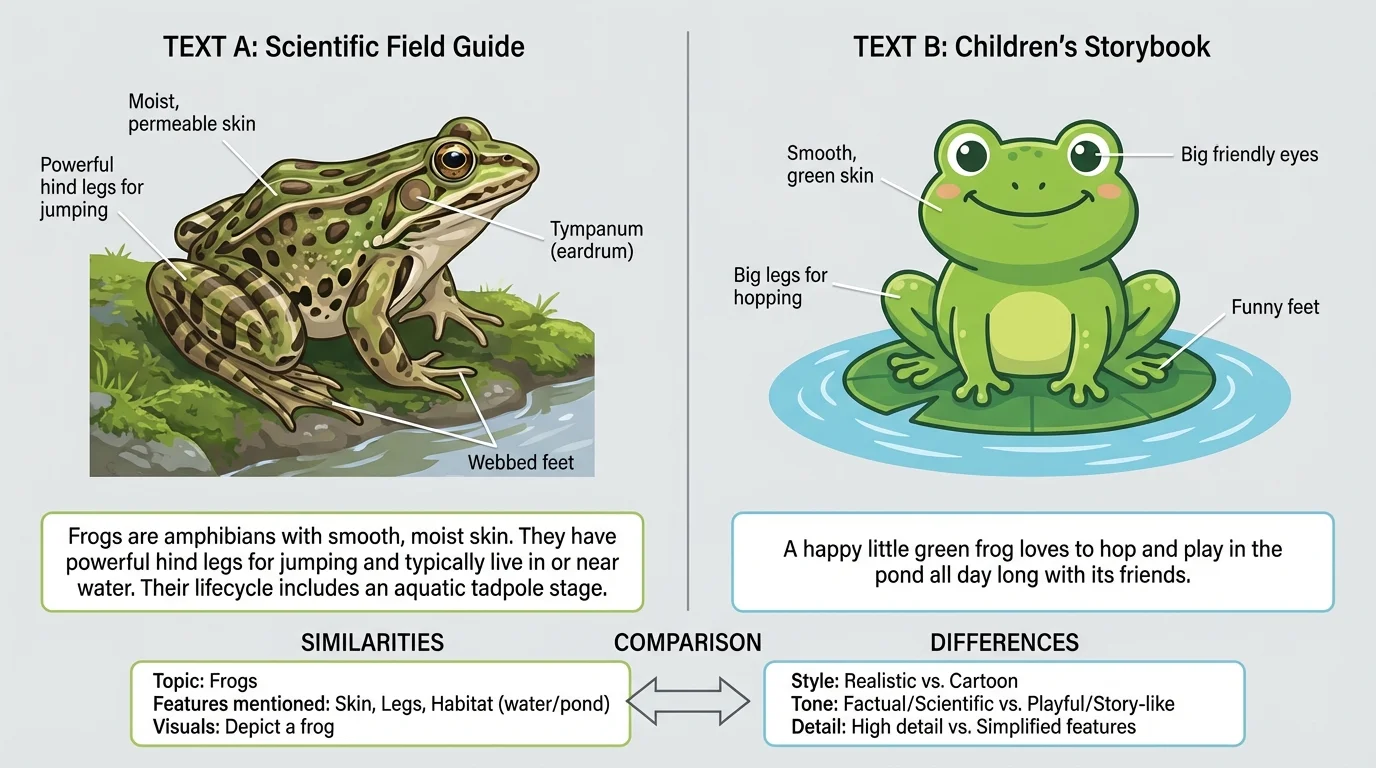
Illustrations can be different too. One text may use a large green frog picture. Another may show a frog life cycle with eggs and tadpoles. The pictures do not match, even though the topic is the same.
You can use the words but, only one, and different to explain what changes. You might say, "Both texts are about frogs, but only one text shows tadpoles."
An illustration is a picture that helps us understand a text. Pictures are important because they can show information fast. In the apple texts from [Figure 1], the pictures help us see that the topic stays the same even when the pages look different.
Words matter too. One text may describe a dog as "small and fluffy." Another may describe the same kind of dog as "soft and playful." The descriptions are different, but both tell us about the dog.
Pictures and words work together to teach readers. A picture may show what something looks like, while the words explain facts, actions, or details the picture does not show.
Good readers compare what they see and what they read. If one text has labels, photographs, or drawings and the other does not, that is an important difference. If both pictures show the same animal, plant, or object, that is a similarity.
[Figure 3] Some texts do not just describe things. Some texts tell how to do something. This is called a procedure. Two procedure texts can have the same goal but different steps.
For example, two texts may teach how to wash hands. One text may say: get hands wet, add soap, rinse. Another text may say: get hands wet, add soap, scrub, rinse. Both texts teach hand washing, but one includes an extra step.
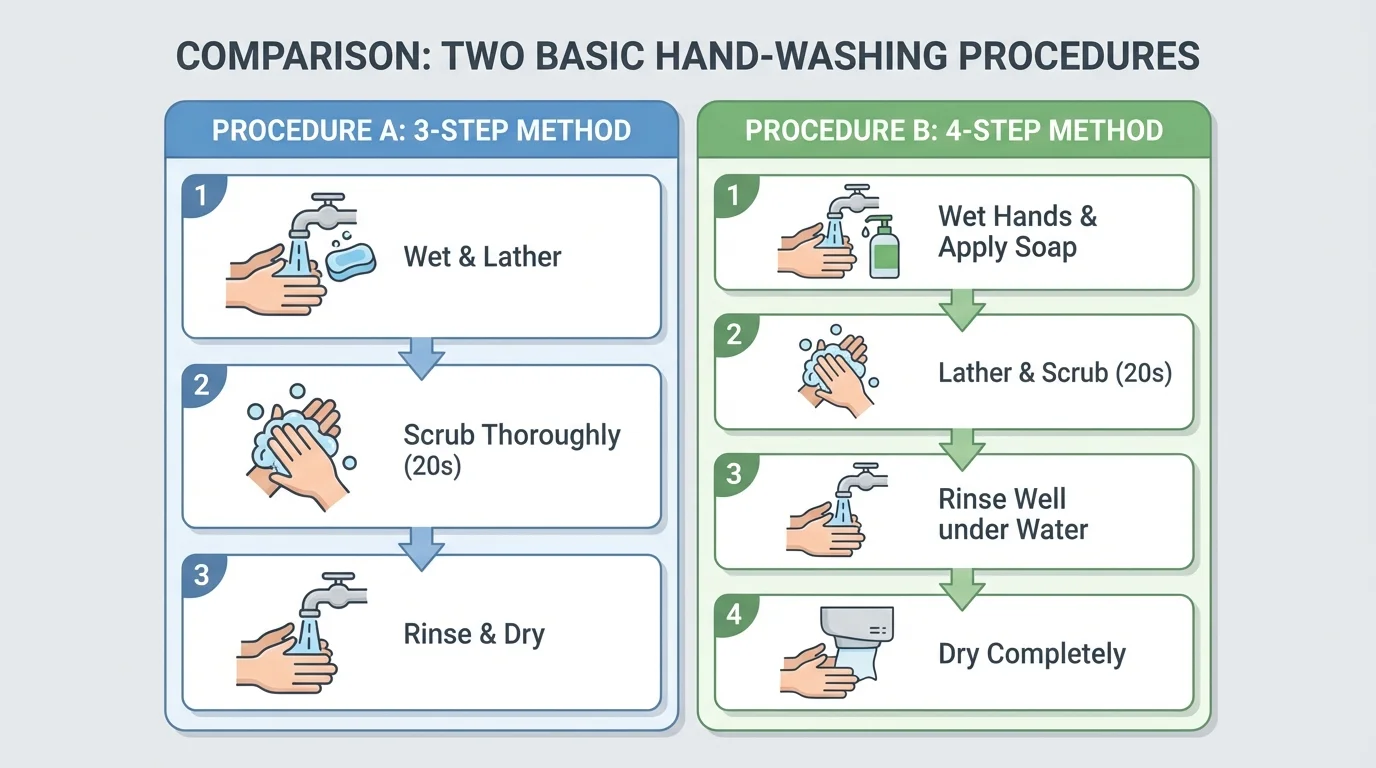
The order can be different too. Two seed-planting texts might both tell you to use soil, a seed, and water. But one text may tell you to water after covering the seed, while another tells you to water at the end. The goal is the same, but the procedure is not exactly the same.
When you compare procedures, look for these things: the job being done, the materials used, the number of steps, and the order of the steps. Later, when you think again about hand washing in [Figure 3], you can see that even one extra step changes the text.
Comparing words help us describe what we notice. Here are some useful words: both, same, also, different, but, and only one.
You can say, "Both texts are about birds." You can say, "The pictures are different." You can say, "One text gives more details." These simple sentence starters help you share your thinking clearly.
| Comparing word | How to use it |
|---|---|
| both | Both texts are about rain. |
| same | The topic is the same. |
| different | The pictures are different. |
| but | Both texts are about cats, but one has more facts. |
| only one | Only one text shows a kitten. |
Table 1. Comparing words students can use to talk about two texts on the same topic.
These words help readers explain their ideas clearly and precisely. Instead of just saying, "I read two pages," you can tell exactly how the pages match and how they do not match.
Let us compare two short texts about planting seeds. Text A says, "Put soil in a cup. Add one seed. Pour in water. Put the cup by a window." Text B says, "Fill a pot with soil. Place two seeds in the dirt. Cover the seeds. Water the pot and set it in the sun."
Example: Comparing two seed texts
Step 1: Find the same topic.
Both texts are about planting seeds.
Step 2: Find similarities.
Both texts use soil, seeds, and water. Both texts tell where to put the plant after planting.
Step 3: Find differences.
Text A uses one seed, but Text B uses two seeds. Text A says cup, but Text B says pot. Text B tells the reader to cover the seeds, and Text A does not.
This comparison helps the reader understand that the texts share one topic but give different details and steps.
Notice how we looked at topic, details, and steps. We did not need the texts to be exactly the same. We just needed to read closely and compare carefully.
When you read two texts on the same topic, you are like a reading detective. You look for clues in pictures, in descriptions, and in procedures. The frog texts from [Figure 2] remind us that even when the topic matches, the details and illustrations may change.
