What makes a story fun to hear again and again? It is often the people, the place, and the big things that happen. When we read a story, we do more than say the words. We think about who is in the story, where the story happens, and what happens first, next, and last.
A story has parts that work together. The characters are the people or animals in the story. The setting is the place and time of the story. The major events are the important things that happen. When we talk about these parts, we use key details. Key details are the important clues the author and illustrator give us.
Character means the person, animal, or creature in a story. Setting means where and when a story happens. Major events are the big, important things that happen in the story.
We can find key details in the words and in the pictures. If a picture shows rain boots, puddles, and gray clouds, that gives us details about the setting. If the words say, "Mia shared her snack with Ben," that tells us something important about a character.
A character is someone in the story. A character can be a child, a parent, an animal, or even a talking toy. We learn about a character by noticing what the character says, does, thinks, and feels. These details help us describe the character.
[Figure 1] For example, if a story says, "Lena picked up the books that fell on the floor," we can say Lena is helpful. If a story says, "Jamal hid behind his dad when the dog barked," we can say Jamal feels scared. If a picture shows a girl grinning with arms up high after finishing a race, we can say she feels proud or excited.
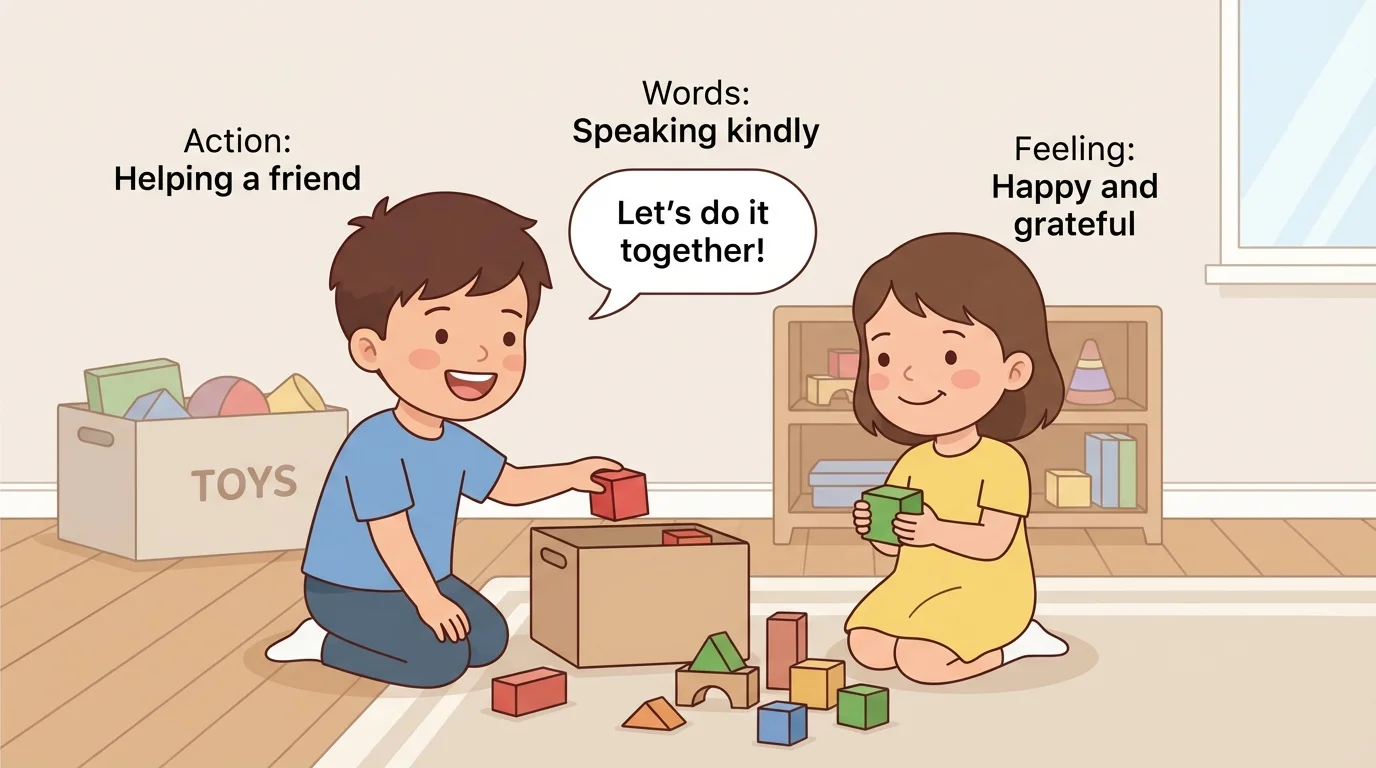
Sometimes characters stay the same in a story, and sometimes they change. At the beginning, a little bear may be nervous about school. By the end, the bear may feel brave because he made a friend. We use story details to tell how the character feels and changes.
Example: Describing a character
Story detail: "Tara gave her umbrella to her friend and got wet on the way home."
Step 1: Notice the action.
Tara gives her umbrella away.
Step 2: Think about what that action shows.
She cares about her friend.
Step 3: Describe the character with a key detail.
Tara is kind because she shared her umbrella.
When you describe a character, it is best to say the detail too. Instead of only saying, "He is nice," you can say, "He is nice because he helped his sister." The detail makes your idea stronger and clearer.
The setting tells where and when a story happens. It might be a farm, a school, a beach, or a city. It might happen in the morning, at night, in winter, or long ago. We use clues from the story to figure out the setting.
[Figure 2] Words and pictures both help. If the story shows snow, coats, and a sled, the setting may be outside in winter. If the words say, "The crickets chirped while the moon shone," the setting is probably at night. If a story says, "The class hung up backpacks and sat on the rug," the setting is likely a classroom.
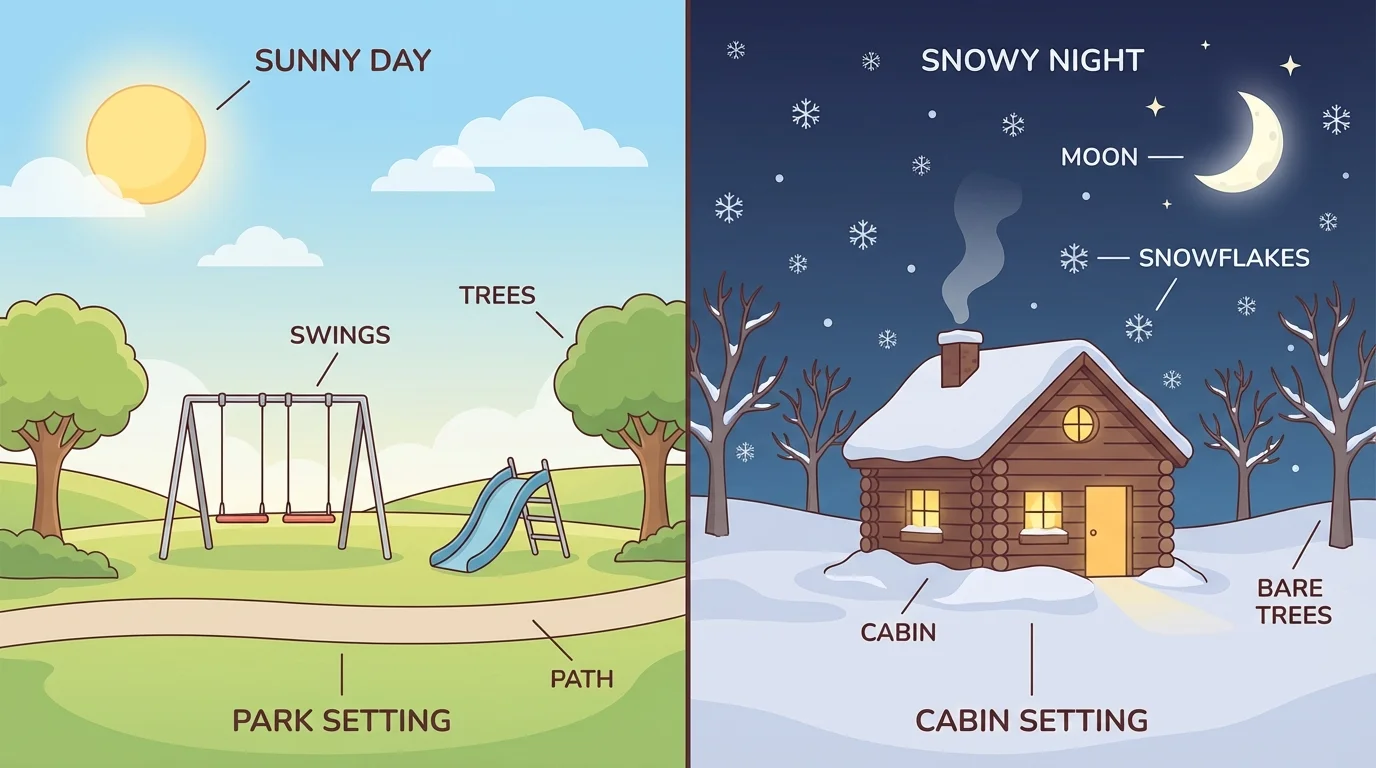
The setting can change in a story. A story may begin at home, move to the bus, and end at school. When the setting changes, the events may change too. A rainy setting can make a picnic hard. A dark forest can make the story feel mysterious. A bright playground can make the story feel cheerful.
The setting does more than show where a story takes place. It can help us feel the mood of the story, such as happy, spooky, calm, or exciting.
Later, when you think back to Figure 2, notice how small clues can tell a lot. Snow, moonlight, trees, and playground equipment are all key details that help readers understand where and when a story happens.
Major events are the big things that happen in a story. They are not every tiny detail. They are the parts that matter most. We often think about major events in the beginning, middle, and end.
[Figure 3] In the beginning, we meet the characters and learn about the setting. In the middle, a problem often happens. The character may lose something, make a mistake, or need help. At the end, the problem may be solved, and we learn what happens last.
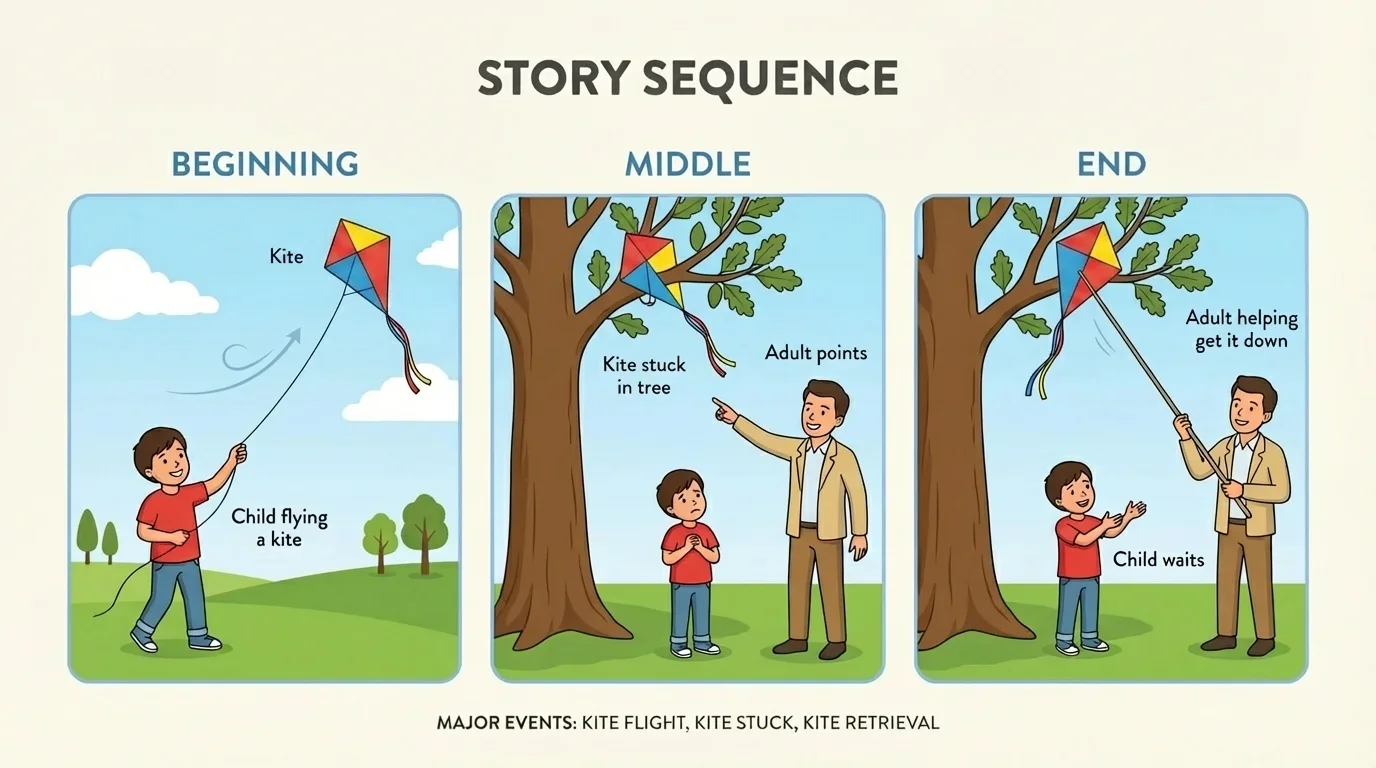
Here is an example. Beginning: A boy brings a kite to the park. Middle: The wind blows the kite into a tree. End: His aunt helps him get it down. Those are the major events because they tell the most important parts of the story.
Beginning, middle, and end help us keep story events in order. The beginning starts the story. The middle tells what important things happen. The end tells how the story finishes.
We can also listen for a problem and a solution. The problem is what goes wrong. The solution is how it gets fixed. In the kite story, the problem is that the kite gets stuck. The solution is that the aunt helps get it down. Looking for a problem and solution helps us find major events.
Good readers use details from the story, not just guesses. If you say, "The dog is playful," you should be able to tell why. Maybe the dog chased bubbles, rolled in the grass, and wagged its tail. Those details support your idea.
A key detail is an important clue. Key details can come from the words the author writes or from the pictures the illustrator makes. In a picture book, the pictures often tell us a lot. A worried face, a dark sky, or a knocked-over bucket can give big clues about the story.
Example: Finding key details
Story detail: "The little fox peeked out of the cave. Rain tapped on the rocks. He pulled the blanket up to his chin."
Step 1: Find details about the setting.
Rain and a cave tell us the story is outside near a cave on a rainy day.
Step 2: Find details about the character.
Pulling the blanket up may show the fox feels cold or nervous.
Step 3: Use the details in a description.
The setting is near a cave on a rainy day, and the fox seems cold or scared.
As we saw with the event order in [Figure 3], details help us keep track of what matters most. If a story has many little actions, we choose the biggest ones when we tell the major events.
Let's put all the parts together with a short story idea. "On a windy fall afternoon, Nia and her puppy, Pip, played in the yard. Pip grabbed Nia's red scarf and ran behind the shed. Nia followed the puppy and found a small box with old family pictures inside. She showed the box to Grandpa, and he smiled and told stories about when he was young."
Who are the characters? Nia, Pip, and Grandpa are the characters. What is the setting? The story happens in a yard on a windy fall afternoon. What are the major events? First, Nia and Pip play outside. Next, Pip runs off with the scarf. Then Nia finds the box. Last, Grandpa looks at the pictures and tells stories.
When you talk about a story, answer with details from the story. Use the words and pictures to help you explain your thinking.
Now we can describe the story clearly: Nia is curious because she follows Pip and discovers the box. The setting is outdoors in fall because it is windy and there is a yard. The major events move from playing, to losing the scarf, to finding the box, to sharing the discovery with Grandpa.
