Have you ever heard two people tell the same thing in different ways? One might say, "I saw a big dog!" and another might say, "Mia saw a big dog." Both are about the same event, but the voice sounds different. When we read, we can listen for that voice and figure out who is telling the story.
A narrator is the one who tells the story. Sometimes the narrator is a character inside the story. Sometimes the narrator is not a character and tells about other people instead.
Narrator means the teller of the story. The narrator may say "I" and be in the story, or may tell about "he," "she," or "they."
When you read, it helps to ask, "Who is talking right now?" That question helps you keep track of the story. It also helps you understand who saw something, who felt something, and who knows what is happening.
Readers can look for clue words to help them find the storyteller, and [Figure 1] shows a simple way to compare these clues. Some words tell us that the narrator is talking about self. Other words tell us that the narrator is talking about someone else.
If a story says I, me, my, we, or our, the narrator is often a character in the story. This is called first-person telling. Example: "I ran to the red swing. My shoes were muddy." The word I tells us the speaker is telling about themselves.
If a story says he, she, they, or uses a character's name, the narrator may be someone outside the story. This is called third-person telling. Example: "Lena ran to the red swing. Her shoes were muddy." Now the storyteller tells about Lena.
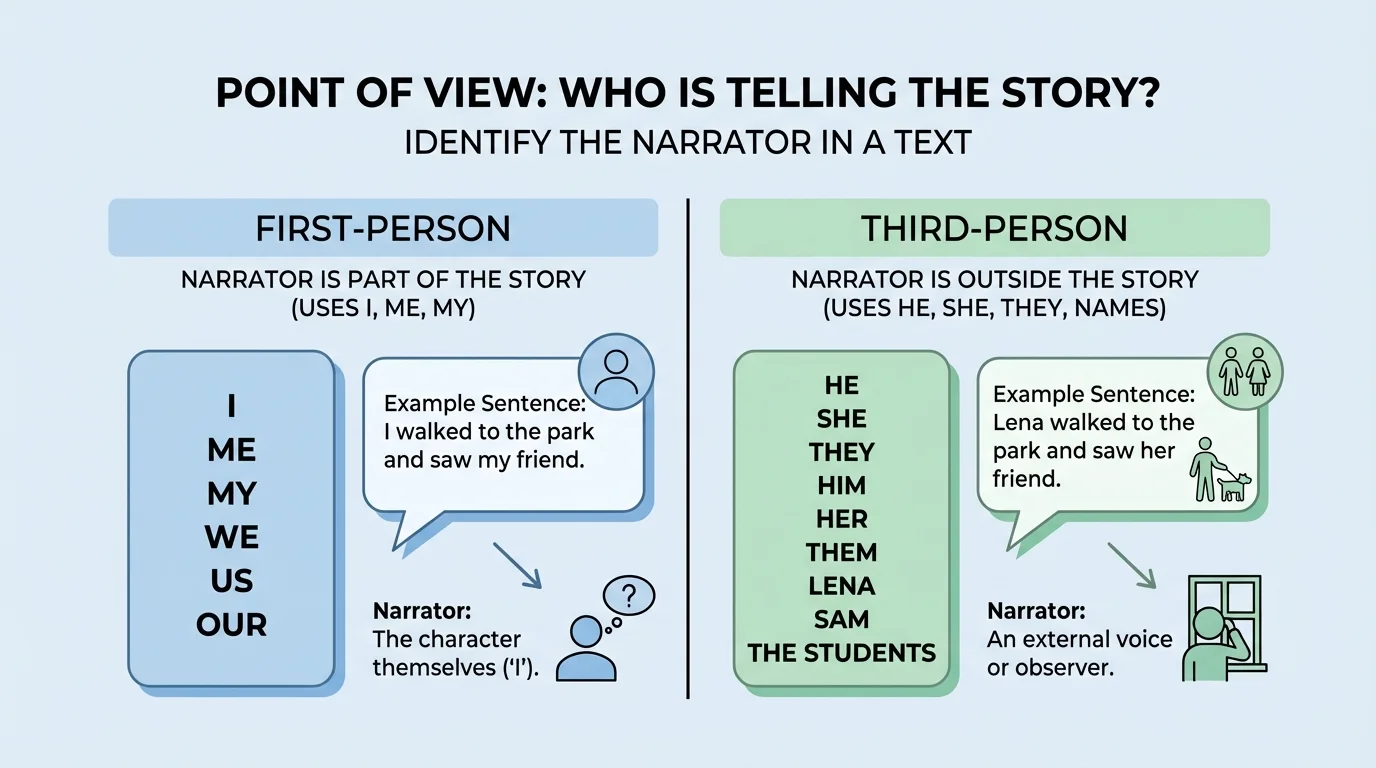
Listen to how these two sentences sound different: "I lost my hat," and "Ben lost his hat." In the first sentence, Ben might be the one talking. In the second sentence, a narrator is telling us about Ben.
Many picture books let you figure out the narrator just by one tiny word. A single word like I or she can change the whole story voice.
Sometimes readers need to slow down and look carefully. A story can begin one way and then include another person speaking. That means you must keep checking who is talking at that moment.
Not every line in a text is told by the same person. In one story, there may be story words from the narrator, talking words from characters, and even a note or letter from someone else. [Figure 2] shows how one text can have different parts with different speakers.
Look at this example: "Mia opened the box. 'I found the puppy!' she shouted." The part "Mia opened the box" is told by the narrator. The part "I found the puppy!" is spoken by Mia. The word I in the quotation is Mia talking, not the outside narrator.
Stories may also have thoughts. Example: "Kai looked at the dark cave. He thought, 'I feel scared.'" The outside narrator says "Kai looked," but the thought "I feel scared" belongs to Kai. Readers must notice the change.
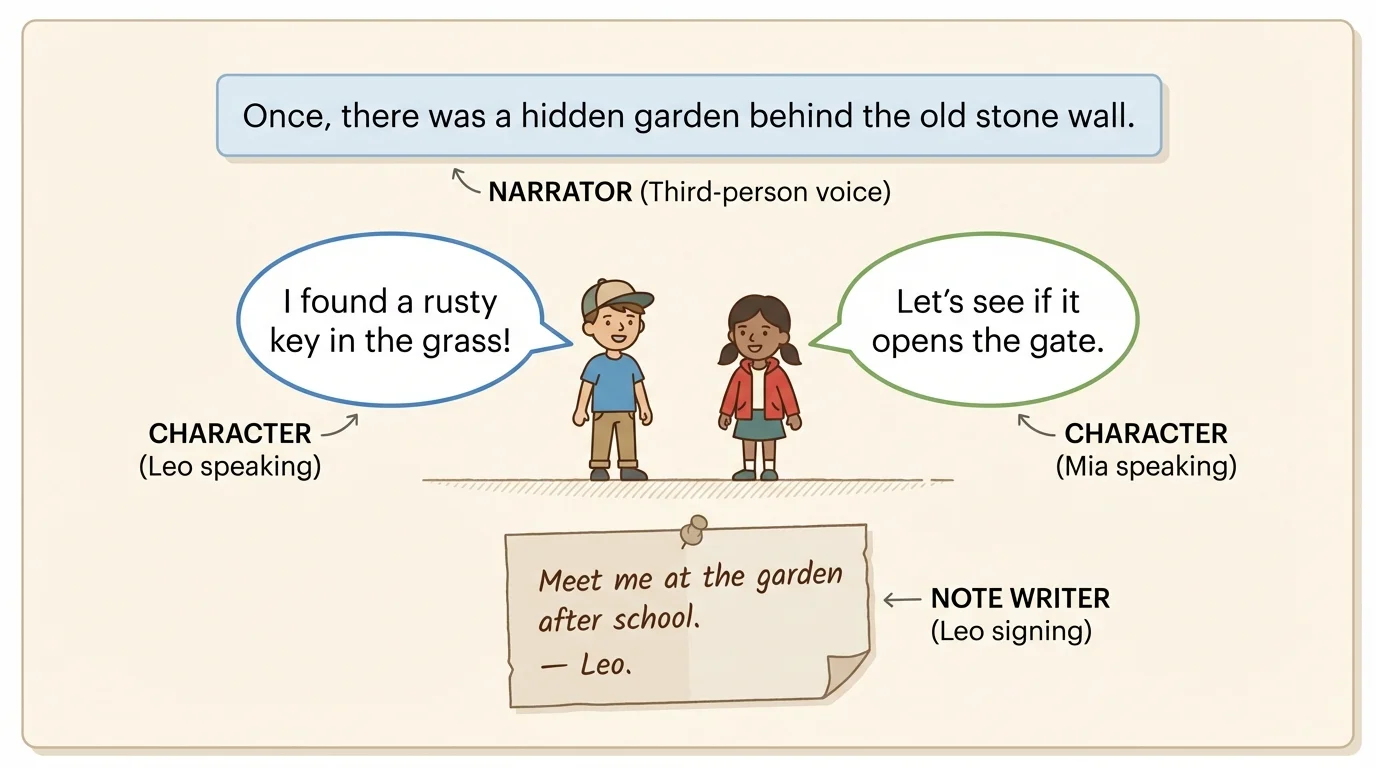
A text may even include a letter or note. Example: "Sofia read the card. 'Dear Sofia, I miss you. Love, Dad.'" The sentence about Sofia is told by the narrator. The words inside the card are told by Dad.
Good readers pause and ask simple questions. You do not have to rush. You can stop after a sentence and think about the voice you hear.
A simple way to identify the storyteller
First, look for clue words like I, my, he, or she. Next, ask who is speaking in that line. Last, check whether the text is narration, dialogue, a thought, or a note. These small checks help you know who is telling each part.
You can ask: Who saw this happen? If the line says, "I saw the bird fly away," then the person speaking saw it. You can also ask: Who is speaking now? If quotation marks show someone talking, that character may be the storyteller for that sentence.
Another helpful question is: Is the story saying a name, or is someone saying I? As we saw earlier in [Figure 1], those little words are big clues. They help readers tell whether the voice is inside the story or outside it.
Now let's look at short pieces of text and identify who is telling each part.
Example 1
"I carried my lunch to the table."
Step 1: Find the clue word.
The clue words are I and my.
Step 2: Decide who is telling.
A character in the story is telling about self.
The storyteller is the person carrying the lunch.
That is first-person telling because the narrator is speaking as a character.
Example 2
"Noah carried his lunch to the table."
Step 1: Find the clue word.
The clue words are Noah and his.
Step 2: Decide who is telling.
The narrator is telling about Noah.
The storyteller is not Noah in this sentence. The narrator tells about him.
This is third-person telling because the story uses a name and his instead of I.
Example 3
"Ella picked up the shell. 'I will keep this forever,' she said."
Step 1: Look at the first part.
"Ella picked up the shell" is told by the narrator.
Step 2: Look at the talking part.
"I will keep this forever" is spoken by Ella.
Step 3: Identify both storytellers.
The narrator tells the action, and Ella tells the spoken words.
This text has a change in who is telling each part.
When readers notice these changes, the story becomes clearer. The picture in [Figure 2] helps show how narration and talking can live on the same page.
Knowing who tells the story helps you understand feelings and events. If a character says, "I am nervous," you know that feeling belongs to that character. If the narrator says, "Jada looked nervous," then the narrator is describing Jada.
It also helps you know what each person knows. A character might only know one part of the story. A narrator may tell more. When you know who is talking, you can follow the story more easily.
Remember that stories have characters, events, and settings. The narrator is the voice that tells us about those parts.
As you read books, listen for the story voice. Ask yourself, "Is this a character talking? Is this the narrator talking? Did the voice change?" Those questions help you become a strong reader.
