Look around your room. You can see letters on books, labels, charts, and names. Letters help us read, write, and share ideas. When we learn to print letters clearly, our words become easy for other people to read. That is an important writing skill for young authors.
We use letters to write our names, tell stories, make lists, and label pictures. Letters come in a special set called the alphabet. English has 26 letters. Each letter has a name, a shape, and a sound we can hear in words.
When you print letters, you make them by hand. Good printing means the letters are easy to see and easy to tell apart. Clear letters help your teacher, family, and friends read your writing.
Uppercase letters are the big forms of letters, like A, B, and C. Lowercase letters are the small forms of letters, like a, b, and c.
Some people also call uppercase letters capital letters. We use both uppercase and lowercase letters when we write. Knowing both kinds helps us read books and write sentences the right way.
An uppercase letter is a capital letter. A lowercase letter is a small letter. The letters match because they are the same letter in two forms. For example, M and m are uppercase and lowercase forms of the same letter.
Uppercase letters are important because they help start sentences and show names. Lowercase letters are important because we use them in most of the words we write. Both kinds work together in good writing.
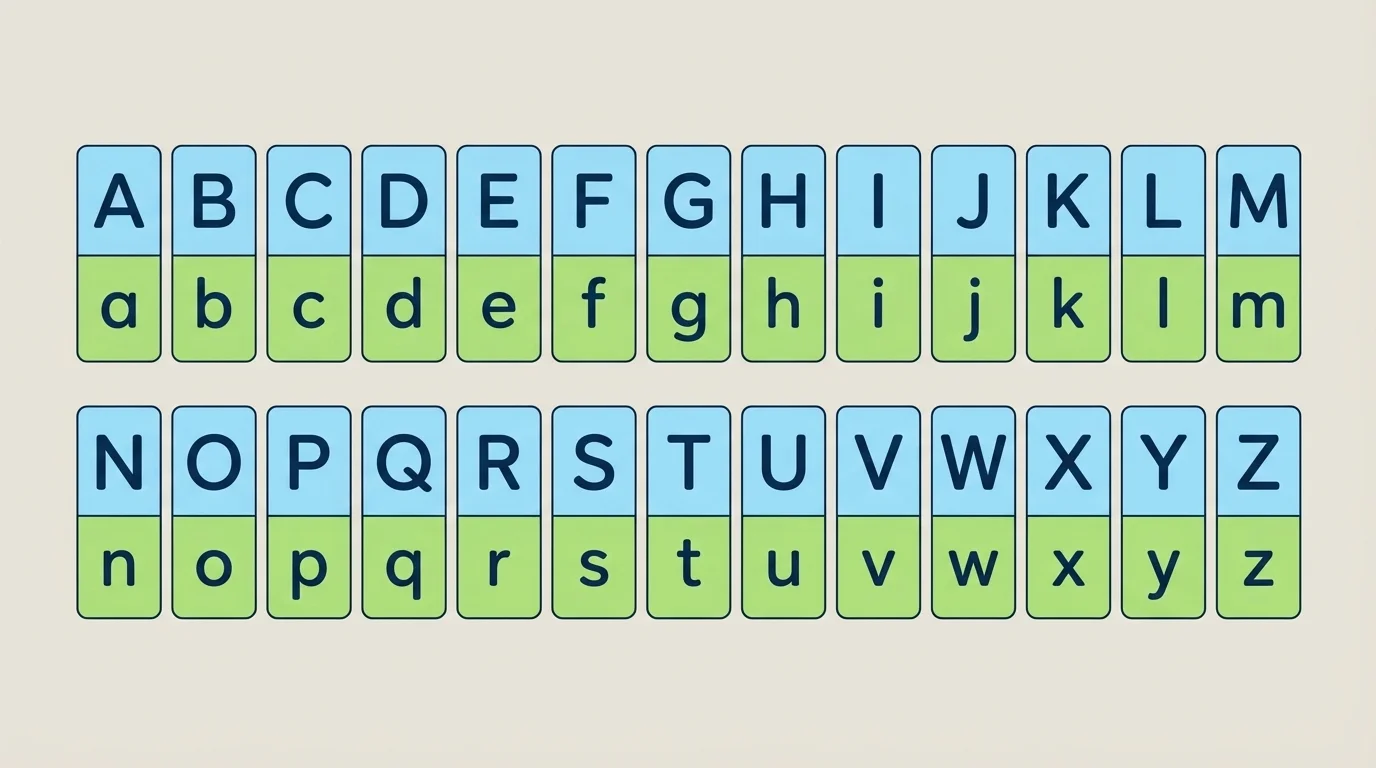
Each letter has an uppercase form and a lowercase form, as [Figure 1] shows in matching pairs. Learning the alphabet in order helps you find letters quickly and print them from memory.
Here are all the letters:
A a, B b, C c, D d, E e, F f, G g, H h, I i, J j, K k, L l, M m, N n, O o, P p, Q q, R r, S s, T t, U u, V v, W w, X x, Y y, Z z
It helps to say the letter name as you print it. You might say, "A, a," then "B, b," and keep going to the end. This helps your eyes, hands, and ears learn together.
The uppercase and lowercase forms of some letters look almost the same, but others look very different. That is why writers practice both forms again and again.
You do not need to rush. Slow, careful printing is better than fast, messy printing. When letters are formed correctly, words look neat and make sense.
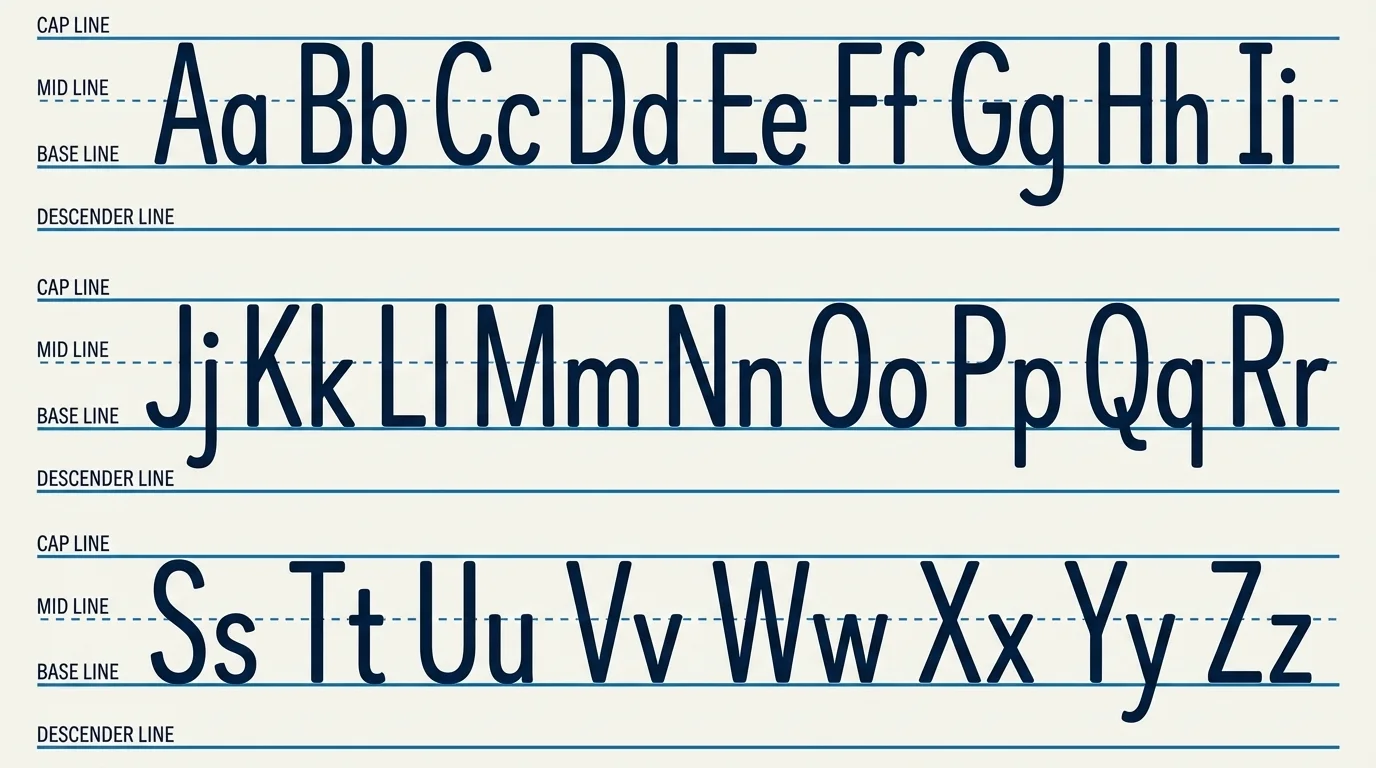
Good printing means making each letter the right shape and size. In handwriting, letters sit on lines, and those lines help you place letters neatly, as [Figure 2] shows. Some letters are tall, some are small, and some have tails that go below the line.
For example, uppercase letters are often tall. Many lowercase letters, such as a, c, e, m, and n, stay in the middle space. Letters like g, j, p, q, and y have parts that drop below the line.
Keep a little space between letters in a word, and keep a bigger space between words. If letters are too close, they can look mixed up. If they are too far apart, the word can look broken.
Start letters the same way each time. Make straight lines straight and curved lines smooth. When you erase and try again, you are practicing, and practice helps your hand remember the shapes.
Clear printing helps communication. Writing is for readers. If your letters are clear, readers can understand your message. If letters are too messy, even a good idea can be hard to read. Neat printing shows care and helps your grammar, capitalization, and punctuation stand out.
When you look back at your own writing, check whether each letter is easy to name. If you cannot tell what a letter is, fix it so the word is clear.
We use uppercase letters at the beginning of a sentence. A sentence starts with a capital letter and ends with punctuation such as a period. Example: The dog ran.
We also use uppercase letters for the special names of people, places, days, and months. These are often called names. Example: Maria, Denver, Monday, and June.
Look at these examples: I am Sam. The first word starts with an uppercase I. The name Sam also starts with an uppercase S. In We went to Lake Park., We, Lake, and Park begin with capitals for the right reasons.
Examples of uppercase letters in writing
Step 1: Start the sentence with an uppercase letter.
cat naps. becomes Cat naps.
Step 2: Use an uppercase letter for a name.
my friend ana becomes My friend Ana.
Step 3: Add the ending punctuation.
My friend Ana.
Uppercase letters are not used for every letter in a word. We usually use just the first letter when a sentence or name begins.
Most letters in most words are lowercase. In the sentence The cat is soft., only the T in The is uppercase. The other letters are lowercase.
Lowercase letters do a lot of the work in reading and writing because they appear so often. When students learn to print them well, their writing becomes smoother and easier to read.
Here are more examples: ball, sun, happy, and jump. These words are made with lowercase letters. If they begin a sentence, only the first letter changes to uppercase: Ball, Sun, Happy, Jump.
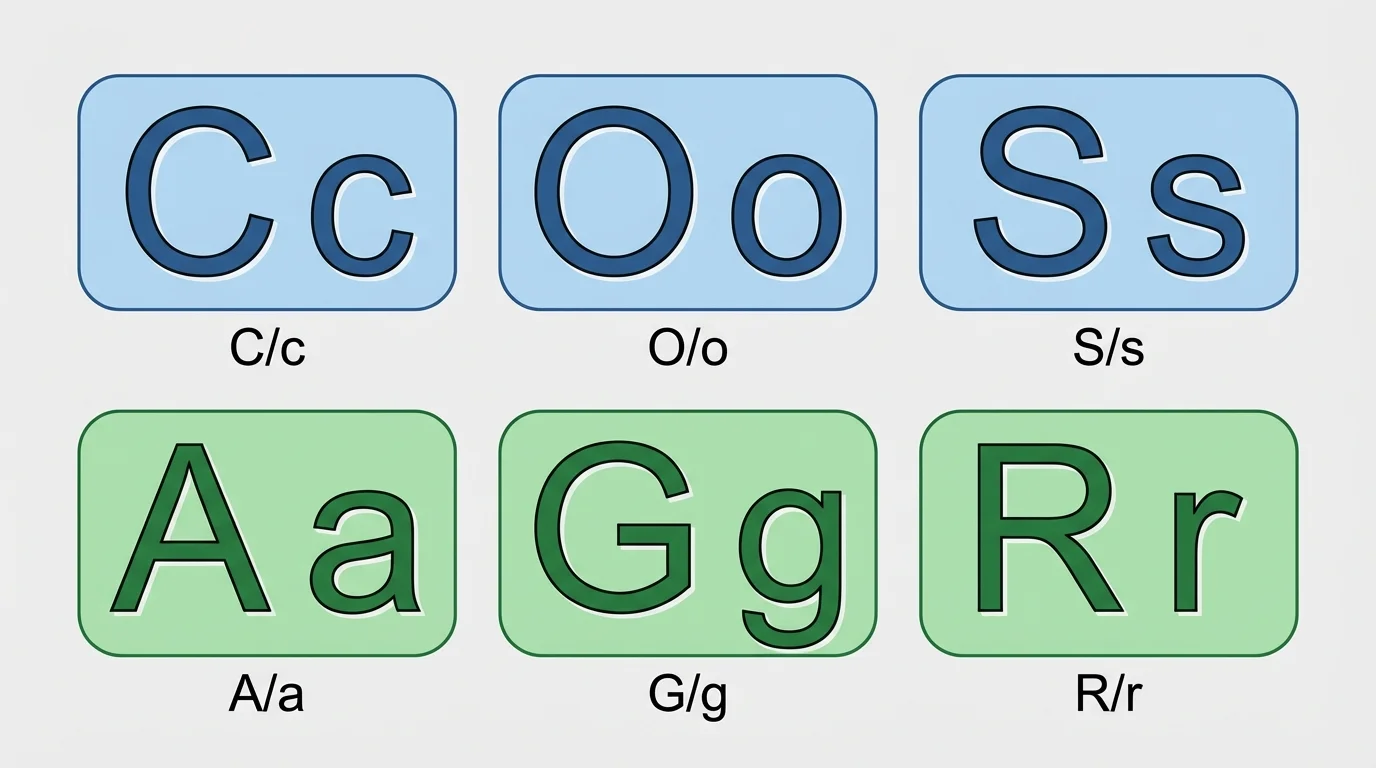
Some uppercase and lowercase pairs look almost the same, as [Figure 3] shows. For example, C c, O o, S s, and Z z have similar shapes in both forms.
Other pairs look very different. For example, A a, G g, R r, and Q q do not look the same in uppercase and lowercase. That is why careful practice matters.
Some lowercase letters can also be mixed up with each other. Writers sometimes confuse b and d, or p and q. Looking at the line, the stick, and the round part helps you check each one. Small shape changes matter.
Letters with circles and sticks, such as a, b, d, g, p, and q, need extra attention. Print slowly enough to make each part in the right place.
You already know that a sentence is a group of words that tells a complete idea. Remember to start it with a capital letter and end it with punctuation.
When you check your work, ask yourself: "Did I use the right kind of letter here?" That question helps with both printing and grammar.
Good writing often uses uppercase and lowercase letters together. Look at this sentence: Lila has a red kite. The word Lila begins with an uppercase letter because it is a name. The first letter in the sentence is uppercase too. The other letters are lowercase.
Here is another one: Ben and I play. The name Ben begins with uppercase B. The word I is always uppercase when it means the person speaking.
Notice how clear letters, correct capitals, spaces, and a period all work together. Printing letters is not only about shapes. It is also part of writing complete, correct sentences.
"Good writers help readers by making letters clear."
As you become a stronger writer, you will use these letter forms in stories, notes, labels, and answers. The alphabet chart in [Figure 1] stays helpful because every word you write is built from those same letter pairs.
Hold your pencil comfortably. Sit so you can see your paper well. Move carefully from one letter to the next. Stop and check your work often.
A good writer watches for four things: letter shape, size, spacing, and capitalization. Punctuation matters too. A sentence needs an ending mark, such as a period, question mark, or exclamation mark.
When you print all upper- and lowercase letters clearly, you build a strong writing foundation. Clear letters help every other writing skill grow.
