Have you ever heard a word you did not know, but then the rest of the sentence helped you understand it? That is something strong readers do all the time. They listen to the whole sentence, look at the other words, and make a smart guess. A sentence is like a team. The words work together.
Sometimes you see a word that is new. You do not have to stop right away. The other words around it may give a clue. If a sentence says, "Mia was confused. She did not know which door to open," the words "did not know" help us understand that confused means not sure what to do.
Good readers pay attention to the whole sentence, not just one word. They think, "What is happening? Who is in the sentence? What do the other words tell me?" These questions help them figure out meaning.
Context is the words around a word that help explain it. Sentence-level context means using the same sentence to help figure out what a word or phrase means.
When you use context, you are being a word detective. You collect hints and put them together. Then you make the best guess you can about the meaning.
Context can come from many places, but today we are thinking mostly about one sentence. The sentence gives us hints. It may tell what someone does, how someone feels, what something looks like, or what happens next.
Read this sentence: "The puppy was tiny. It fit inside the little basket." The words "fit inside the little basket" help us know that tiny means very small.
Here is another one: "Lena wore a soaked coat after playing in the rain." The words "playing in the rain" help us know that soaked means very wet.
Your brain is very good at using clues fast. Many readers figure out word meanings in just a few seconds by thinking about the whole sentence.
Sometimes the clue is easy to see. Sometimes you have to slow down and think carefully. Both ways are part of reading.
There are different kinds of clues in a sentence. Nearby words give hints about meaning, as [Figure 1] shows with clue words pointing to an unknown word. One clue may tell about a feeling. Another clue may tell about an action. Another clue may describe something.
A feeling clue helps you know how someone feels. "Jay felt proud when he showed his painting to the class." The words "showed his painting" and the happy moment help us know that proud means happy about doing something well.
An action clue helps you know what is happening. "The rabbit hopped across the yard." The words "across the yard" help us know that hopped is a way of moving by jumping.
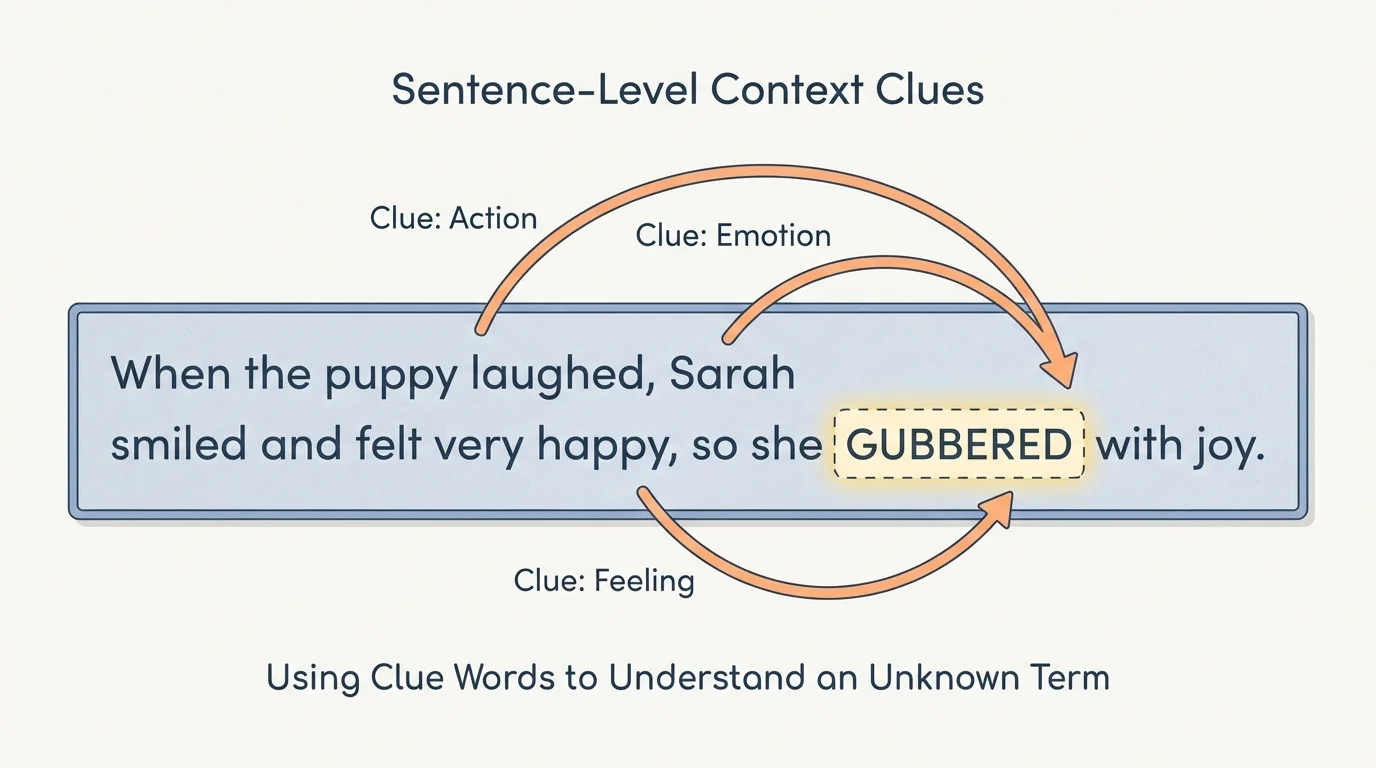
A description clue tells what something is like. "We saw a gigantic pumpkin. It was bigger than my backpack." The words "bigger than my backpack" help us know that gigantic means very big.
A what-happens clue tells what comes next. "Ben was exhausted, so he lay down and closed his eyes." The words "lay down and closed his eyes" help us know that exhausted means very tired.
Sometimes a whole phrase can be understood with context too. "The baby began to doze off during the story." The words about the story and the baby getting sleepy help us know that doze off means begin to fall asleep.
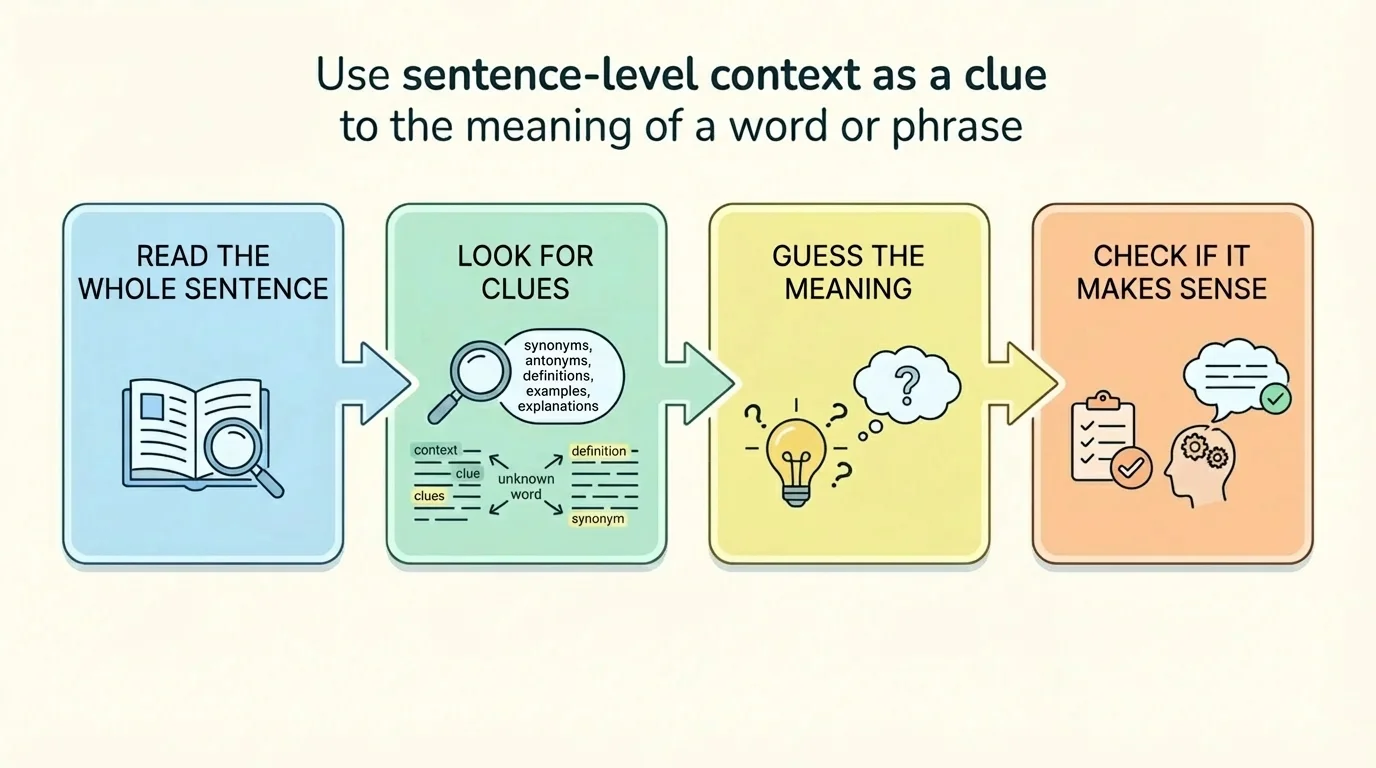
Readers can follow a simple process to solve unknown words, and [Figure 2] lays out the steps in order. This process helps the meaning become clearer.
A smart way to use context
First, read the whole sentence. Next, look for clue words. Then, make a guess about what the word means. Last, put your guess into the sentence and check whether it makes sense.
If the sentence says, "The ice was slippery, and Ava almost fell," you can read the whole sentence, notice "almost fell," guess that slippery means hard to walk on, and check that the sentence still makes sense.
This checking step is important. A good guess should fit the sentence. If it does not fit, try again.
You do not need a perfect dictionary meaning every time. You need a meaning that works in the sentence. That is what readers do while they are reading stories and books.
Let's look closely at some sentences. We will use the words around the unknown word to help us.
Example 1
"The soup was steamy, so Maya blew on it before taking a sip."
Step 1: Look for clues.
The clue words are "blew on it before taking a sip."
Step 2: Think about why someone blows on soup.
People blow on soup when it is hot.
Step 3: Make a meaning.
Steamy means hot with steam coming up.
Here the sentence gives an action clue. Maya blows on the soup, so we know something about the soup.
Example 2
"The kitten hid under the bed during the loud storm because it was frightened."
Step 1: Look for clues.
The clues are "hid under the bed" and "loud storm."
Step 2: Think about the feeling.
Hiding during a storm means the kitten feels scared.
Step 3: Make a meaning.
Frightened means scared.
This sentence gives both an action clue and a feeling clue. The kitten's action tells us the meaning.
Example 3
"Noah used a damp towel to wipe the table after lunch."
Step 1: Look for clues.
The clue is that the towel is used to wipe the table.
Step 2: Think about what kind of towel works for wiping.
A towel that is a little wet works well.
Step 3: Make a meaning.
Damp means a little wet.
Clue words around the unknown word help the meaning come into focus. The sentence does the teaching.
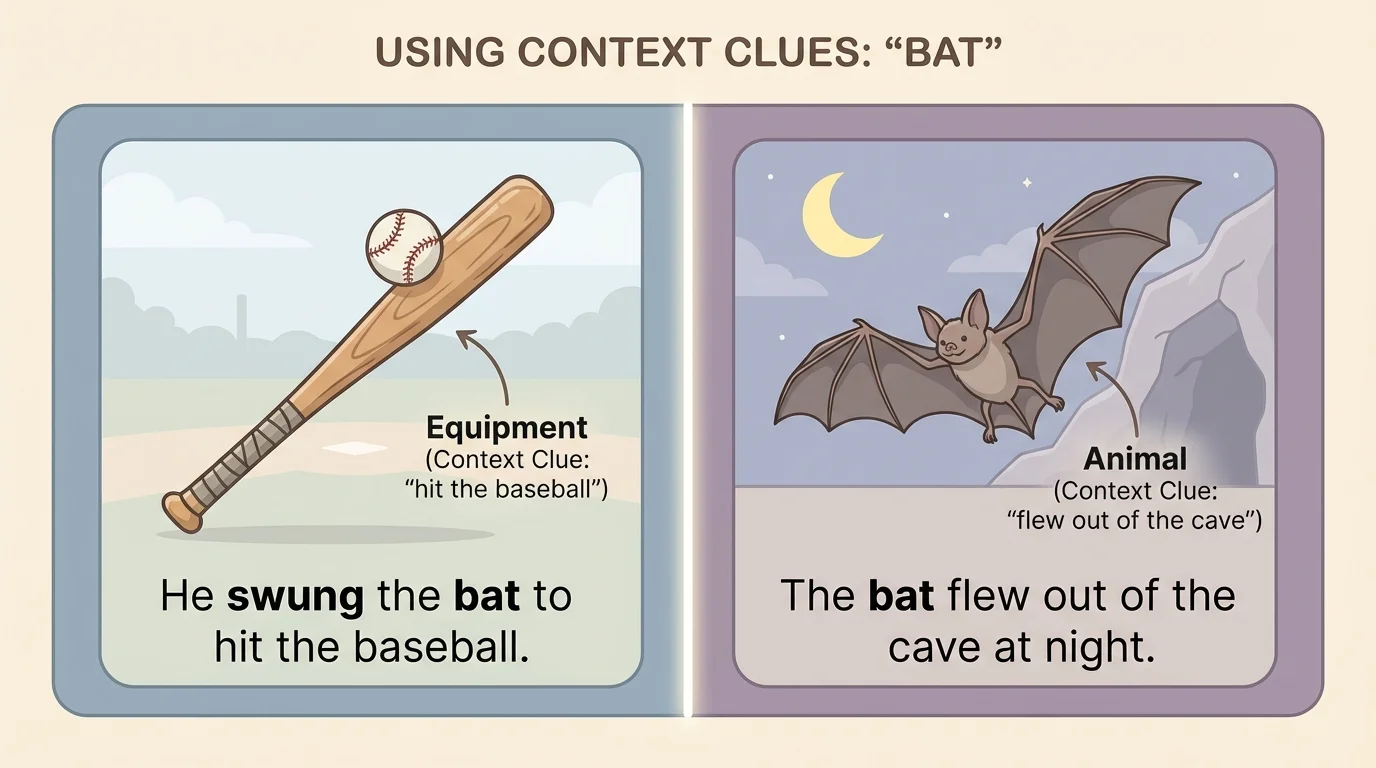
Some words have more than one meaning, and the sentence helps us choose the right one, as [Figure 3] makes clear with two different meanings of the same word.
Look at the word bat. In "I hit the ball with a bat," bat means sports equipment. In "A bat flew out of the cave at night," bat means an animal. The rest of each sentence tells us which meaning is right.
Look at the word park. In "We play at the park," it means a place outside. In "Please park the car," it means to stop a car in a place. The sentence-level context helps us choose the correct meaning.
This is why reading the whole sentence matters so much. One word by itself may be confusing, but the full sentence gives strong clues.
Sometimes one sentence does not give enough clues. That is okay. You can reread the sentence slowly. You can read the next sentence too. You can also look at the picture if there is one in the book.
Remember that readers already know how to listen for words they know well. Now they add a new skill: using nearby words to help with a word they do not know yet.
If a sentence says, "Kim carried a crate," you may still wonder what crate means. But if the next sentence says, "The box was full of apples," now you have a bigger clue. A crate is a kind of box.
Even when you are not exactly right at first, keep thinking. Try a new guess and check again. Strong readers are flexible.
Using context is a powerful reading skill. It helps you keep reading instead of getting stuck. It helps you learn new words while you enjoy a story. It also helps you understand words with more than one meaning.
When you notice actions, feelings, descriptions, and what happens next, you can solve many word mysteries. The simple steps in [Figure 2] still work: read, look for clues, guess, and check.
And when a word has more than one meaning, the sentence around it points to the right one. The more you practice noticing clues, the stronger and more confident a reader you become.
