Have you ever seen a sign, a book page, or a note and known right away where one thought begins and ends? That is because sentences have special clues. Good readers look for these clues in print. When you can spot a sentence, reading becomes smoother and meaning becomes clearer.
A sentence is a group of words that tells a complete thought. A sentence can tell something, ask something, or show strong feeling. Sentences help us understand what an author wants to say.
Sentence means a group of words that tells a complete thought. A sentence usually starts with a capital letter and ends with punctuation.
Punctuation means marks in writing that help readers know when to stop, ask, or show feeling.
When you read, you can look for three big clues. First, a sentence begins with a special first word. Second, the first word starts with a capital letter. Third, the sentence ends with a punctuation mark. These clues help your eyes and your brain work together.
A sentence is not just any group of words. The words must go together in a way that makes sense. For example, "The cat sleeps." is a sentence because it tells a whole idea. But "cat the sleeps" is not a sentence because the words are not in the right order.
Some sentences are short. Some are longer. A sentence can have only two words, like "Birds fly." It can also have more words, like "The little birds fly over the pond." Both are sentences because both tell a complete thought.
Very short sentences can still be real sentences. "Go!" and "Stop!" are tiny, but they are complete and meaningful.
Readers use print features to recognize where a sentence starts and where it ends. This is part of understanding how print works on a page. In books, sentences move from left to right, and spaces separate the words so each word can be read clearly.
The first word of a sentence begins with a capital letter, as [Figure 1] shows. A capital letter is an uppercase letter such as A, B, or C. This gives the reader an important clue: a new sentence is starting.
Look at these examples: "My dog barks." "We jump." "The sun is bright." In each sentence, the first word starts with a capital letter: My, We, The.
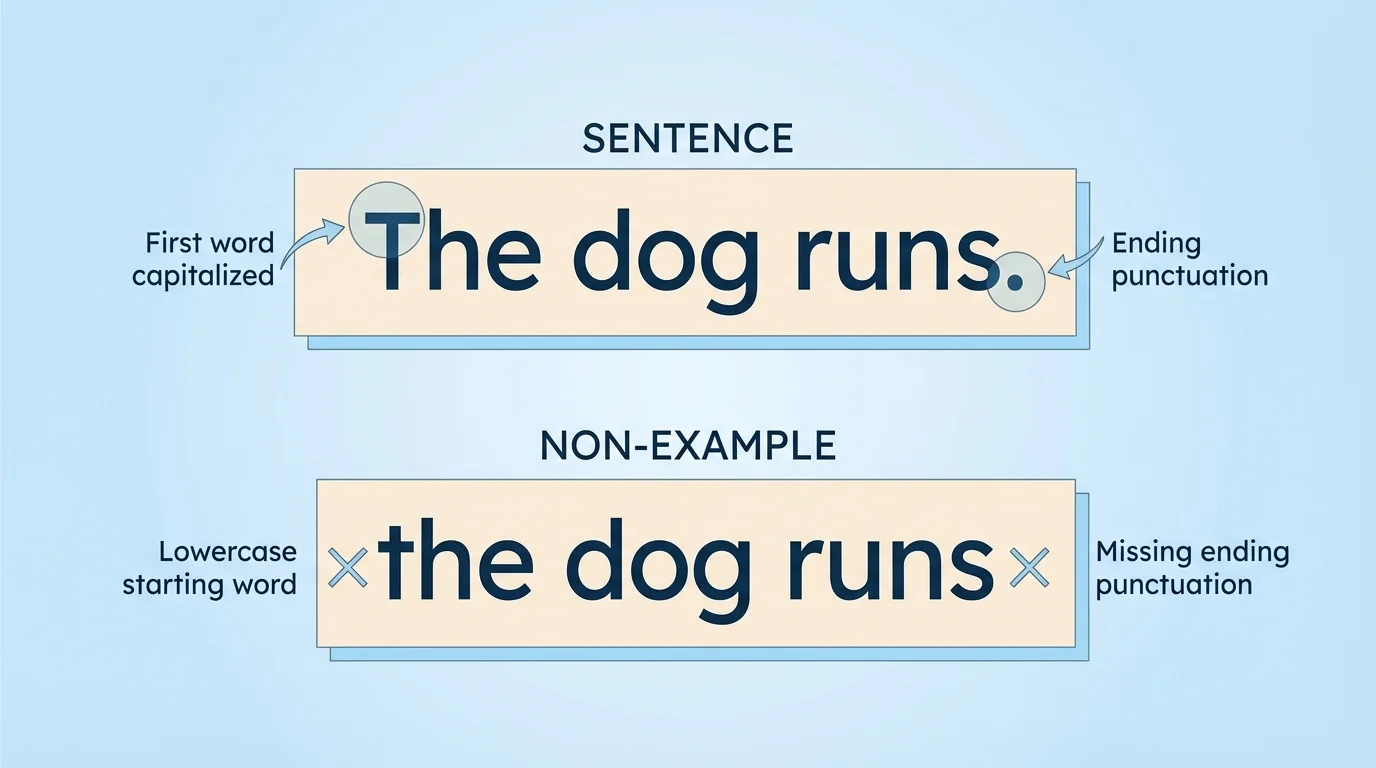
If a sentence begins with a lowercase letter, something is wrong. For example, "the dog runs." does not look correct because the first word should begin with a capital letter. Writers use capitals to help readers notice the start.
Sometimes a name inside a sentence also begins with a capital letter, like "I see Maria." But the most important clue here is the capital at the beginning of the whole sentence. Later, when you see another capital at the start of a new thought, you know another sentence may be beginning.
Every sentence ends with ending punctuation, as [Figure 2] illustrates. The ending mark tells the reader how the sentence finishes. It helps the reader know whether to stop, ask, or show excitement.
There are three common ending marks in early reading. A period ends a telling sentence: "I have a hat." A question mark ends an asking sentence: "Do you have a hat?" An exclamation mark ends a sentence with strong feeling: "What a big hat!"
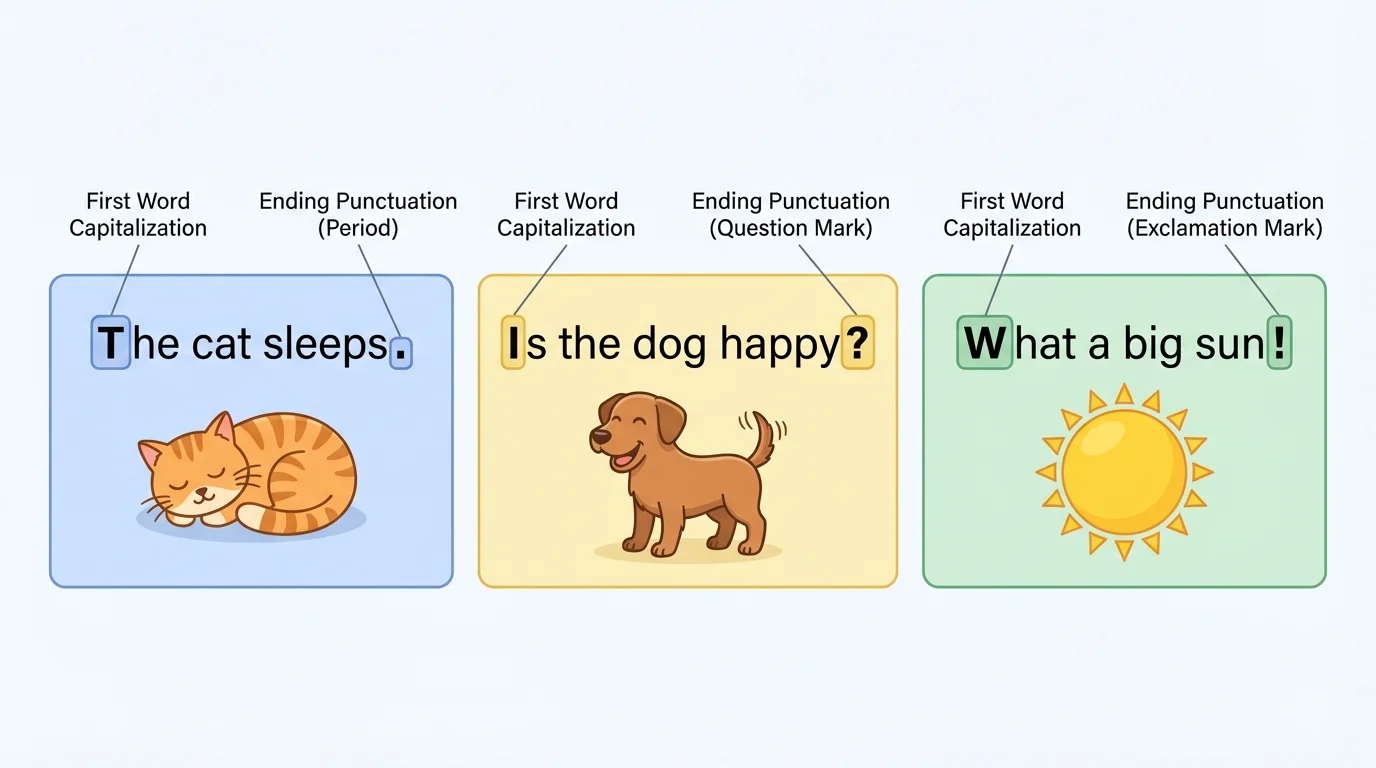
When you read aloud, these marks help your voice. A period sounds calm and finished. A question mark can make your voice rise at the end. An exclamation mark can make your voice sound excited or surprised.
Look at how the ending mark changes meaning. "You came." tells something. "You came?" asks something. "You came!" shows strong feeling. The words are almost the same, but the punctuation changes how we read them.
Why ending marks matter
Ending punctuation is like a stop sign for your eyes. It tells you where one sentence ends so you do not run all the words together. This helps you understand the message and read with expression.
Much later in your reading, you will see many sentences on one page. The ending marks help you separate one thought from the next. That is why readers pay close attention to the last mark in a sentence.
A sentence also has words in an order that makes sense. English print is read from left to right. The words are separated by spaces. These spaces help readers see each word clearly.
Compare these two groups of words: "The frog hops." and "frog The hops." The first one is a sentence because the words are in order and tell a complete thought. The second one has the same words, but it does not sound right because the words are mixed up.
Spaces matter too. If all the words were pushed together, reading would be hard. In a sentence, each word has its own place. The sentence starts with the first word, continues across the line, and finishes at the punctuation mark.
You already know that print goes from left to right and top to bottom. Those print rules help you track a sentence from its first capital letter all the way to its ending punctuation.
When you read a book, your eyes can sweep across the line and stop at the punctuation. Then you move to the next sentence. This is one reason sentence features are so useful.
[Figure 3] shows how to decide whether words make a sentence. Look for a complete thought and the print clues. Ask yourself: Does it make sense? Does it start with a capital letter? Does it end with punctuation?
"I can swim." is a sentence. It makes sense, starts with a capital letter, and ends with a period. "Can swim" is not a complete sentence here because we do not know who can swim. "Blue happy" is not a sentence because it does not tell a clear thought.
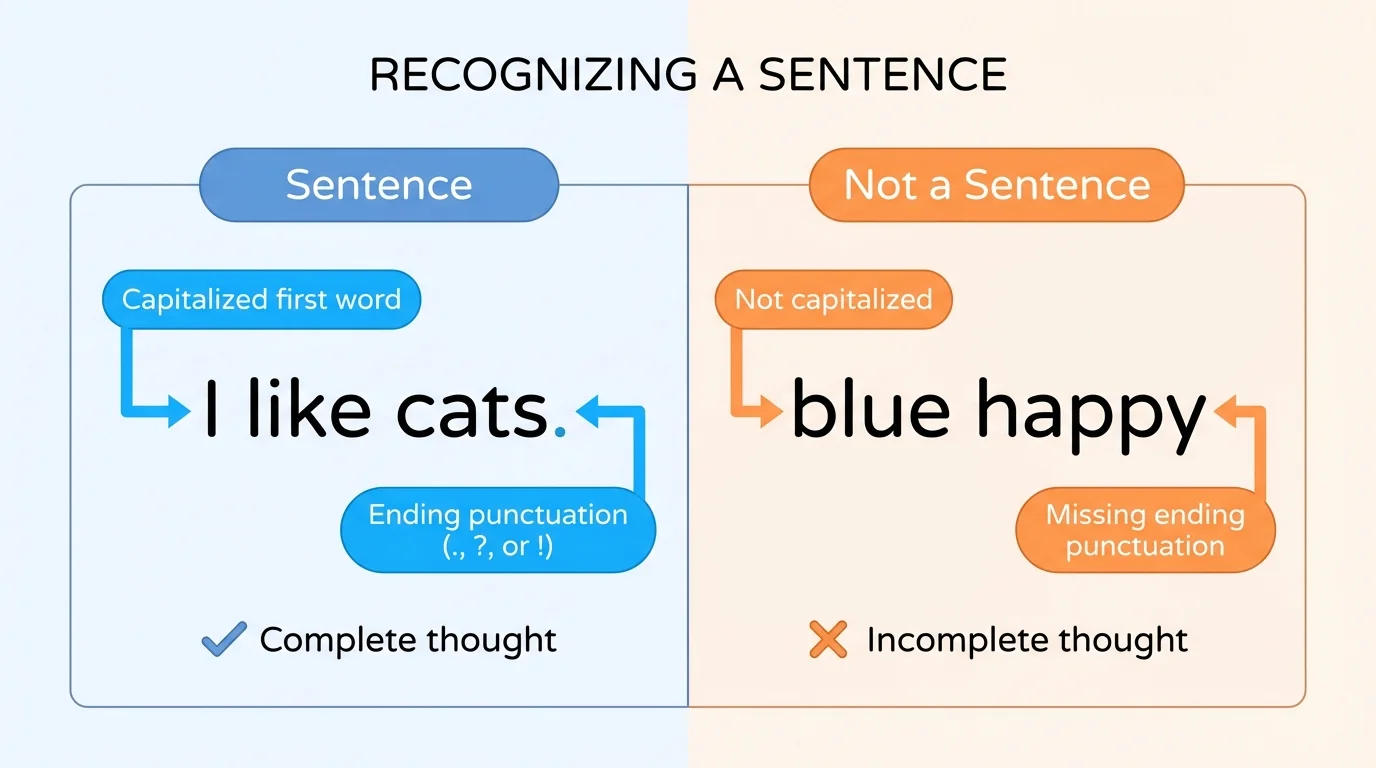
Sometimes a group of words may have a capital letter but still not be a sentence. For example, "The yellow" starts correctly, but it does not finish the idea. We wait for more words. A real sentence gives enough words to share a whole message.
| Words | Sentence or Not? | Why? |
|---|---|---|
| The baby sleeps. | Sentence | Complete thought, capital letter, period |
| Runs fast | Not a sentence | Does not tell who runs |
| Can we play? | Sentence | Complete thought, capital letter, question mark |
| so funny | Not a sentence | Not a complete thought |
| What a mess! | Sentence | Complete thought, capital letter, exclamation mark |
Table 1. Examples of sentences and non-sentences with reasons.
As you keep reading, you can use the same clues from [Figure 1] and [Figure 2]. Check the beginning, check the ending, and listen in your mind for a full idea.
You see sentences everywhere. In storybooks, sentences tell what characters do. On signs, a sentence may give directions, such as "Walk on the path." In a note at home, a sentence may say, "Snack is on the table."
Good readers notice sentence features quickly. They see the capital letter at the beginning. They read the words in order. They stop at the punctuation mark. This helps them understand print in books, labels, notes, and classroom charts.
Finding sentence clues in print
Step 1: Look at the first word.
If the first word begins with a capital letter, that is a clue that a sentence is starting.
Step 2: Read the words together.
Ask whether the words make sense and tell a complete thought.
Step 3: Check the ending mark.
A period, question mark, or exclamation mark shows where the sentence ends.
Using these steps helps you recognize sentences in many kinds of print.
When you write, these same features help other people read your ideas. When you read, they help you understand someone else's message. Sentence clues are small, but they do a very big job.
By now, you can notice that a sentence has a beginning, a middle, and an end. The beginning often has a capital letter, the middle has words in order with spaces, and the end has punctuation. Those features work together to show one complete thought.
