A tiny sound can make a big difference. If someone says bit and then says bite, only one vowel sound changes, but the word changes too. Your ears can learn to catch that small change. When you hear vowel sounds carefully, words become easier to understand, read, and spell.
In many words, the vowel is the sound we hear in the middle. The vowels are a, e, i, o, and u. In this lesson, we are listening to spoken single-syllable words. A single-syllable word is a word with one syllable, like cat, dog, bed, or sun.
Each vowel can make different sounds. Two important kinds are short vowel sounds and long vowel sounds. When we listen, we do not count letters first. We listen to the sound we hear.
Short vowel sounds are the quick vowel sounds we hear in words like cat, bed, pig, hot, and cup.
Long vowel sounds are vowel sounds that usually say the vowel's name, like in cake, me, kite, go, and cube.
When you listen to a word, you can ask, "Do I hear the quick vowel sound, or do I hear the vowel sound say its name?" That question helps you tell long and short vowels apart.
[Figure 1] The five short vowel sounds are important to know. These sounds are short and quick when we say them.
Here are the short vowel sounds: short a as in cat, short e as in bed, short i as in pig, short o as in hot, and short u as in sun.
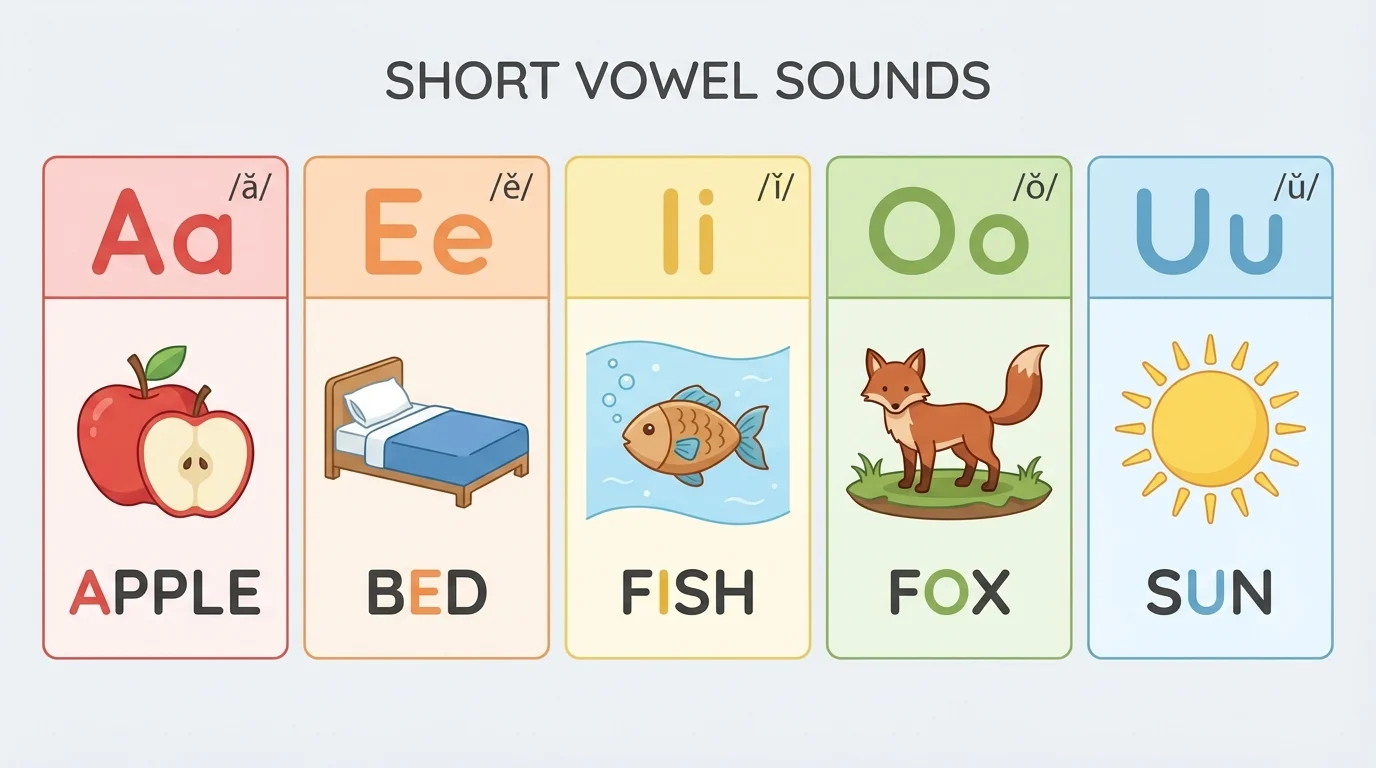
Listen to these spoken words: map, pen, sit, top, bus. Each word has one syllable, and each has a short vowel sound in the middle.
Short vowels often sound quick. Say cat. The vowel sound in the middle is short. Say bed. The vowel sound in the middle is short again. Your mouth opens for the vowel, and then the word ends quickly.
Some word pairs are almost the same except for the vowel sound. That is why careful listening matters so much when people speak.
You can hear the same short vowel in groups of words. For example, short a is in cat, map, and jam. Short i is in pig, sit, and lip. When the middle sound matches, the words belong in the same sound group.
[Figure 2] Long vowels usually say their names. If you know the vowel names a, e, i, o, u, you already know a lot about long vowels.
Here are the long vowel sounds: long a as in cake, long e as in me, long i as in kite, long o as in go, and long u as in cube or sometimes mule.
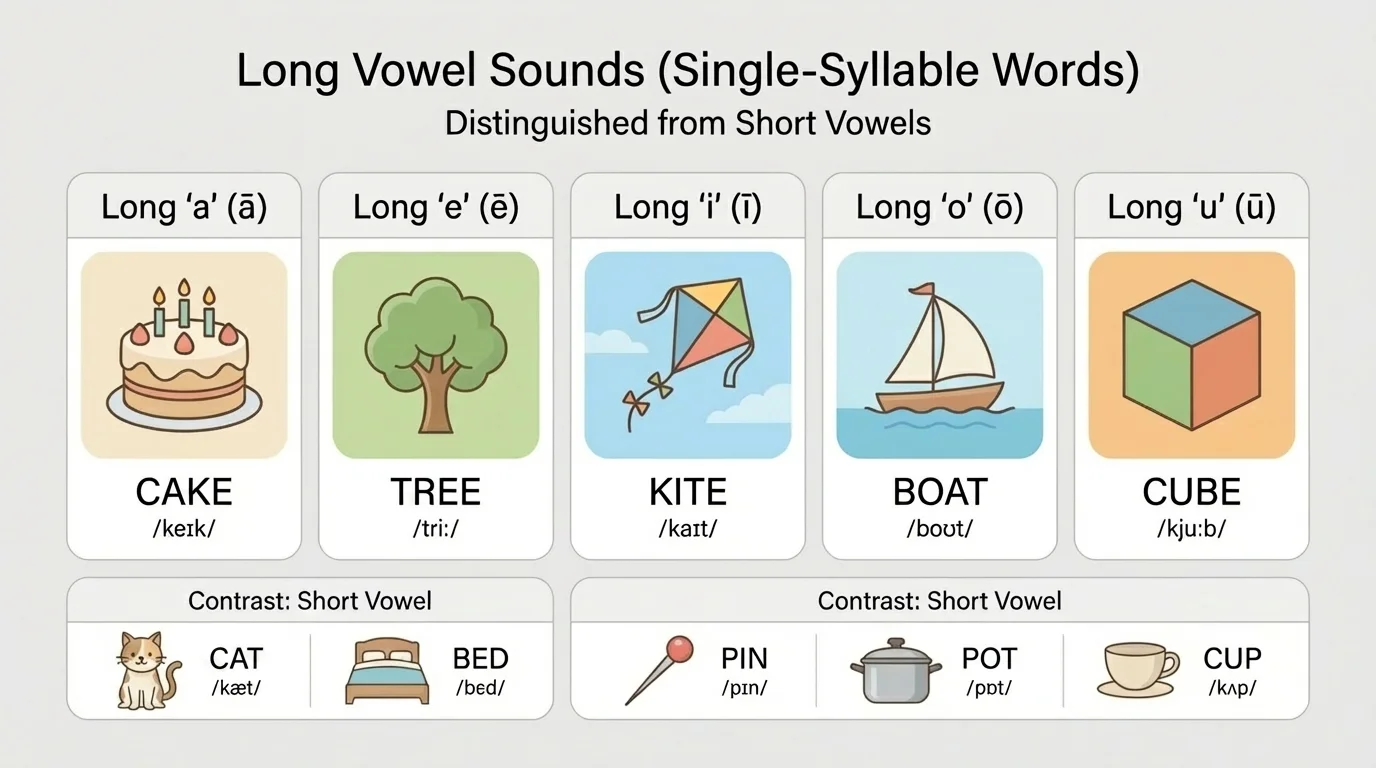
Listen to these spoken words: lake, seed, bike, home, tune. Each word has one syllable, and each has a long vowel sound.
Long vowels often sound as if the vowel sound stretches a little longer than a short vowel sound. In cake, you hear long a. In bike, you hear long i. In home, you hear long o.
Long vowels and short vowels change words
If you switch a short vowel to a long vowel, the word can become a different word. Hop and hope do not mean the same thing. Cub and cube are different too. That one vowel sound matters.
Later, when you read, you may notice that long vowels can be spelled in different ways. But when you are listening, your job is to hear the sound, not to worry about spelling first.
[Figure 3] One of the best ways to listen carefully is to compare two words that are almost the same. Listen to the middle sound and ask, "Is it short or long?"
Compare these pairs: cap and cape, bit and bite, hop and hope, cub and cube. In each pair, one word has a short vowel and the other has a long vowel.
When you listen, keep the first and last sounds in mind. In cap and cape, the beginning sound and ending sound are close, but the vowel changes. That is the clue you need.
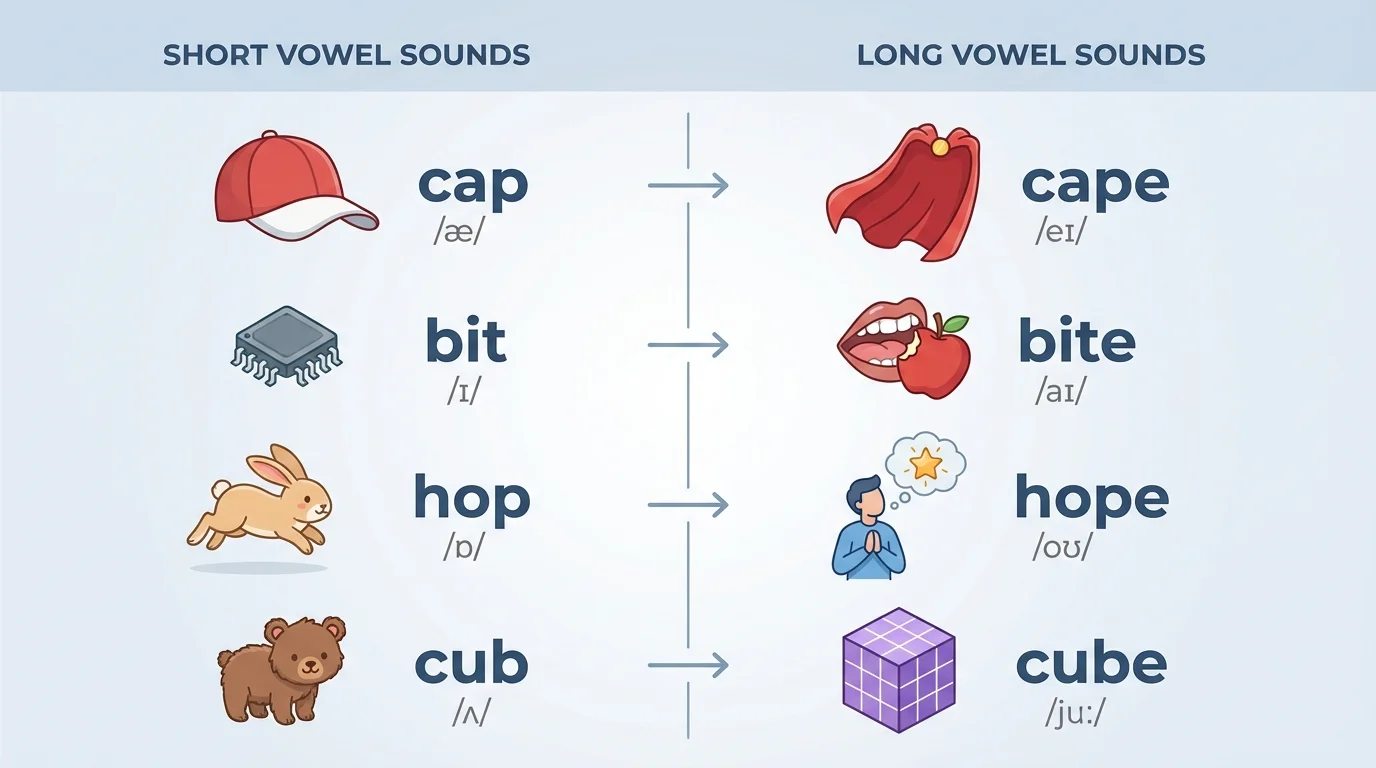
You can also notice how the word feels when you say it. Bit has a quick middle sound. Bite has a long middle sound. Hop is quick in the middle, but hope has the long o sound.
As you keep listening, [Figure 1] reminds you what short vowels sound like, and [Figure 2] reminds you what long vowels sound like. Those sound groups help your ears sort words correctly.
We can put spoken words into groups by their vowel sounds. This helps us hear patterns in spoken language.
Here is a comparison of some short and long vowel examples.
| Vowel | Short vowel word | Long vowel word |
|---|---|---|
| a | cap | cake |
| e | pet | me |
| i | sit | kite |
| o | hop | home |
| u | cub | cube |
Table 1. Examples of short and long vowel sounds in single-syllable words.
If someone says pet, you hear a short e. If someone says me, you hear a long e. If someone says sit, you hear a short i. If someone says kite, you hear a long i.
Listening to the middle sound
Step 1: Hear the whole word.
Listen to hop.
Step 2: Notice the middle vowel sound.
The middle sound is short o.
Step 3: Compare with a long vowel word.
Hope has a long o sound instead.
The words sound similar in some ways, but the vowel sound changes the word.
Sometimes two words may not look alike when written, yet they can still share a vowel sound when spoken. The important job here is to listen for the sound you hear.
Some vowel sounds can feel tricky at first. That is normal. A word may have letters that make you want to guess, but your ears should help you decide.
For example, mad has a short a, but made has a long a. rid has a short i, but ride has a long i. These pairs connect with the sound changes shown earlier.
You already know that words are made of sounds. When you stretch a word slowly and listen to the beginning, middle, and end, the vowel is often the middle sound you hear.
Sometimes children mix up long e and short i, or short e and short i, because the sounds can feel close. Slow, careful listening helps. Hearing the whole word and focusing on the middle sound makes the difference clearer.
Knowing long and short vowel sounds helps with reading because words that sound different often mean different things. It also helps with spelling because writers think about the sounds they hear in words.
When a teacher reads aloud, when a friend talks, or when you say a word yourself, vowel sounds carry important information. If you hear cub instead of cube, or bit instead of bite, the meaning changes. Careful vowel listening helps you understand spoken language clearly.
"Good readers are good listeners to sounds."
As you grow as a reader, you will use this skill again and again. The more you notice the middle sound in one-syllable words, the easier it becomes to tell whether the vowel is short or long.
