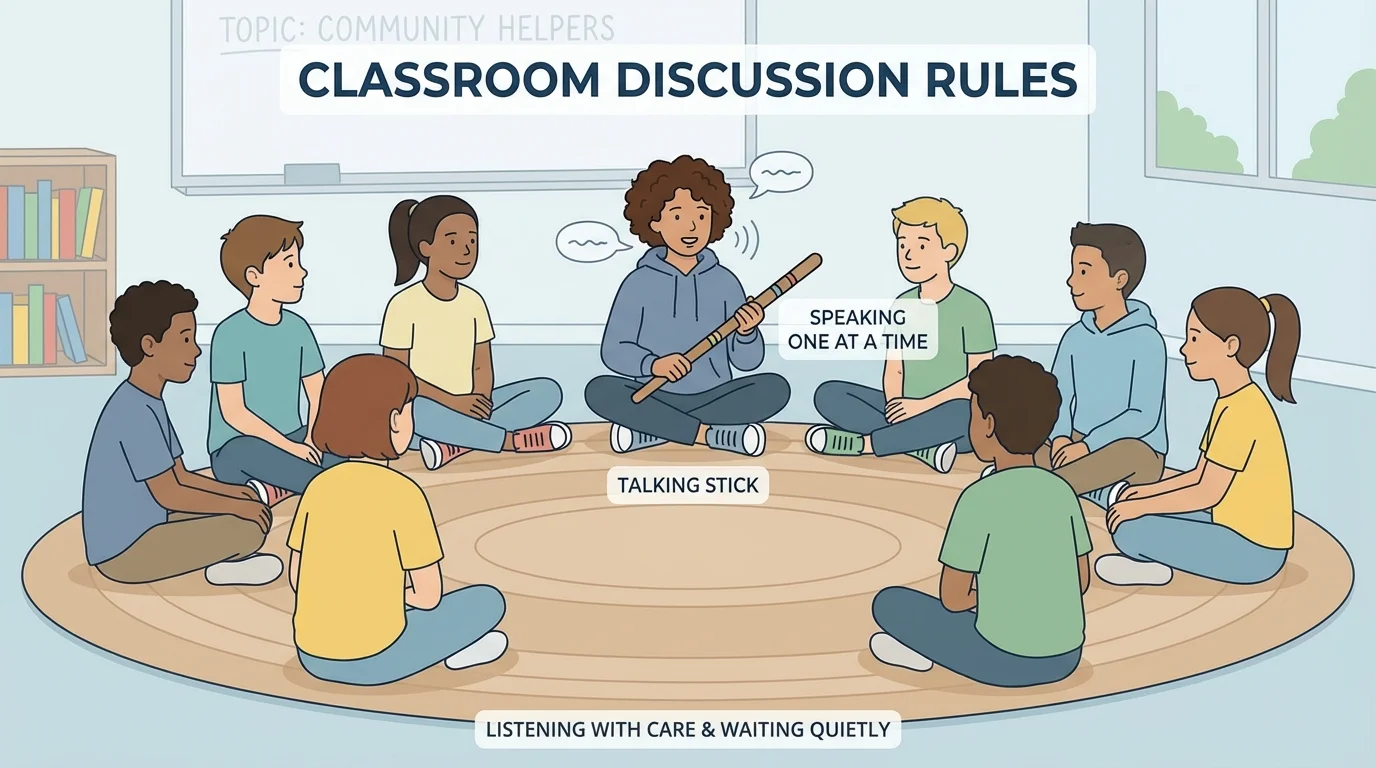
Have you ever tried to talk when many people were all talking at once? It can sound like a noisy jumble. In a classroom, we learn better when we follow rules for discussions. [Figure 1] These rules help everyone feel safe, heard, and ready to learn.
A discussion is a time when people talk and listen about the same topic. In first grade, discussions may happen when the class talks about a story, a science idea, a picture, or something that happened during the day. Good discussion rules help each person have a chance to share.
When we follow rules, we show respect. Respect means we care about other people's thoughts and feelings. If one person talks at a time and others listen, everyone can understand the speaker better. This also helps us remember important ideas.
Discussion rules are the agreed ways people talk and listen together. They help a group share ideas, take turns, and stay kind and focused.
Discussion rules are not just for school. Families use them at the dinner table. Teams use them during games. Friends use them when deciding what to play. Learning these rules helps you in many places.
One important rule is to listen with care. Listening with care means you are not just hearing sounds. You are paying attention to the speaker's words and trying to understand the idea. A good discussion has one speaker and careful listeners who wait for their turn.
Another important rule is to speak one at a time. If two people talk at once, the words can get mixed up. Waiting for a turn helps everyone hear clearly. Sometimes a teacher may use a signal, a hand raise, or a special object to show whose turn it is to speak.
A third rule is to stay on the topic. The topic is what the group is talking about. If the class is discussing a story about a lost puppy, talking about your favorite ice cream is off-topic. Staying on topic helps the group think deeply about one idea.
We also use kind and clear words. We can say, "I think the puppy was scared," or "I would like to add something." We do not shout, tease, or grab attention in rude ways. Kind words make discussions feel welcoming.
Example of following the rules
The class is talking about a book about a garden.
Step 1: Mia listens while Ben speaks.
Ben says, "I learned that plants need water."
Step 2: Mia waits for her turn.
She does not interrupt while Ben is talking.
Step 3: Mia stays on the same topic.
She says, "I want to add that plants also need sunlight."
This discussion works well because the children listen, take turns, and talk about the same idea.
Later, the same idea from [Figure 1] helps during story time too. One child speaks, the others listen, and then the next speaker gets a turn. That simple pattern makes learning smoother for everyone.
[Figure 2] Talking is not only about words. We also use nonverbal language. Nonverbal language means the messages we send without speaking. The students show listening with their eyes, faces, and bodies.
When someone is speaking, you can face the speaker, keep your body calm, and look at the person who is talking. Your face can show interest. Your hands can stay quiet. These actions tell the speaker, "I am listening."
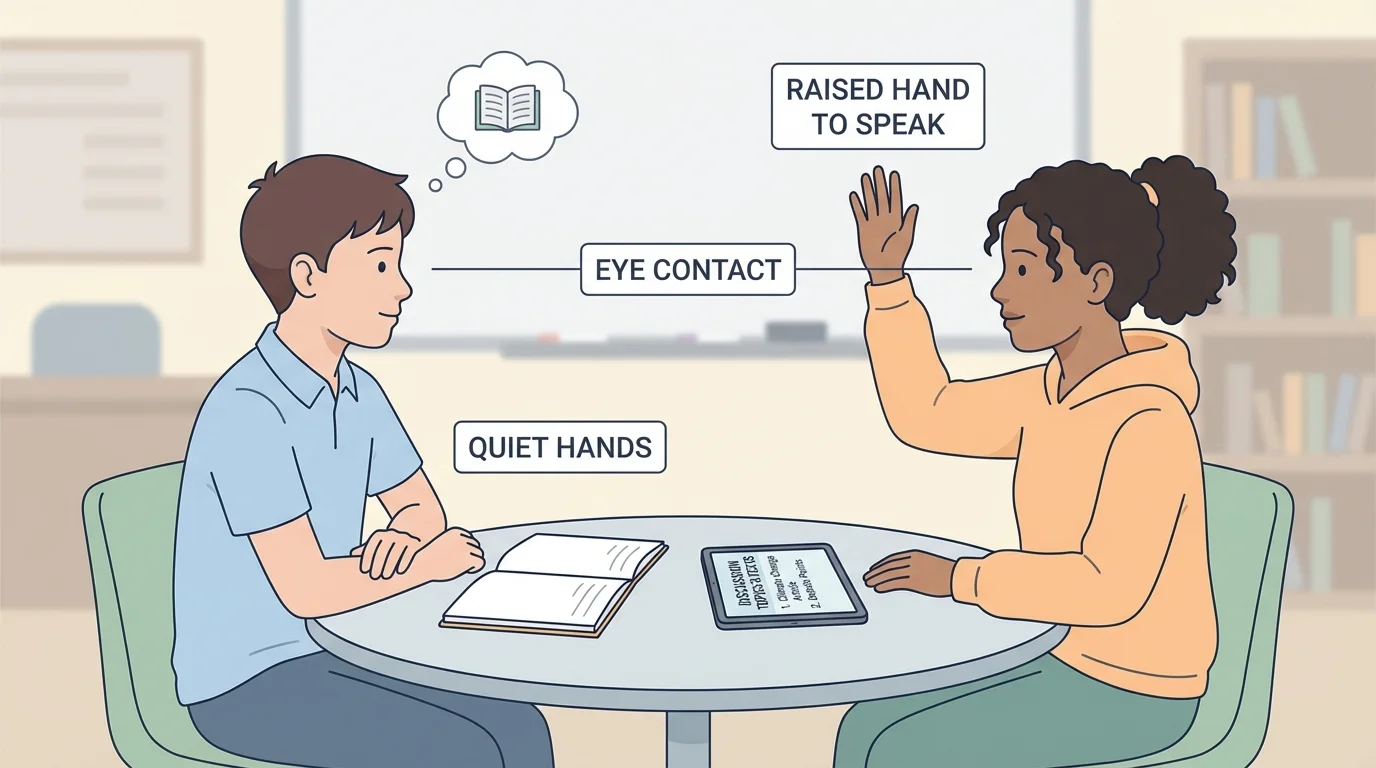
Your voice matters too. A calm voice helps others understand you. Speaking loudly enough to be heard is helpful, but shouting is not. Speaking clearly means saying your words so others can follow your idea.
Sometimes nonverbal language shows that you want to speak next. You might raise your hand, lean forward a little, or wait with a quiet body. These signals can help discussions stay organized.
Listening uses your whole body
Good listening is something you do with your ears, eyes, mind, and body. You hear the words, look at the speaker, think about the meaning, and wait until the person is finished before you respond.
If a classmate looks confused, you can help by speaking slowly or repeating an idea kindly. Good discussions are about sharing understanding, not rushing through words.
[Figure 3] Discussion rules work in many group sizes. Discussions can happen with a partner, in a small group, or as a whole class. The rules stay mostly the same in each one: listen, wait, speak clearly, and stay on topic.
With a partner, it may be easier to take turns because only two people are talking. You can look right at your partner and listen carefully. You still need to wait and not interrupt.
In a small group, more people have ideas to share. That means taking turns becomes even more important. You may need to wait longer, but your listening helps the group work well together.
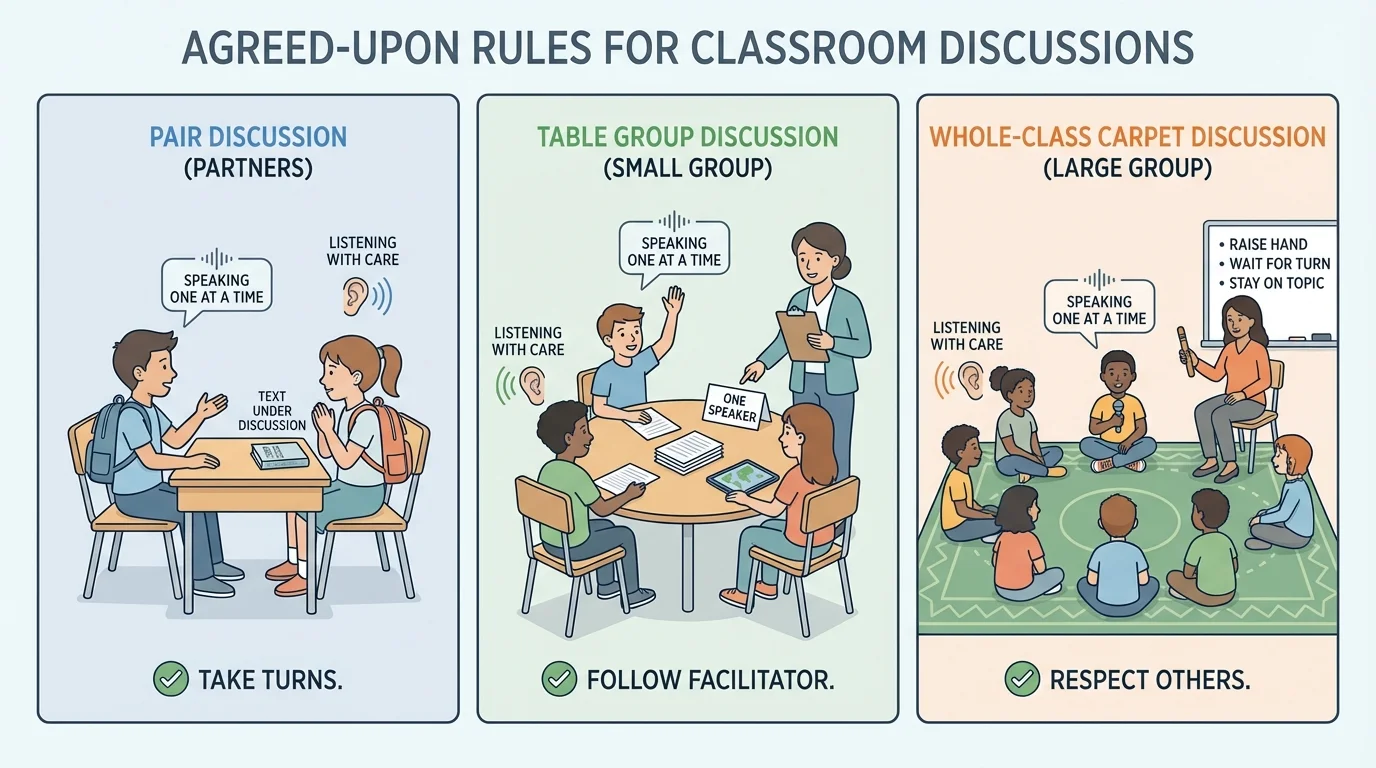
In a whole-class discussion, many students may want to speak. The teacher may call on students one by one. You might not speak every time, but you are still part of the discussion when you listen, think, and get ready to respond.
Adults are discussion partners too. You might talk with your teacher, a helper, or a family member visiting class. The same respectful rules still matter when speaking with adults.
| Group | What to do |
|---|---|
| Partner | Look at your partner, listen, and take turns. |
| Small group | Wait patiently, listen to each speaker, and add on to the topic. |
| Whole class | Follow teacher signals, raise your hand, and listen carefully. |
Table 1. Ways discussion rules are used in different group sizes.
When you move from one group size to another, the rules do not disappear. They travel with you. That is why practicing them every day is so helpful.
Polite discussion phrases can help us join the conversation respectfully. You can say, "I agree because...," "I want to add...," "Can you say more?," or "I have a different idea." These sentence starters make talking together easier.
If the class is talking about a story, one student might say, "The bear feels lonely." Another student can respond, "I agree because he has no friends in the picture." A third student might say, "I noticed that too." These responses connect to the same topic and build understanding.
Even quiet students are strong discussion partners. Careful listening, thoughtful waiting, and one clear idea can help a group just as much as talking many times.
Questions are also important in a discussion. Asking, "Why do you think that?" or "What happened first?" helps everyone think more deeply. Good questions show that you are listening and wondering.
You do not always have to agree. If you disagree, you can still be respectful. You might say, "I think something different," and then explain your reason calmly.
"Take turns. Listen well. Speak kindly."
These simple words can guide many classroom conversations, from talking about books to sharing ideas in science and art.
Sometimes discussion rules are forgotten. A student may interrupt. Someone may talk about something unrelated. Another person may speak too softly or too loudly. These are common problems, and they can be fixed.
If you interrupt by accident, you can stop and say, "Sorry, you go first." If you forget the topic, you can listen again and bring your words back to the group's idea. If you disagree, you can use kind words and explain your thinking.
When discussions feel hard, remember the listening signals from [Figure 2]. Calm hands, eyes on the speaker, and a quiet mouth help your body get ready to listen. And the group examples in [Figure 3] remind us that the same respectful habits work with one person, a few people, or the whole class.
You already know how to be kind, wait in line, and share materials. Discussion rules use those same ideas with talking and listening.
Every time you follow discussion rules, you help your classroom become a better place for learning. You show that your ideas matter and that other people's ideas matter too. That is what strong listeners and speakers do.
