Have you ever seen a word that looked a little strange, but part of it looked familiar? That is a helpful reading strategy. Many words are like building blocks. If you know one small part, you can unlock the meaning of the whole word. Readers do this all the time when they meet a new word in a story or a book.
Words can have different parts. One part may be a word you already know. Another small part may be added to the beginning or the end. These little parts can change the meaning. When you notice word parts, you become a stronger reader.
For example, if you know the word pack, you can get a clue from the word unpack. The word still has pack in it. The new part at the front changes the meaning. Now the word means to take things out instead of putting them in.
You may already know that some words belong in word families, like play, plays, and playing. These words are connected because they share a base word.
When readers look closely at words, they often ask, "What part do I know already?" Then they ask, "What does the extra part tell me?" Those two questions help readers understand the word.
A affix is a small word part added to another word. It can go at the beginning or at the end. An affix gives us a clue about the meaning of the whole word, as [Figure 1] shows.
A word you start with is called a base word. If we start with play, we can make new words like replay or plays. The base word stays important, and the affix adds a new idea.
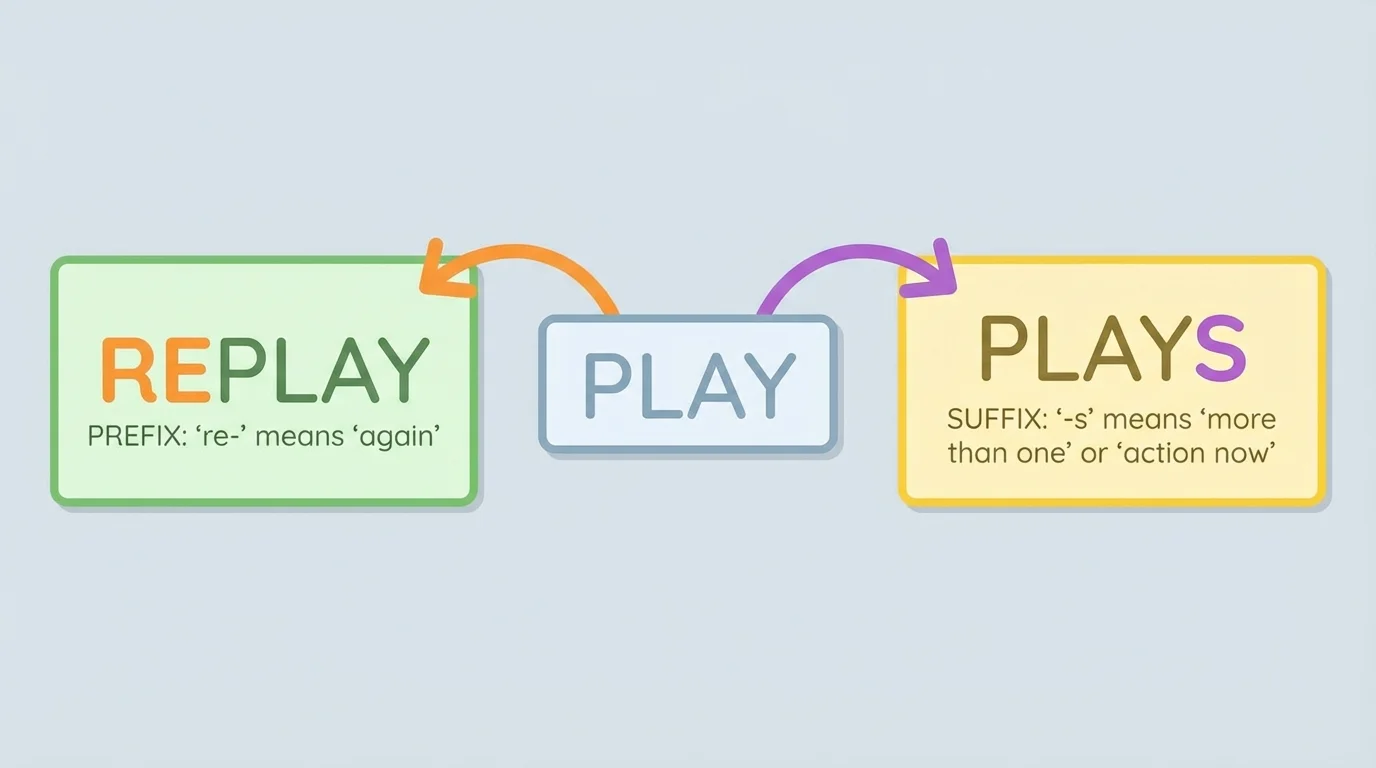
Prefix is an affix at the beginning of a word. Suffix is an affix at the end of a word. A base word is the main word part that carries the main meaning.
Some affixes are used again and again in many words. That is why they are so helpful. If you learn a few common affixes, you can read many more words.
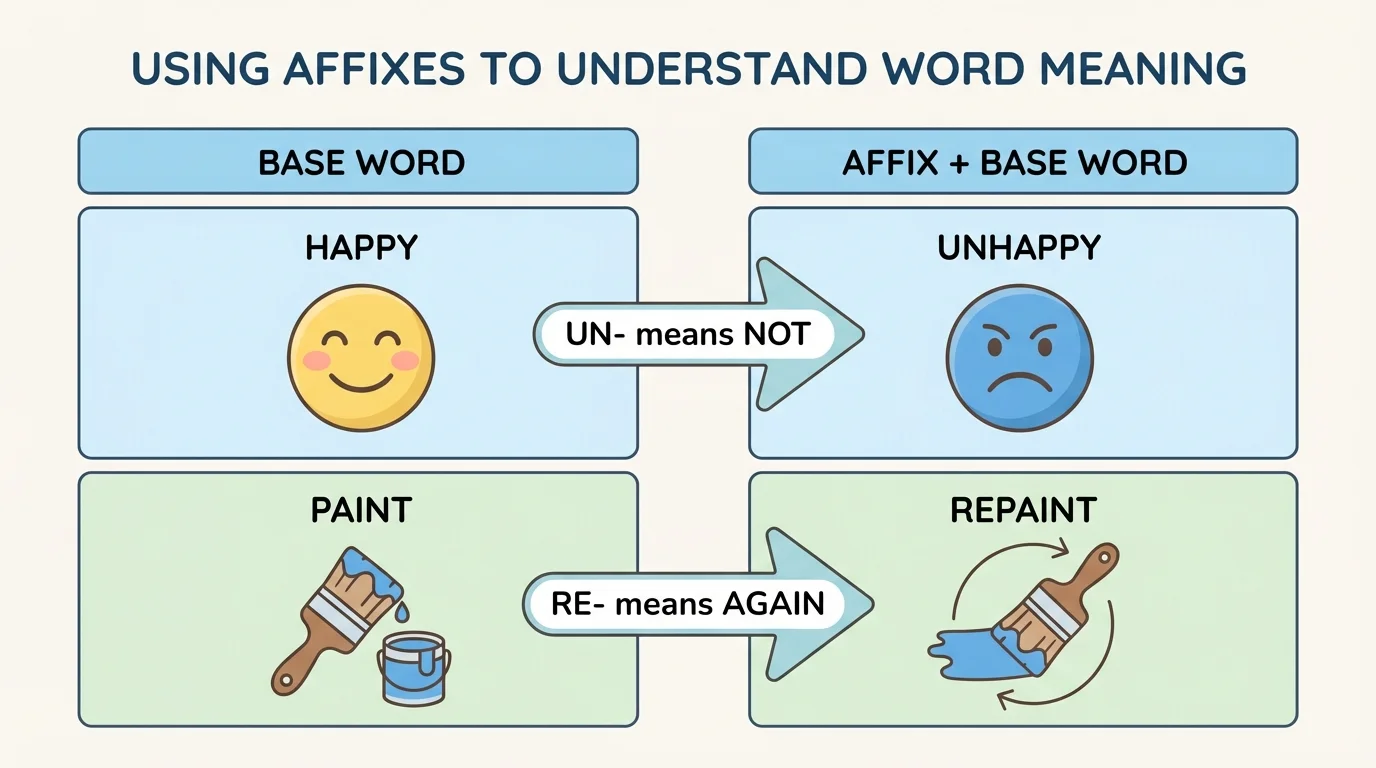
A prefix comes at the beginning of a word. Common prefixes like un- and re- are very helpful clues. When you see one, stop and think about what it usually means, as [Figure 2] shows.
The prefix un- often means not or the opposite of. If you know happy, then unhappy means not happy. If you know tie, then untie means to undo the tie.
The prefix re- often means again. If you know read, then reread means read again. If you know paint, then repaint means paint again.
Using a prefix clue
Step 1: Look for the base word.
In redo, the base word is do.
Step 2: Look at the prefix.
The prefix re- means again.
Step 3: Put the parts together.
Redo means do again.
Sometimes the prefix changes the word only a little, and sometimes it changes it a lot. The important thing is to use the clue and then check whether the meaning makes sense in the sentence.
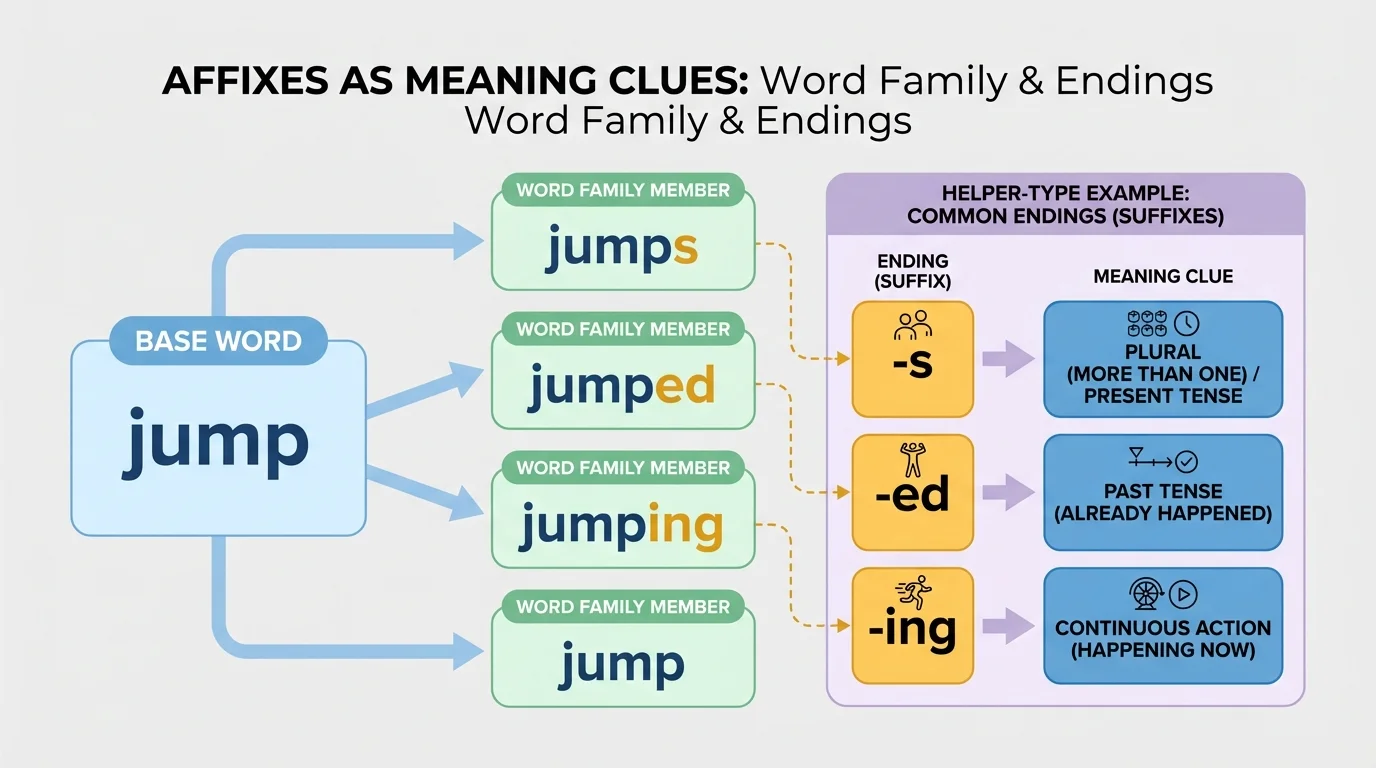
A suffix comes at the end of a word. Common suffixes like -s, -ed, -ing, and -er give clues about number, time, or who does something. These endings appear in books and stories all the time.
The suffix -s can mean more than one. Cat becomes cats. Book becomes books. This helps readers know whether there is one thing or many.
The suffix -ed often shows that something already happened, as [Figure 3] shows. Jump becomes jumped. Look becomes looked. The suffix -ing often shows that something is happening now. Jump becomes jumping. sing becomes singing.
The suffix -er can mean a person or thing that does something. A teacher teaches. A helper helps. A painter paints.
When you read, these endings help you understand what is happening in the sentence. Later, when you write, they help you choose the right word form too.
One tiny ending can change a whole sentence. Compare The dog jump. and The dog jumped. That little -ed tells us the action happened before.
We can also think back to the examples of word endings when we see a new word ending. The ending may tell us whether there is one or many, now or before, or a person who does something.
Good readers do not look only at the affix. They also look at the base word. The base word carries the big meaning, and the affix adds a clue. Together, they help you understand the whole word.
If you see replay, you can think: the base word is play, and re- means again. So replay means play again. If you see untie, the base word is tie, and un- means not or undo. So untie means to undo a tie.
Put the parts together
When a word has an affix, readers can use a simple idea: find the base word, notice the affix, and blend the meanings. This strategy helps when the word is new but its parts are familiar.
Sometimes a word part clue is enough by itself. Other times, you also need the sentence. If a story says, Sam will reread the page, the prefix tells you again, and the sentence tells you Sam is reading one more time.
Some words can mean different things in different places. That is why readers use both word parts and sentence clues. An affix gives one clue, but the whole sentence helps confirm the meaning.
For example, player has the suffix -er. The base word is play. A player is someone who plays. In one sentence, that might mean a child playing a game. In another sentence, it might mean a person who plays music. The suffix clue still helps, because it tells you the word names someone who does the action.
We can also remember that the prefix re- means again when we read a word like repaint. The prefix tells us the action happens again, and the sentence tells us what is being painted.
Affixes help in many parts of reading. They help you understand story words, directions, and words in science or social studies books. They also help when you talk and write, because you can build new words from words you already know.
If you know help, then helper makes sense. If you know clean, then unclean or reclean give you more meaning. If you know print, then reprint means print again. Small parts can do big jobs.
When you come to a new word, slow down and look carefully. Ask yourself what the base word is. Then notice whether there is a prefix or a suffix. Finally, read the whole sentence and make sure your idea fits.
Small word parts can give big reading clues.
The more often you notice these patterns, the easier reading becomes. Words start to feel less tricky because you know how to break them into parts and listen for meaning.
