Have you ever played a sorting game with pictures or toys? You might put all the animals together, all the foods together, and all the things you wear together. Readers do something like that with words. We sort words into groups, and then we look closely at what makes each word special. That helps us understand what a word means.
When we define a word, we can tell its category and its special features. For example, a duck is not just an animal. A duck is a bird that swims. A tiger is not just an animal. A tiger is a large cat with stripes. These kinds of definitions help us understand words clearly.
Many words belong with other words. Dog, cat, horse, and rabbit all belong in the same kind of group. Apple, banana, and grape belong in another kind of group. When we notice how words are connected, we become stronger readers and speakers.
Sometimes a word belongs to a big group and also to a smaller group. [Figure 1] A robin is an animal. It is also a bird. It is even a kind of songbird. The more clearly we can name the group, the better our definition can be.
Category means a group that things belong to.
Attribute means an important feature or detail that tells about something.
A good definition often has both parts: the category and one or more key attributes. That is why "A whale is an animal that lives in the ocean" is clearer than just saying "A whale is big." The first definition tells the category and a helpful detail.
A category is a group of things that go together. Birds are one category. Fruits are one category. Vehicles are one category. A category helps us start a definition because it tells what kind of thing we are talking about.
If someone says, "A carrot is a food," that is a start. Food is the category. But we can be even more exact. We can say, "A carrot is a vegetable." Now the category is clearer.
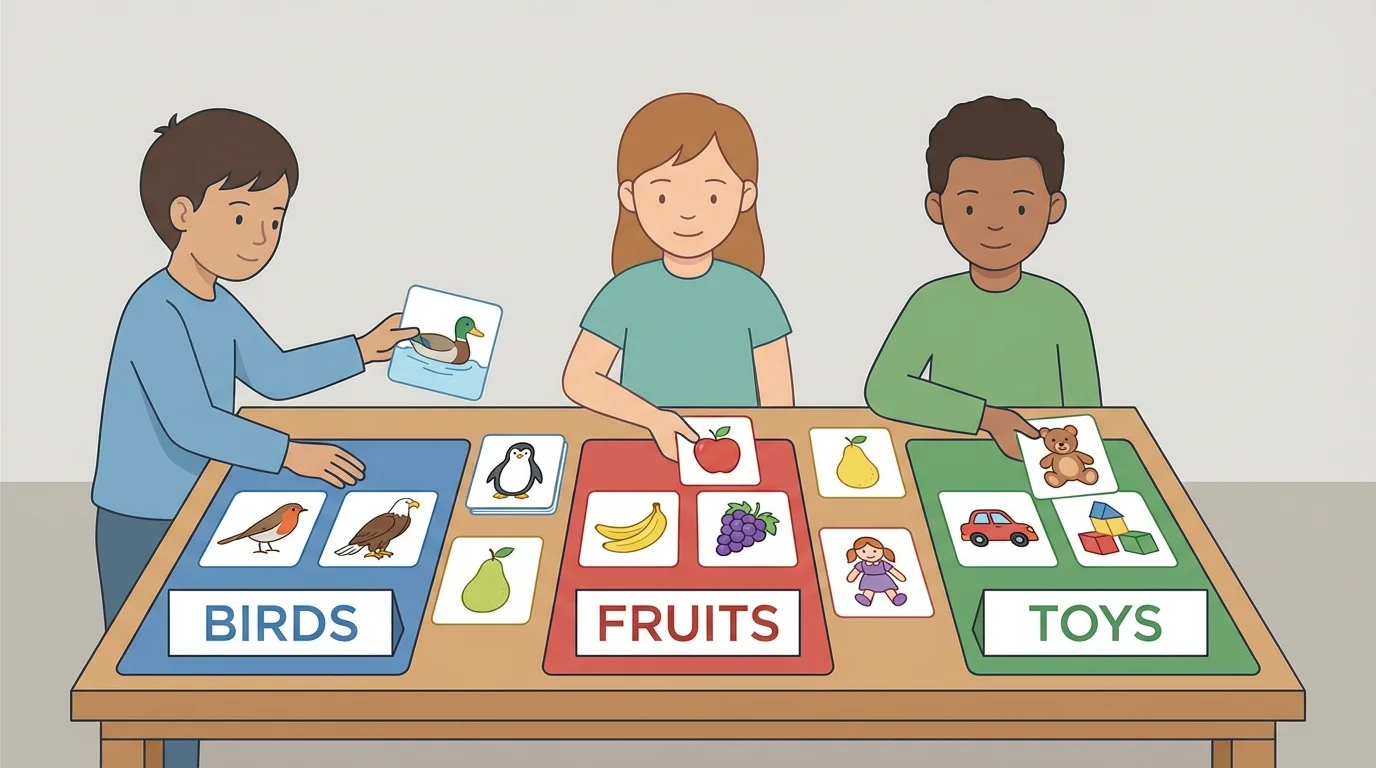
Here are some examples of categories: table, chair, and desk are furniture. Rose, tulip, and sunflower are flowers. Shirt, socks, and coat are clothes. The category is like the word family that something belongs to.
[Figure 2] When you read a book, authors often help you find the category first. If a story says, "We saw a creature in the pond," and then says it had feathers and a beak, you can begin to think about the category bird.
A key attribute is an important detail we notice about something. Attributes help us tell one word apart from another word in the same category.
Attributes can be about what something looks like, what it does, where it lives, what parts it has, or how it feels. A lemon is a fruit that is yellow and sour. A bear is an animal with fur that can be very large. A firefighter is a worker who helps put out fires.
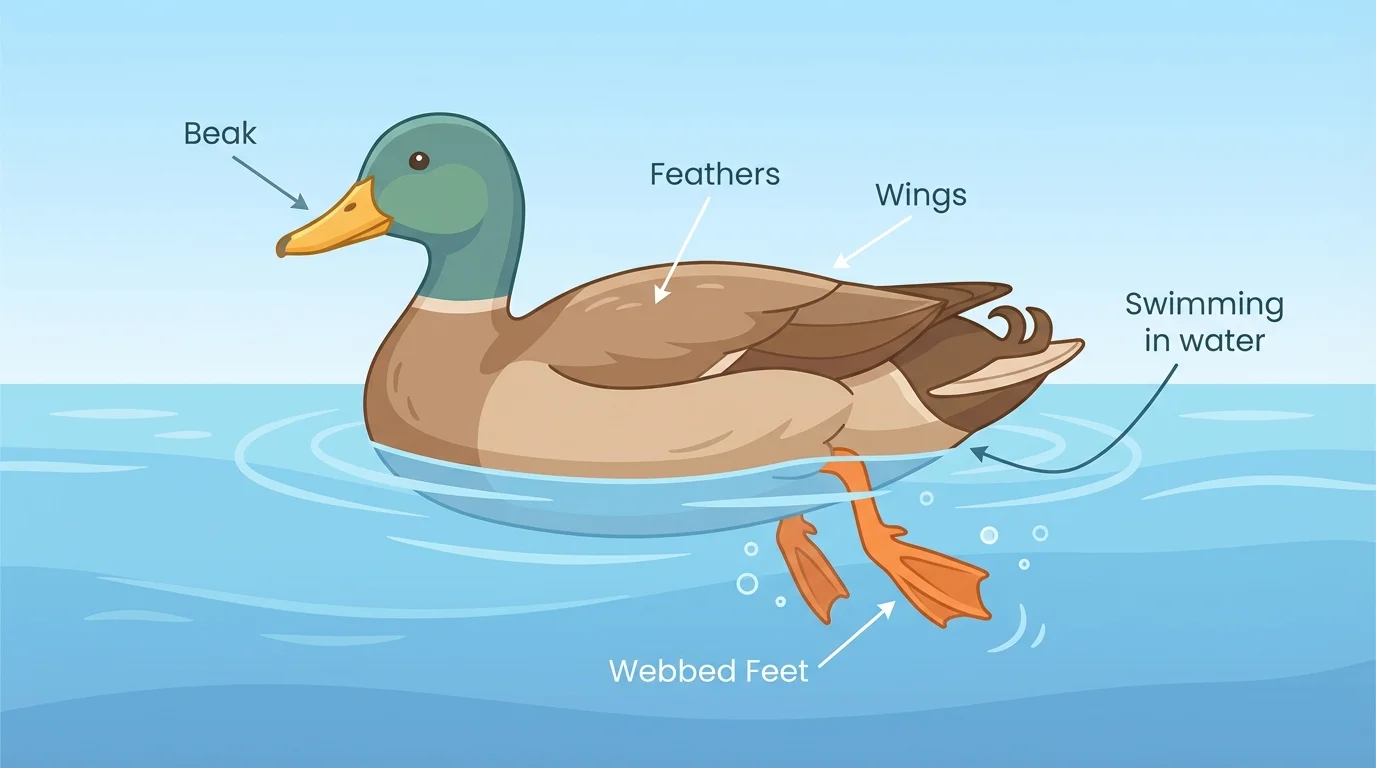
Some attributes are more helpful than others. If we say, "A duck is a bird that is alive," that is true, but it is not very helpful because all birds are alive. If we say, "A duck is a bird that swims and has webbed feet," that tells us much more.
Good readers listen for attributes in sentences. In the sentence "The red ball bounced across the yard," the word red is an attribute of the ball, and bounced tells what it does. These details build meaning.
Strong definitions use important details. A strong definition does not give just any detail. It gives a detail that helps someone know exactly what the word means. "A zebra is an animal" is true, but "A zebra is an animal with black-and-white stripes" is much clearer.
Sometimes one attribute is enough. Sometimes we need more than one. A stool is a seat with no back. A tiger is a large cat with stripes. A penguin is a bird that cannot fly and lives in cold places.
One easy way to define a word is to use this pattern: A ___ is a ___ that ___. The first blank is the word. The second blank is the category. The last blank tells one or more important attributes.
Listen to how clear these definitions sound: "A hammer is a tool that is used to hit nails." "A blanket is a cover that keeps you warm." "A dolphin is an animal that lives in the ocean and swims." Each definition starts with a category and then gives key details.
This pattern also works with people and places. "A chef is a person who cooks food." "A library is a place where people borrow books." "A dentist is a doctor who cares for teeth." The category word can change, but the idea stays the same.
Examples of clear definitions
Step 1: Name the word.
Word: pumpkin
Step 2: Tell the category.
A pumpkin is a fruit.
Step 3: Add key attributes.
A pumpkin is a fruit that is round, orange, and grows on a vine.
The definition becomes clear because it tells the group and the important details.
You can also use this pattern when you meet new words in reading. If you read, "The otter floated on its back," you can think, "An otter is an animal that lives near water and swims." You may not know every detail yet, but the category and attributes help you understand.
Words in the same group can still mean different things, as [Figure 3] illustrates with two birds from the same category. This is why attributes matter so much. A duck and a swan are both birds, but they are not the same kind of bird.
A duck is a bird that swims and often has a shorter neck. A swan is a large water bird with a long neck. A tiger and a lion are both big cats. A tiger has stripes. A lion usually has no stripes, and a male lion may have a mane.
Think about furniture. A chair is furniture for sitting and usually has a back. A stool is furniture for sitting but usually has no back. The category is the same, but one key attribute changes the meaning.
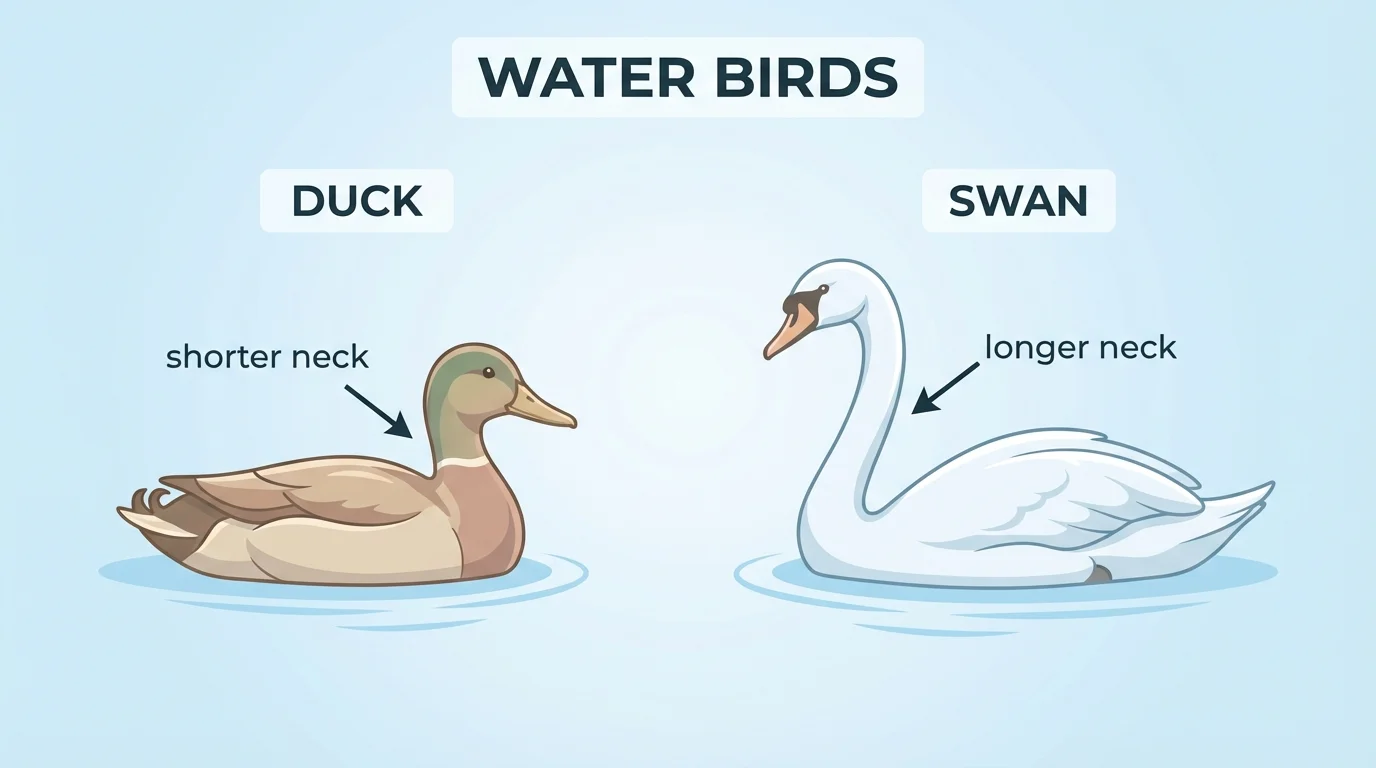
Later, when you read about animals again, you can remember the comparison. It helps show that category words are helpful, but attributes make the meaning exact.
Comparing similar words also helps with word relationships. We can see how words are connected and how they are different at the same time. That is an important reading skill.
Some describing words are stronger and more exact than others. If we say, "A tiger is a cat," that is true, but it is not very exact. If we say, "A tiger is a large cat with stripes," the meaning becomes sharper.
Exact words help us notice small differences. Big and huge are close in meaning, but huge means even bigger. Happy and joyful are close in meaning, but joyful can sound even stronger. When we define words, we try to choose the clearest words we can.
Some words can fit in more than one group. A tomato can be called a fruit in science because it grows from a flower, but many people think of it as a food used like a vegetable in cooking.
That is why readers need to think carefully. The best definition depends on what idea we want to show. In one book, a bat may be defined as an animal that flies at night. In another, it may be called a mammal with wings. Both use category and attributes.
When teachers, families, and books explain new words, they often use category and attributes together. You may hear, "A volcano is a mountain that can erupt," or "A uniform is clothing worn by members of a group." These definitions are easy to understand because they are organized.
As you read, listen for clue words like is a, has, can, lives in, and used for. These clues often bring in attributes. If a sentence says, "A seal is a sea animal with flippers," the category is sea animal, and the attribute is flippers.
Writers do not always give a full dictionary definition. Sometimes they spread the clues across many sentences. One sentence may tell the category. Another may tell the color, shape, size, or action. Good readers gather the clues together.
You already know many describing words such as color words, size words, and action words. Those words can become key attributes when you define something clearly.
Speaking clearly works the same way. If you say, "I saw a bird," people know only the category. If you say, "I saw a small brown bird with a red chest," people understand much more.
Words are like parts of a web. One word connects to its category, and then to smaller groups, and then to attributes. For example, animal is a big group. Bird is a smaller group inside animal. Duck is a smaller group inside bird. Then we add attributes such as swims, has webbed feet, and lives near water.
This word web helps us learn new words faster. If you already know what a bird is, then hearing "A penguin is a bird that cannot fly and swims in cold water" gives you a strong picture right away. The word you already know helps you understand the new word.
We can also use more than one attribute to make meanings very clear. A panda is a bear with black-and-white fur that eats bamboo. A cactus is a plant with thick stems and sharp spines that can grow in dry places. More useful details create a stronger definition.
When we define words by category and key attributes, we become more careful thinkers. We notice how words fit together, how they differ, and how authors help us understand meaning. That makes reading, listening, and speaking much stronger.
