What happens when tiny sounds snap together like building blocks? They make words. When you hear /m/ /a/ /p/ and say map, your brain is doing something powerful. It is taking small sounds and blending them into one whole word. This skill helps you become a stronger reader because spoken words are made of parts you can hear and put together.
A phoneme is one small sound in a word. The word sun has three phonemes: /s/ /u/ /n/. The word fish also has sounds you can hear and blend together. When we talk about blending, we are listening to the sounds in order and then saying the whole word.
A single-syllable word is a word with one beat, like dog, sit, flag, and milk. Even when a word has more than three sounds, it can still be one syllable. We are learning to put those sounds together with our voices.
Phoneme means one small sound in a spoken word. Blend means to push the sounds together smoothly to say the whole word. A consonant blend is when two consonant sounds are next to each other and you can still hear both sounds.
When you blend, you do not name the letters. You say the sounds. For example, you do not say "bee-a-tee." You say /b/ /a/ /t/ and then bat. Blending is about sounds we hear and say.
[Figure 1] Blending works best when sounds go in order from left to right. You listen to the first sound, then the next sound, then the last sound, and your mouth says them smoothly together. If you hear /c/ /a/ /t/, you blend them into cat.
Sometimes it helps to stretch the sounds a little: /mmmm/ /aaa/ /nnn/. Then you say man. You can also say the sounds more quickly: /m/ /a/ /n/, man. Both ways help your ears and mouth work together.
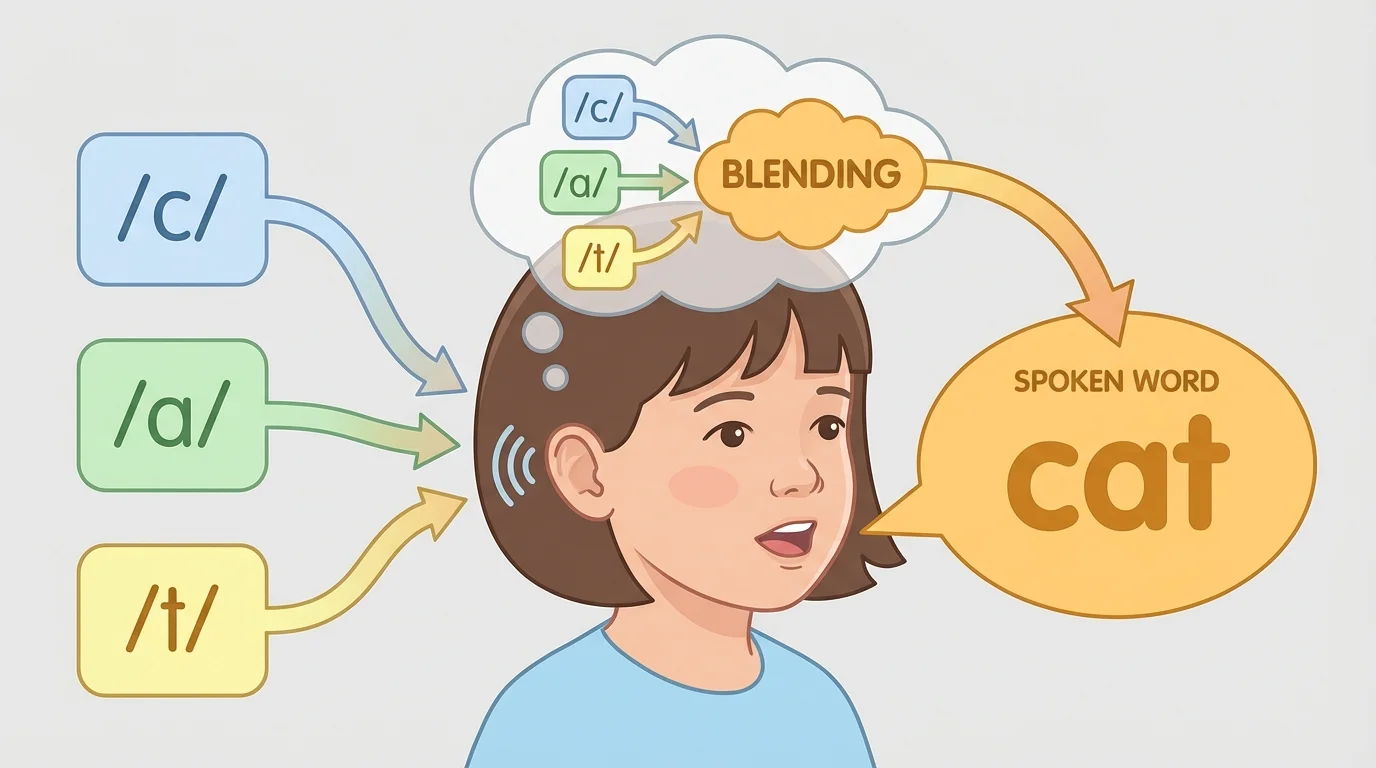
Here are more examples of oral blending: /d/ /o/ /g/ makes dog. /p/ /i/ /g/ makes pig. /r/ /u/ /n/ makes run. Each word has one syllable, and each word can be made by blending the sounds in order.
If a word has four sounds, you blend four sounds. For example, /j/ /u/ /m/ /p/ makes jump. The word is still one syllable, but it has more phonemes to push together.
Hearing and blending simple words
Step 1: Listen to the sounds /f/ /a/ /n/.
Step 2: Say the sounds smoothly: /f/ /a/ /n/.
Step 3: Blend them into the whole word: fan.
The same idea works for /h/ /e/ /n/ to make hen and /l/ /o/ /g/ to make log.
As you become stronger at blending, your brain starts doing it faster. That is one reason good readers can look at new words and figure them out. They know how to put the sounds together.
[Figure 2] Some one-syllable words have a consonant blend. A consonant blend happens when two consonant sounds are side by side. You can still hear both sounds. In blue, the beginning sounds are /b/ and /l/. In stop, the beginning sounds are /s/ and /t/.
It is important to keep both sounds. In flag, the blend /fl/ has /f/ and /l/. In grab, the blend /gr/ has /g/ and /r/. We do not squash them into one sound. We hear both and blend them smoothly with the rest of the word.
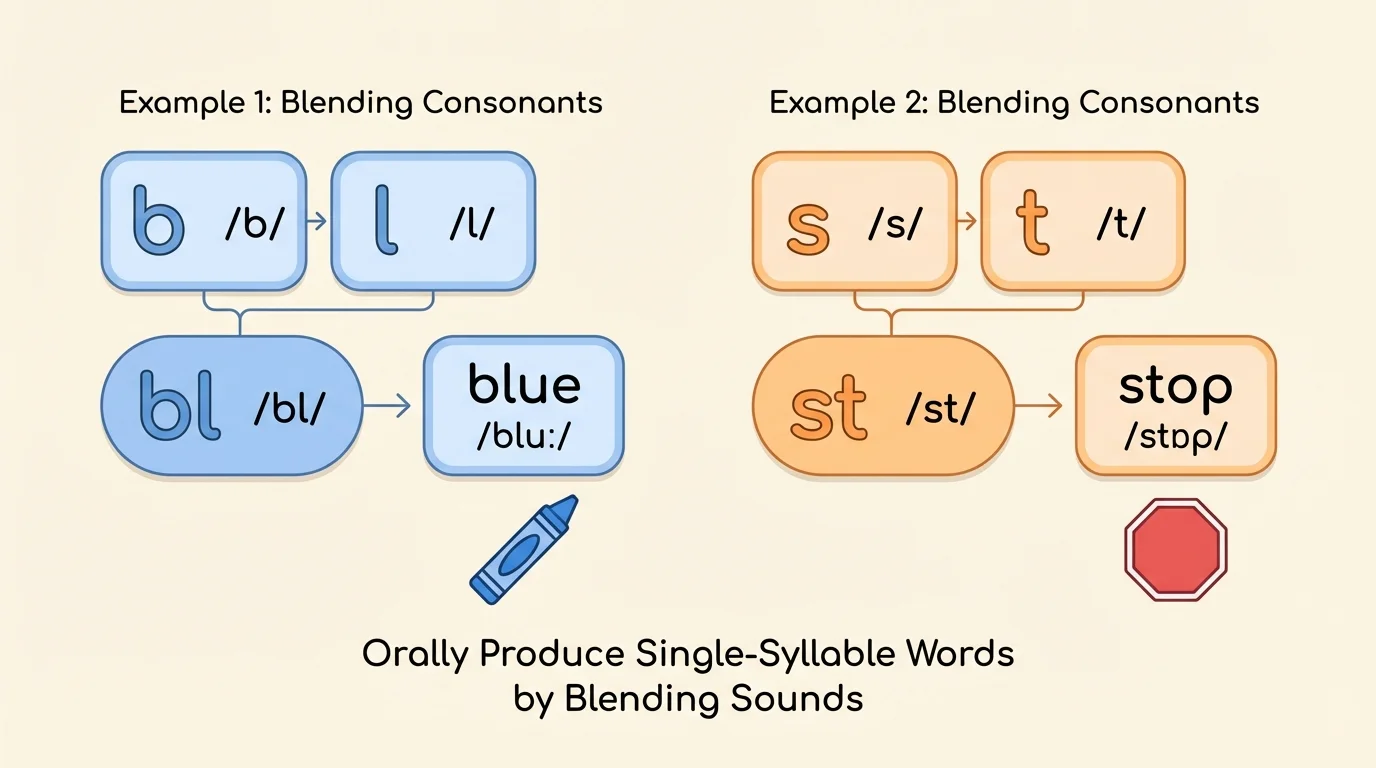
Beginning blends can come before a vowel sound. Listen to these: /b/ /l/ /a/ /k/ makes black. /s/ /t/ /e/ /m/ makes stem. /f/ /r/ /o/ /g/ makes frog. These words are still one syllable, but they begin with two consonant sounds.
Words can also have blends at the end. In hand, the ending /nd/ keeps both /n/ and /d/. In milk, the ending /lk/ keeps both /l/ and /k/. In fast, the ending /st/ keeps both /s/ and /t/.
Some short words have many sounds packed into one syllable. The word spring is just one syllable, but it has several sounds blended closely together.
Consonant blends can be at the start, at the end, or even at both places in the same one-syllable word. For example, stand begins with /st/ and ends with /nd/. That makes blending extra important.
You can compare words with blends at the start and words with blends at the end, as [Figure 3] displays. Looking at them in groups helps you notice patterns. These patterns help your ears hear the sounds more clearly.
Here are some common examples:
| Beginning blend | Word | Ending blend | Word |
|---|---|---|---|
| bl | black | nd | hand |
| fl | flag | st | fast |
| gr | grab | lk | milk |
| sl | slip | mp | jump |
| fr | frog | nt | went |
Table 1. Examples of single-syllable words with consonant blends at the beginning or end.
When you blend a word like slip, you can hear /s/ /l/ /i/ /p/. When you blend a word like fast, you hear /f/ /a/ /s/ /t/. The sounds stay in order, and the whole word comes at the end.
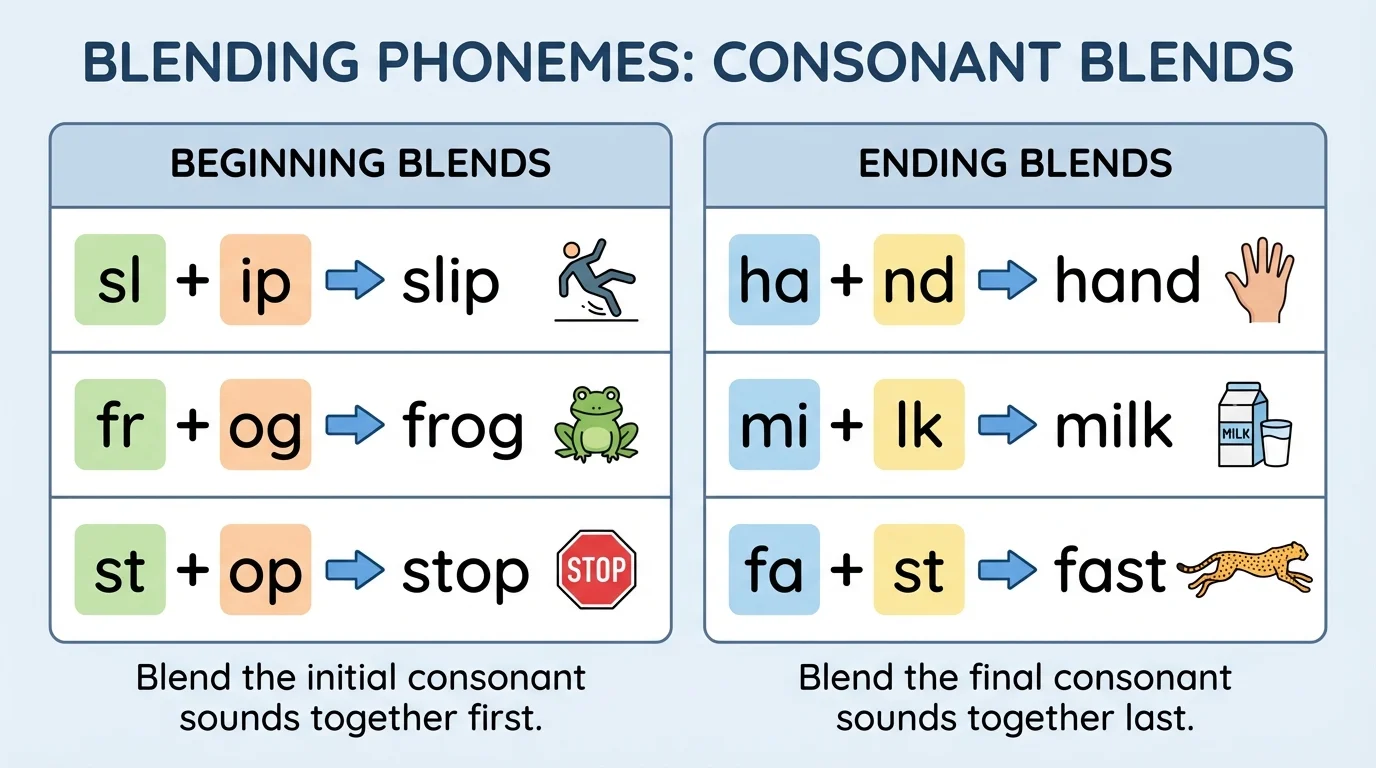
Some words have no blend at all, like map or sun. Some words have one blend, like flag or milk. Some words have more than one blend, like stand. Seeing these groups helps you notice that blending can be simple or a little more complex.
Blending words with consonant blends
Step 1: Listen to /s/ /t/ /o/ /p/.
Step 2: Keep the blend /st/ together, but still hear both sounds.
Step 3: Blend all the sounds into stop.
Another example is /h/ /a/ /n/ /d/, which blends into hand with the ending blend /nd/.
When readers meet a new short word, they often listen for these patterns. That makes words with blends less intimidating and more predictable.
Blending is not only a speaking skill. It helps with reading too. When you see a word, you can match letters to sounds and blend the sounds to read the word. If you see frog, you can think /f/ /r/ /o/ /g/ and say the whole word.
Blending also helps with spelling because your ears notice each sound. If you can hear /s/ /t/ /a/ /n/ /d/ in stand, it is easier to remember which sounds belong in the word. The sound work and the letter work support each other.
Why blending matters
Blending teaches your brain that words are made of smaller sounds in a set order. When you can hear and produce those sounds, you are building the foundation for fluent reading and careful spelling.
You use blending in real life all the time. You hear names, labels, game words, and book words. A child who can blend /b/ /l/ /o/ /k/ into block or /s/ /l/ /i/ /d/ into slide is using a reading skill during play, conversation, and story time.
Sometimes children add an extra vowel sound inside a blend. For example, they may say /buh/ /l/ instead of /b/ /l/. But in a true blend, the consonant sounds stay close together. In blue, we hear /b/ /l/ /oo/, not extra sounds in the middle. This is one reason consonant blends need careful listening.
Another tricky part is ending blends. In words like fast or milk, the last two sounds can be easy to miss. Slow blending helps: /f/ /a/ /s/ /t/, fast. Then, after the slow blend, you can say the word smoothly and naturally.
You already know that words are made of sounds. Now you are building a stronger skill: taking separate sounds and producing the whole word out loud, even when two consonants stand together in a blend.
As you keep practicing oral blending, short words become easier to hear, say, read, and write. Your ears learn to catch every sound, and your mouth learns to put them together quickly and smoothly.
