Have you ever heard someone read a story in a voice that made the story come alive? It can sound almost like the characters are talking right in front of you. Good readers do more than just say words. They read so the words make sense, sound smooth, and match the feeling of the text.
When we read aloud well, we use accuracy, rate, and expression together, as [Figure 1] shows. These three parts help us read in a way that supports understanding. If a reader says the wrong words, rushes, or reads in a flat voice, it is harder to understand the text.
Accuracy means reading the words correctly. Rate means reading at a speed that is not too fast and not too slow. Expression means using your voice to match the meaning of the words. When these work together, reading sounds smooth and natural.
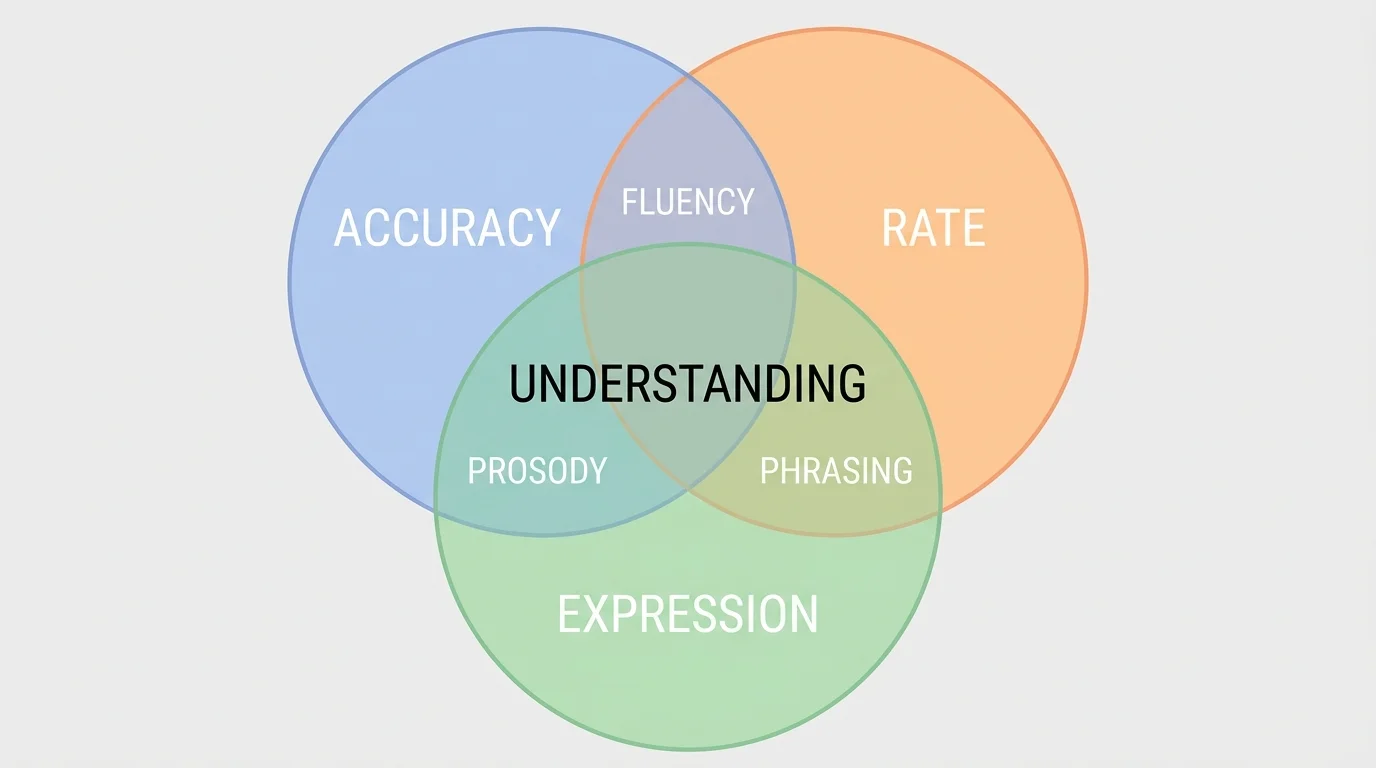
Good oral reading helps the reader and the listener understand the text. A smooth reader can pay attention to the meaning instead of struggling over every word. That is why fluent reading is so important.
Fluency is the ability to read text aloud accurately, at an appropriate rate, and with expression so the reading makes sense.
Fluent reading does not mean reading as fast as possible. It means reading in a clear, meaningful way. A strong reader notices words, punctuation, and the feelings in the text.
Reading with accuracy means saying the words the way they are written, and it starts with looking carefully at letters and parts of words, as [Figure 2] illustrates. Readers notice the beginning, middle, and ending of a word. They can also use what they know about word families and word parts to help.
For example, if a reader knows the word hop, that reader can read hops, hopping, and hopped more easily. If a reader sees sunset, the reader may notice two smaller words: sun and set. Looking for familiar parts helps readers say words correctly.
Accurate readers also notice when something does not sound right. If a child reads, "The dog ran to the tree," but says "The dog rain to the tree," the sentence does not sound right. A careful reader stops, looks again, and fixes the word. This is called self-correction.
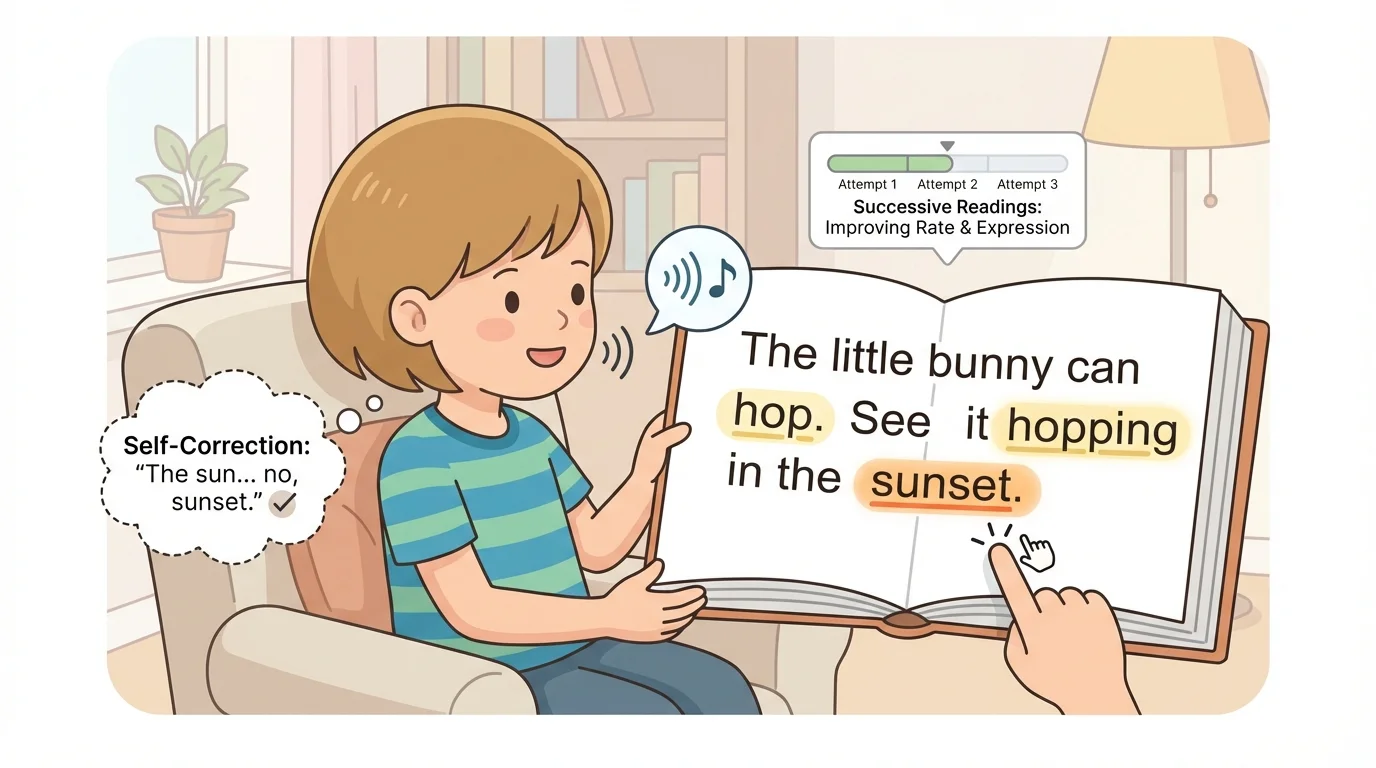
Accuracy matters because even one wrong word can change the meaning. If a story says, "The cat hid," but the reader says, "The cat hit," the meaning changes. Reading the words correctly helps the story or information stay clear.
Example of accurate reading
Step 1: Look at the word playing.
Step 2: Notice the known word play and the ending -ing.
Step 3: Read the whole word smoothly: playing.
Knowing smaller parts helps the reader say the whole word correctly.
When readers practice reading a text again, they often make fewer mistakes because the words become more familiar. That gives them more attention to focus on meaning.
An appropriate rate means reading at a pace that sounds smooth and understandable. If reading is too slow, the meaning can get lost because the words are too far apart. If reading is too fast, the reader may skip words or miss punctuation.
Think about walking with a class. If everyone walks at a steady pace, the group stays together. If someone crawls very slowly or runs too fast, the group gets mixed up. Reading rate works in a similar way. A steady pace helps the words stay connected in your mind.
Here is an example. Listen to these two ways a sentence might sound: "We went to the park." If a reader says each word with a very long stop, it is hard to keep the idea together. If the reader rushes and blurs the words, it is also hard to understand. A smooth middle speed is best.
You already know that spaces separate words and punctuation gives clues. Those print features help readers keep a steady pace while reading aloud.
Appropriate rate supports comprehension. When the words flow together, the reader can hold the meaning of the sentence in mind. That helps with stories, directions, and facts.
Punctuation helps readers know how their voices should sound, as [Figure 3] shows. Expression means your voice matches the meaning of the sentence. Your voice may go up for a question, sound excited for an exclamation, or sound calm at the end of a statement.
Look at these sentences: "I found my hat." "I found my hat?" "I found my hat!" The words are almost the same, but the punctuation changes how the reader sounds. Expression helps listeners understand what the sentence means.
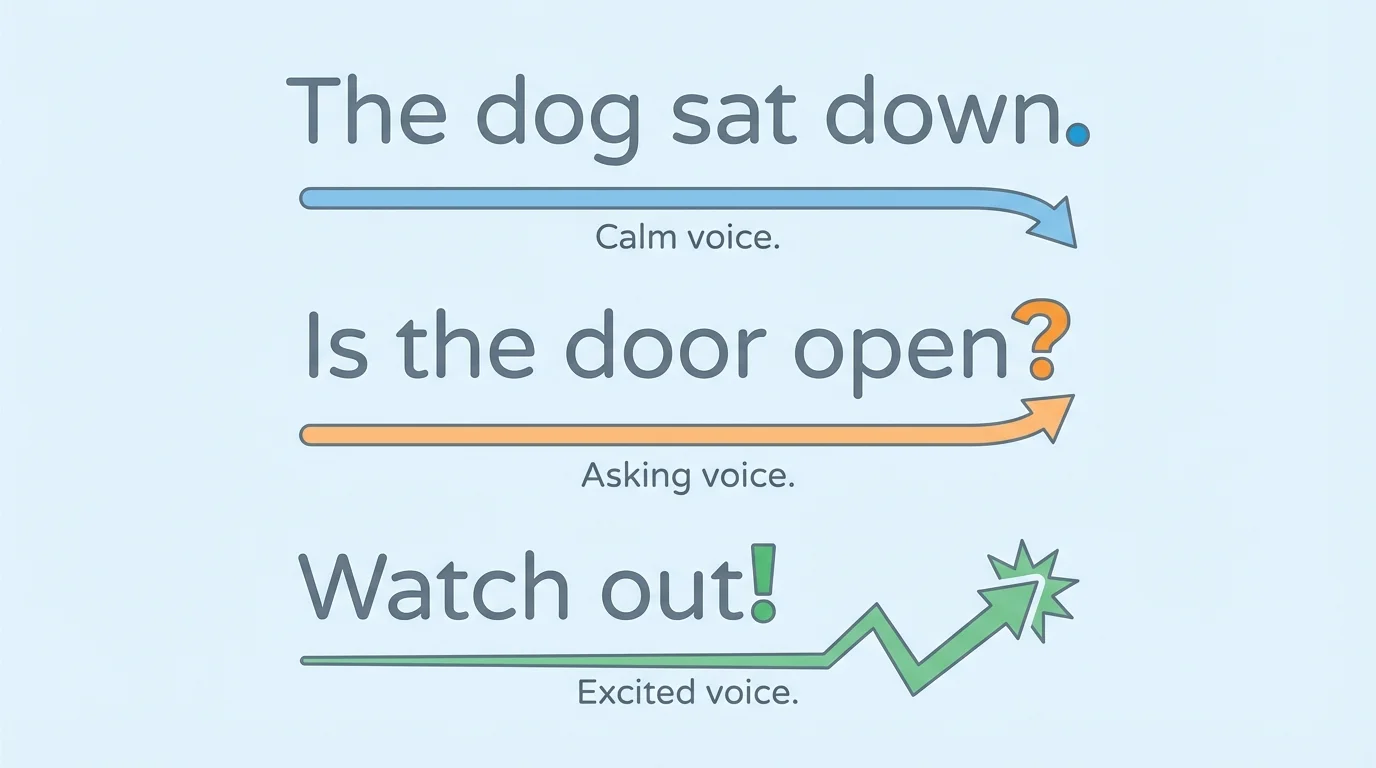
Expression also means noticing the feeling in the text. If a character whispers, the reading voice should sound soft. If a character is surprised, the voice may sound lively. If the story is serious, the voice should match that feeling.
Dialogue is another place where expression matters. When a book says, "Dad called, 'Dinner is ready!'" the reader can make the words sound like someone is calling from another room. This does not mean acting wildly. It means using your voice to show meaning.
Some people call expression "reading with feeling." That is a helpful way to remember that good readers do not sound like robots. Their voices help show what the words mean.
Expression makes reading more enjoyable, but it also supports understanding. When readers notice punctuation and feeling, they pay closer attention to the message of the text.
Sometimes the first time you read a text, your brain works hard just to figure out the words. With successive readings, each rereading helps the reader sound smoother and understand more, as [Figure 4] illustrates. The same text becomes easier because the words and sentences are more familiar.
On a first reading, a child may stop at hard words or sound choppy. On a second reading, there are often fewer stops. On a third reading, the reader may sound much smoother and use better expression. The reader is not guessing. The reader is becoming more fluent.
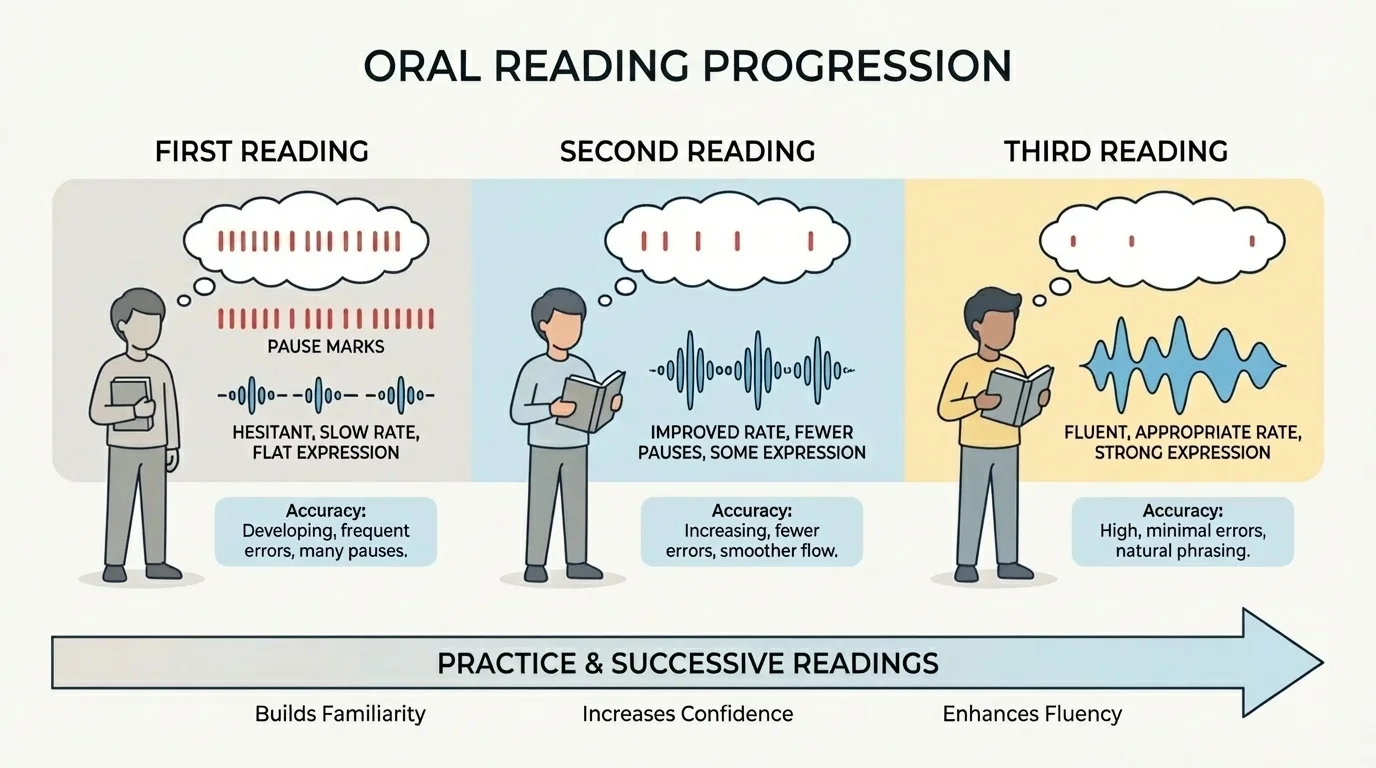
Successive readings help in three important ways. First, they can improve accuracy because the reader sees the same words again. Second, they can improve rate because less time is spent figuring out words. Third, they can improve expression because the reader can focus more on meaning and feeling.
This is one reason teachers often ask students to read a short passage more than once. Repeating a text is not just doing the same thing again. It is a way to strengthen reading fluency.
Why rereading builds fluency
When words become familiar, the brain spends less effort figuring them out. That leaves more attention for smooth reading, punctuation, and meaning. Rereading helps all parts of fluency grow together.
Later, when readers meet new on-level texts, the fluency skills they built through rereading help them read those texts more successfully too.
A fluent reader reads the words correctly, keeps a steady pace, and uses a voice that fits the text. We saw earlier in [Figure 1] that these parts work together. If one part is missing, reading becomes harder to understand.
Suppose a child reads a short story about a lost puppy. If the child reads the word puppy correctly, keeps a smooth pace, and sounds worried when the character is worried, the story makes much more sense. If the same child reads too fast and in a flat voice, the story loses meaning.
We also saw in [Figure 2] that careful readers look closely at letters and word parts. They use what they know about smaller words, endings, and word families. They also fix mistakes when something does not sound right.
Punctuation clues still matter later in the reading process, just as [Figure 3] reminds us. Periods, question marks, commas, and exclamation points help guide the voice. Rereading matters too, because [Figure 4] shows how a text can become smoother on each reading.
Reading aloud well is not about being perfect the first time. It is about reading in a way that helps words make sense. With careful eyes, a steady pace, and a voice that matches the text, readers can understand more and help others understand too.
