Have you ever noticed that a great conversation is a little like a game of catch? One person tosses out an idea, another person catches it and tosses back a new idea. When children do this well, their talk grows bigger, smarter, and more interesting. That is called building on others' talk.
When you have a conversation with someone, you do not just say your own idea and stop. You listen to what the other person says, and then you respond in a way that fits. Building on talk means your words connect to the other speaker's words.
Build on others' talk means listening to what someone says and then answering in a connected way. You might add a new idea, ask a question, agree, or explain your thinking.
Respond means to answer what someone else said.
If a classmate says, "I like rainy days because I can splash in puddles," you can build on that idea by saying, "I like rainy days too, and I wear my boots," or "What is your favorite game to play in puddles?" These answers match the first speaker's idea. They help the talk continue.
A response that does not match the topic can stop the conversation. If someone says, "I saw a butterfly," and the answer is "My shoes are blue," the talk does not connect. Good conversations stay on the same topic.
To build on another person's idea, you need strong listening skills, as [Figure 1] shows with a speaker and a careful listener. Listening is more than hearing sounds. It means paying attention with your ears, eyes, brain, and body.
You can listen with your whole body by looking at the speaker, keeping your body calm, waiting for your turn, and thinking about what the speaker means. You can also notice nonverbal language, such as a smile, a nod, or a confused face. These clues help you understand the message.
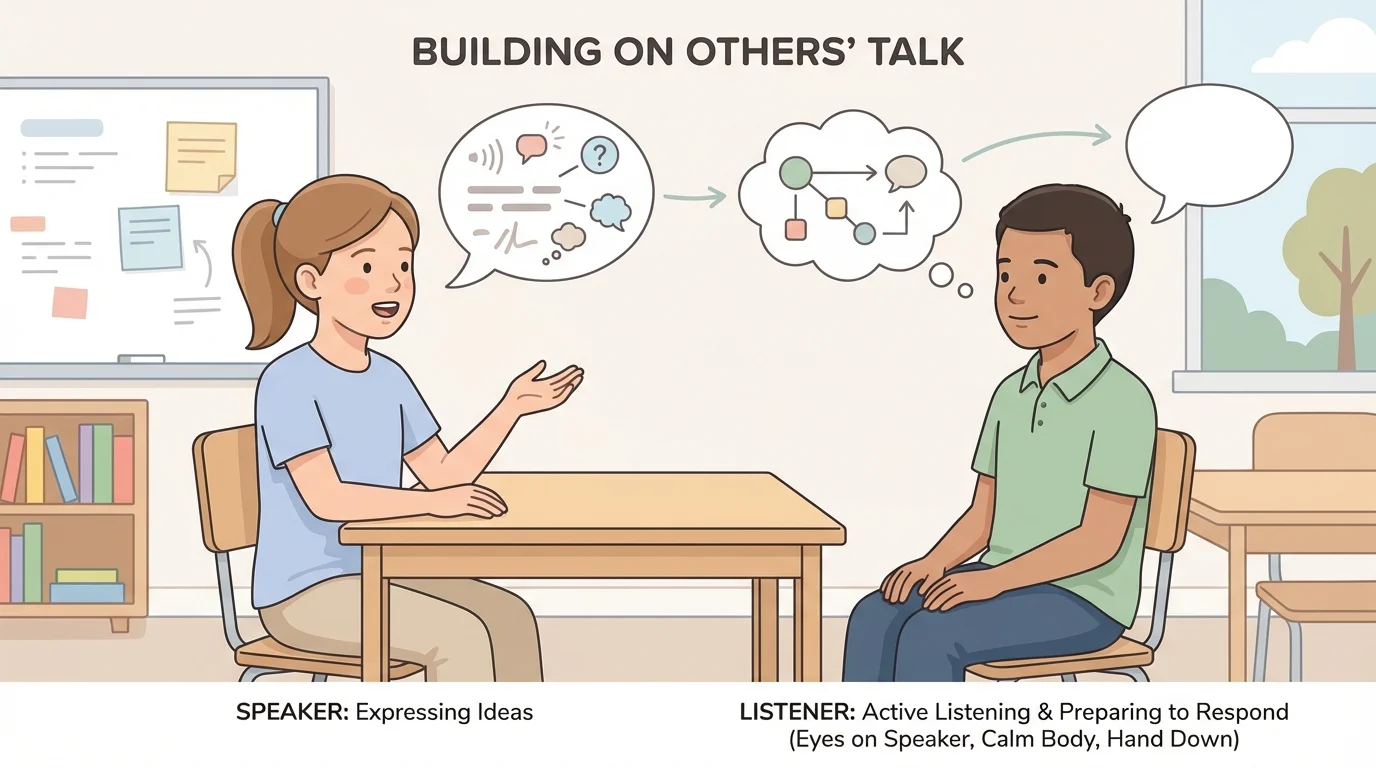
Sometimes a person uses words that are soft, excited, happy, or worried. A listener pays attention to these clues too. If a friend says, "I lost my pencil," with a sad face, a caring response might be, "I can help you look for it."
Good listeners often become good speakers too, because they learn how ideas fit together in a conversation.
Listening also means not interrupting. When you interrupt, the other person may feel unheard. Waiting shows respect. It also gives you time to think of a better answer.
There are many ways to respond when someone else talks, and [Figure 2] introduces several helpful kinds of answers. You can agree, add on, ask a question, make a connection, or politely say something different.
Agree and add on: "I like apples too, and I like apple juice." This tells the speaker you heard the idea and added more.
Ask a question: "You built a tall tower. How did you keep it from falling?" Questions help you learn more and keep the talk moving.
Make a connection: "You saw a bird at the park. I saw one in my yard." A connection links the speaker's idea to something you know.
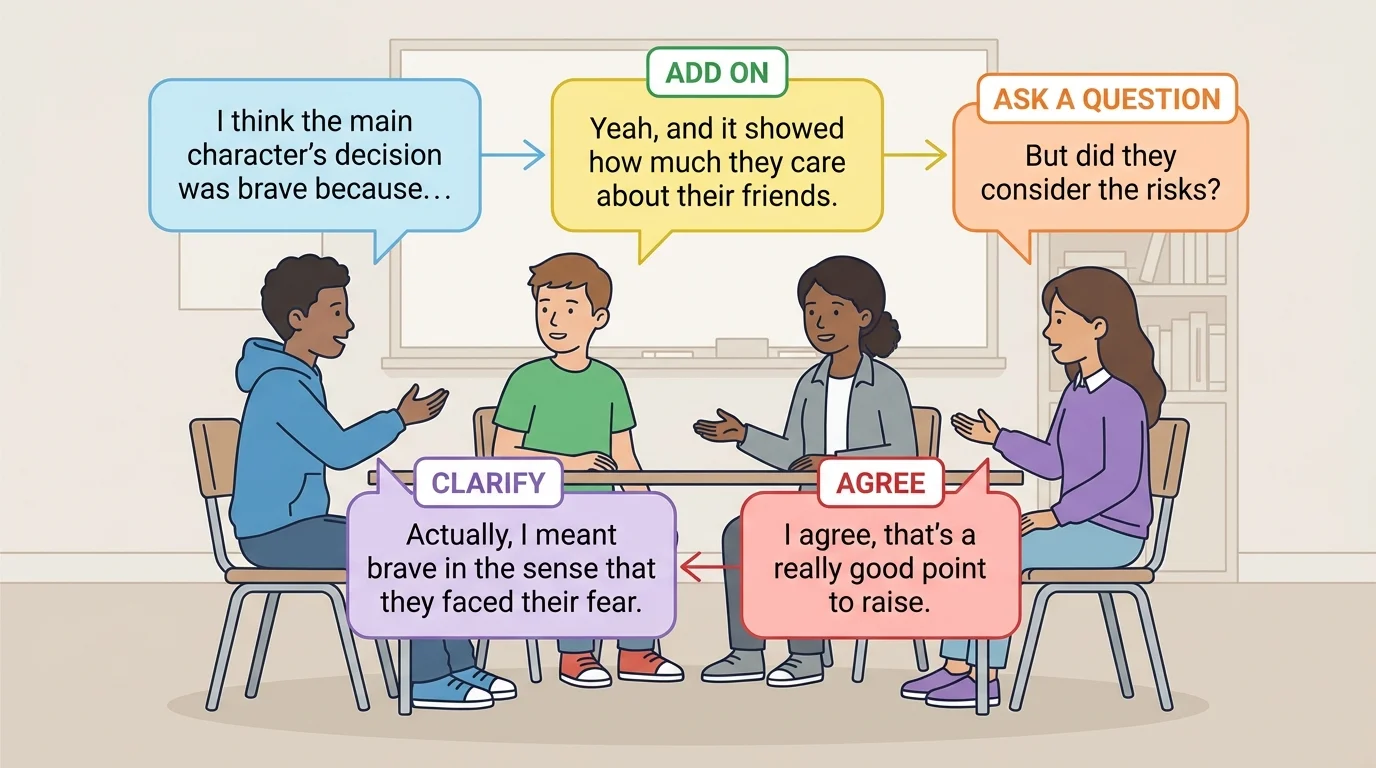
Clarify: If you are not sure what someone means, you can say, "Can you say that again?" or "Do you mean the red ball?" Clarifying helps everyone understand.
Politely disagree: Sometimes people think differently. You can say, "I think something else," or "My idea is different because..." Kind disagreement is part of learning together.
Connected responses make conversations stronger. A strong response matches the topic, shows that you listened, and gives the other person something to answer. This is how talking turns into shared thinking.
As we saw in [Figure 2], different kinds of responses all do the same important job: they connect your turn to the turn before it.
A strong exchange does not end after one quick answer. In a real conversation, one person speaks, another responds, and then the talking keeps going. [Figure 3] shows how one small idea can grow through several turns.
Look at this talk: "I planted seeds." "What kind of seeds?" "Sunflower seeds." "I planted beans once." "Did they grow tall?" This is a multiple exchange. Each speaker listens and answers the idea that came before.
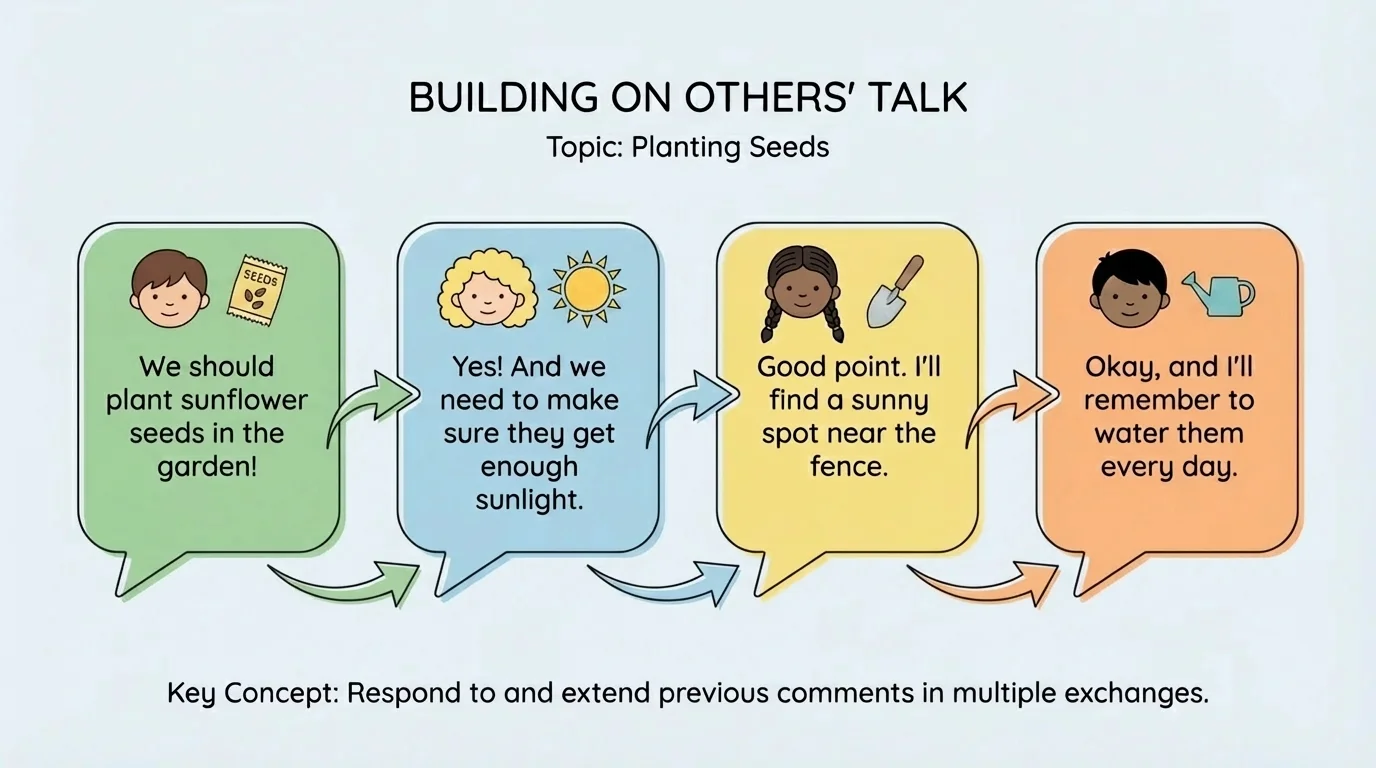
Multiple exchanges help children learn more. They also help groups solve problems, share stories, and understand books. When everyone takes turns and stays on topic, the conversation becomes richer.
Conversation example
Here is a conversation that builds through several exchanges.
Step 1: First speaker starts the topic.
"My favorite animal is a turtle."
Step 2: Second speaker responds with a connected idea.
"I like turtles too because they have shells."
Step 3: First speaker adds more information.
"Yes, and some turtles live in water."
Step 4: Second speaker asks a question to keep the talk going.
"Have you ever seen one at a zoo?"
This conversation keeps growing because each turn matches the one before it.
Later, when students work in groups, the same idea matters. As shown in [Figure 3], each turn links to the previous one, so the group can keep thinking together instead of starting over each time.
Some helpful sentence starters can make responding easier. You might say, "I agree because...," "I want to add...," "What do you mean by...?" or "That reminds me of...." These little sentence frames help children join the conversation more easily.
Body language matters too. A nod can show you are following along. Looking at the speaker shows attention. A calm face and quiet body help everyone focus. These actions support the words you say.
| Helpful move | What it sounds or looks like |
|---|---|
| Add on | "I also think..." |
| Ask a question | "Can you tell me more?" |
| Make a connection | "That reminds me of..." |
| Clarify | "Do you mean...?" |
| Show listening | Eyes on speaker, body still, no interrupting |
Table 1. Helpful words and actions that support collaborative conversations.
Using kind words is especially important when talking with many different people. Some classmates may have different ideas, experiences, or ways of speaking. Respectful talk helps everyone feel safe to share.
You can build on talk with a partner, in a small group, or in a large class discussion. With one partner, each person may get many turns. In a small group, you listen to several classmates. In a large group, you may need to wait longer for your turn and listen carefully to many ideas.
Remember that taking turns is part of every good conversation. One person speaks at a time, and the next speaker connects to that idea.
You can also talk with adults, such as teachers or family members. When an adult asks, "Why do you think the character felt sad?" a strong answer might be, "I think she felt sad because her friend moved away." An even stronger answer builds on the talk: "I think she felt sad because her friend moved away, and I know that can feel lonely."
Building on talk helps during read-alouds, science talks, partner sharing, and problem solving. It is a skill used all day long in school.
Sometimes conversations become hard. A person may interrupt, forget the topic, or feel unsure. When that happens, you can gently get back on track.
If someone changes the topic too fast, you can say, "We were talking about the story." If you do not understand, you can ask for help. If two people speak at once, one person can stop and say, "You go first." These small choices help the group work together.
"Good talk means good listening, kind words, and ideas that connect."
When children build on one another's ideas, conversations become more thoughtful. They learn from friends, teachers, and texts. They also show respect, curiosity, and care.
