Have you ever curled up in a blanket corner and thought, "This place feels just right"? One word can help name that feeling: cozy. Words are powerful because they help us notice the world around us. They help us talk about a soft pillow, a bright window, a noisy lunchroom, or a quiet bedroom. When we connect words to real life, we understand them better and use them better, too.
An adjective tells more about a person, place, thing, or feeling. Adjectives help us paint a picture in our minds. When we hear "warm soup," "muddy boots," or "shiny bike," we can almost see or feel them.
Words are not just in books. They are in kitchens, classrooms, playgrounds, cars, parks, and bedrooms. If someone says a room is cozy, they may mean it feels warm, soft, safe, and comfortable. If someone says a room is bright, they may mean it has lots of light. Real-life connections help us understand what a word means.
Real-life connection means linking a word to something you know from everyday life. Meaning is what a word tells us about a thing, place, action, or feeling. Figurative language is language that paints a picture in our minds and does not always mean exactly what the words say.
When children learn a new word, it helps to ask, "Where have I seen this? Where have I felt this? Where have I heard this?" That is how words become easier to remember.
[Figure 1] Some words are easy to understand when we connect them to places we know with everyday spaces at home. A reading corner with pillows and a blanket may feel cozy. A kitchen with sunshine coming through the window may look bright. A bedroom at night may be quiet. A blender or vacuum may sound loud.
These words help us notice different parts of life. Cozy is not just about what we see. It can also be about how a place feels inside us. Loud is something we hear. Bright is something we see. Quiet is often what we hear when there is very little sound.
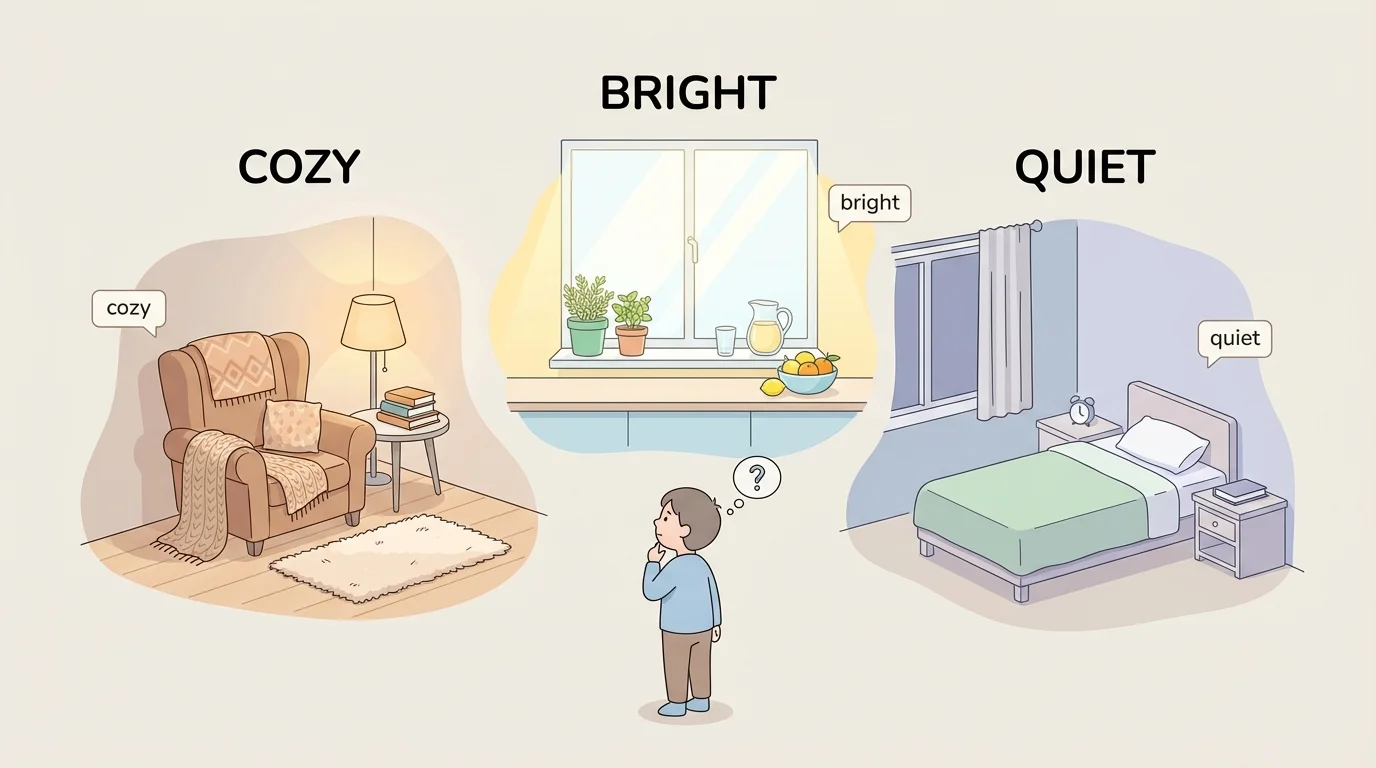
A word can fit one place but not another. A flashlight can be bright, but it is not usually cozy. A blanket can be cozy, but it is not loud. Choosing words carefully helps us speak clearly.
Real-life word matches
Step 1: Think about the place.
A couch with pillows and a soft blanket is a place many children rest.
Step 2: Think about the feeling or sense.
It feels warm, soft, and safe.
Step 3: Choose a word that matches.
Cozy is a strong match for that place.
Connecting the word to a real place helps the meaning stay in your mind.
We can use the same thinking at school. A bell may be loud. A library may be quiet. A classroom window may be bright. A beanbag corner may be cozy.
Some words connect to feelings as well as places. A hug can feel warm. A smile can look bright. A rainy afternoon may feel gloomy. A game with friends can feel cheerful. These words help us talk about emotions and moods.
This is important because words do more than label objects. They help us explain experiences. If a student says, "My room feels cozy," that student is sharing more than what the room looks like. The student is telling how the room feels to be in.
Some words can describe both things and feelings. For example, warm can describe soup, but it can also describe a kind person.
That is why readers and listeners pay attention to context. Context means the other words and ideas around a word. Context helps us know whether "warm" means hot to the touch or kind and friendly.
[Figure 2] Some words are close in meaning, but they are not exactly the same. This small difference is called a nuance. For young readers, it is helpful to know that two words may be alike, but one may fit better.
For example, small and tiny both mean not big. But tiny means even smaller than small. A toy car may be small. An ant is tiny. Loud and noisy are also close. A drum can be loud. A messy cafeteria with many sounds at once can be noisy. Noisy often means lots of sound all mixed together.
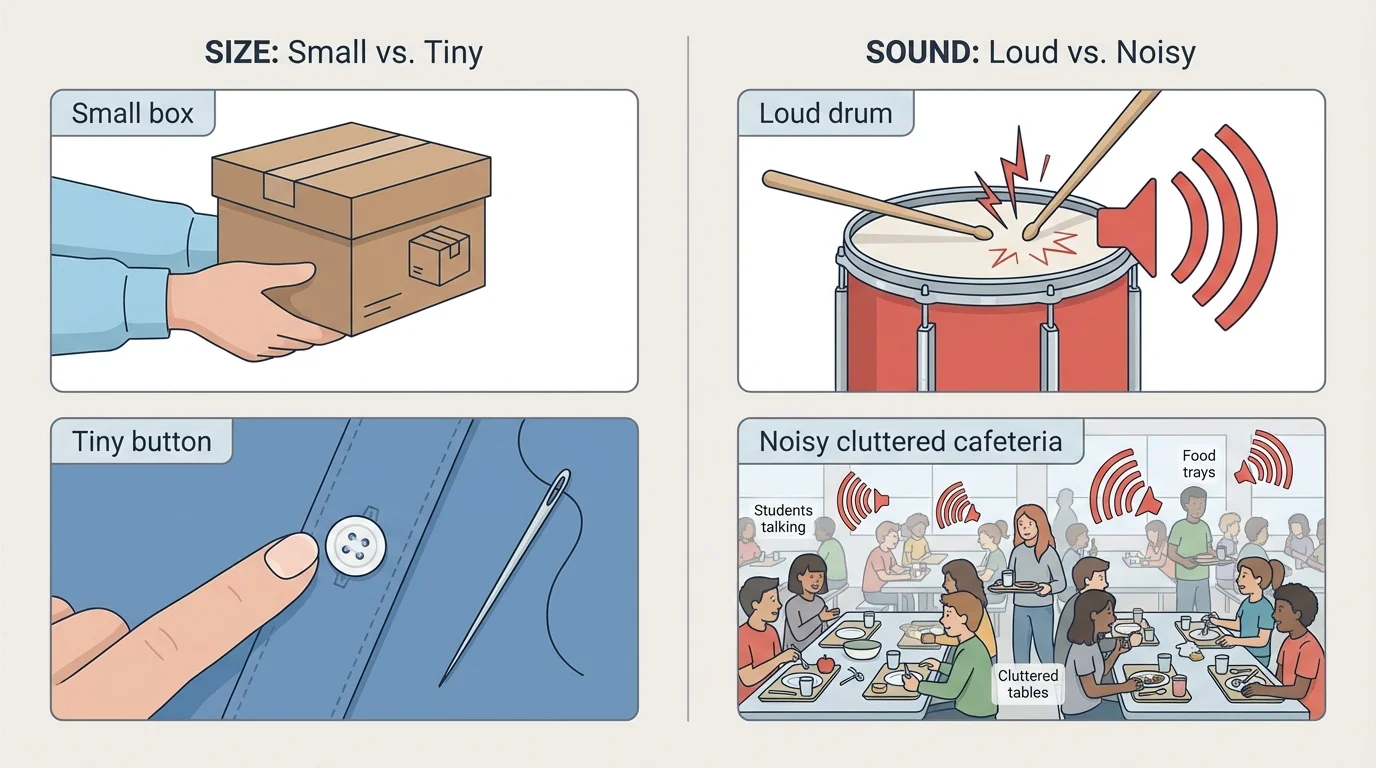
Another pair is soft and cozy. A teddy bear can be soft. A bed with blankets can be cozy. Something cozy may be soft, but it also feels comfortable and safe. Looking closely at words helps us become stronger readers and writers.
| Word | Close Word | How They Differ |
|---|---|---|
| small | tiny | Tiny means even smaller. |
| loud | noisy | Noisy often means many sounds together. |
| soft | cozy | Cozy means comfortable, warm, and safe too. |
| happy | cheerful | Cheerful can sound brighter and more lively. |
Table 1. Examples of words with similar meanings and the small differences between them.
Later, when we hear a story character say a cabin is cozy, we know that means more than just soft. As we saw earlier in [Figure 1], a place can feel cozy because it seems warm and welcoming.
We learn words better when we connect them to places we know. At home, a rug may feel rough or soft. In the yard, grass may feel wet after rain. In the kitchen, cookies may smell sweet. On the playground, a whistle may sound sharp. These real examples make word meanings stronger.
A reader who knows real-life meanings understands books more easily. If a story says, "The cabin was cozy," the reader can think of a warm corner, a blanket, or a soft chair. If a story says, "The street was noisy," the reader can think of many sounds at once.
Words connect reading to life
When you connect a word to a real object, place, sound, or feeling, you build understanding. Then, when the word appears in a book, your brain already has a picture ready.
This is one reason adults help children talk about words during daily life. Reading grows stronger when word meanings are tied to the real world.
[Figure 3] Sometimes people use a simile or another kind of figurative language to make speech more colorful with familiar sayings. A simile compares two things using words like like or as. When someone says, "busy as a bee," they do not mean a child is truly a bee. They mean the child is moving and working a lot.
Another example is "cold as ice." That phrase does not mean the drink is literally ice. It means the drink is very cold. Figurative language helps us make strong pictures in our minds. It makes speaking and reading more interesting.
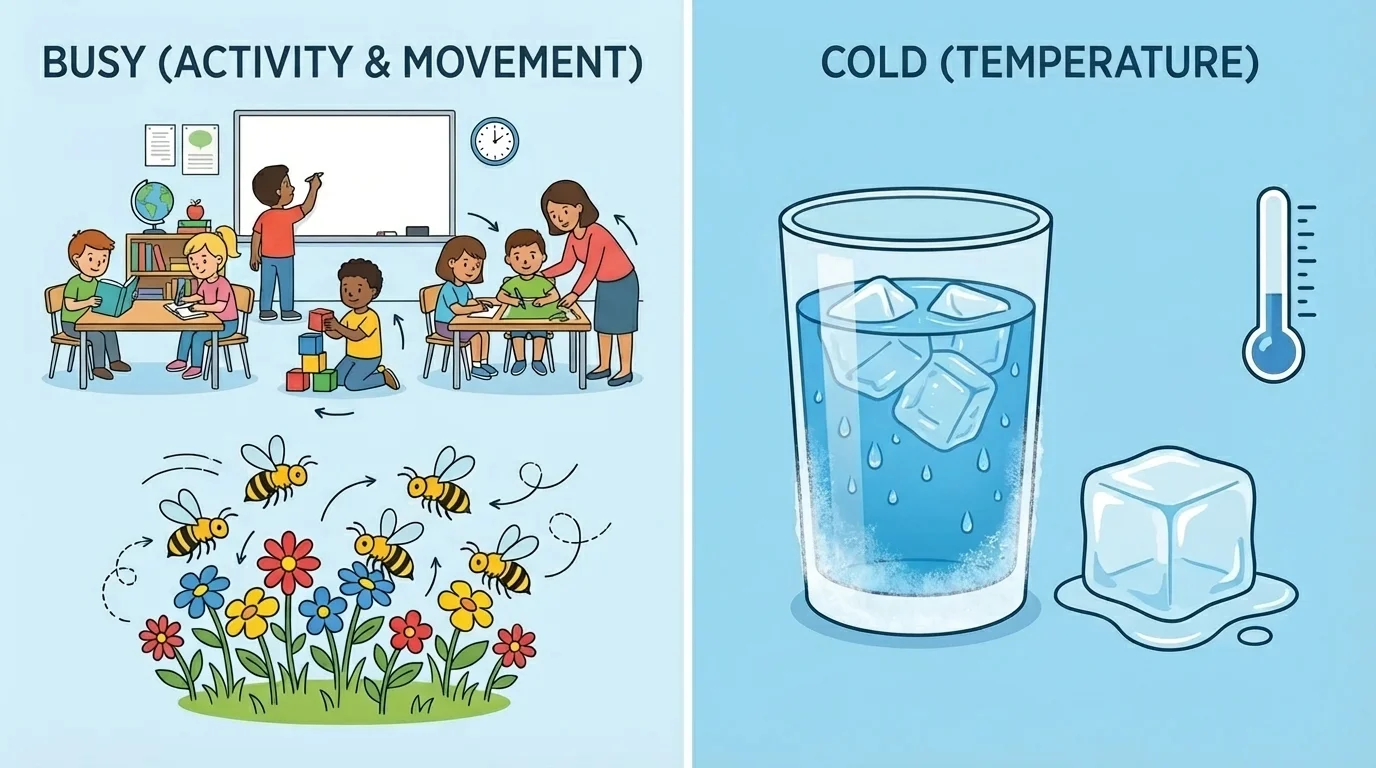
Young readers should learn that figurative language is not always literal. Literal meaning is the exact meaning of words. If someone says, "The pillow is soft," that is literal. If someone says, "She is as quiet as a mouse," that is figurative. The person is not a mouse. The phrase means she is very quiet.
When listening to a story or conversation, ask, "Do the words mean exactly what they say, or are they painting a picture?" That question helps children understand figurative language.
Good readers and speakers choose words carefully. More than one word may work, but one word may work better. A lamp can be bright, but a smile can also seem bright in a different way. A room can be quiet, but a child can also have a quiet voice.
Choosing the best word depends on what is happening. A drum is loud, but a room full of talking, scraping chairs, and clattering trays is noisy. A sweater may be soft, but a favorite corner with a blanket and a book is cozy. The more we notice these differences, the stronger our language becomes.
Words can tell about what we see, hear, feel, smell, and think. Using our senses helps us understand word meaning.
That is also why close attention matters in reading. If a book says a forest was quiet, we picture calm, little sound, and maybe a gentle breeze. If a book says the forest was noisy, we picture many sounds all around. As we saw in [Figure 2], small word changes can make a big difference in meaning.
Figurative language works the same way. "Busy as a bee" paints a picture quickly. The phrase helps us understand action and movement, just as [Figure 3] shows through a simple comparison.
