Have you ever said a word while reading and then suddenly thought, "Wait... that does not sound right"? That is something strong readers do all the time. They do not just keep going. They stop, think, and fix it. That is how readers grow stronger every day.
Sometimes a word looks a little like another word. A reader might see house but say horse. Or a reader might see can but say car. That can happen, especially when we are reading quickly. Good readers know that mistakes are okay. What matters is noticing the mistake and fixing it.
When readers fix their own reading, that is called self-correcting. A reader self-corrects by going back, looking carefully, and trying again.
Context means the words, pictures, and ideas around a word that help a reader understand it. Reread means to read something again. Word recognition means knowing what a written word is when you see it.
Good readers use many clues at the same time. They look at the letters in the word, but they also think about what is happening in the sentence. They listen to how the sentence sounds. They ask whether the sentence makes sense.
Context helps readers figure out or check a word, as [Figure 1] shows. If a sentence says, "The dog can run fast," the word dog makes sense there. If someone said, "The log can run fast," that would not make sense.
The words around a tricky word are clues. Pictures can be clues too. If a page shows a girl eating soup, and the sentence says, "Mia has a hot ___," the picture and the sentence help us think of bowl or lunch, not a word that does not fit.
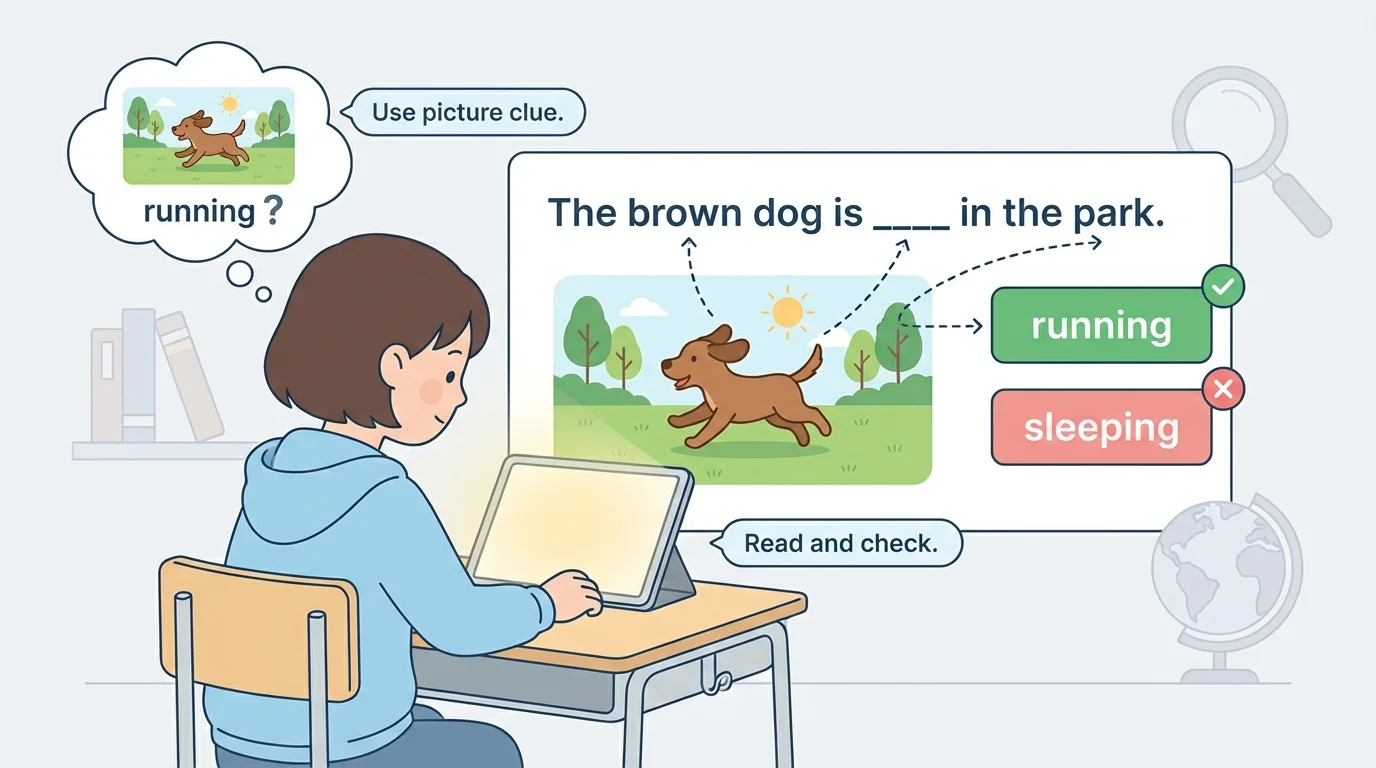
Context does not work by itself. A reader still needs to look at the letters in the word. If the sentence says, "I can hop like a ___," and the reader guesses frog, that makes sense. But if the word starts with b, then frog is not correct. The reader should think again and maybe read bunny.
Strong readers often fix mistakes so quickly that other people do not even notice. Their brains are checking meaning while they read.
This is why reading is like being a word detective. A reader uses letter clues, sound clues, sentence clues, and picture clues together.
Sometimes a sentence sounds strange, and that is a sign to stop and check, as [Figure 2] explains. If the sentence does not sound right or does not make sense, a good reader goes back and tries again.
For example, a child reads, "The cat drank the sun." That sounds silly. The reader can stop and look again. Maybe the word is milk, not sun. When the reader goes back and reads the sentence again, it makes sense: "The cat drank the milk."
Rereading helps in two big ways. First, it helps the reader read the right word. Second, it helps the reader understand the whole sentence better.
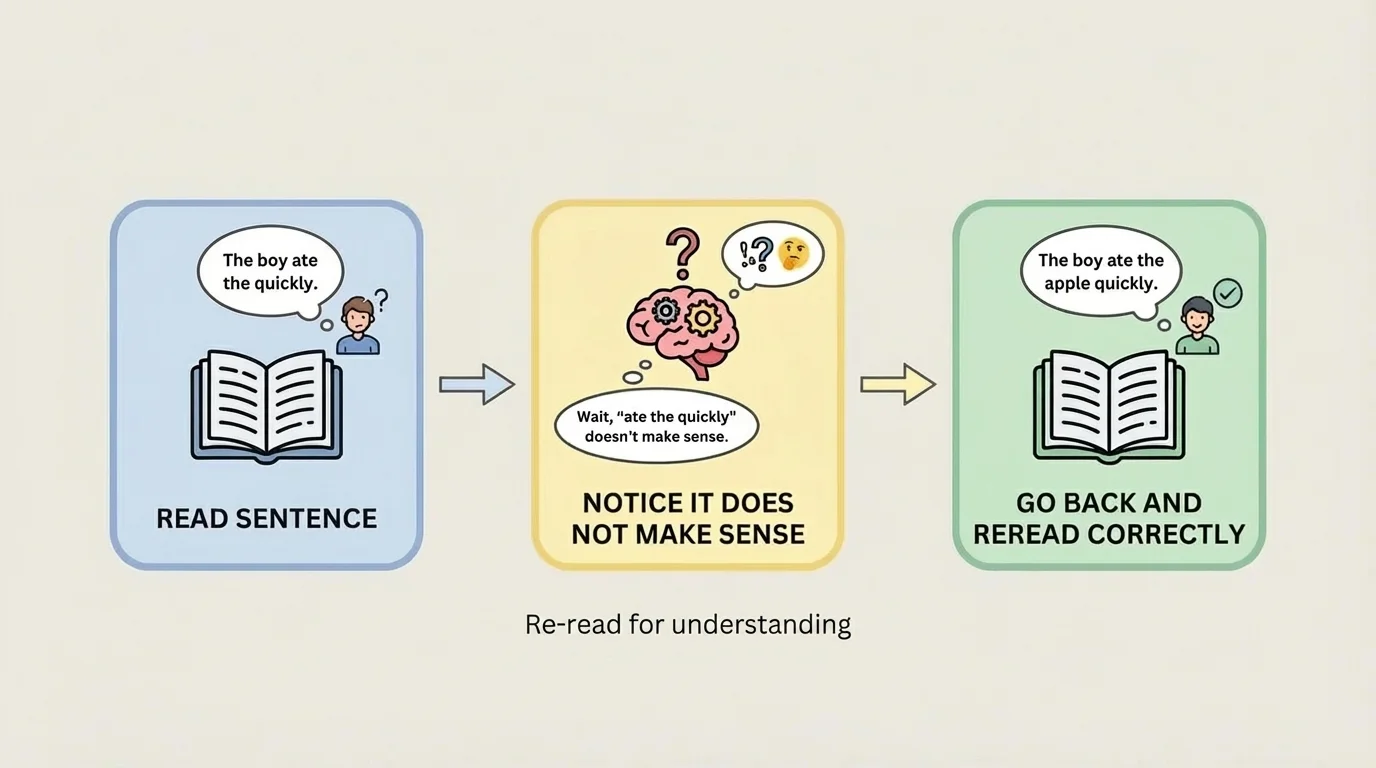
Sometimes only one word needs fixing. Sometimes the whole sentence needs to be read again. Readers do not have to be perfect the first time. They just need to be thoughtful and ready to try again.
Smart readers check their reading with three simple questions, as [Figure 3] shows. Does it look right? Does it sound right? Does it make sense?
If the word in the book is play and the reader says pray, it may sound close, but it does not look right because the letters are different. If the sentence says, "We play at recess," then play also makes sense.
If a reader says, "She goed home," that does not sound right. A reader might know it should be, "She went home." Good readers listen to their own reading.
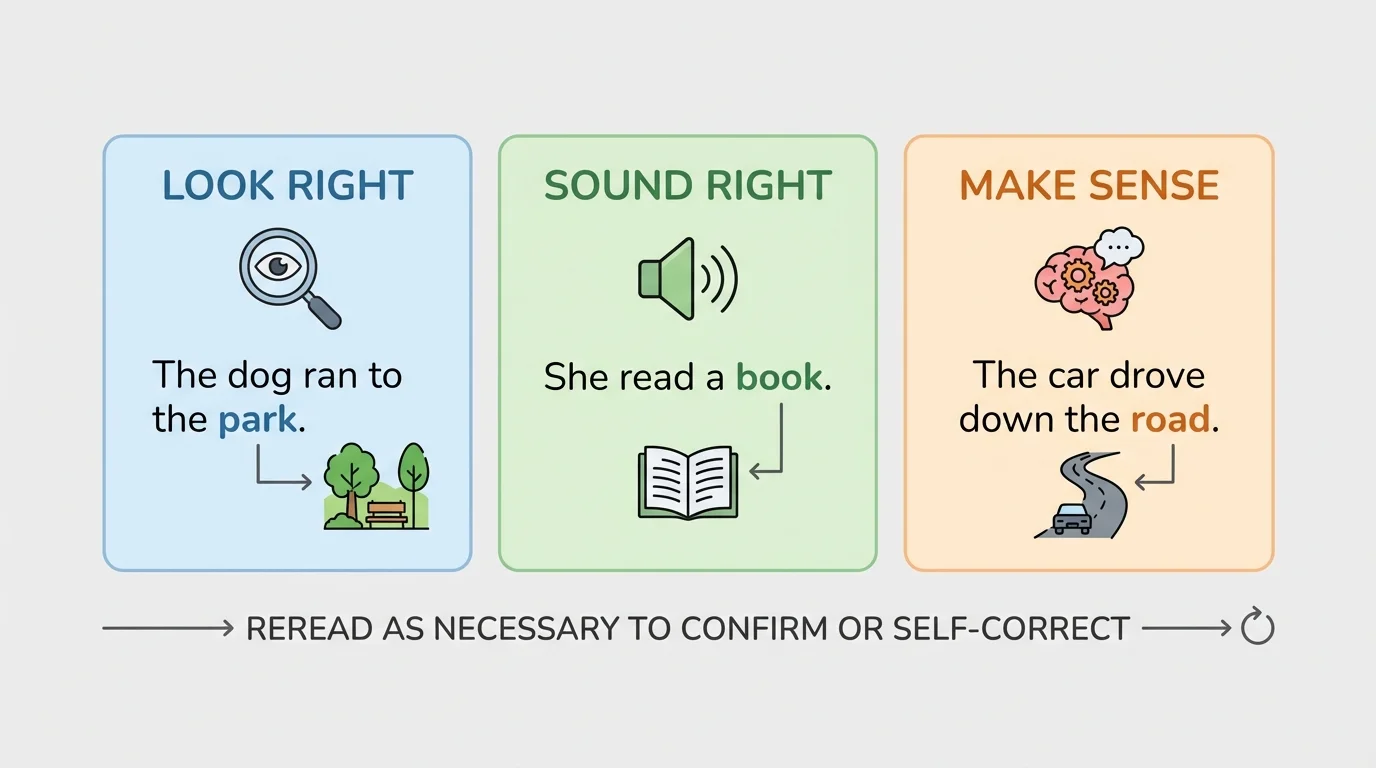
These three questions work together. A word is not confirmed just because it matches one clue. It should match the letters, fit the sentence, and sound right when read aloud.
Checking a word in more than one way helps readers become accurate and fluent. Accurate reading means reading the correct words. Fluent reading means reading smoothly and with understanding. When readers check a word and fix mistakes, they build both skills at the same time.
Later, when we think again about [Figure 3], we can see why these three questions are so powerful. A reader does not need to guess wildly. The reader has a simple plan.
A sentence is like a puzzle. Each word needs to fit. If one word does not fit, the whole sentence can feel wrong. That is why readers should think about the whole sentence, not just one word by itself.
Read this sentence: "Ben wore his coat because it was cold." If someone reads boat instead of coat, the sentence becomes confusing. A boat is not something you wear. The whole sentence helps the reader know that coat is the right word.
Here is another sentence: "The baby is taking a nap." If a reader says map instead of nap, the beginning sound may be close to the letters, but the sentence tells us nap makes more sense.
Example: Checking with the sentence
Sentence: "The fish swims in the pond."
Step 1: A reader says, "The fish swims in the park."
Step 2: The reader asks, "Does that make sense?" Fish do not usually swim in a park.
Step 3: The reader looks again at the word and rereads the sentence.
The correct word is pond, and the sentence now makes sense.
Thinking about the whole sentence helps readers understand stories, facts, and directions. It is not only about saying words. It is about making meaning.
Here are more ways readers can use context and rereading.
Sentence: "The boy kicked the ball." A reader says doll instead of ball. The mistaken word rhymes with the correct word, but kicked the doll does not fit the picture or the action as well. The reader looks again and fixes it.
Sentence: "Mom cut the cake." A reader says cat instead of cake. The word begins the same way, but the end is different. The sentence helps the reader notice the mistake and try again.
Sentence: "We ride the bus to school." A reader says bug instead of bus. The reader hears that the sentence sounds strange and corrects it.
You already know that letters and sounds matter. This lesson adds something important: readers also use sentence meaning to check whether the word is correct.
When readers use both the letters and the meaning, they are stronger than when they use only one clue.
Accuracy means reading the correct words. Fluency means reading smoothly, at a good speed, and with expression. Accuracy comes first. If a reader rushes and reads many wrong words, the story will not make sense.
Rereading can help fluency too. When a reader goes back and reads a sentence again, the sentence often sounds smoother the second time. The meaning becomes clearer.
As we saw earlier in [Figure 1], readers use the picture and nearby words to help confirm a word. Then they can keep reading with more confidence and smoother pacing.
Readers may reread when a word looks hard, when a sentence sounds funny, when the meaning is confusing, or when they notice they skipped a word.
Readers may also reread after finishing a whole page if they realize they do not understand what happened. Going back is a smart reading move. It is not a sign of failure.
As shown earlier in [Figure 2], rereading is a simple process: read, notice, and try again. The more a child practices this habit, the more natural it becomes.
Every time a reader notices a mistake and fixes it, the brain is learning. The reader is paying attention to letters, sounds, and meaning all at once.
That is what strong reading looks like in first grade. A strong reader does not just say words. A strong reader thinks about words. The reader checks whether the words look right, sound right, and make sense.
When a sentence is tricky, stop. Think. Reread. Then read on with confidence.
