Have you ever heard a story and thought, "Wait, what just happened?" That confused feeling is important. It tells your brain that it needs more information. Good learners do not stay quiet when they are confused. They ask questions. Questions help us understand stories, directions, and ideas. Questions also help us work with other people.
Sometimes we understand right away. Sometimes we do not. When something is not clear, we can ask for help. A question is something we say when we want to know more. Asking questions helps us learn new things and fix misunderstandings before they become bigger problems.
Confused means you are not sure or do not understand yet. Clear up means to make something easier to understand. Discussion means people are talking together about one topic.
Questions are useful in many places. You can ask a question when a teacher gives directions, when a classmate shares an idea, or when you hear a new word in a book. Asking shows that you are thinking carefully. It is a smart thing to do.
[Figure 1] You may need to ask a question when you miss an important part in a classroom talk. Maybe the teacher says, "Put your paper in the bin," and you are not sure which bin. Maybe a story says the fox was sneaky, and you do not know what sneaky means. Maybe a friend explains an idea too fast. Those are good times to ask.
You can also ask a question when you want to make sure you heard correctly. A student might say, "We are drawing the bird's home," and you might ask, "Do you mean its nest?" That helps everyone stay on the same topic.
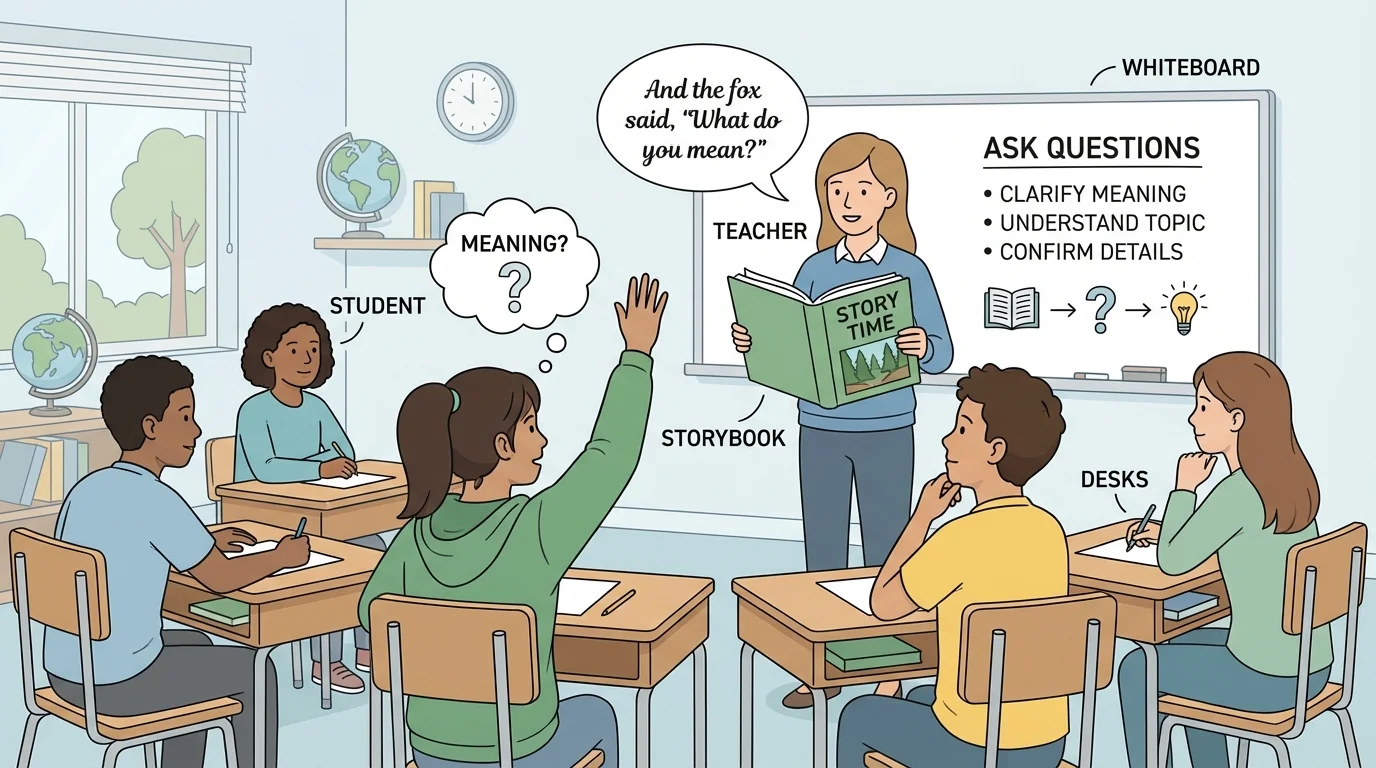
Sometimes confusion feels like this: your face looks puzzled, your brain feels stuck, or you notice that other people seem to know what to do and you do not. That is a clue to stop and ask. You do not need to wait too long. A quick question can help right away.
Examples of when to ask
Step 1: Listen for the part you do not understand.
"I heard the story say the bear hibernates, but I do not know that word."
Step 2: Ask a clear question.
"What does hibernate mean?"
Step 3: Listen to the answer.
Now you can understand the story better.
Questions do not have to be long. Short questions can be very helpful. The important thing is that the question matches the part that is confusing.
Helpful questions are clear, kind, and easy to answer. You can begin with words like who, what, where, when, why, and how. You can also say, "I do not understand," or "Can you say that again?"
Here are some good question starters:
A clear question usually asks about one thing at a time. If you ask too many things together, the listener may not know which part to answer first. One careful question is often best.
Strong readers and strong listeners often ask questions in their minds even when they are quiet. Their brains keep checking, "Does this make sense?"
Polite words matter too. Saying "please" and listening to the answer shows respect. In a classroom, we talk with many people, and kind words help everyone feel safe to share.
[Figure 2] Talking is only one part of communication. We also use nonverbal language. Nonverbal language means messages we show without speaking. Our eyes, face, hands, and body can all show that we are listening.
When someone else is speaking, a quiet body helps. Looking at the speaker, facing the group, keeping hands calm, and waiting for your turn all show attention. A nod can mean, "I am following." A raised hand can mean, "I have a question."
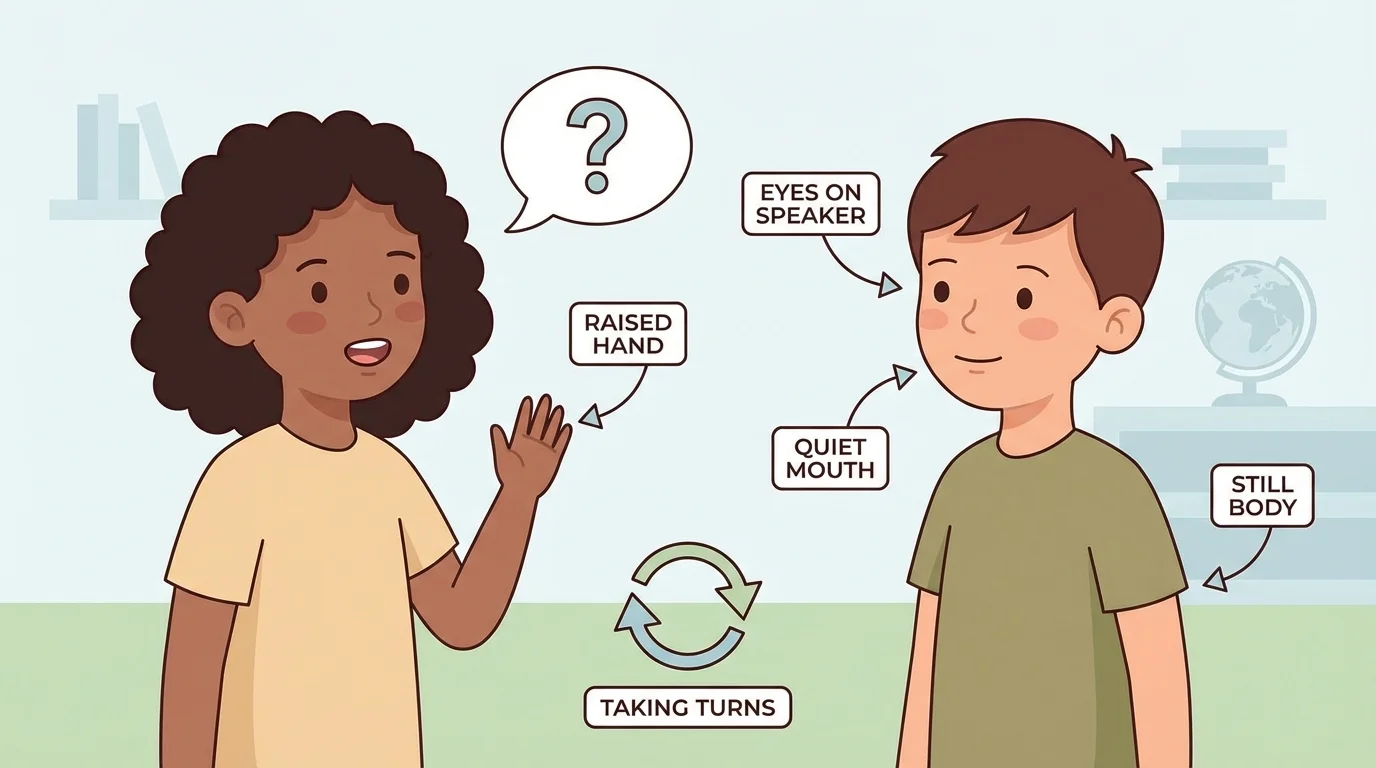
Nonverbal language also helps us notice when someone else is confused. A classmate may tilt their head, look puzzled, or pause before speaking. Then we can help by speaking more clearly or explaining kindly.
Words and body work together
Good communication happens when spoken words and body language match. If you ask, "Can you explain that?" in a calm voice and wait your turn, your listener understands that you want help. If you interrupt or look away, the message is harder to understand.
Later, when you join another discussion, remember the signals from [Figure 2]. A listening face and patient body make it easier for everyone to share ideas and ask questions.
Sometimes the class talks about a text. A text can be a story, a poem, an information book, or words on a chart. When we talk about a text, we ask questions to understand the characters, setting, events, or important facts.
For example, if the class reads a story about a lost puppy, you might ask, "Where did the puppy go?" or "How did the girl feel when she found it?" If the class reads a book about plants, you might ask, "What does a seed need to grow?" These questions help you understand the text better.
You can also ask about words in the text. If a book says a giant turtle moved slowly across the sand, and you do not know the word slowly, you can ask what it means. Knowing word meanings helps the whole text make sense.
Questions for stories and information books
Story question: "Why did the boy hide under the table?"
Word question: "What does gigantic mean?"
Fact question: "How does the caterpillar change into a butterfly?"
When a class discusses a topic like weather, animals, or community helpers, your question should match the topic. Staying on topic helps the group learn together.
In a group, everyone needs a turn. You listen when someone else speaks, and you speak when it is your turn. This is called taking turns. Good conversations are not one person talking all the time. They are shared.
You may talk with a partner, a small group, or the whole class. Each setting can feel a little different. In a partner talk, you may ask a question right away. In a large group, you may raise your hand and wait. In both places, your question should connect to what the group is discussing.
Different people may think different things. One classmate may notice one part of a story, and another classmate may notice another part. Asking questions helps you learn from many people. That is one way we become better listeners and speakers.
"Good questions help us grow our ideas."
Earlier, the classroom scene in [Figure 1] showed a student stopping confusion by asking for help. The same idea works in partner talk, group talk, and read-aloud time. A simple question can move the whole conversation forward.
Sometimes one answer is not enough. That is okay. You can ask again in a new way. You might say, "I still do not understand," or "Can you give me an example?" Asking again does not mean you are failing. It means you are trying to learn.
You can also listen to other people's questions. A classmate may ask the very thing you were wondering. Their question can help you too. Learning is something we do together.
When you ask questions, listen carefully to the answer. Then think: "Is it clear now?" If yes, you are ready to keep going. If not, ask another kind question. That is how learners become stronger every day.
