Have you ever noticed that two words can be almost the same, but one feels a little different? If you look at a puppy, that is not quite the same as if you peek at a puppy from behind a door. Words are powerful because tiny changes in a word can change the whole picture in our minds.
Some words have shades of meaning. That means the words are related, but they are not exactly the same. They have small differences. Good readers and speakers notice those differences.
Think about color. Light blue and dark blue are both blue, but they are not the same shade. Words can work that way too. Happy and excited are both good feelings, but excited often feels stronger. Big and gigantic both mean something is not small, but gigantic means much, much bigger.
Shades of meaning are small differences between words that are close in meaning.
Verb means an action word, like run, jump, or look.
Adjective means a word that describes a noun, like big, tiny, happy, or angry.
When we learn these small differences, we understand stories better. We also speak and write in a clearer way. Instead of using just any word, we can choose the word that fits best.
Many verbs tell about using our eyes, but each one gives a special picture, as [Figure 1] shows. A reader can tell whether a person is calm, curious, sneaky, or upset just by the verb that is chosen.
Verb words like look, peek, glance, stare, glare, and scowl are related, but they do not mean the same thing. Look is the general word. It simply means to use your eyes to see something.
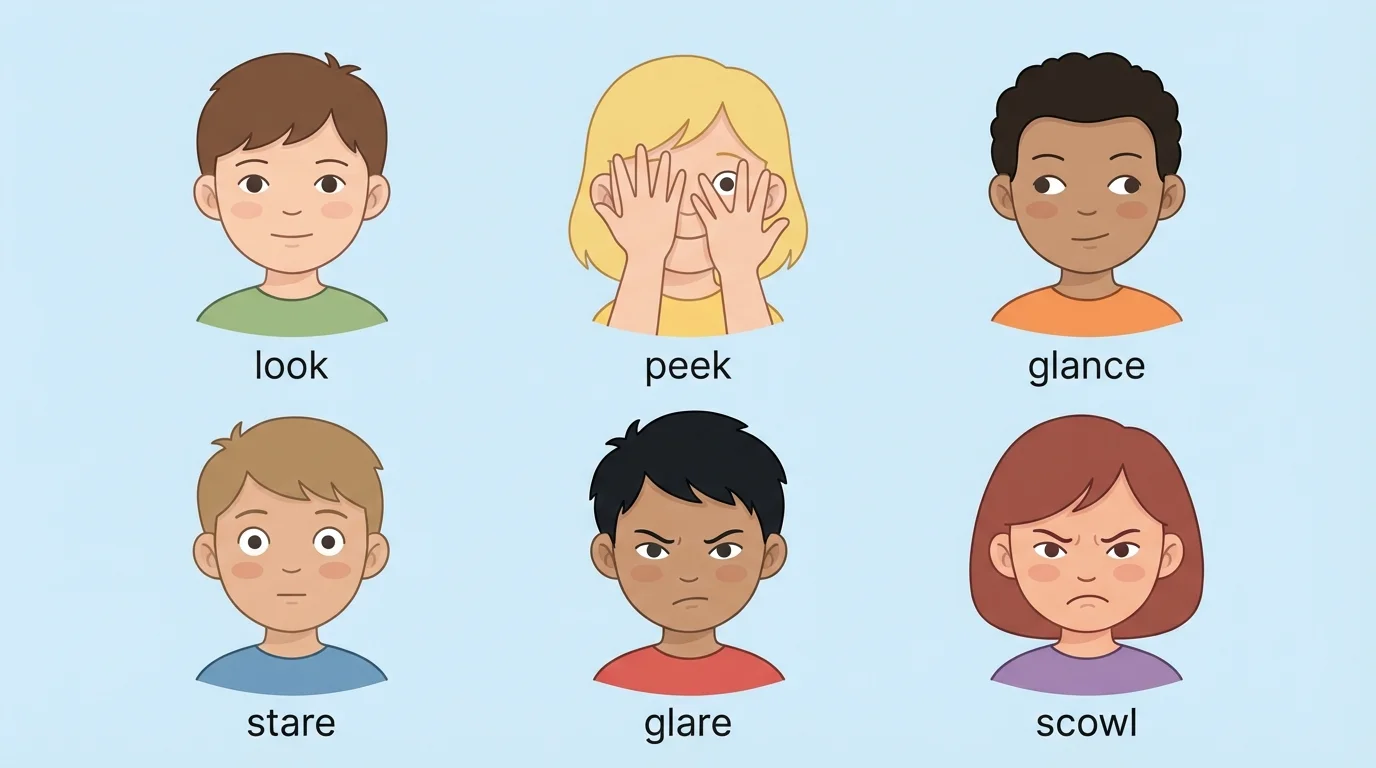
Peek means to look quickly or secretly, often from a partly hidden place. You might peek at a present before your birthday. Glance means to look quickly for just a moment. You might glance at the clock to check the time.
Stare means to look for a long time without looking away. If a child sees a huge rainbow, the child might stare at it. Glare means to stare in an angry way. The eyes look hard and strong. Scowl is a little different because it is mostly about the face. A person scowls by making an angry expression, often with eyes and eyebrows pulled together.
| Word | What it means | Example |
|---|---|---|
| look | use your eyes | I look at the book. |
| peek | look secretly or from hiding | I peek into the bag. |
| glance | look very quickly | I glance at the board. |
| stare | look for a long time | I stare at the stars. |
| glare | look angrily | The boy glares when he is upset. |
| scowl | make an angry face | The girl scowls after losing a turn. |
Table 1. A comparison of verbs that are close in meaning but show different ways of looking or showing anger.
Notice that glare and scowl both can show anger. But they are still not the same. A glare is more about the eyes. A scowl is more about the whole face. As we saw in [Figure 1], face clues help us tell these words apart.
Why the exact verb matters
If a story says, "Mia glanced at the door," we think Mia looked quickly. If the story says, "Mia stared at the door," we think she looked for longer and maybe felt worried or surprised. One changed word can change the whole scene.
Authors choose these verbs on purpose. They do not just tell what someone did. They also tell how the person did it.
Sometimes we can understand a word better by thinking about what the body does. If someone peeks, the body may hide a little. If someone glances, the head may turn quickly and then turn back. If someone stares, the eyes stay fixed on one thing.
Expression clues matter too. A glare often comes with tight eyes. A scowl often comes with a frown. These clues help us connect words to feelings and actions.
Your face can send a message even when you do not say a word. Writers use special verbs so readers can picture that message in their minds.
When you hear one of these verbs in a read-aloud story, listen for the feeling. Is the character curious? Sneaky? In a hurry? Angry? The verb helps answer that question.
Adjectives can also have small differences in strength, and [Figure 2] helps show how one describing word can be stronger than another. Some adjectives tell how much of something there is.
A adjective like big tells size. But large can mean about the same thing, and gigantic means much bigger. These are shades of meaning because they all relate to size, but they show different amounts.
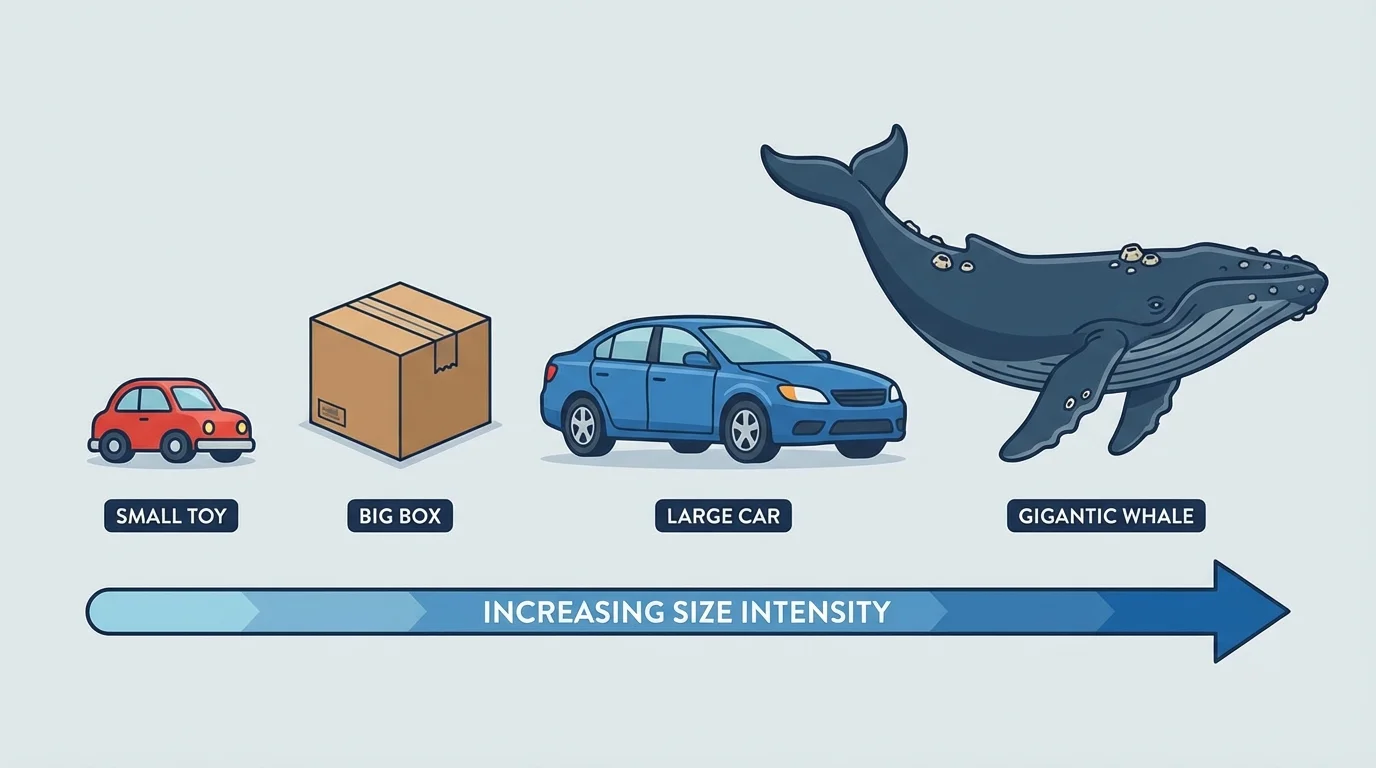
Here are some adjective groups: small, little, tiny; big, large, gigantic; mad, angry, furious. In each group, one word may feel stronger than another. Tiny is smaller than small. Gigantic is bigger than big. Furious is stronger than mad.
These words help us paint a picture. A big dog and a gigantic dog are very different in our minds. A child who feels mad may be annoyed, but a child who feels furious sounds much more upset.
| Adjective group | Less strong | Stronger |
|---|---|---|
| size | big | gigantic |
| size | small | tiny |
| feeling | mad | furious |
| sound | loud | deafening |
Table 2. Examples of adjectives that differ in intensity, from less strong meaning to stronger meaning.
When we look again at [Figure 2], we can see that the words are like steps on a ladder. Each step changes the picture a little more.
Choosing a stronger adjective
Read this idea: "We saw a big animal at the zoo."
Step 1: Think about the animal.
If the animal is an elephant, big works.
Step 2: Ask if a stronger word fits better.
If the animal is a whale in a book or picture, gigantic may fit better.
Step 3: Choose the clearest word.
"We saw a gigantic animal" gives a stronger picture than "We saw a big animal."
Good word choice helps listeners and readers make a sharper picture in their minds.
When we choose between close words, we can ask simple questions. Was the look quick or long? Secret or open? Calm or angry? Was the object just big, or was it gigantic? Was the feeling a little angry, or very angry?
Context means the other words and ideas around a word. Context helps us choose. If a sentence says, "Lena hid behind the curtain and looked at the stage," the best word might be peeked. If it says, "Lena looked at the stage for one second and sat down," the best word might be glanced.
Remember that readers use clues from pictures, sentences, and feelings in the story. Word meaning is not alone. Other clues help us understand the best choice.
A precise word is a word that fits exactly. Precise words make speaking and writing stronger. Instead of saying "The man looked at me," a writer might say "The man glared at me," if the man seemed angry.
When your teacher reads a story aloud, listen for words that are close in meaning. Ask yourself what extra idea the word gives. Does it show speed? Feeling? Size? Strength? This is one way to grow as a reader.
You can also notice these words in real life. A friend may glance at the door when the bell rings. A child may scowl after dropping an ice cream cone. A huge parade balloon is not just big. It may feel gigantic.
The more words you know, the more clearly you can understand others and share your own ideas. Tiny word changes can create big changes in meaning, and that is what makes language so interesting.
