Your brain is a great sorter. When you hear the words red, blue, and yellow, you probably think, "Those are colors!" When you hear shirt, socks, and coat, you may think, "Those are things to wear!" Sorting words helps readers notice how words are connected. When we group words that belong together, we understand them better.
A category is a group of things that are alike in some way. Words in the same category belong together because they share something important. As [Figure 1] shows, words can be sorted into groups when they have the same kind of meaning.
For example, red, green, and purple all belong in the category colors. Hat, dress, and boots all belong in the category clothing. The words are different, but each group has something in common.
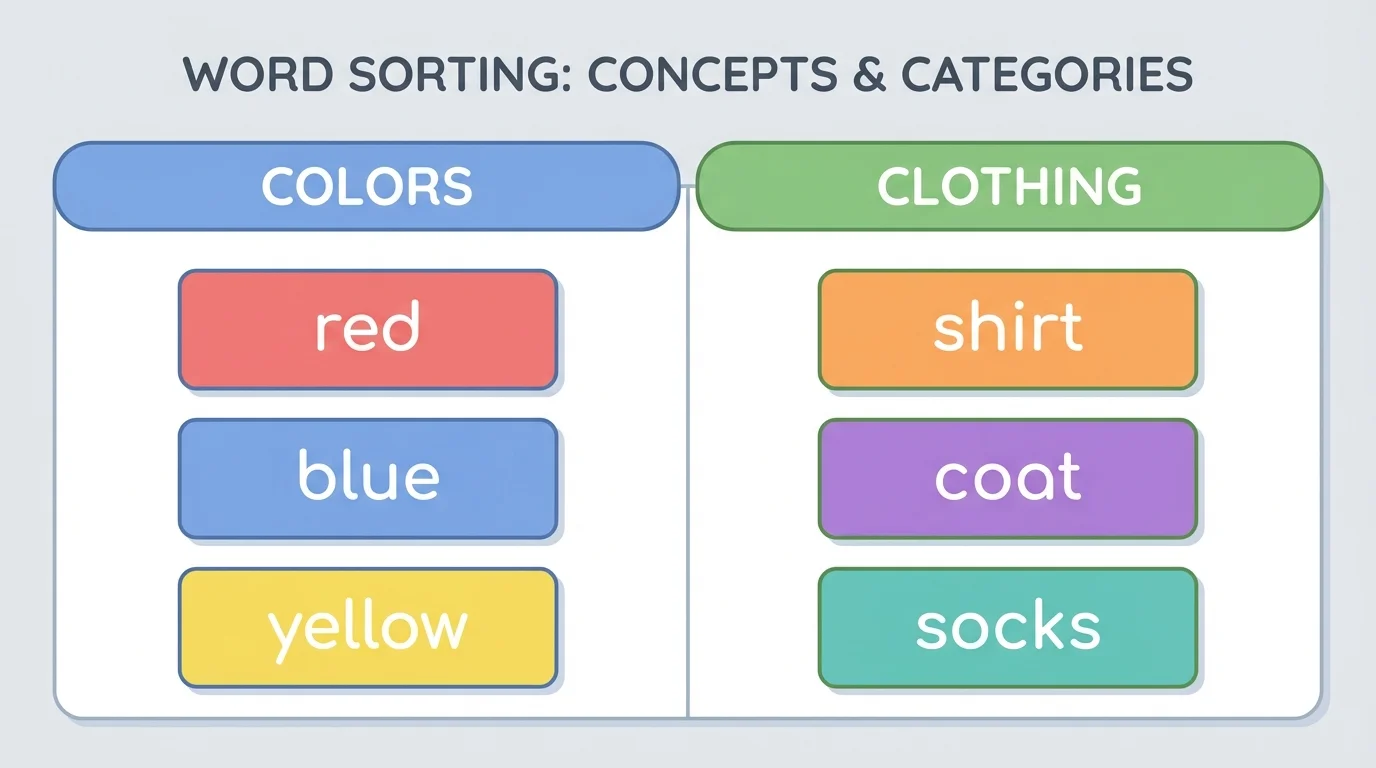
Category means a group of words or things that belong together because they share a common idea.
Sort means to put words or things into groups.
When readers sort words, they look for the shared idea. They ask, "What do these words have in common?" That question helps them understand the meanings of words, even if some words are new.
Sometimes a word suggests its category right away. A banana is a food. Mittens are clothing. A robin is an animal. Other times, readers need to think a little more carefully and use clues.
If you see the words spoon, fork, and plate, you might notice they are all things used at a table. If you see hop, run, and skip, you can tell they are action words. The clue is in what the word means.
Words can be connected by meaning.
Readers do more than sound out words. They also think about what words mean and how they are related. Sorting by meaning helps readers make sense of groups of words in stories, poems, and informational books.
Sometimes the category name is easy to say. Apple, orange, and grape belong in fruits. Dog, cat, and rabbit belong in animals. Sometimes the category name is a little broader, like things at school for pencil, book, and backpack.
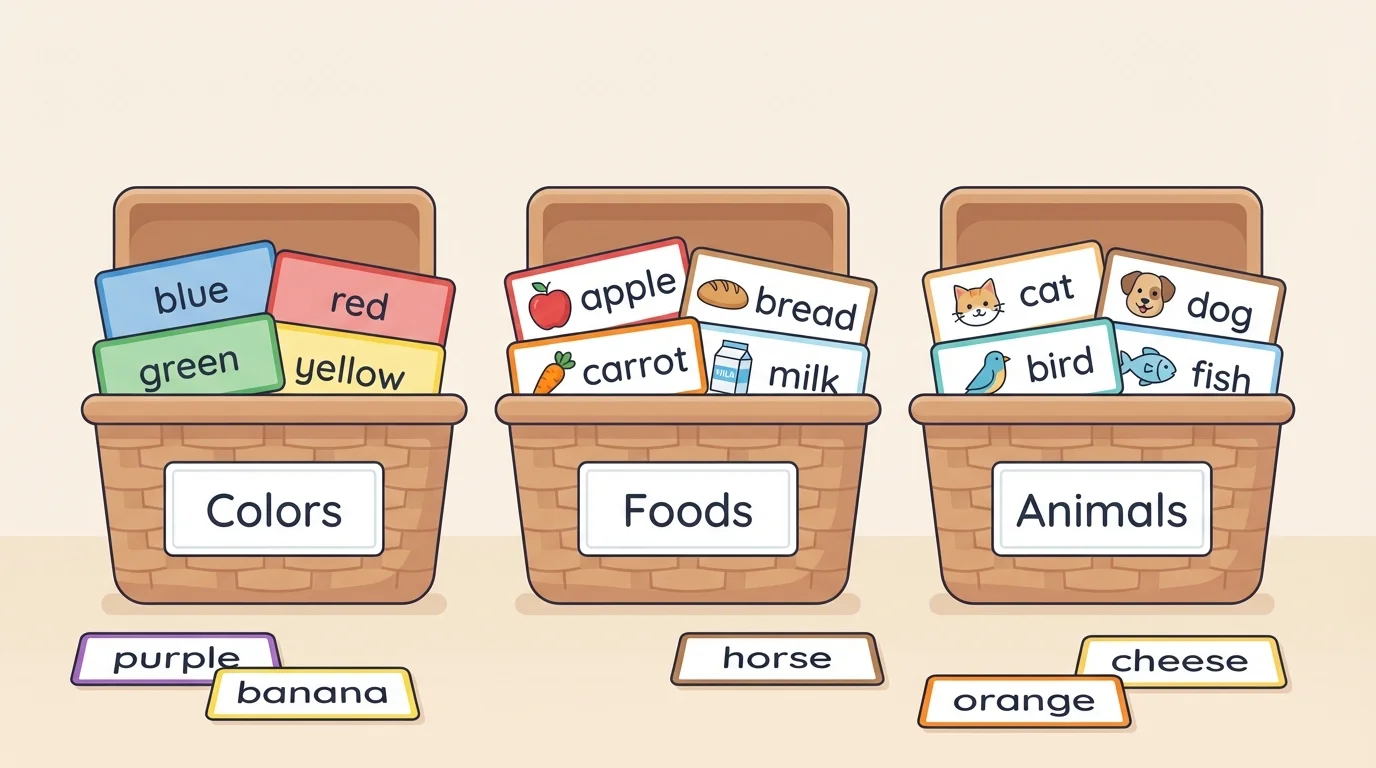
Many word groups are familiar from everyday life. [Figure 2] illustrates how readers can organize words into groups they already know, such as colors, foods, and animals.
Here are some common categories:
| Category | Example Words |
|---|---|
| Colors | red, blue, green |
| Clothing | shirt, pants, hat |
| Foods | bread, cheese, apple |
| Animals | horse, frog, bird |
| Toys | ball, doll, blocks |
| Places | park, school, home |
| Actions | jump, clap, smile |
Table 1. Examples of common word categories for young readers.
If you can say what the words have in common, you can name the category. Yellow, orange, and pink are all colors. Coat, scarf, and gloves are all clothing. Carrot, corn, and peas are all vegetables.
Categories help us organize what we know. When we hear a new word with other related words, we can often make a smart guess. If a book says, "She put on her mittens, scarf, and parka," a reader can tell these are clothing words, even if parka is new.
Most of the time, words fit nicely into one group for beginning readers. But sometimes a word may connect to more than one idea. Chicken can be an animal, and it can also be a food. Orange can be a color, and it can also be a fruit.
This is why meaning matters. Readers use the other words around it to decide which category fits best. In "The orange is juicy," orange is a fruit. In "The orange kite is bright," orange is a color. The words around it give a clue.
Some words are tricky because they can mean different things in different sentences. Good readers pay attention to nearby words to figure out the right meaning.
That is an important part of reading. We do not just memorize words. We think about how words work together.
[Figure 3] Sorting words helps readers understand books, directions, and conversations. When a reader notices words like boots, coat, and hat together, the group gives a strong clue about meaning.
If a story says, "Lila packed her swimsuit, towel, and sunscreen," the words form a group. A reader can tell the story may be about swimming or going to the beach. The category helps the reader build meaning from the text.
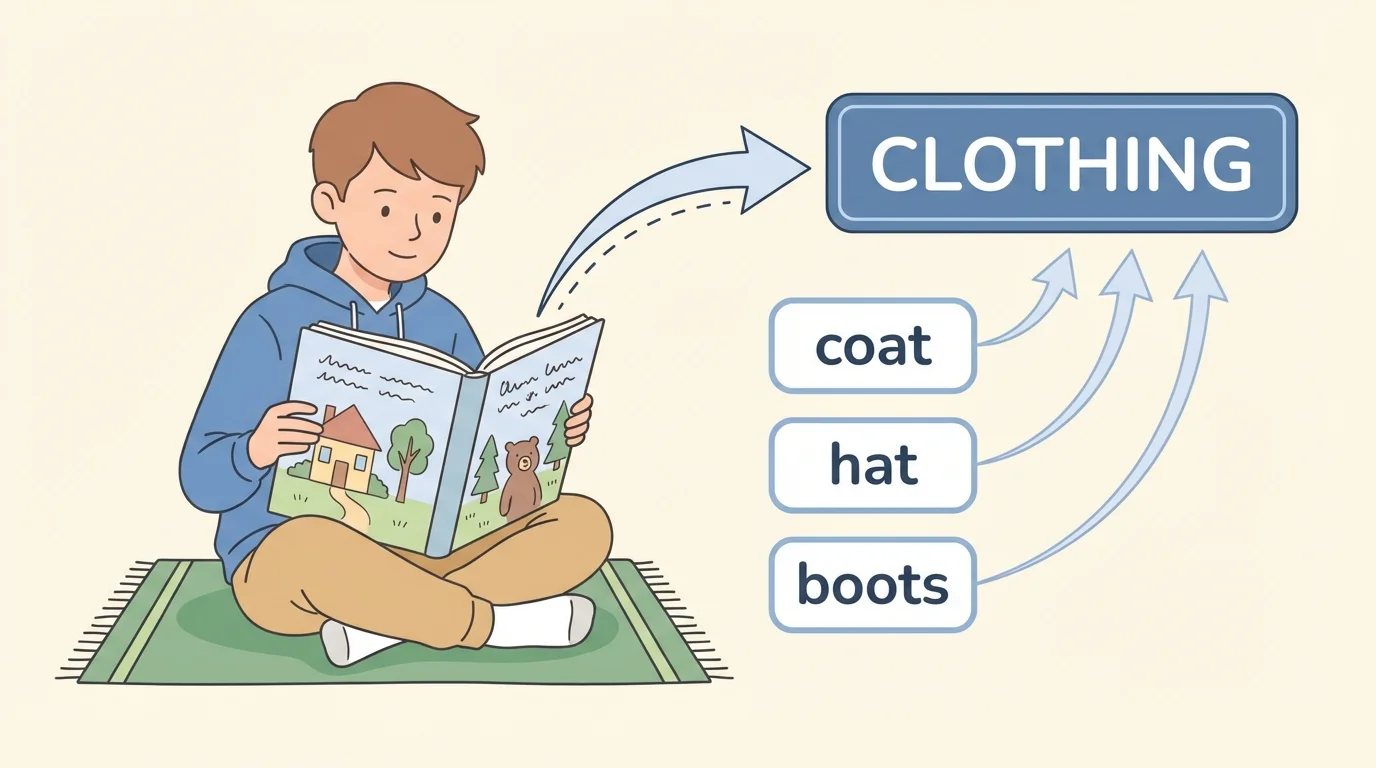
Sorting also helps with memory. It is easier to remember groups of related words than random words. That is why learning words in categories can make vocabulary stronger. Earlier, [Figure 1] showed that words become easier to understand when they are grouped by a shared idea.
Reading example
Listen to this group: socks, sweater, jacket.
Step 1: Think about what the words mean.
These are all things people wear.
Step 2: Find the shared idea.
They belong together because they are clothing.
Step 3: Name the category.
The category is clothing.
Here is another group: tiger, zebra, elephant. These words are all animals. If you know the group, you understand each word better.
A good category name tells what all the words in the group have in common. For red, blue, and green, the best category name is colors. For shoes, socks, and boots, the best category name is clothing.
Sometimes there is more than one possible category name, but one is better. For carrot, pea, and corn, you might say foods. That is true. But vegetables is an even better category name because it is more exact.
You already know that words have meanings. Now you are learning that words can also be linked by meaning. Grouping related words is one way to understand them more clearly.
Being exact helps readers and writers. A clear category name tells more. Saying animals is good for dog, cat, and horse. Saying farm animals is even more exact for cow, pig, and chicken.
When words are in the same group, they have a relationship. That means they connect by meaning. Colors connect to colors. Foods connect to foods. Actions connect to actions.
Readers also notice small differences inside a category. For example, coat, cape, and jacket are all clothing, but they are not exactly the same. Happy, glad, and cheerful are close in meaning, but each word has its own shade of meaning. Learning categories is one step toward noticing these important differences.
As we saw in [Figure 2], putting words into groups helps us see both the big idea and the individual words within the group. It is like putting toys into bins. One bin may be for blocks, another for cars, and another for stuffed animals. The bins help you stay organized, and categories do the same job for words.
The more you read, the more categories you will notice. In one book, you may find weather words like rainy, windy, and snowy. In another, you may find sound words like buzz, chirp, and ring. Each group teaches you something about the words and about the text.
