Have you ever watched dark clouds roll in and said, "It will rain soon"? That is something readers do too. When we read, we can think ahead and make a good guess about what might happen next in a story. This helps us pay close attention and understand the story better.
Readers do not make wild guesses. They use clues. The clues can come from the title, the pictures, the characters, and the things that have already happened in the story. When readers think carefully, they can make a prediction that makes sense.
A prediction is a smart guess about what will happen next. It is not just any guess. It is a guess based on clues from the story.
Prediction means a smart guess about what may happen next in a text. Confirmed means the story shows your prediction was right. Not confirmed means the story shows something different happened.
If a story says, "Mia put on her boots and picked up her umbrella," you might predict that it will rain or that Mia is going outside in wet weather. That prediction matches the clues in the text.
Sometimes a prediction is correct, and sometimes it is not. Both are okay. Good readers keep reading to find out what really happens.
Readers look for clues in many places, as [Figure 1] shows. A picture may show a boy carrying a birthday cake. The title may say The Surprise Party. A character may smile and hide a present. All of these clues help a reader think about what might happen next.
You can use clues from the words in the story. You can also use clues from the pictures. In grade 1, both words and pictures are important. They work together to help you understand.
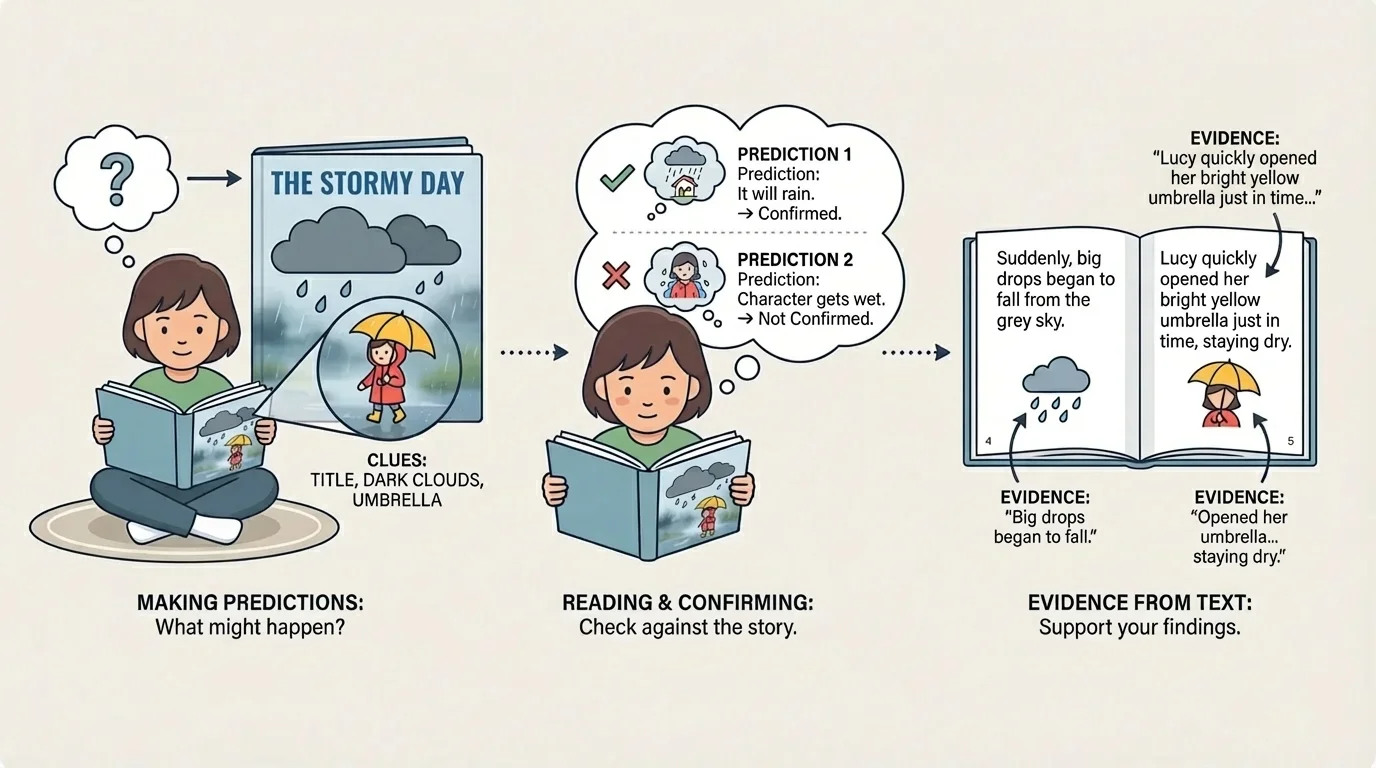
Here are some kinds of clues readers use:
If a rabbit in a story is carrying a basket and walking toward a garden, you might predict that the rabbit will pick vegetables. That makes sense because the story gives you clues.
Good readers often stop for a moment while reading. They think, "What do I think will happen next?" This helps them stay active while they read.
Readers think while they read
Making predictions is part of active reading. Instead of only saying the words, readers also think about the story. They notice clues, make a smart guess, and then keep reading to check that guess.
You can make a prediction before you read, during reading, and sometimes near the end of a story. Before reading, the cover and title may help you. During reading, new events give you more clues. Near the end, you may predict how the problem will be solved.
As we saw with the clue ideas in [Figure 1], readers do not need to guess randomly. They gather clues first and then make a thoughtful prediction.
[Figure 2] After you make a prediction, you keep reading to see what happens. Then you ask, "Was my prediction confirmed?" Sometimes the story matches your prediction, and sometimes the story surprises you.
If your prediction matches the story, it is confirmed. If the story does not match your prediction, it is not confirmed. That does not mean your thinking was bad. It means the story gave new information.
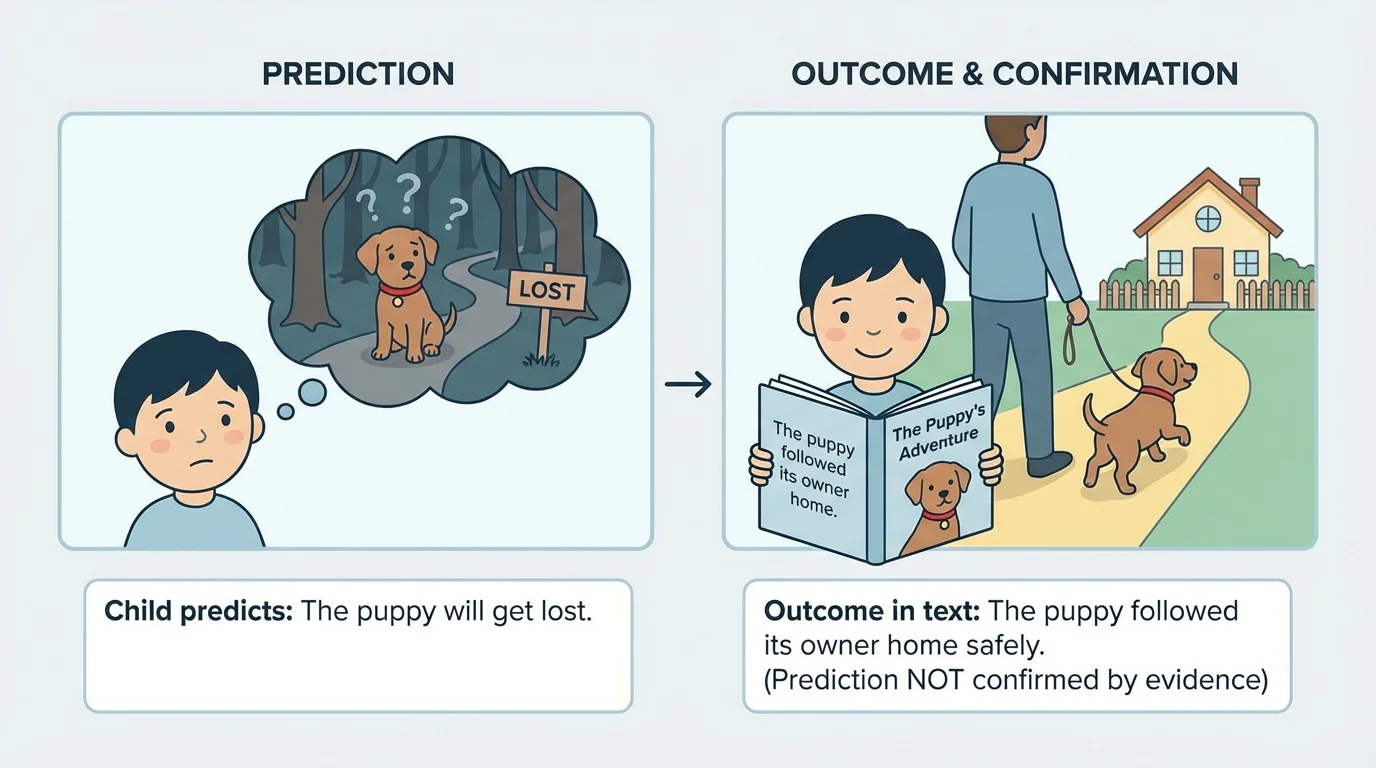
For example, you may read, "The puppy ran out the gate." You might predict, "The puppy will get lost." But then the next page says, "The puppy followed Ben all the way to the park." Your prediction was not confirmed because the puppy did not get lost.
Another time, your prediction may be confirmed. If a story says, "Lena mixed flour, eggs, and milk," you might predict that Lena is making pancakes. If the next page says, "Soon the pancakes were sizzling in the pan," your prediction was confirmed.
When readers explain their predictions, they should tell why they thought that. They use evidence from the text. Evidence means the words and pictures in the story that support your idea.
Talking about a prediction with evidence
Step 1: Make the prediction.
"I predict the boy will share his snack."
Step 2: Tell the evidence.
"I think that because the story says his friend forgot lunch and the boy is opening a big bag of crackers."
Step 3: Check what happens.
If the next page says, "He gave half the crackers to his friend," the prediction is confirmed.
When you speak or write about a prediction, it helps to use simple sentence starters such as:
The best answers use clues from the story. A strong reader does not just say, "I guessed it." A strong reader says what in the text helped them think that way.
Short examples help us see how prediction, confirmation, and evidence work together, as [Figure 3] illustrates with a simple story sequence. Each time, the reader uses clues first and then checks the story to see what really happens.
Example 1: "Nora put a bone by the door. She called, 'Max! Max!'" A reader may predict that Max is a dog and will come to the door. If the next line says, "Max wagged his tail and ran inside," the prediction is confirmed. The evidence is the bone and the calling, which are clues about a dog.
Example 2: "Sam held his kite. The wind blew hard." A reader may predict that Sam will fly the kite. If the next line says, "Rain started to pour, so Sam went inside," the prediction is not confirmed. The evidence for the first prediction was the kite and the wind. New evidence changed what happened.
Example 3: "Ava planted seeds in the soil. Then gray clouds filled the sky." A reader may predict that rain will help the seeds grow. If the story later says, "After the rain, tiny green sprouts popped up," the prediction is confirmed. The evidence is that Ava planted seeds and rain came afterward.
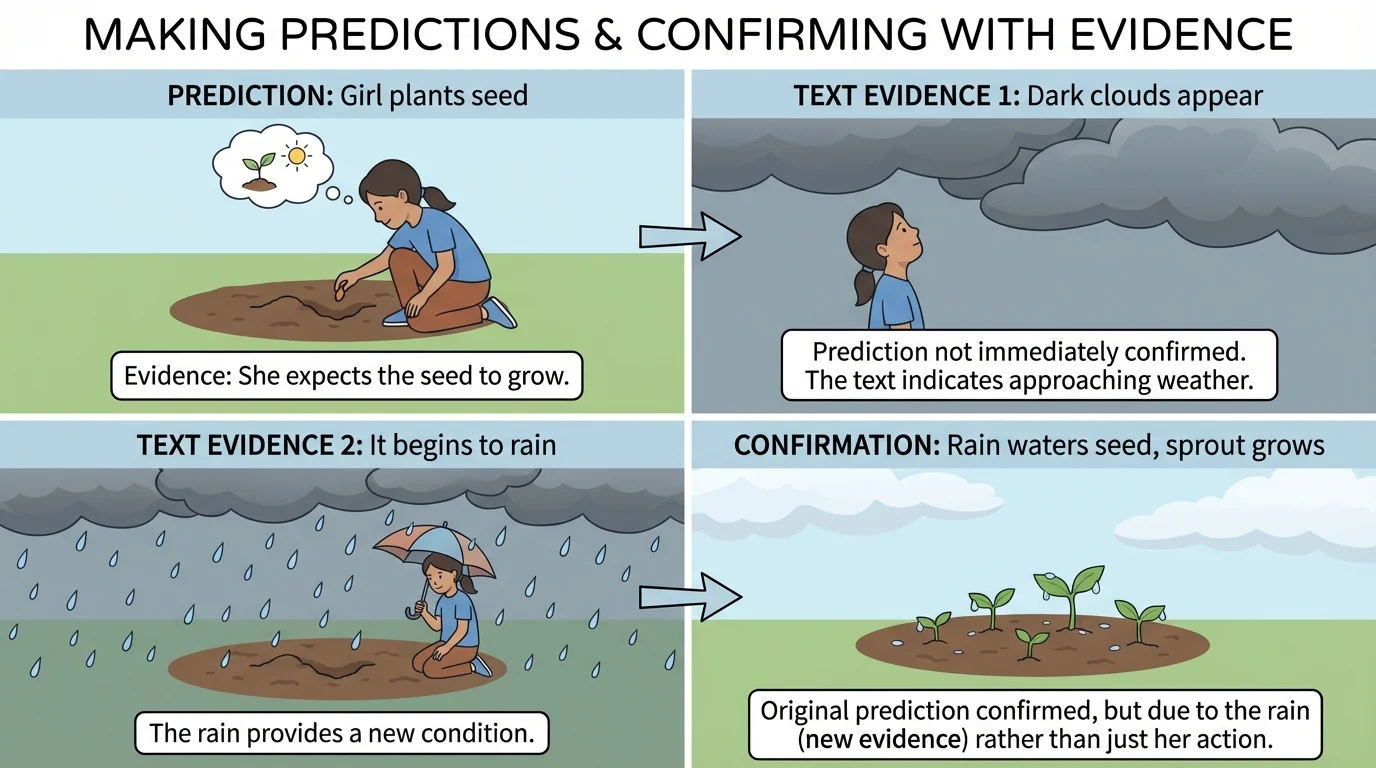
The seed example connects words and pictures well. Later, you can see how one event leads to the next: planting, rain, and growth. That is exactly how readers check whether a prediction fits the story.
Stories often surprise readers on purpose. Authors sometimes give one clue first and then add a new clue later so the ending feels exciting.
That is why readers must keep paying attention. The first clue matters, but the new clues matter too.
Sometimes you make a prediction, and then new information appears. Good readers can change their minds. That is not a mistake. It is smart reading.
For example, if a girl is packing a towel and sunscreen, you may predict she is going to the beach. But if the story then says she is heading to the backyard to play in a small pool, you can change your prediction. You used the new clue to update your thinking.
When you retell a story, you tell important events in order. Predictions help with this because they make you watch closely for what happens next.
Readers ask themselves questions such as: "What clue did I notice?" "What do I think will happen?" and "What happened in the text that proved me right or showed something different?" These questions help build strong understanding.
When you explain your thinking clearly, you become a careful reader. You are not only reading the story. You are also thinking about the story as you read.
