Have you ever known the next words in a song before anyone sang them? Poems can work that way too. Some poems have patterns that repeat again and again, so your brain starts to say, "I know what comes next!" That is one reason predictable poems are fun to read. They help readers listen carefully, join in, and feel successful.
A predictable poem is a poem with parts that happen again in a way we can notice. A word may repeat. A whole line may repeat. The ending sound may repeat. Sometimes the poem grows in the same way from one line to the next.
When a poem is predictable, readers can follow its pattern. A pattern is the order or way something repeats. In poems, patterns help us know what to expect. They also make the poem sound musical and fun.
Pattern means something that repeats in a rule or order.
Predictable poem means a poem with repeated parts that help the reader know what may come next.
Repeat means to say or see the same thing again.
Some predictable poems are very short. Some are longer. No matter the length, readers look and listen for parts that stay the same and parts that change.
When we read a poem, we do not only look at the words. We also listen to how the poem sounds. We can listen for a rhythm, which is the beat or flow of the words. We can also listen for a rhyme, which happens when words have the same ending sound, like cat and hat.
Readers can ask simple questions while reading: What repeats? What changes? What sounds the same? These questions help us find the poem's pattern. If a line begins with "I see" many times, that repeated beginning is a clue. If each line ends with words like day, play, and say, the rhyming endings are a clue too.
You already know that good readers look for clues in words and sentences. In poems, repeated words and sounds are important clues that help you read with confidence.
As you hear the same words again, you begin to read more smoothly. That smooth, easy reading is called fluency. Patterns help fluency because your eyes and ears are ready for what comes next.
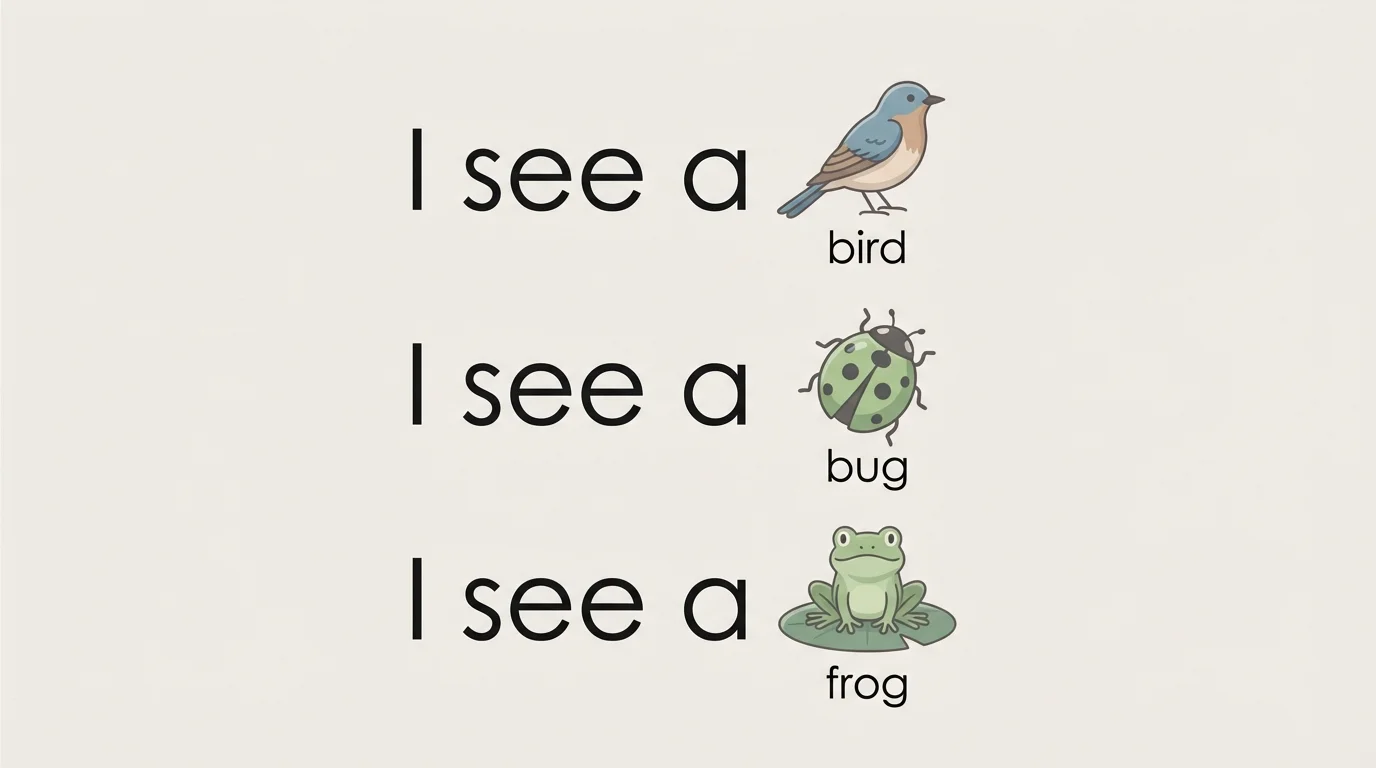
Many poems begin lines the same way, as [Figure 1] shows. This kind of pattern uses the same words at the start of each line and changes only one small part. For example: I see a bird. I see a bug. I see a frog. The beginning stays the same, but the last word changes.
Another pattern is repeated whole lines. A poem may say, Run, run, run! again and again between other lines. Readers quickly learn that line and can join in.
Some poems use rhyme. For example: The star is bright. The moon is white. The words bright and white sound alike at the end. Rhyming patterns make poems catchy.
Some poems grow in a counting pattern. They may add one more thing each time, such as One red leaf, two red leaves, three red leaves. Some poems use a question-and-answer pattern, such as Who hops here? A bunny hops here.
| Pattern type | What repeats | Example |
|---|---|---|
| Repeated beginning | Start of each line | I hear the... |
| Repeated line | Whole line | Clap with me! |
| Rhyme | Ending sound | day, play |
| Growing pattern | Same frame with more added | one, two, three |
Table 1. Different kinds of patterns readers can notice in predictable poems.
When readers notice these kinds of patterns, they understand the poem better. The pattern is not just for fun. It helps the poem make sense.
Many nursery rhymes and playground chants are predictable poems. That is why children often remember them so quickly and can say them together.
Later, when you read a new predictable poem, you can think back to the repeated line starters in [Figure 1] and notice how one part stays the same while one part changes.
To follow a pattern, first listen or look for the part that repeats. Then notice the part that changes. If the poem says, I like apples. I like oranges. I like grapes., the repeated part is I like. The changing part is the fruit name.
Next, read with your voice in a smooth way. If each line sounds alike, your voice can move in a steady rhythm. This helps the poem sound clear and pleasant.
It is important to look carefully at each new line. Even when a poem is predictable, readers still check the words. The pattern helps us make a smart guess, but the words tell us the exact answer.
Following a pattern while reading means using repeated words, sounds, and line shapes to help your reading. Good readers use the pattern and the printed words together. They do not only guess; they confirm by looking at the words.
For example, if you read I can hop. I can jump., you may expect the next line to begin with I can. That expectation helps you read more easily. Then you look at the final word to see what action comes next.
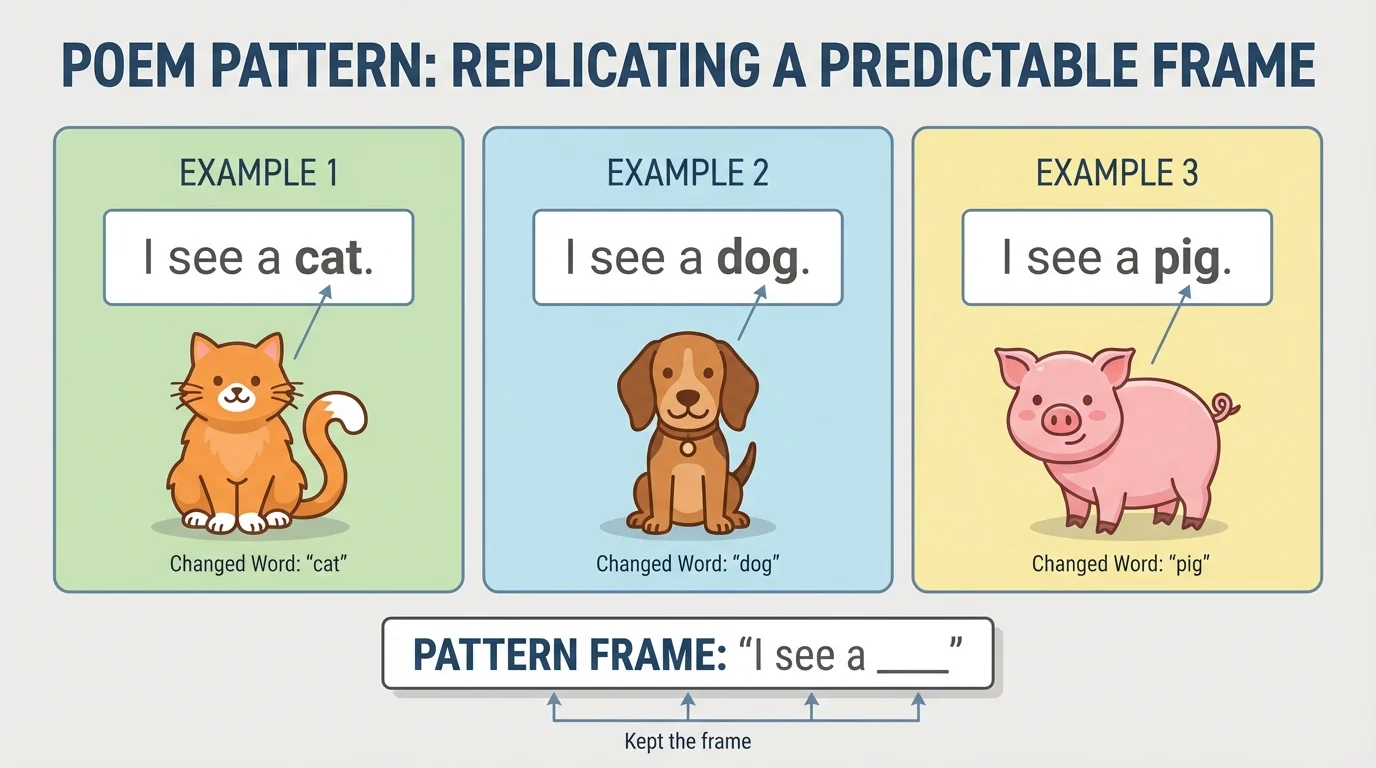
To replicate a pattern means to make a new part that matches the same rule. You keep the poem frame and change just one fitting word or idea. If the poem says, The baby duck is small. The baby mouse is small., you can replicate the pattern by adding The baby bug is small.
[Figure 2] When you replicate a pattern, you ask, What stays the same? What must match? Maybe the beginning must stay the same. Maybe the ending sound must rhyme. Maybe the line must have the same beat.
If a poem rhymes, your new line should rhyme too. For example, if the poem says, I see a fox in red socks, a matching line might be I see a goat on a boat. The idea changes, but the playful rhyme pattern stays.
If a poem repeats a line, your new line may need that same repeated line after it. If a poem counts up, your new line may need the next number. Replicating means matching the poem's rule.
Example: Making a matching line
Poem lines: I can clap. I can tap.
Step 1: Find the repeated part.
The repeated part is I can.
Step 2: Find what changes.
The action word changes: clap, tap.
Step 3: Make a new line that matches.
A matching line is I can hop.
The new line follows the same pattern because it keeps I can and changes the action word.
Looking back at the frame in [Figure 2] can help you remember that a replicated line should sound like it belongs with the other lines.
Here is a short predictable poem:
I see the sun.
I see the tree.
I see the bird
looking at me.
The first three lines begin with I see. That repeated beginning gives the poem a pattern. A new matching line could be I see the cloud.
Here is another one:
Blue at the pond,
blue at the sky,
blue on the feather
floating by.
This poem repeats the word blue at the start of each line. A new matching line could be blue on the kite. The line fits because it keeps the beginning word and the same kind of idea.
"Poems are words that dance in patterns."
Here is a rhyme pattern poem:
I have a ball.
It is not small.
It can bounce by the wall.
The words ball, small, and wall rhyme. If you add a line such as I hear its happy call, the new line matches the rhyme pattern.
[Figure 3] Patterns help readers read smoothly and confidently. When children know that some words will come again, they can focus on the changing words and keep their reading moving. This builds confidence.
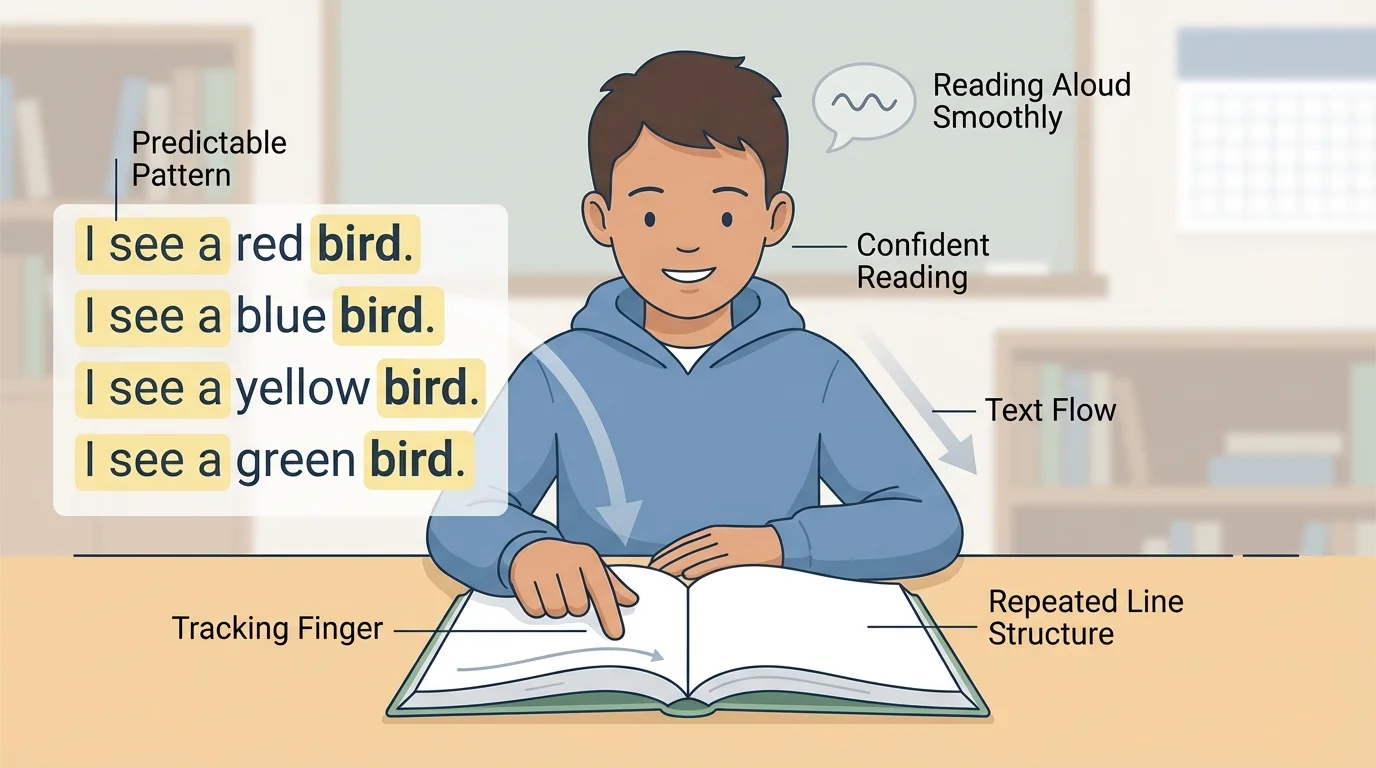
Patterns also help readers remember what they read. Repeated words stay in the mind. Rhymes stick in the ear. Rhythm helps the poem feel steady.
Patterns support comprehension too. If you know how the poem is built, you can think more about what it means. You can notice that the poet repeats a word because it is important, or uses rhyme to make the poem sound playful.
When you read aloud, those repeated parts can make your voice stronger and smoother. This support for fluency is one reason predictable poems are often used when young readers are learning to read with expression.
Following and replicating patterns in poems is a smart reading skill. It helps you notice structure, read with rhythm, and create lines that fit. Poems may be short, but their patterns can teach readers a lot.
