Have you ever seen a long word and then suddenly noticed it is really made of two small words hiding inside it? A word like sunflower is like a word puzzle. When we see sun and flower together, the big word starts to make sense. Learning about compound words helps us become stronger readers because we can use parts we already know.
A compound word is one word made from two smaller words. Each small word has its own meaning. When the two words join, they make a new word with a new meaning. As [Figure 1] shows, the two parts work together to build one bigger idea.
Compound word means a word made by joining two smaller words, such as rainbow, cupcake, or bedroom.
Here are some examples: doghouse is dog + house. playground is play + ground. fishbowl is fish + bowl. When we know the small words, we can often understand the larger word more easily.
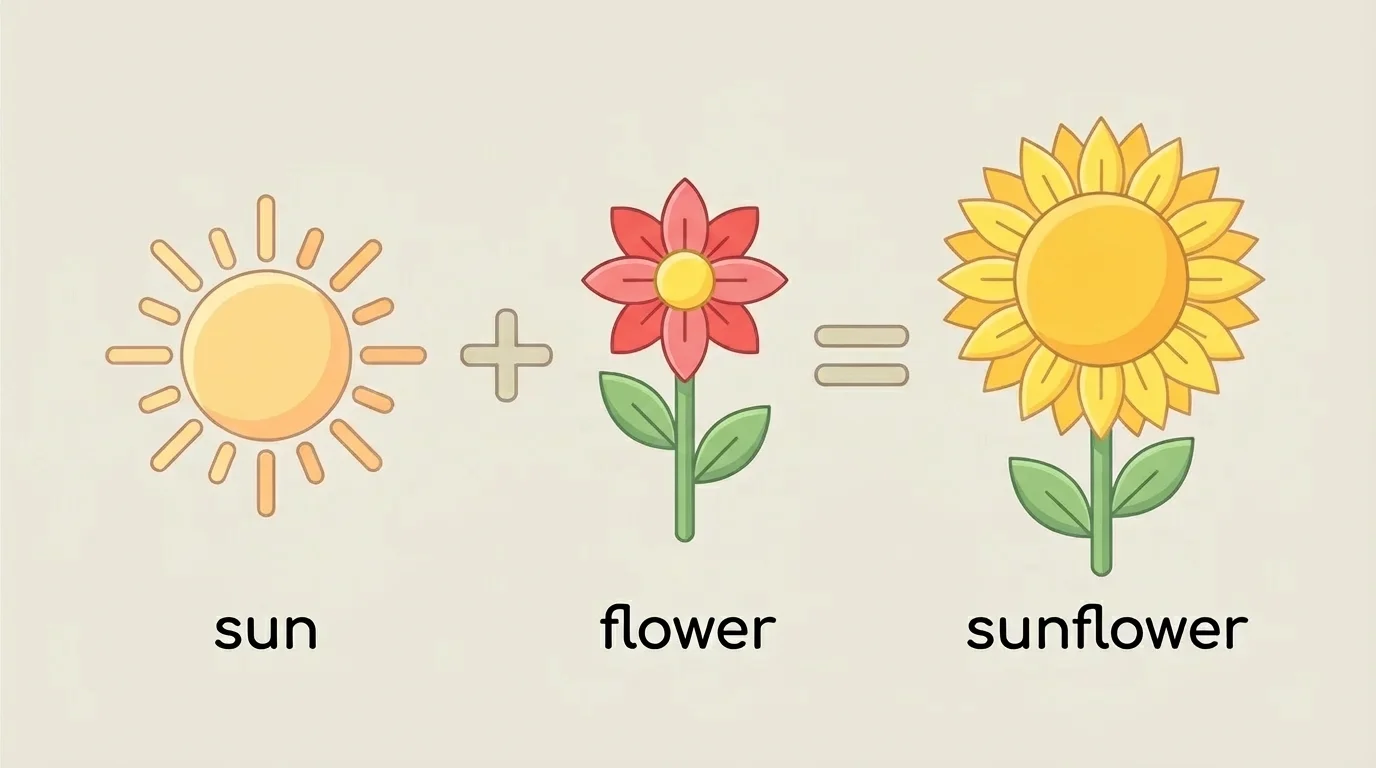
Many compound words are nouns, which are naming words. For example, backpack, snowman, and mailbox name things. Some compound words can name places, such as bedroom or classroom. Some name times, like sunrise.
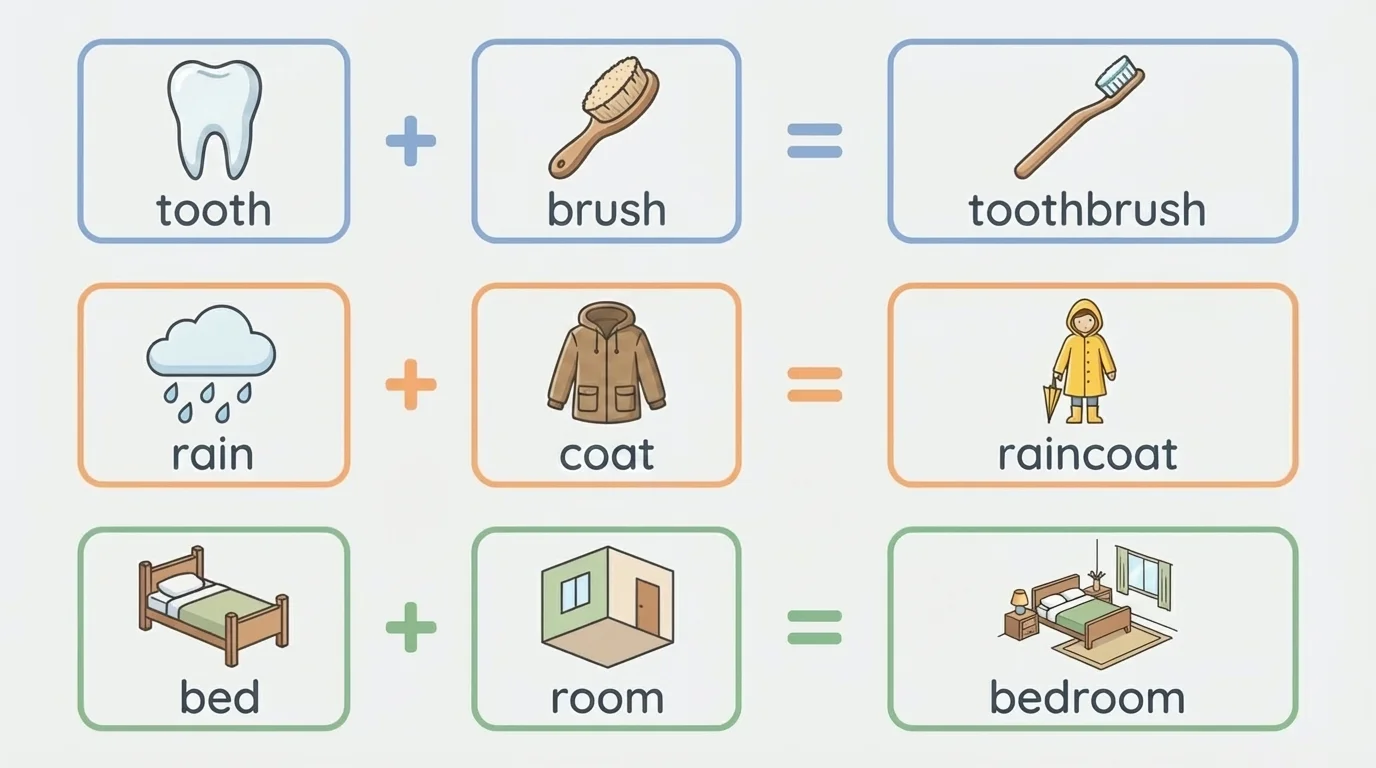
One smart reading strategy is to look for the smaller words inside a big word. A word part is a piece of a word that helps us understand it. In compound words, the word parts are often whole small words. As [Figure 2] illustrates, readers can split the big word into two known parts and think about each one.
If you read the word raincoat, you can split it into rain and coat. Then you can think: a coat is something you wear, and rain is water from the sky. A raincoat is a coat you wear in the rain. If you read toothbrush, you can split it into tooth and brush. That helps you know it is a brush for teeth.
How compound words help reading
When readers come to a longer word, they do not always have to guess. They can slow down, look for smaller words they already know, say each part, and then put the meanings together. This is a powerful way to figure out unknown words.
Let's look at more examples. Bathtub is bath + tub. Football is foot + ball. Bookshelf is book + shelf. When you break the word apart, the meaning becomes clearer.
Sometimes saying the two small words aloud helps too. If a word feels tricky, try listening for the parts. You may hear the smaller words inside the larger one.
In first grade, you will mostly read compound words written as one word, like sandbox, cupcake, and inside. These are often called closed compound words because the two parts are closed up together with no space.
As you grow as a reader, you may also see some compound words written in other ways. A few may have a hyphen, and some may be written as two words. Right now, the most important job is to notice that two smaller words can work together to make meaning, even if the writing looks a little different in some books later on.
| Compound Word | Small Word 1 | Small Word 2 | Meaning |
|---|---|---|---|
| sunset | sun | set | the time when the sun goes down |
| bedroom | bed | room | a room with a bed |
| snowball | snow | ball | a ball made of snow |
| playground | play | ground | a place where children play |
Table 1. Examples of compound words, their two parts, and their meanings.
Notice that the new word keeps ideas from both smaller words. That is why compound words are helpful clues for readers.
Sometimes you see a word you have never read before. You do not have to stop right away. You can use meaning clues from the parts of the word. If you know snow and flake, then snowflake will make sense. If you know home and work, then homework will make sense too.
Using parts to understand a word
Step 1: Read the word lunchbox.
Step 2: Split it into lunch and box.
Step 3: Think about the parts. Lunch is food you eat in the middle of the day. A box can hold something.
Step 4: Put the meanings together. A lunchbox is a box that holds lunch.
This strategy helps a reader figure out the word without needing someone else to tell them.
Readers also use the sentence around the word. If a sentence says, "I put my sandwich in my lunchbox," the sentence gives extra help. The word parts and the sentence work together.
Many compound words are easy to understand because the small words match the big meaning very closely. Sunshine means light from the sun. popcorn is corn that pops. bathroom is a room for taking a bath or using the sink and toilet.
But sometimes we must think a little more. The parts still help, but the meaning may not be exactly what we first picture. For example, butterfly has butter and fly, but a butterfly is not butter and it is not just any fly. That means compound words often help, but good readers also check the picture, the sentence, and what makes sense in the story.
Some English words look like compound words even when the whole word has its own special meaning. That is why strong readers use both the word parts and the rest of the sentence.
When you read, ask yourself: "Do the two smaller words help me understand this word?" Then ask: "Does that meaning fit the sentence?" Those two questions help make you a stronger reader.
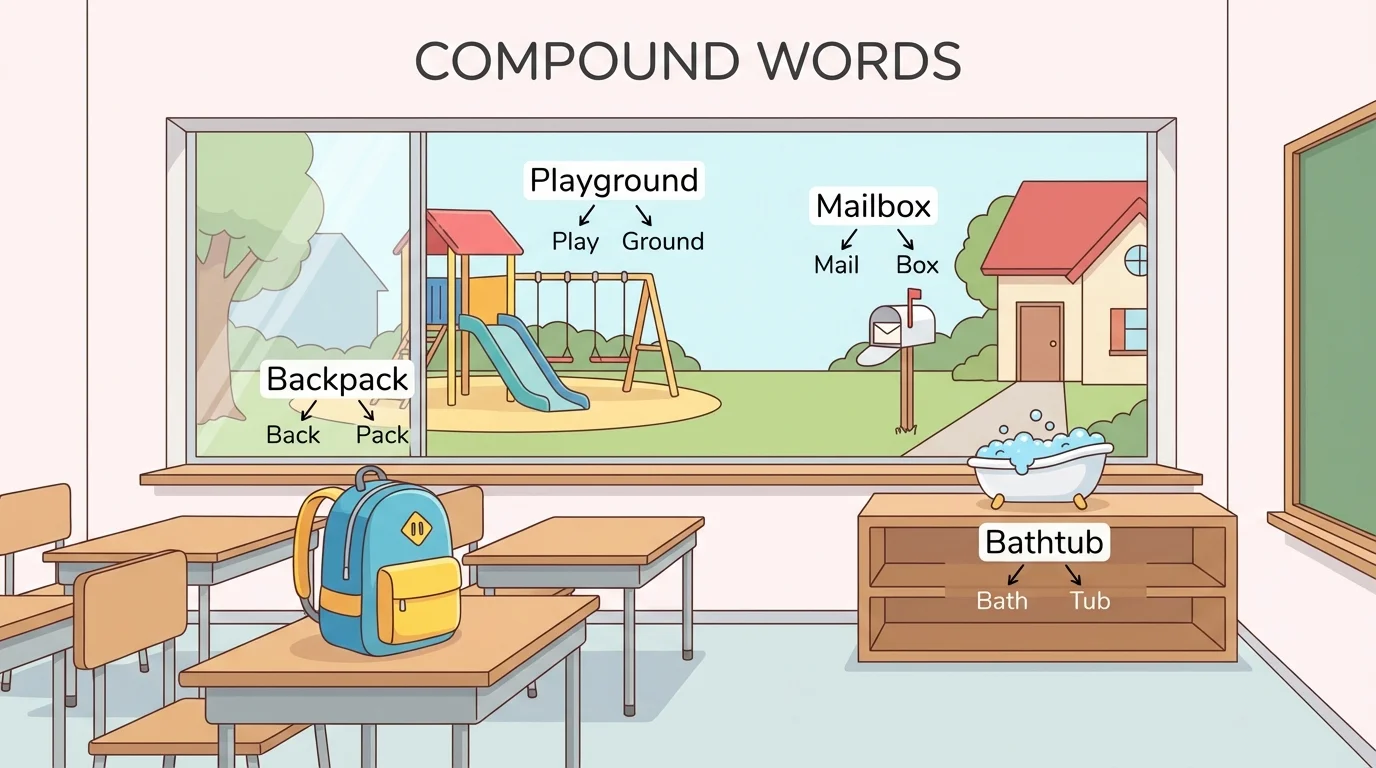
Compound words are all around you. In a classroom or neighborhood scene, [Figure 3] shows words you might notice every day, such as backpack, mailbox, and playground. These are not just school words. They are real words from life.
You may hear compound words at home, at school, outside, and in books. A teacher may say classroom. A parent may say sunlight. A story may use moonlight or railroad. The more you notice them, the easier they become to read.
Compound words also help with spelling and writing. If you know how to spell snow and man, that can help you spell snowman. If you know base and ball, that can help with baseball. Looking for the two known words gives your brain a helpful path.
Later, when you come to a new word in a book, think back to the way compound words work, as we saw earlier in [Figure 1] and [Figure 2]. Big words can become less scary when you look inside them and find familiar pieces.
You already know many small words like sun, bed, room, play, and ground. Compound words build on words you already know.
Reading is a little like building with blocks. One block is useful, but two blocks together can build something new. Compound words work the same way. Two small words join together, and suddenly a new meaning appears.
