Have you ever wondered why birds hop on the ground, how a seed starts to grow, or why shadows move? Good learners do something special when they wonder: they ask questions and look for answers. Sometimes one way of finding out is not enough. We can look closely, listen to a book, watch a video, and talk with friends. When we use many ways to learn, we often find better answers.
A good inquiry begins with a question. An inquiry is a careful search for answers. In first grade, questions are often about things children can see, hear, or notice in everyday life. A class might ask, "What do worms do after rain?" or "How do leaves change?" These are questions of interest because they matter to the learners.
Some questions are very big, and some are small enough to study together. A helpful question is clear and focused. "What do birds do?" is very wide. "What do birds near our playground eat?" is easier to explore. When a class asks a focused question, it becomes easier to gather information.
Question of interest means something learners really want to know. Resource means a tool or source of information that helps answer a question. Peers are classmates or other children who learn with you.
Questions can come from stories, nature walks, classroom objects, or something a teacher reads aloud. A child may notice that one plant leans toward a window and ask why. Another may hear a story about animals and wonder where those animals sleep. Questions help learning grow.
Guided inquiry means children investigate with support from a teacher. The teacher helps students choose a question, look at good resources, talk about what they notice, and stay on the topic. The teacher does not just give every answer right away. Instead, the teacher helps children learn how to find answers.
Guided inquiry often happens in steps. First, the class asks a question. Next, students look for information. Then they share what they learned. Last, they use the information to answer the question. These steps help young learners feel confident and organized.
Learning from more than one source helps children understand a topic better. One source may show what something looks like, another may tell facts, and another may help children hear new ideas. When sources fit together, the answer becomes clearer.
For example, if children want to know how a sunflower grows, they might observe a real plant, listen to a read-aloud book about seeds, and watch a short video showing plant growth. As [Figure 1] shows, each resource adds a piece of the answer.
A resource can be many things. To answer one question, students may use direct observation, trade books, texts read aloud, or viewed texts such as pictures and videos. The same question can be explored in more than one way. Using different resources helps children notice more details and compare information.
Direct observation means looking closely at something real. Children may watch ants move, notice cloud shapes, or look at the parts of a flower. Observation helps students learn from the world around them. It is especially useful when the question is about something nearby and visible.
Trade books are books written for children about real topics or stories that include useful information. A book about weather can teach words like cloud, rain, and wind. A book about farms can show animals, tools, and jobs. Books often give facts that children cannot discover by looking only once.
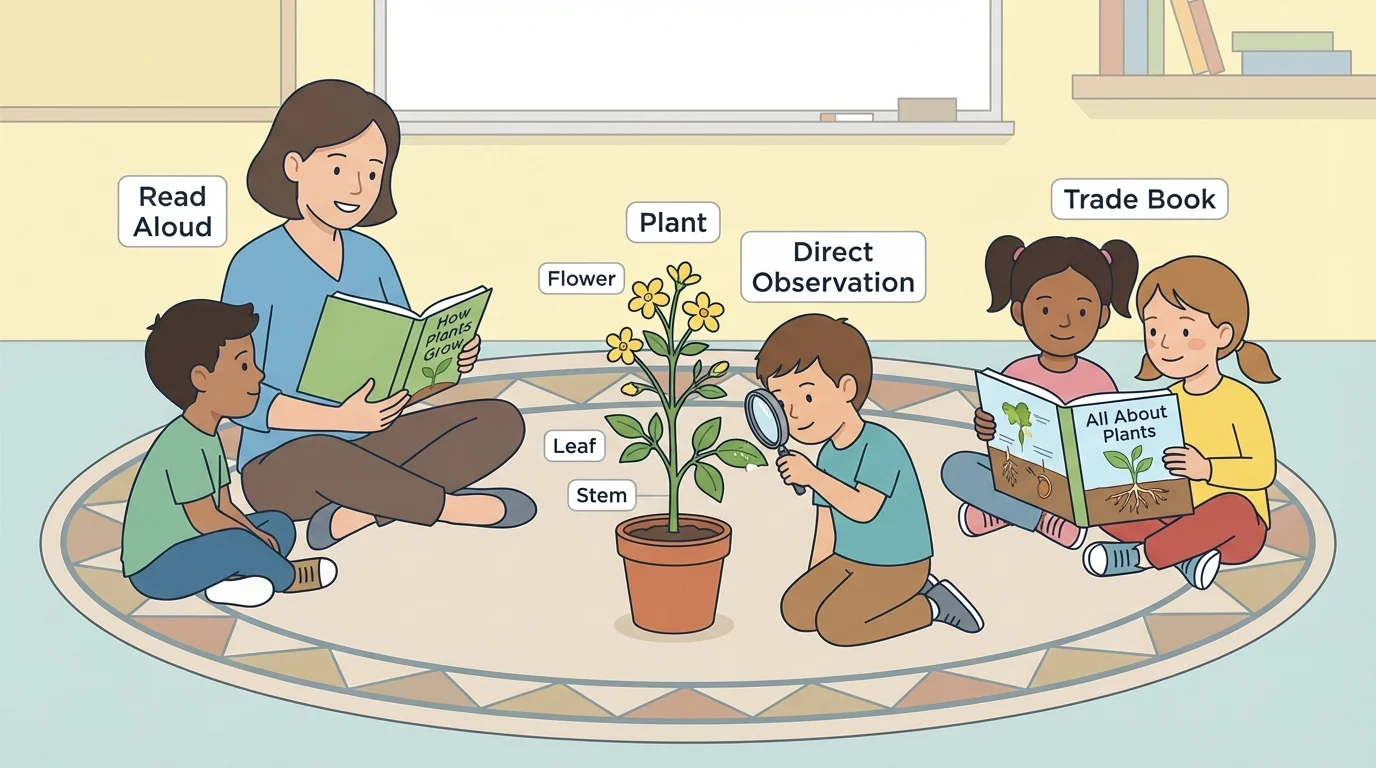
Texts read aloud are also important. When a teacher reads aloud, children can focus on listening and thinking. They may hear strong vocabulary, big ideas, and details they might miss if they tried to read alone. Listening to a text can help everyone in the class learn together.
Viewed texts include photographs, charts, labeled pictures, and short videos. These can help when children need to see movement, change, or parts of something. A video of a butterfly coming out of a chrysalis shows change over time. A labeled picture of a bird can help children notice wings, beak, and feet.
Later, when students compare what they saw in real life with what they learned from a book, [Figure 1] still helps explain why multiple resources matter. One resource may answer one part of the question, while another fills in missing details.
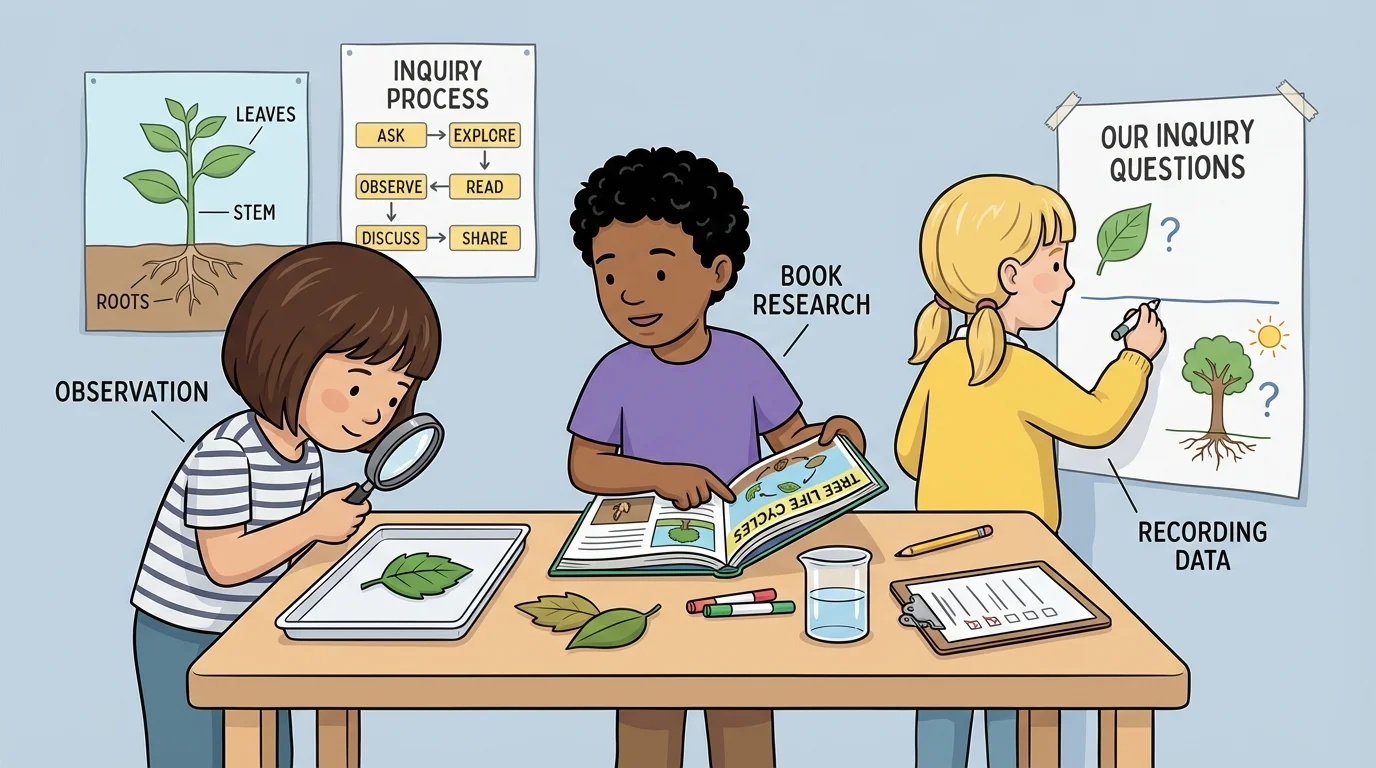
Learning with peers means working with classmates. As [Figure 2] shows, children do not have to find every answer alone. When students talk together, they can share what they noticed, ask each other questions, and build a stronger answer.
Working with peers includes important habits: taking turns, listening carefully, speaking kindly, and staying on the topic. One child may notice that a leaf is smooth. Another may notice its color. Another may remember hearing in a read-aloud that leaves need sunlight. Together, the group gathers more information than one child might gather alone.
Children can also have simple jobs during group inquiry. One child can be the observer. One can hold the book. One can draw what the group learned. One can share the group's answer with the class. These jobs help everyone join the learning.
Scientists often work in teams too. They share observations, ask questions together, and use many tools to learn about the world.
Later, when children explain how group members helped one another, they can think back to [Figure 2]. Inquiry is not only about finding facts. It is also about listening, sharing, and learning together.
As [Figure 3] illustrates, when children find information, they need ways to keep it. To gather information means to collect facts, ideas, or observations that help answer a question. Young learners can record information by drawing pictures, making labels, telling what they remember, or helping create a class chart.
Some information comes from direct observation. A child might draw a sprout with two leaves. Some information comes from recalling what was heard in a read-aloud. A child might say, "The book said roots drink water." Some information comes from a viewed text. A child might point to a bird's beak in a photo and say what it is used for.
Recording does not have to be long writing. In first grade, children may use short words, labels, pictures, or shared sentences. A teacher may write the class's ideas on chart paper. This makes the group's thinking visible and helps children return to the information later.
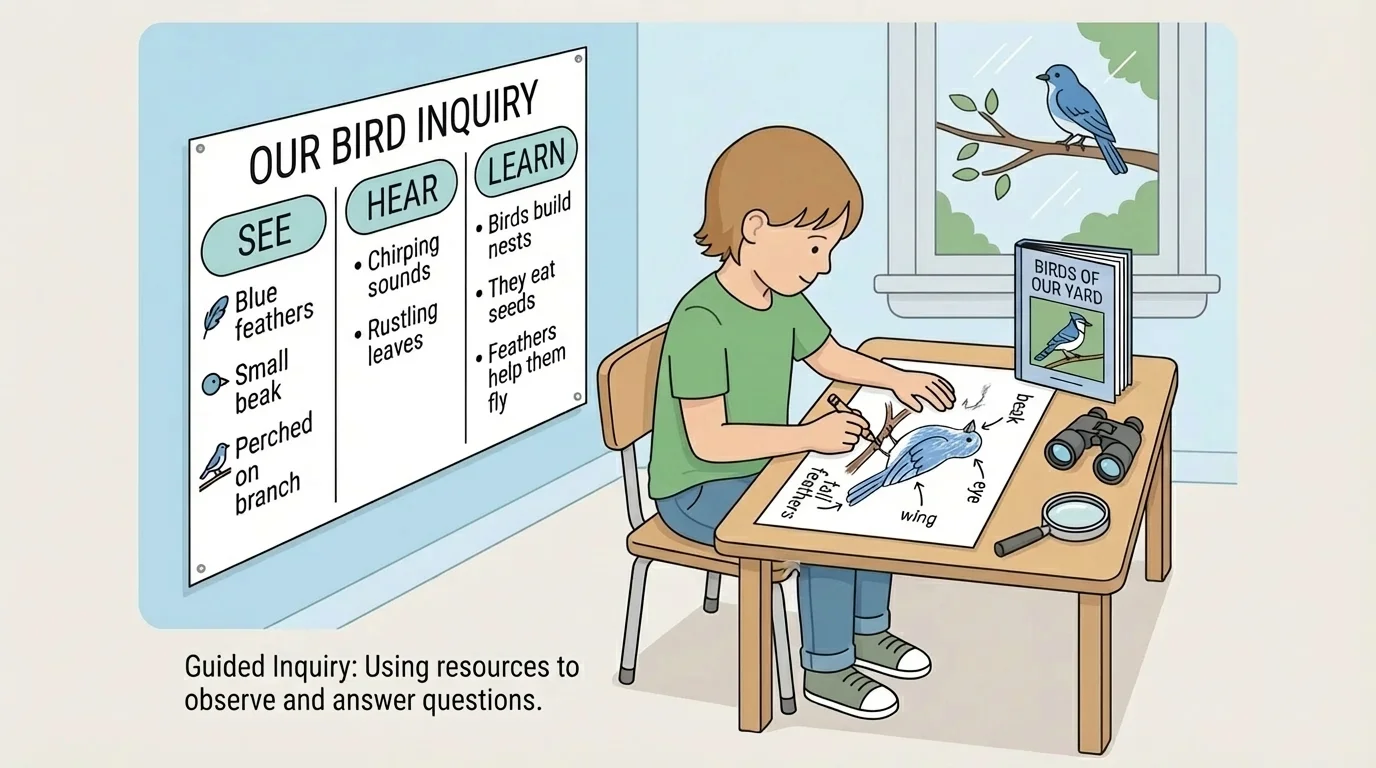
Example: Answering a class question about birds
The class asks, "What do birds use their beaks for?"
Step 1: Observe
Students watch birds outside and notice pecking and picking up food.
Step 2: Listen
The teacher reads a book aloud about bird body parts.
Step 3: View
Students look at photos showing different beak shapes.
Step 4: Record
The class draws birds and labels beaks, food, and nests.
The class can now answer that birds use beaks for jobs such as eating, picking up things, and helping build nests.
Students can revisit [Figure 3] when they need to remember where information came from. A chart or drawing helps children connect what they saw, heard, and learned.
After gathering information, students put ideas together. They think, "What did we learn from our observation of the plant?" "What did the book say?" "What did our group notice?" Then they answer the question in a clear way. The answer should match the information they collected.
Sometimes the answer is one sentence. Sometimes it is several ideas. For example, if the question is "How do plants get what they need?" children may answer, "Plants need water, light, and soil to grow." That answer may come from observing a plant, hearing a book, and talking with peers.
When children explain answers, they are learning to use evidence. Evidence means the information that supports an answer. In first grade, evidence may be a drawing, something seen outside, or a fact from a read-aloud.
Remember that a strong answer matches the question. If the class asks about what birds eat, the answer should stay about food, not switch to where birds sleep.
Inquiry helps children become careful thinkers. They learn that answers do not come from guessing only. Answers come from noticing, listening, remembering, discussing, and checking resources.
One answer often leads to another question. If students learn that worms come out after rain, they may next ask, "How do worms move?" If they learn that a flower needs sunlight, they may ask, "Do all plants need the same amount of light?" Learning keeps growing because curiosity keeps growing.
This is one reason inquiry is exciting. Children start with one simple wonder, then use resources and teamwork to discover more. Over time, they learn that books, observations, videos, read-alouds, and classmates all help them understand the world.
