Have you ever opened a book and found the answer you wanted fast? That is not just luck. Books and articles often have special parts that help readers look for facts. These special parts are like signs on a road. They help us know where to look, what is important, and how to understand what we read.
When we read to learn, we do more than sound out words. We look carefully at the page. A big title, a small heading, a picture, or words in bold type can all help us. Good readers use these clues to find information and answer questions.
Some books tell stories. Other books teach us about animals, weather, space, plants, and many other topics. In books that teach facts, the page is often set up to help us learn. We can look at the parts of the page before we read every word.
If your class wants to learn about penguins, you might first look for the title. Then you might look at the headings to find a part about food or homes. This helps you go right to the information you need.
Text features are parts of a book or article that help readers find and understand information. Some common text features are the title, headings, illustrations, labels, captions, and bold type.
Text features are very helpful when we are doing research together in class. If the teacher asks, "What do penguins eat?" we can use text features to help us search for that answer.
A nonfiction page has many helpful parts, as [Figure 1] shows. Each part gives us a clue. The title tells the big topic. A heading tells what one part is about. An illustration shows something we are learning about. Bold type makes important words stand out.
You may also see labels and captions. Labels point to parts of a picture. A caption is a short sentence that tells about the picture. All of these features work together to help us learn.
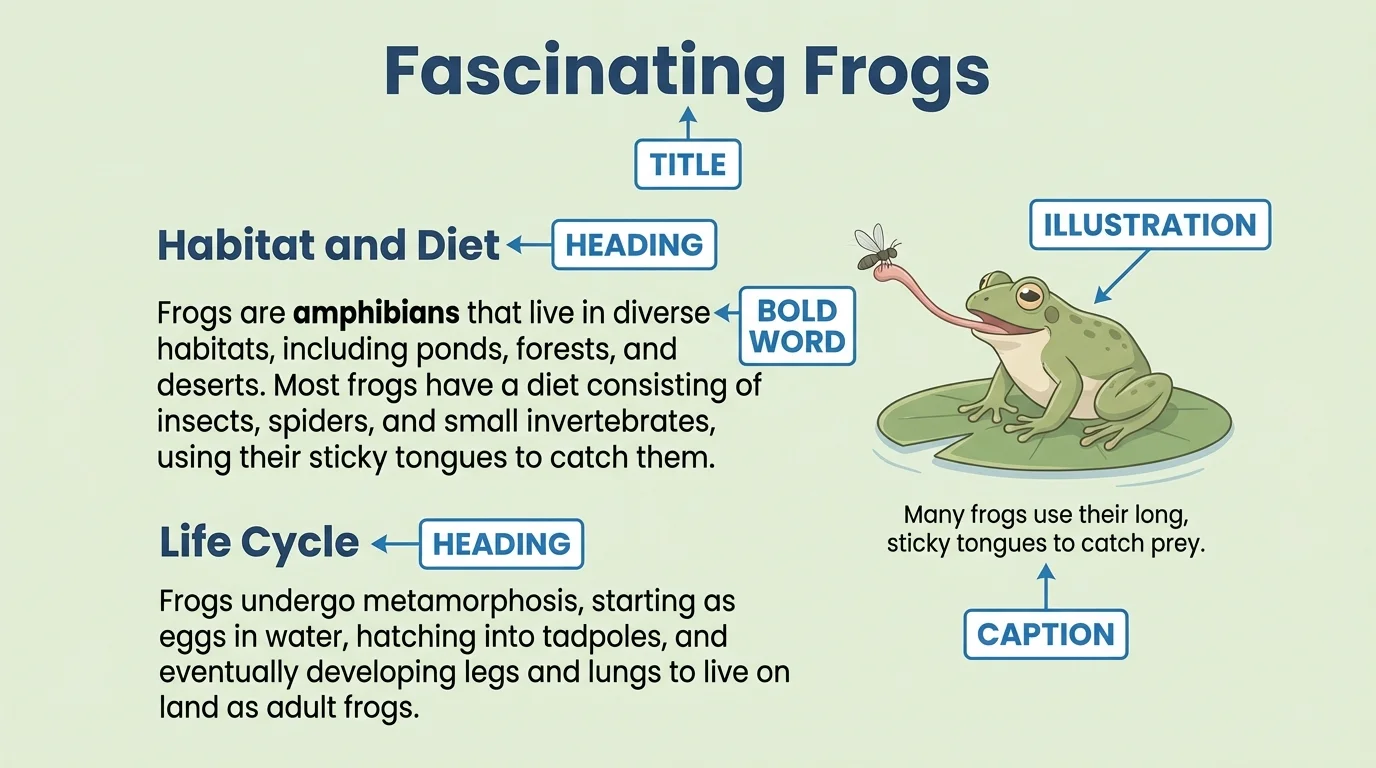
When you open a page, do not rush past these clues. They are there to help you. If the page title is Frogs and a heading says What Frogs Eat, you already know where to look for food facts.
[Figure 2] shows how titles and headings are like signs in a building. The title names the whole topic. Headings break the topic into smaller parts. This makes a page easier to read and easier to search.
Think about a book with the title Weather. Inside, one heading might say Rain. Another heading might say Wind. Another might say Snow. If your question is "What falls from clouds?" the heading Rain helps you know where to look first.
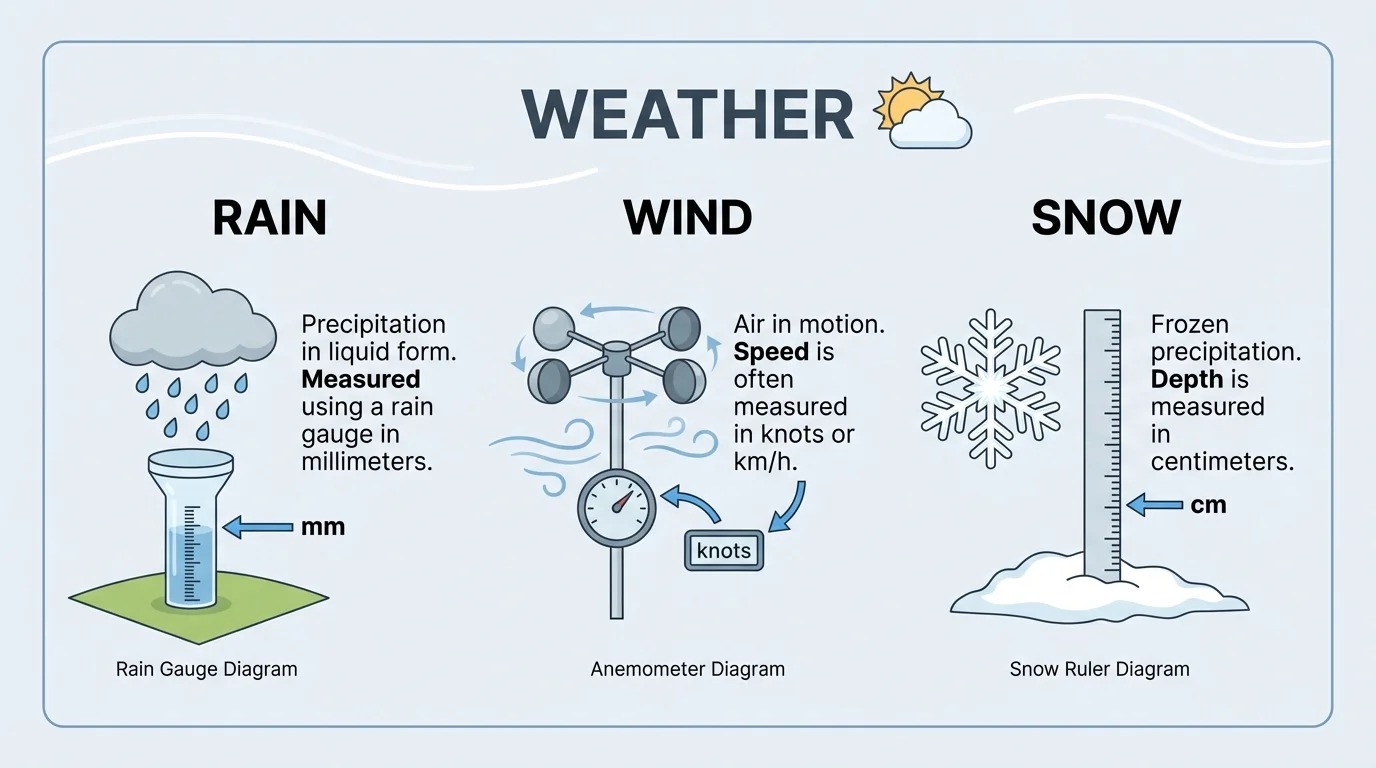
The title gives the big idea. The heading gives the smaller idea. When we use both, we can locate information faster. That means we can spend more time learning and less time searching.
Using a title and heading
A class question is: "Where do bears sleep in winter?"
Step 1: Look at the title.
The title is Bears, so the book is about bears.
Step 2: Look at the headings.
One heading says Food. Another says Homes. Another says Winter.
Step 3: Choose the best heading.
The heading Winter is the best place to look for where bears sleep in winter.
The title and headings help the reader find the right part of the text.
Sometimes a heading answers part of the question before we even read the paragraph. That is one reason headings are so useful in shared research.
[Figure 3] shows that pictures are not just for decoration. They give information too. A picture can show what an animal looks like, how a plant grows, or what a place is like. This can help us understand the words better.
Labels and captions add even more meaning. A label might point to a bird's beak or wings. A caption might say, "A robin uses its beak to pick up food." Now the reader learns from both the picture and the words.
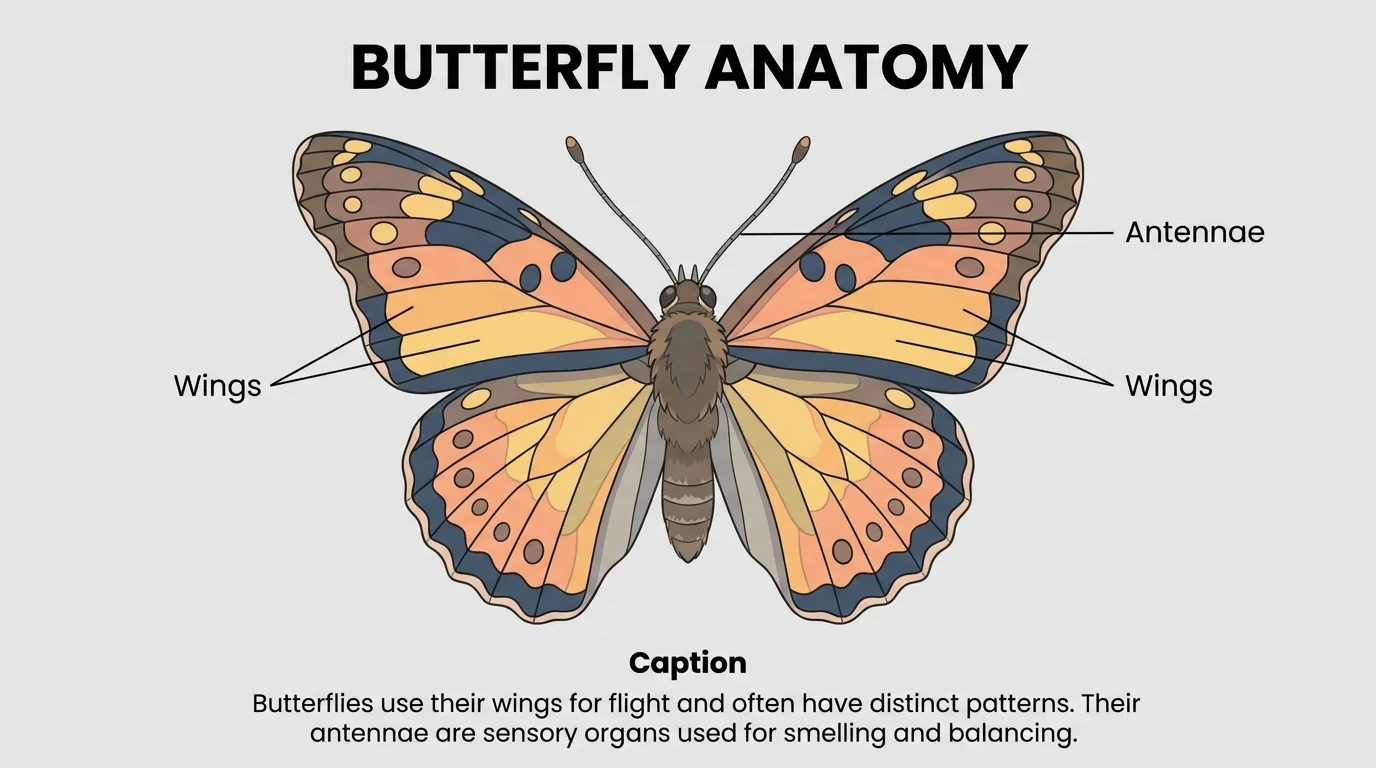
If a page is about butterflies, the illustration can help you notice body parts. The labels tell the names of those parts. The caption tells a little fact about the picture. When readers use all three, they understand more.
Many young readers understand hard ideas better when they look at a picture and the words together. That is why nonfiction books often use clear illustrations with labels and captions.
Later, when you answer a question in class, you can use the picture clues too. If your teacher asks, "Which part helps the butterfly smell?" you might look at the labeled picture and find the antennae.
Sometimes a word looks darker and thicker than the other words. That is bold type. Writers use bold words to show, "This word is important."
For example, in a book about plants, the word roots might be in bold. This tells you to pay close attention. It may be a new word to learn. The sentence near it will often explain what it means.
Bold words can help readers remember key ideas. They can also help readers find special words again when they go back to the page. When we are learning new facts, that is very useful.
Using text features to interpret information
To interpret information means to figure out what it means. Readers do this by putting clues together. A heading tells the topic of a section, a picture adds details, and a bold word points to an important idea. When readers combine these clues, they understand the text more clearly.
Suppose you see the bold word habitat in a book about frogs. You read the heading Where Frogs Live and look at a pond picture. Together, these clues help you understand that habitat means the place where an animal lives.
When a class works together to answer a question, text features help everyone gather facts. If the class asks, "How do plants grow?" students can look for a title about plants, headings such as Seeds or Sunlight, and pictures that show each part of growth.
This is one way readers use information, not just find it. We locate the right page, interpret what it means, and then share the fact in speaking or writing. In a shared inquiry project, these steps help the whole class learn together.
Finding an answer in a class project
The class question is: "What do bees do on flowers?"
Step 1: Find the right text.
A book title says Bees.
Step 2: Search the headings.
A heading says Getting Food.
Step 3: Use the picture and caption.
The picture shows a bee on a flower, and the caption says the bee collects nectar.
Step 4: Share the information.
The class can say, "Bees visit flowers to collect nectar."
Text features help students find facts and use them to answer a question.
The labeled page from earlier, shown in [Figure 1], reminds us that one page can give many kinds of clues at the same time. Good researchers notice all of them.
Strong readers do not use only one text feature. They use many. The title tells the whole topic. The heading narrows the search. The illustration adds details. The caption explains the picture. Bold words point out important vocabulary.
Think about a page called Bird Nests. A heading says Where Nests Are Built. A picture shows a nest in a tree. A caption says, "Some birds build nests high above the ground." A bold word says shelter. All these clues help the reader learn that nests are safe places where birds live and care for eggs.
Titles and headings help us search the page, while pictures and labels help us understand what we find. When we use every clue, learning becomes easier.
That is why text features matter so much. They help us locate information, understand information, and use information to answer questions. They turn a page into a map for learning.
