Have you ever started looking for answers and then wondered, "Wait, what am I really trying to learn?" That happens to researchers too. A good researcher does not just collect lots of facts. A good researcher first decides on a purpose. The purpose tells us why we are learning about something and what we hope to find out.
When we do research, we read, ask, look, listen, and remember information. Our purpose is the reason for doing all of that work. It helps us stay on the right path. If our purpose is clear, we know what kind of facts to gather. If our purpose is not clear, we may gather facts that do not help.
Research purpose means the reason for finding out information. It tells what you want to learn and why that learning matters.
Topic means the subject you are researching, such as frogs, dogs, trees, or weather.
A topic and a purpose work together. The topic is what you are studying. The purpose is why you are studying it. For example, if the topic is frogs, a strong purpose might be "I want to learn how frogs grow." That purpose fits the topic.
A clear purpose matches the topic and is easy to understand, as [Figure 1] shows with good and bad matches. If we say, "I am researching frogs so I can learn what frogs eat," that is clear. We know the topic is frogs, and we know what we are trying to learn.
An unclear purpose may be too mixed up, too broad, or about the wrong thing. If we say, "I am researching frogs to understand more about mammals," that is not clear. Frogs are not mammals. The purpose does not match the topic, so the research may get confusing.
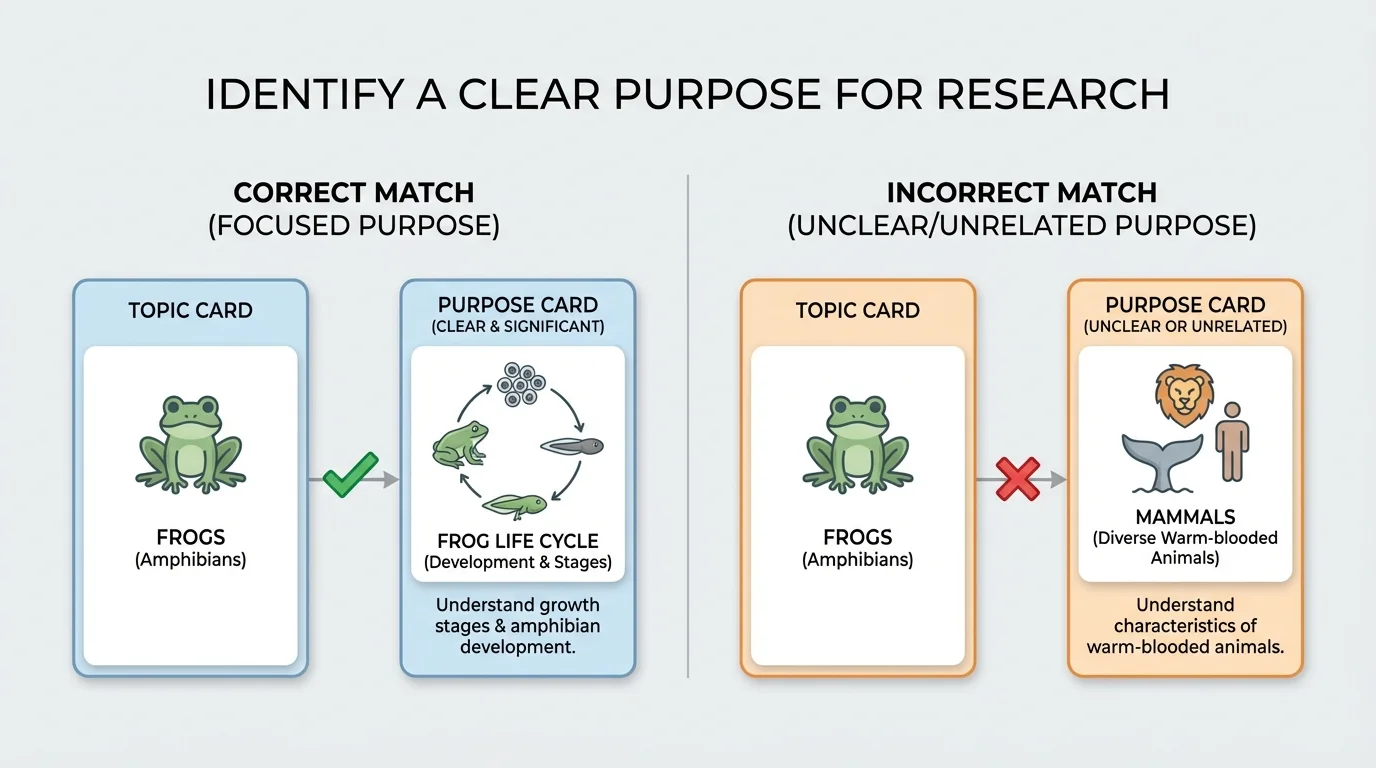
Another unclear purpose is one that is too big. "I want to learn everything about animals" is hard to research because there are too many animals and too many facts. A clearer purpose would be "I want to learn how baby rabbits stay safe." That gives us one good path to follow.
Clear and not clear purposes
Step 1: Look at the topic.
Topic: butterflies
Step 2: Ask if the purpose matches.
"I want to learn how butterflies change as they grow." This matches.
Step 3: Check for confusion.
"I want to learn why fish swim in the ocean." This does not match the butterfly topic.
The first purpose is clear. The second purpose is not clear.
When we read books, look at pictures, or talk with our class, a clear purpose helps us know which details belong. That is why researchers do not choose random facts. They choose facts that fit the purpose.
A purpose should also be important. Important means the research helps us understand something useful about the topic. It should help answer a real question, not a silly or off-topic one.
Suppose the topic is trees. "I want to learn how trees help animals" is important because it teaches something meaningful. Animals use trees for food, homes, and shade. But "I want to learn if trees like ice cream" is not an important purpose because trees do not eat ice cream, and that question does not help us understand trees.
Scientists, doctors, and builders all begin with a purpose. They do not just collect facts. They decide what they need to understand first.
An important purpose does not have to be huge. Small questions can be important too. "How do worms help soil?" is a small question, but it helps us understand gardens and plants. Important research helps us learn something real.
The topic and purpose must fit together. When they do, they help form a good research question or research plan. When they fit, we can answer the question more easily. When they do not fit, we may end up with facts that belong to a different subject.
Look at these examples. If the topic is dogs, a matching purpose is "I want to learn how dogs communicate." If the topic is rain, a matching purpose is "I want to learn where rain comes from." If the topic is frogs, a matching purpose is "I want to learn where frogs live." These are all strong matches.
| Topic | Good Purpose | Does It Match? |
|---|---|---|
| Frogs | Learn how frogs grow | Yes |
| Birds | Learn what nests are for | Yes |
| Sharks | Learn how flowers make seeds | No |
| Weather | Learn why clouds bring rain | Yes |
Table 1. Examples of topics and whether the research purpose matches each topic.
Earlier, we saw in [Figure 1] that some topic-purpose pairs fit and some do not. This is an important checking step before anyone starts gathering information.
A good purpose often becomes a focused question, as [Figure 2] illustrates from a big topic to one small question. A big topic like birds can lead to many smaller questions. We choose one question that is clear and important.
For example, "birds" is a topic. "What do baby birds eat?" is a better research question. "How do birds fly south in winter?" is another good research question. These questions help us know exactly what information to gather.
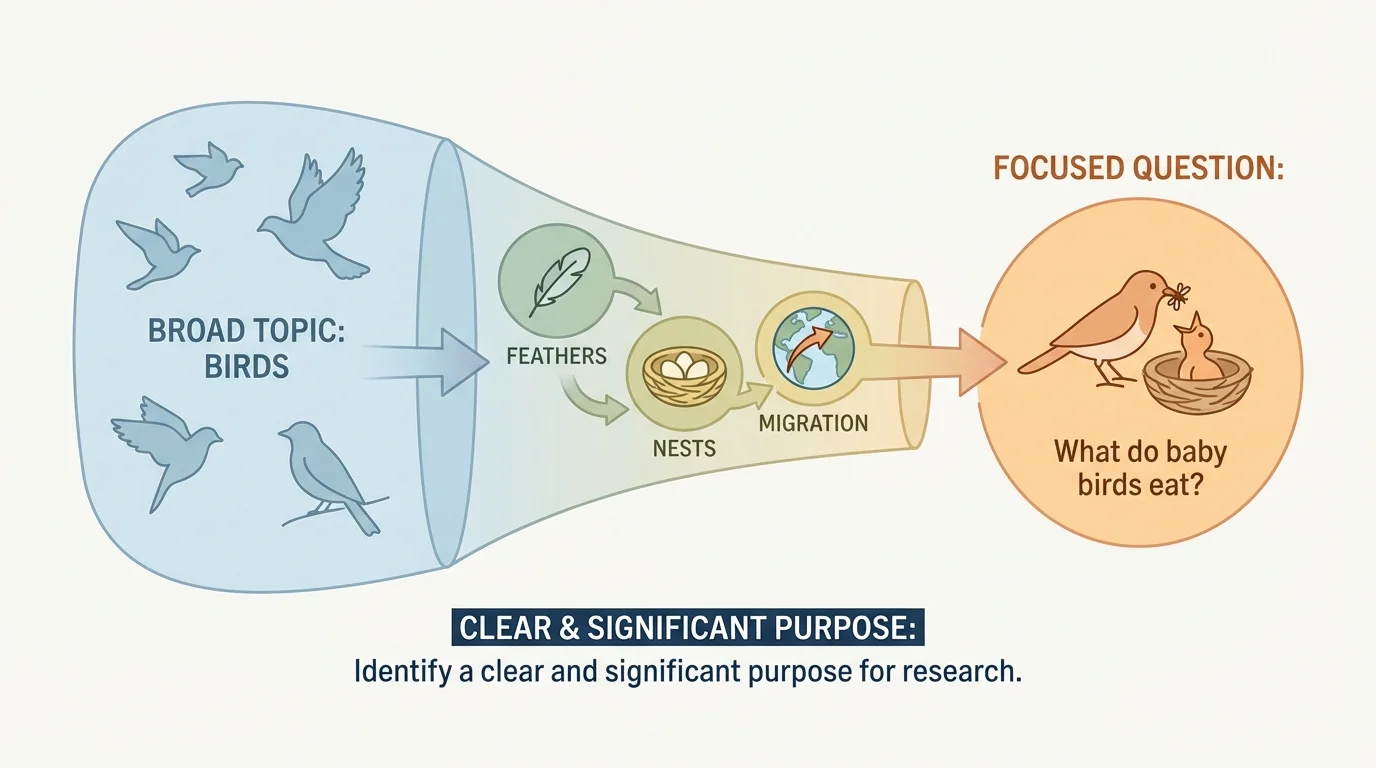
If the question is too broad, we can make it smaller. "What can I learn about insects?" is broad. "How do ants work together?" is smaller and clearer. Researchers often start broad and then narrow their thinking.
From wondering to researching
Research often starts with curiosity. A child wonders about frogs, clouds, or pets. Then the wonder becomes a question. Then the question becomes a purpose. A strong purpose helps the class read, observe, and talk about the right information.
Shared research projects work best when everyone understands the question. If one student looks for facts about frog eggs and another looks for facts about lions, the group will not stay together. One clear question helps the whole class learn as a team.
Once we have a clear and important purpose, we can start a simple inquiry. Inquiry means asking questions and gathering information to answer them. In first grade, this may mean listening to a book, studying pictures, recalling what we already know, or observing something in real life.
If our purpose is "I want to learn what plants need to grow," we gather facts about sunlight, water, soil, and air. We do not need facts about how trucks move or how fish breathe. The purpose helps us sort useful information from information that is not useful.
Good researchers also notice when information does not answer the question. If the class is researching how penguins stay warm, a fact about what zebras eat may be interesting, but it does not fit the purpose. We can save that fact for another day.
You already know how to ask questions like who, what, where, when, and why. Research uses those same question words to guide learning.
As we saw in [Figure 2], moving from a big topic to one question makes gathering information much easier. The question tells us what to listen for and what to write or say later.
Many early research projects are shared projects. That means the class or a small group works together. Students listen to each other's ideas, and then they choose one purpose that is easy to understand and worth studying.
Suppose a class wants to research butterflies. One student says, "Let's learn their colors." Another says, "Let's learn how they begin life." Another says, "Let's learn where they sleep." The class can talk about which purpose is the clearest and which one helps everyone gather good facts.
Teachers often help by asking simple questions: Does it match the topic? Can we answer it? Is it important? If the answer is yes, then the purpose is probably strong.
Choosing a purpose as a class
Step 1: Name the topic.
Topic: rain
Step 2: Share possible purposes.
Learn where rain comes from. Learn what clouds are. Learn if rain can sing songs.
Step 3: Check each one.
The first two are clear and important. The last one is not a real science question.
The class should pick a purpose that is real, clear, and useful.
Working together also helps students hear better questions. Sometimes one child's idea helps another child make a stronger research purpose.
Sometimes a purpose is weak at first, and that is okay. [Figure 3] shows examples of how researchers fix weak purposes so they become clear and important. Changing the purpose is part of learning.
If the topic is frogs and the purpose is "to understand more about mammals," we can fix it. We might change it to "to learn how frogs grow" or "to learn where frogs live." Now the purpose matches the topic.
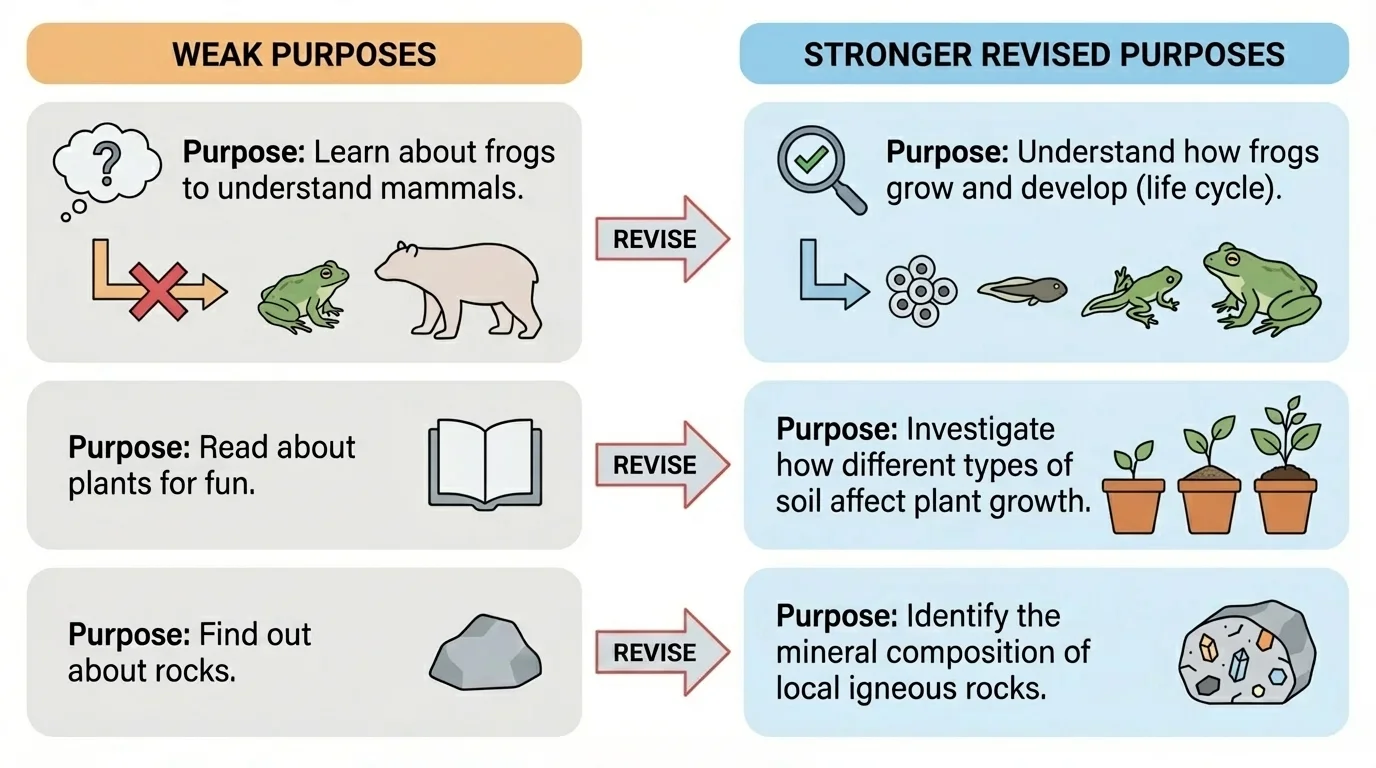
If the purpose is too silly, we can fix it by making it real. "Do stars wear hats?" can become "Why do stars shine?" If the purpose is too big, we can make it smaller. "Learn everything about oceans" can become "Learn what animals live in tide pools."
Later, when students revise their own questions, this model remains helpful: match the topic, make the question real, and keep it focused enough to answer.
A strong purpose helps every part of research. It helps us ask better questions, gather better facts, and share better answers. When we know why we are researching, our learning becomes clearer and stronger.
