A discussion can change what people think, what a class understands, and sometimes even what a community decides to do. In courtrooms, laboratories, school board meetings, and team strategy sessions, the people who move conversations forward are rarely the loudest. They are usually the ones who ask the right questions, listen closely, test ideas carefully, and make room for more than one point of view. That is what effective academic discussion demands: not just speaking, but helping a group think better.
In school, collaborative discussion is not simply a chance to take turns talking. It is a way of examining ideas together. When students discuss a poem, a scientific claim, a current event, or a public policy issue, they are doing more than sharing opinions. They are testing interpretations, comparing evidence, identifying assumptions, and refining conclusions.
Strong discussions matter because difficult questions rarely have simple answers. A class discussing whether social media benefits democracy, for example, may hear arguments about free expression, misinformation, activism, privacy, and mental health. If students only state opinions, the conversation stays shallow. If they probe reasoning and evidence, the conversation becomes analytical.
Reasoning is the logical thinking that connects a claim to its support. Evidence is the information used to support a claim, such as facts, data, quotations, observations, or examples. A position is a viewpoint or stance on an issue. A collaborative discussion is a shared conversation in which participants build understanding together rather than simply trying to win.
Productive discussion also depends on intellectual character. Participants need curiosity, patience, and discipline. They need to recognize that another person's idea may reveal a weakness in their own thinking or may expand it in a valuable way. This is not a sign of failure. It is a sign that genuine learning is happening.
To propel a conversation means to move it forward in a meaningful direction. That does not mean speaking often for its own sake. It means contributing in ways that increase clarity, depth, fairness, and insight.
There are several key ways to do this. First, a speaker can ask questions that probe another person's reasoning or request stronger evidence. Second, a speaker can make sure that a full range of positions is heard rather than letting the conversation be dominated by the first or most confident voices. Third, a speaker can clarify, verify, or challenge ideas and conclusions. Finally, a speaker can promote divergent and creative perspectives by opening the discussion to alternative possibilities.
Each of these actions improves the quality of thinking in the room. If one student says, "School uniforms improve learning," a weak response might be, "I agree" or "I disagree." A stronger response would be, "What evidence connects uniforms to academic performance?" or "Are you arguing that uniforms improve focus, behavior, or school identity?" Those questions force the claim to become clearer and more testable.
The most effective discussions are often shaped by questions rather than speeches. Good questions, as [Figure 1] illustrates, open several paths for analysis at once: they can test logic, uncover assumptions, ask for evidence, or explore consequences. A question should not be asked just to trap someone. It should help the group think more carefully.
One important kind of question probes the basis of a claim. If someone argues that later school start times improve student success, you might ask, "What makes you think start time is the main cause?" That question targets the reasoning behind the idea. Another kind asks for support: "What data or examples support that claim?" That focuses attention on evidence rather than assertion.
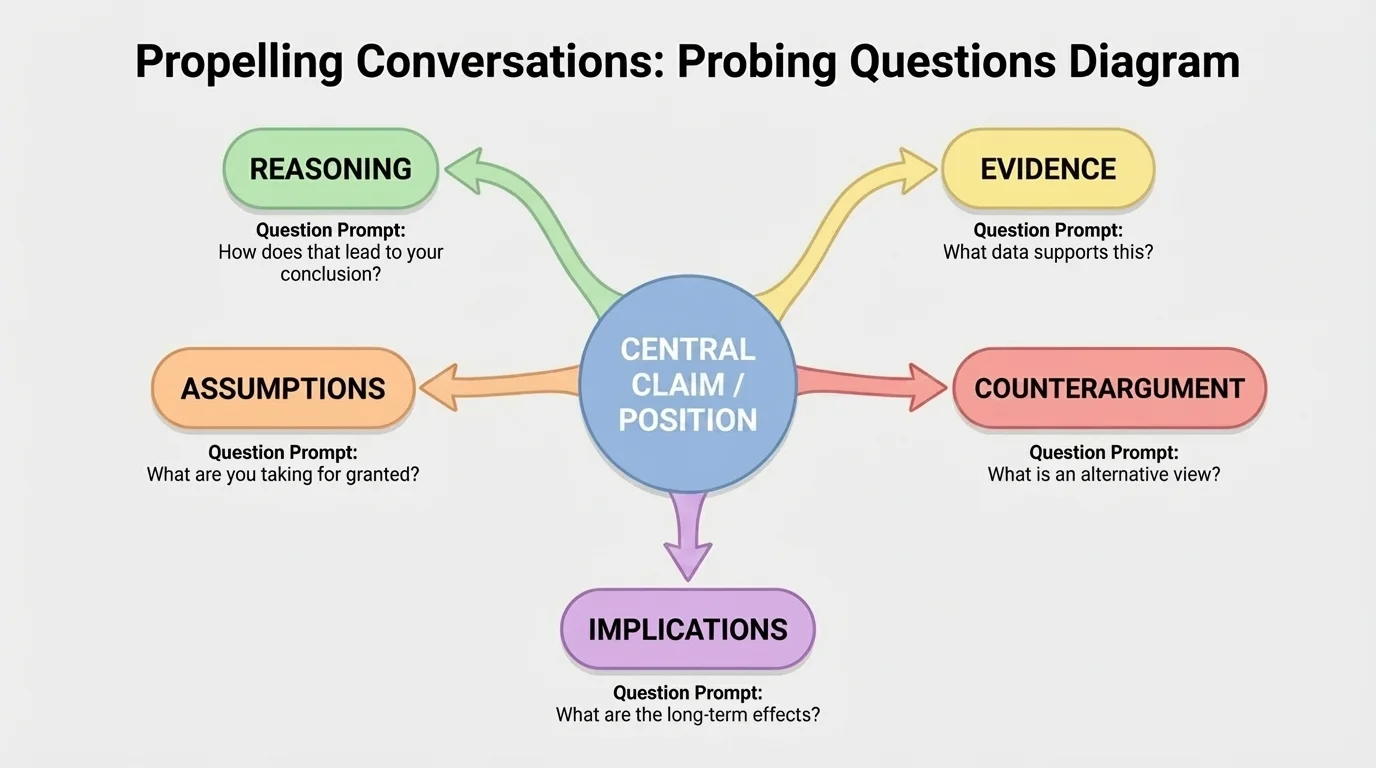
Another powerful category of questions examines assumptions. Every argument rests on ideas that may not be stated directly. A student arguing that artificial intelligence should replace some routine office jobs may be assuming that efficiency matters more than human connection, or that displaced workers can easily retrain. Asking, "What assumptions does that argument rely on?" can expose hidden parts of the logic.
Questions can also explore counterarguments. These are responses that challenge a claim from a different angle. For example: "What would someone on the other side say?" or "How would your argument respond to a case where the opposite happened?" This keeps discussion from becoming one-sided.
A final category asks about implications. If an idea were accepted, what would follow? "If schools banned phones completely, how might that affect emergencies, accessibility, or learning?" Such questions move discussion from simple opinion to broader analysis.
Case study: Turning a shallow exchange into a deeper one
Topic: Should communities limit short-term rental housing?
Step 1: Start with the original claim.
A student says, "Short-term rentals should be limited because they hurt neighborhoods."
Step 2: Probe for clarity.
A classmate asks, "What do you mean by 'hurt neighborhoods'? Are you talking about housing prices, noise, or community stability?"
Step 3: Ask for evidence.
Another student asks, "What sources or examples support that?"
Step 4: Test the reasoning.
A third student asks, "How do you know short-term rentals are a major cause rather than one factor among many?"
Step 5: Invite another perspective.
Someone adds, "What might property owners or tourism workers argue in response?"
By the end, the conversation is not just louder. It is more precise, balanced, and informed.
Notice that none of these responses shuts the discussion down. They keep it moving by making the original claim clearer and more accountable. Later in the lesson, the same branching approach shown in [Figure 1] remains useful whenever a discussion begins to flatten into unsupported statements.
Asking strong questions is only half of the skill. Participants must also respond in ways that add substance. A useful response may agree, disagree, extend, qualify, or reframe an idea. What matters is that the response does intellectual work.
One effective move is to clarify. Clarification helps the group understand exactly what a speaker means. For example: "So are you arguing that technology itself is harmful, or that the way schools use it can be ineffective?" That kind of response prevents misunderstanding.
Another move is to verify. Verification checks whether a statement is accurate or whether the evidence actually says what a speaker claims it says. A student might respond, "I want to make sure I understand the source correctly. Does that study show a long-term effect, or only a short-term change?" Verification is especially important when discussions involve statistics, historical claims, or scientific findings.
A third move is to challenge an idea or conclusion. In academic discussion, a challenge is not a personal attack. It is a careful test of the argument. For example: "I'm not convinced that your conclusion follows from the example you gave. Could there be another explanation?" This keeps rigor high while preserving respect.
Building on others is equally important. A student can say, "I want to extend that point by adding a historical example," or "That argument connects to the article's claim about access and inequality." Discussion becomes collaborative when participants treat one another's ideas as material for further thinking, not just targets to defeat.
Respectful disagreement strengthens discussion. A classroom conversation becomes more intelligent when participants can question ideas without attacking people. Respectful disagreement focuses on claims, reasoning, and evidence. It uses language that is direct but measured, such as "I see the issue differently because..." or "That conclusion seems incomplete because..." This preserves trust while allowing serious intellectual challenge.
Good responders also pay attention to timing. They do not interrupt, dominate, or repeat what has already been said without adding value. Sometimes the best response is to synthesize: "So far, we seem to have two different definitions of fairness. Maybe we should compare those directly." That kind of comment helps the group organize its thinking.
A strong discussion is not truly strong if only a few voices shape it. Ensuring a full range of positions means making space for multiple viewpoints, especially when a topic is controversial or complex. Good discussion is not just about who speaks most; it is also about who is invited in, who is listened to, and whose ideas are taken seriously.
[Figure 2] This matters because conversations can become distorted. Sometimes the first idea shared becomes the default. Sometimes confident speakers receive more attention than careful thinkers. Sometimes minority views are dismissed too quickly. In each case, the group may mistake limited discussion for complete understanding.
To prevent that, participants can use moves such as: "We have heard one side clearly; what is another possible perspective?" or "I want to bring in a point that has not been considered yet." They can also invite quieter participants respectfully: "I'm interested in hearing how you read that evidence." These moves broaden the discussion without forcing anyone into performance.
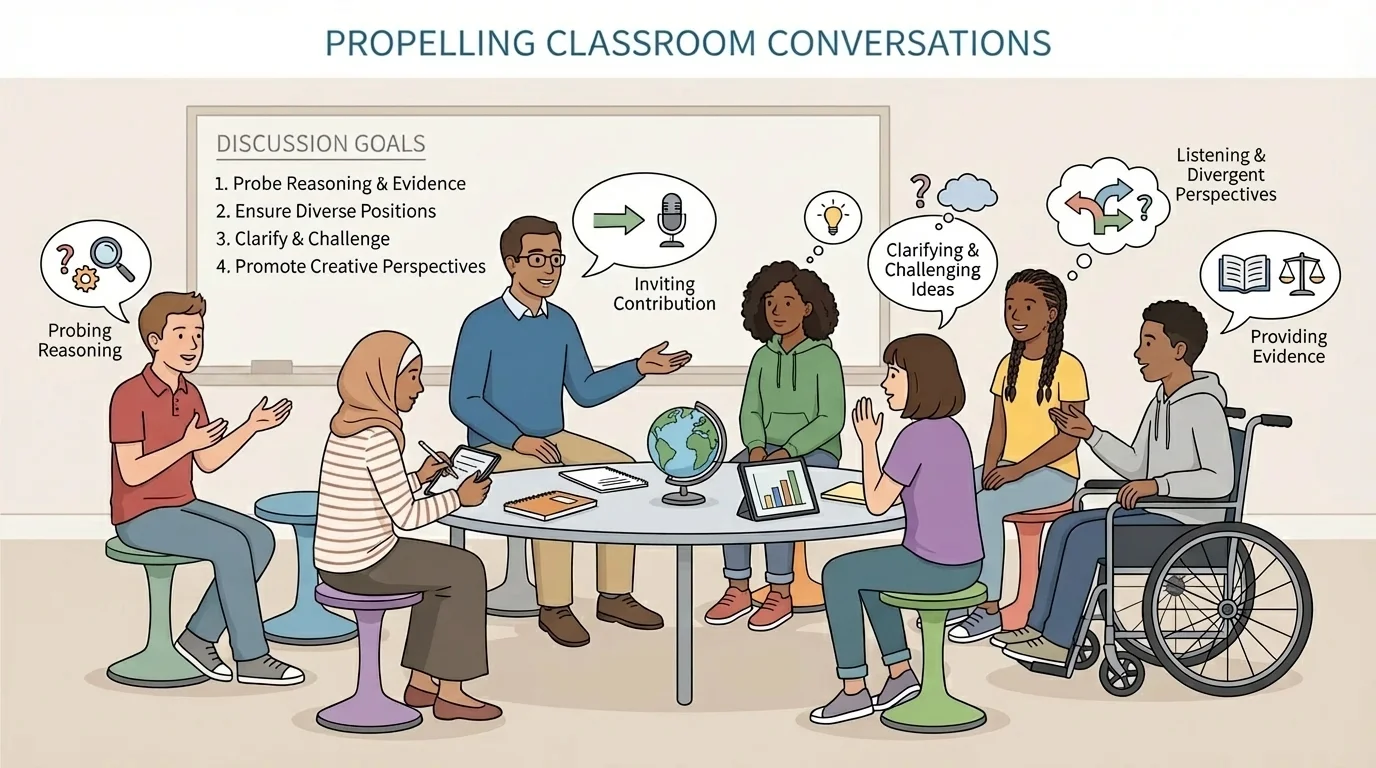
Hearing a full range of positions does not mean all positions are equally strong. It means they deserve to be heard and evaluated based on reasoning and evidence. In a discussion about climate policy, for instance, one student may emphasize economic costs while another emphasizes environmental urgency. Both perspectives should be examined carefully. The goal is fairness in hearing, not automatic agreement.
Listening is therefore an active academic skill. It involves identifying the speaker's main claim, noting their support, and considering what question or response would move the discussion forward. Much later in a conversation, the inclusive structure shown in [Figure 2] still matters because a discussion can only remain balanced if participants continue making room for overlooked voices and neglected ideas.
Studies of group decision-making often show that teams perform better when members feel safe enough to disagree. Groups that silence dissent may appear efficient, but they are more likely to overlook errors and weak reasoning.
Academic discussion also requires attention to how ideas are framed. A student should be able to summarize an opposing view fairly before criticizing it. This practice prevents the straw man problem, where someone oversimplifies an opponent's idea in order to attack an easier version of it.
Not all evidence is equally convincing. Skilled discussants weigh support carefully instead of treating every example as equally reliable. They ask whether the evidence is relevant, credible, sufficient, and accurately interpreted.
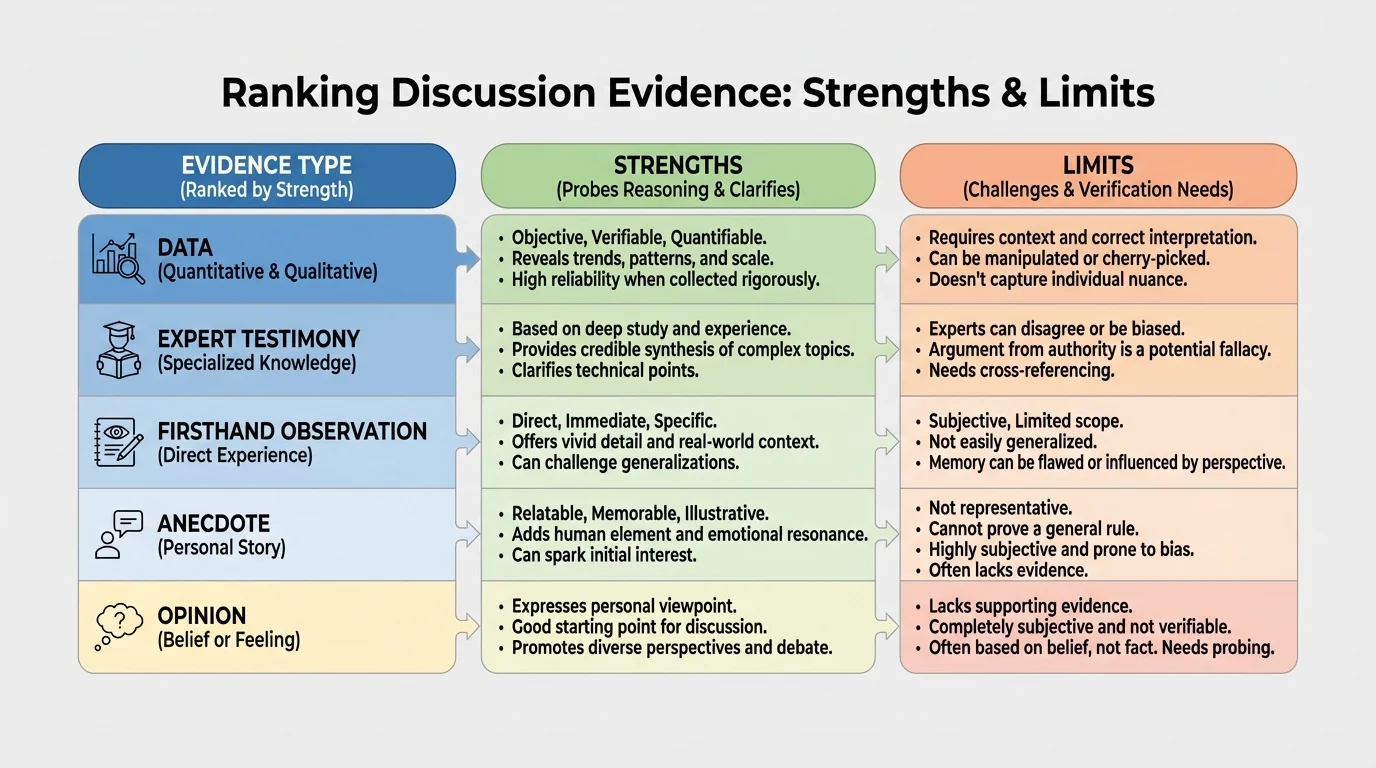
[Figure 3] For example, suppose a student argues that online learning is ineffective because "my cousin learned nothing during remote school." That is an anecdote: a single personal example. It may matter, but it is limited. A stronger argument might include a large study, multiple data sets, expert analysis, and attention to differences among learning environments.
Reasoning must also be examined. Even if the evidence is real, the conclusion may not follow. A student might say, "Students at one high-performing school wear uniforms, so uniforms cause high achievement." That conclusion confuses correlation with causation. Many other factors could explain the result.
| Type of support | What it includes | Strengths | Limits |
|---|---|---|---|
| Data and research findings | Survey results, experiments, statistical studies | Can reveal patterns across many cases | Must be interpreted carefully |
| Expert testimony | Statements from qualified specialists | Uses deep knowledge and experience | Experts can still disagree or be biased |
| Textual evidence | Quotations, details, passages from sources | Anchors interpretation in the source itself | Can be quoted selectively |
| Firsthand observation | Direct witness or experience | Can provide concrete detail | Often limited in scope |
| Anecdote or personal story | Single example from personal experience | Memorable and relatable | Weak basis for broad conclusions |
| Opinion without support | Belief stated without evidence | May reveal perspective | Not enough for strong argument |
Table 1. Comparison of common types of support used in classroom discussion and their strengths and limitations.
Another important test is source credibility. Who produced the information? What is their expertise? What might their purpose be? A government report, a peer-reviewed study, a reputable newspaper, a corporate advertisement, and an anonymous social media post do not carry the same weight.
The evidence hierarchy in [Figure 3] helps students remember that good discussion is not about collecting the most statements. It is about using the most relevant and trustworthy support, then connecting that support through sound logic.
Evaluating a claim
Claim: "Cell phones should be banned in all classrooms because they always distract students."
Step 1: Examine the language.
The word always makes the claim absolute. Absolute claims are often easier to challenge because one counterexample can weaken them.
Step 2: Ask for evidence.
What research supports the claim? Are there classroom studies, teacher reports, or district data?
Step 3: Test for alternative explanations.
Could distraction result from unclear classroom expectations rather than phones alone?
Step 4: Consider nuance.
Are there cases where phones support translation, accessibility, research, or emergency communication?
This process does not guarantee one final answer, but it improves the quality of the discussion.
Some of the best discussions do more than compare two familiar sides. They generate new angles. A divergent perspective introduces a fresh way of seeing the issue. It does not ignore evidence or logic; it expands the field of thought.
Suppose a class is debating whether cities should invest more in public transportation. One student focuses on traffic, another on climate, and another on cost. A divergent contribution might ask, "How might transit design affect access to jobs and health care?" Another might ask, "What can be learned from cities with very different population patterns?" These moves widen the frame of analysis.
Creative perspectives often come from comparison, analogy, or reframing. In literature discussion, a student may compare a character's conflict to a modern social dilemma. In science policy discussion, a student may suggest testing the issue at a smaller scale before adopting a nationwide plan. In civic debate, a student may propose a compromise that combines two apparently opposing positions.
"The important thing is not to stop questioning."
— Albert Einstein
Promoting creative perspectives also helps prevent groupthink, a situation in which a group starts valuing agreement more than careful analysis. When everyone quickly settles on the same conclusion, discussion may feel smooth, but important questions may have been skipped.
Creative discussion does not mean random discussion. New perspectives must still connect to the topic, respond to previous ideas, and be supported with reasoning or evidence. The goal is originality with discipline.
Students need to participate effectively in different discussion formats because each one requires somewhat different habits. In a one-on-one conversation, listening and responsiveness become especially visible. You cannot hide in the group. You must track the other person's idea closely and respond directly.
In small groups, the challenge is balance. Participants need to share airtime, connect ideas across speakers, and prevent the discussion from splitting into separate side conversations. Small groups often benefit from participants who summarize, redirect, and invite quieter members to speak.
In teacher-led discussions, students must learn to contribute without waiting passively for the teacher to do all the thinking. A teacher may guide the discussion, but students still need to build on one another's points, refer to evidence, and challenge ideas respectfully.
Good collaborative habits from earlier grades still matter here: come prepared, refer to the text or topic, listen attentively, and respond to what others actually say rather than what you assume they mean. Advanced discussion builds on these basics; it does not replace them.
Across all settings, strong participants keep the purpose of the discussion in mind. Are they interpreting a text? Solving a problem? Evaluating a proposal? The goal should shape the kinds of questions and responses they choose.
One common problem is confusing confidence with quality. A forceful statement can sound persuasive even when the reasoning is weak. That is why students must focus on argument quality, not delivery alone.
Another pitfall is repetition without development. If a student restates the same opinion three times, the conversation does not advance. To propel discussion, each contribution should add something: a distinction, an example, a challenge, a synthesis, or a new question.
A third pitfall is personalizing disagreement. Statements like "That's ridiculous" or "You clearly don't understand" damage the discussion because they target the person rather than the idea. In academic discourse, criticism should remain focused on claims, logic, evidence, and interpretation.
Students should also avoid rushing to conclusions. Some topics require uncertainty. A strong participant can say, "The evidence seems mixed," or "I think we need to distinguish between short-term and long-term effects." Intellectual honesty is a strength, not a weakness.
Discussion becomes more precise when students use deliberate language. Instead of saying "That's wrong," a student might say, "I question that conclusion because the evidence seems too limited." Instead of saying "I just feel like...," a student might say, "My position is based on the article's second claim and the survey data." The second versions are clearer, more respectful, and more persuasive.
The following expressions can help students contribute effectively without sounding artificial.
| Purpose | Useful discussion language |
|---|---|
| Ask for reasoning | "What leads you to that conclusion?" |
| Ask for evidence | "What evidence supports that claim?" |
| Clarify meaning | "Can you explain what you mean by...?" |
| Verify accuracy | "Is that what the source actually argues?" |
| Challenge respectfully | "I see a weakness in that reasoning because..." |
| Build on an idea | "I want to extend that point by..." |
| Invite another view | "What perspective have we not considered yet?" |
| Synthesize | "It seems we have two main positions so far..." |
Table 2. Discussion moves and sentence patterns that help students participate clearly and persuasively.
These sentence patterns are not scripts to memorize mechanically. They are tools for disciplined thinking. Used well, they help students make their reasoning visible and make the conversation more rigorous for everyone.
