A single sentence in a novel can change how readers judge a character, but only if they can prove their interpretation. In serious reading and writing, saying "I think" is not enough. Strong analysis depends on evidence: exact words, patterns, images, actions, and details from the text. The best readers do more than locate a quote. They show what the text says directly, what it suggests indirectly, and where it refuses to provide a clear answer.
When teachers ask for analysis, they are not asking for personal reaction alone. They are asking you to make a claim and support it with the language of the text itself. That is what separates literary analysis from casual opinion. A reader might feel that a character is brave, selfish, lonely, dishonest, or conflicted. But unless that judgment is supported by the text, it remains only an impression.
Evidence-based reading also matters outside English class. Historians use documents to support interpretations of the past. Journalists support claims with verifiable sources. Scientists justify conclusions with data. In every case, the standard is similar: the claim must match the available evidence. Reading literature with care develops the same discipline of mind.
Textual evidence is the specific language or detail from a text that supports a claim. Explicit meaning is what the text directly states. An inference is a conclusion drawn from evidence and reasoning rather than directly stated words. Uncertainty or ambiguity appears when the text does not fully resolve a question, leaving more than one reasonable interpretation.
Good readers constantly move among these levels. They notice what is plainly stated, infer what is strongly suggested, and recognize where certainty would go beyond the evidence. That last part is especially important. Mature analysis does not pretend that every text has one simple, complete answer.
In analytical writing, a claim is the point you are making about a text. It should be specific enough to prove. "This poem is interesting" is too vague. "The poem presents memory as both comforting and painful" is a claim that can be tested with evidence.
Analysis means explaining how the evidence supports the claim. A quotation by itself is not analysis. Analysis is the thinking that connects the quoted words to your interpretation. It answers questions such as: Why does this detail matter? What does this word choice reveal? How does this moment shape meaning?
A quotation is one form of evidence, but it is not the only one. You can also cite actions, patterns, recurring images, structural choices, contradictions, and shifts in tone. Sometimes a short phrase is more powerful than a long passage because it is more focused and easier to explain.
A reasonable inference depends on textual support. It is not a wild guess or a personal fantasy about the character or author. If several details point in the same direction, the inference becomes stronger. If the text offers mixed signals, a careful reader acknowledges that complexity.
Evidence should be relevant, specific, and sufficient. Relevance means the detail actually relates to the claim. Specificity means the evidence is concrete, not vague. Sufficiency means you have enough support to make the interpretation convincing. As [Figure 1] shows, evidence quality works on a scale: some support is weak because it is broad or isolated, while strong and thorough support combines well-chosen details with clear explanation.
Strong evidence often comes from multiple parts of a text. One line may suggest an idea, but several details across a scene, chapter, or whole work can establish a pattern. Thoroughness does not mean stuffing a paragraph with quotations. It means selecting enough evidence to show that your reading is not accidental or based on a single convenient line.
Context matters too. A sentence can mean one thing by itself and something more complicated in its original setting. Readers should notice who is speaking, when the line appears, what just happened, and whether the speaker is trustworthy. A character's statement is evidence of what the character says, but not always evidence that the statement is true.
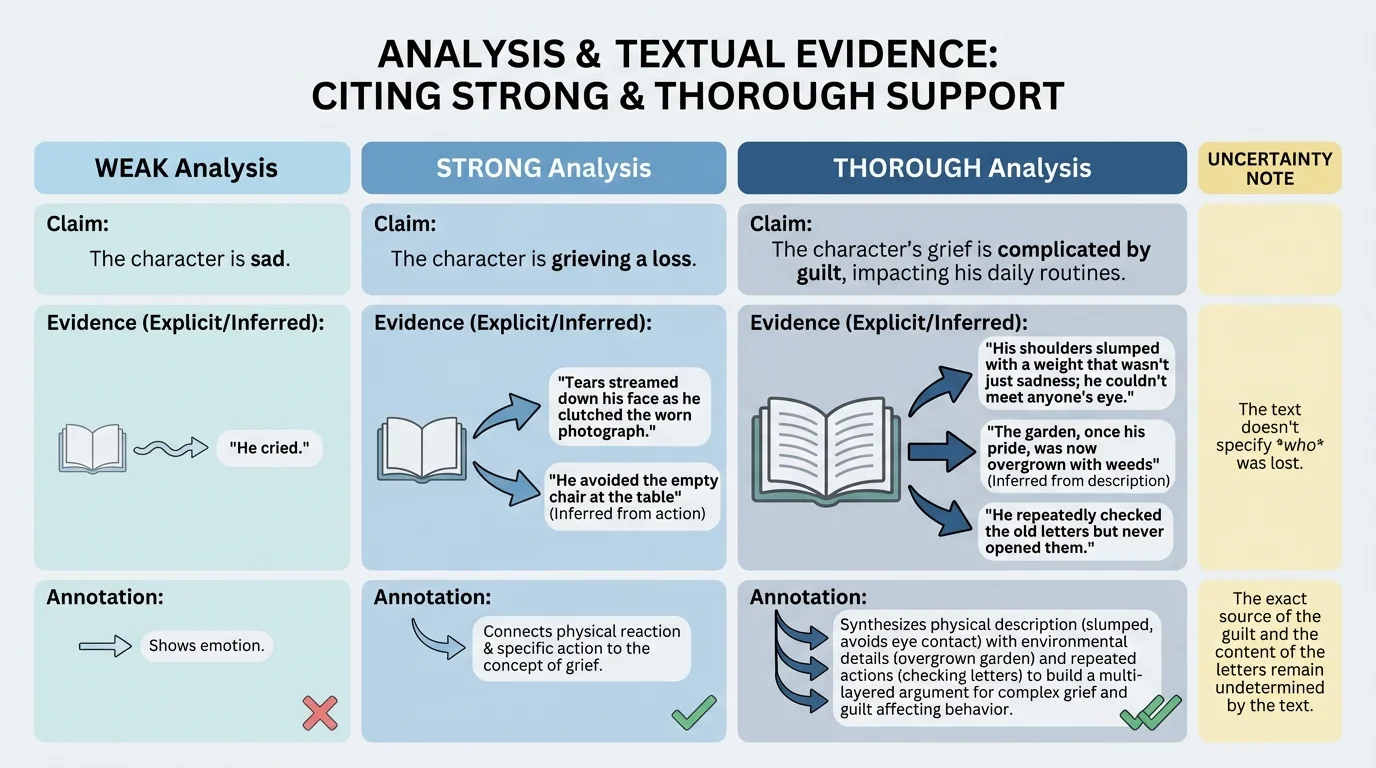
To judge whether evidence is strong, ask several questions. Does this quotation directly relate to my claim? Does it contain language worth analyzing? Do I have more than one detail if the point is important? Have I explained how the evidence works, or did I simply drop it into the paragraph and move on?
Many sophisticated literary arguments are weakened not by bad ideas, but by evidence that is too thin. A smart claim with one poorly explained quote is less convincing than a modest claim supported carefully and fully.
Sometimes the strongest evidence is not the most dramatic line in the text. A repeated word, a shift in punctuation, a contrast between scenes, or a small contradiction may reveal more than a famous quote. Skilled readers are attentive to patterns, not just highlights.
To analyze explicit meaning, begin with what the text directly states. This includes clear facts, direct descriptions, obvious actions, and plainly expressed ideas. If a narrator says, "I had lied to her every day that week," the text explicitly states dishonesty. You do not need to infer that the speaker lied; the words tell you.
Explicit reading sounds simple, but it often requires precision. Students sometimes paraphrase loosely and lose meaning. For example, if a text says a character "hesitated before answering," that is not the same as saying the character "refused to answer." One detail suggests uncertainty; the other claims outright resistance. Exact wording matters.
Reading explicitly also means tracking patterns the text openly presents. A poem may repeatedly mention winter, silence, or closed doors. Those images are directly there on the page. Your interpretation of them may involve inference, but first you must accurately identify what the text repeatedly includes.
Example: explicit meaning in a short passage
Passage: "Elena folded the letter twice, placed it back in the drawer, and locked the desk before anyone entered."
Step 1: Identify direct actions.
The text explicitly states that Elena folds the letter, puts it in a drawer, and locks the desk.
Step 2: Avoid adding meaning too fast.
At this stage, we can say she is concealing or protecting the letter, but we should not yet claim exactly why.
Step 3: Build the base for later inference.
The direct details create a foundation for analyzing secrecy, fear, privacy, or guilt, depending on what surrounding evidence reveals.
Strong readers separate observation from interpretation. First identify what is undeniably present. Then ask what those details imply. This order keeps analysis grounded and prevents unsupported leaps.
Some of the most important meanings in literature are implied rather than directly stated. A reader makes an inference by connecting details and reasoning from them. This process works like a chain, as [Figure 2] illustrates: you begin with observation, connect related details, and arrive at a conclusion that the text supports even though it does not say it outright.
Suppose a character smiles while tearing up a photograph, then tells others she is "perfectly fine." The text may never directly say she is grieving or angry. But the combination of action, imagery, and contrast between words and behavior supports that inference. The key is that the reader can point to evidence for the conclusion.
Good inference is disciplined. It stays close to the text. If a conclusion depends on assumptions that the text never suggests, the inference becomes weak. If several details consistently support the same conclusion, the inference becomes stronger.
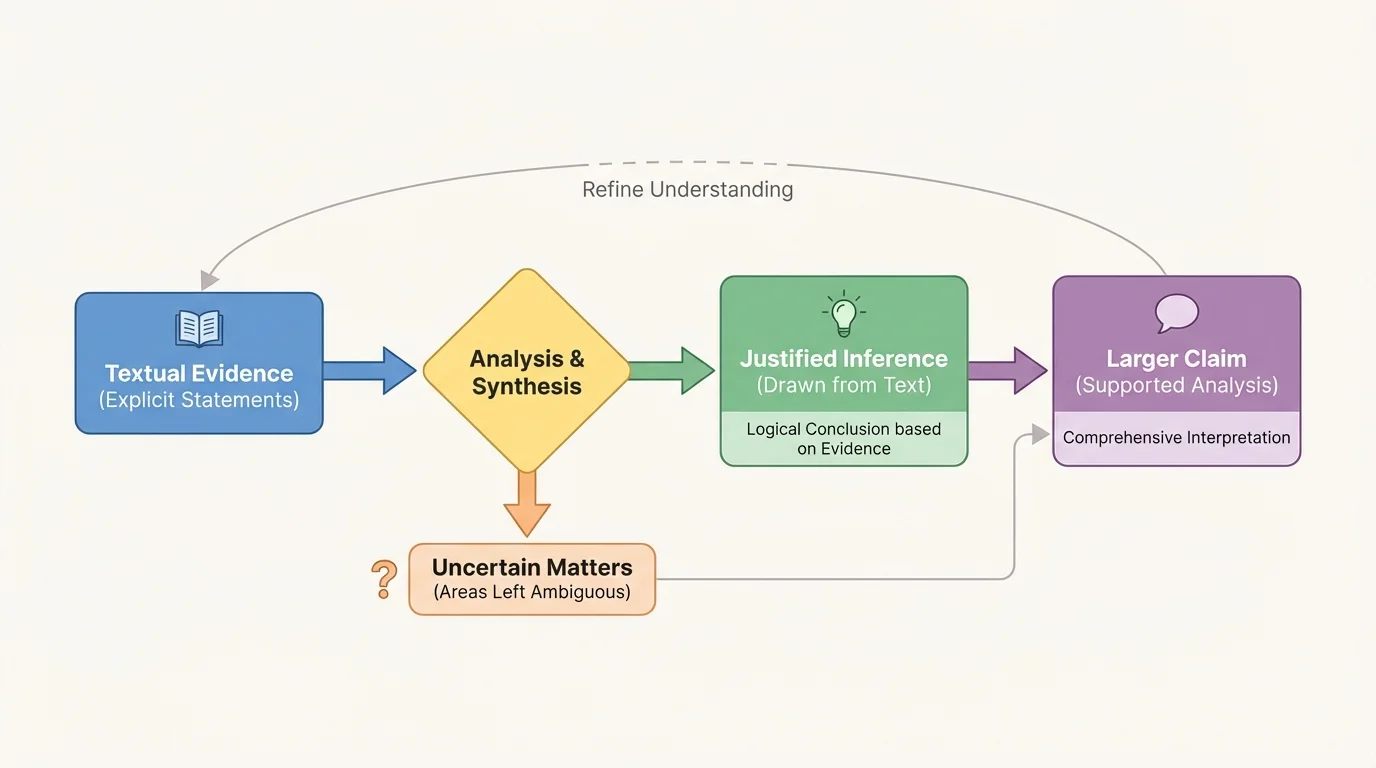
Inference is especially important when characters are complex or narrators are indirect. Writers often avoid explaining everything because they want readers to do interpretive work. A mature reader notices contradictions between speech and action, gaps between self-image and behavior, and tension between surface meaning and deeper implication.
For example, in a story a narrator may describe a neighborhood as "ordinary" while also listing boarded windows, constant sirens, and abandoned stores. The explicit statement is that the neighborhood is ordinary. The inference may be that the narrator is normalizing hardship, hiding discomfort, or revealing a limited perspective. The words on the page justify that conclusion.
How inference stays reliable
A strong inference usually rests on more than one clue. It considers diction, tone, actions, setting, and patterns together. It also remains open to revision if later evidence complicates the first impression.
Notice how this connects back to evidence quality in [Figure 1]. One clue may start an interpretation, but thorough analysis usually develops from several details working together. That is why literary essays often become more convincing when they trace a pattern across multiple moments instead of focusing on only one.
Not every question has a final answer. Skilled readers distinguish among what the text proves, what it strongly suggests, and what remains unresolved, as [Figure 3] demonstrates. This is one of the most advanced parts of analysis because it requires intellectual honesty. You must resist claiming certainty where the text leaves room for doubt.
A text may leave matters uncertain for many reasons. A narrator may be unreliable. A story may end before a conflict is resolved. A poem may use symbolic language that allows multiple interpretations. A character's motive may be mixed rather than singular. Sometimes the author intentionally creates ambiguity because uncertainty itself is part of the meaning.
Consider a story that ends with a character standing outside a house at midnight, holding a suitcase, but never entering or leaving. We can infer conflict, hesitation, or transition. But if the text does not reveal the final choice, then any claim that the character definitely stays or definitely leaves goes beyond the evidence.
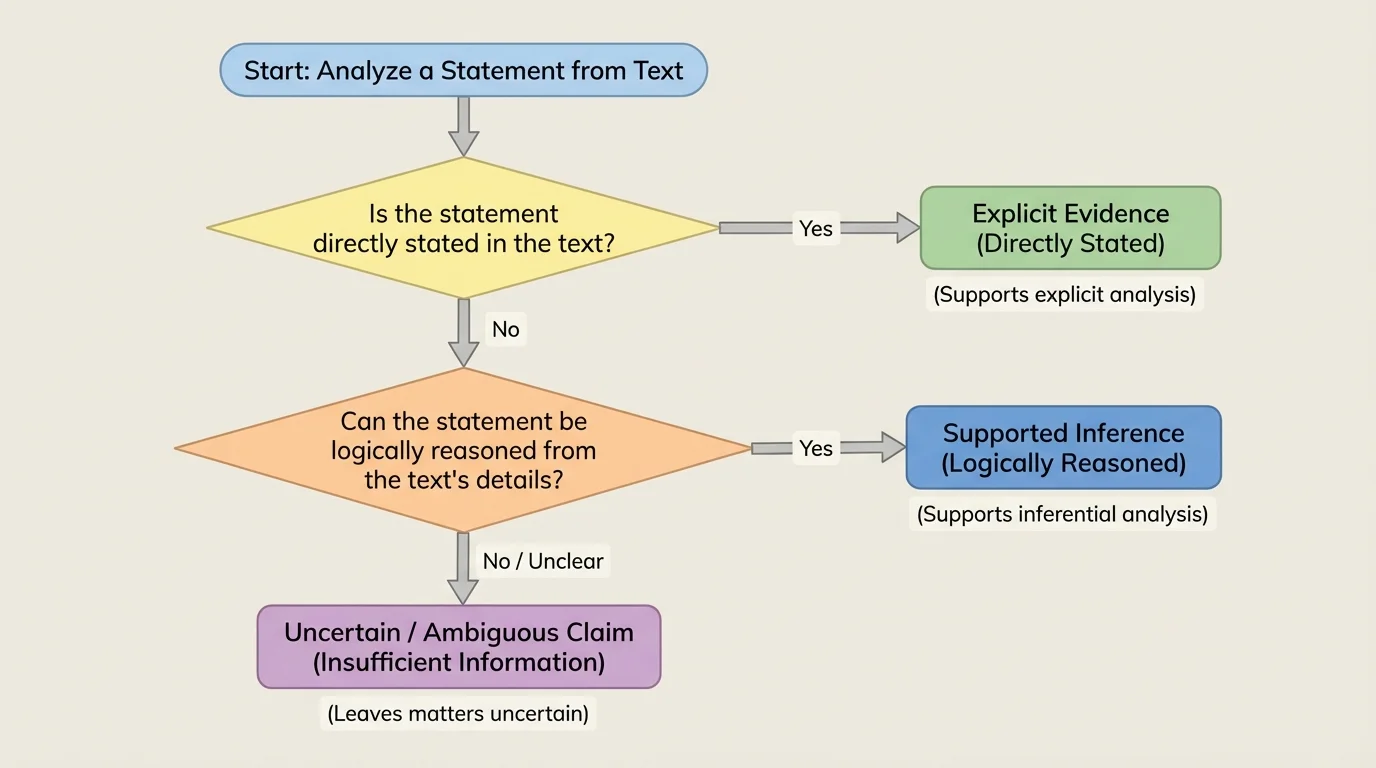
Recognizing uncertainty is not weakness. It is strong reading. An essay can make a powerful argument by showing that a text deliberately withholds closure. For example, you might argue that the unresolved ending reflects the character's fractured identity or the social pressures that make decisive action impossible.
Uncertainty also appears when evidence points in more than one direction. A character may act generously in one chapter and cruelly in another. Rather than forcing a simple label, a strong analysis might conclude that the text presents the character as morally conflicted. That interpretation respects the complexity of the evidence.
Example: identifying uncertainty
Passage: "Marcus laughed when the verdict was read, but his hands shook so badly that he dropped his hat."
Step 1: State what is explicit.
The text explicitly says Marcus laughs and that his hands shake.
Step 2: Form a supported inference.
We can infer that his emotional state is unstable or conflicted because his behavior sends mixed signals.
Step 3: Mark uncertainty.
We cannot say with certainty whether he laughs from relief, shock, fear, defiance, or something else unless other evidence clarifies it.
That distinction matters. A thoughtful reader can write, "Marcus appears emotionally conflicted, though the text leaves the exact cause of his reaction uncertain." This sentence is precise, evidence-based, and honest about limits.
Once you find evidence, you must use it effectively. A quotation should be introduced, presented accurately, and followed by commentary. Readers need to understand who is speaking, what is happening, and why the quoted words matter.
A common problem is the "dropped quote," in which a quotation appears without context or explanation. For example: The character is dishonest. "I had lied to her every day that week." This gives evidence, but it is abrupt. A better version integrates the quotation: The narrator admits sustained deception when he confesses that he had "lied to her every day that week," a phrase that emphasizes not one mistake but a repeated pattern of dishonesty.
The improvement comes from commentary. Commentary explains significance. It might focus on diction, imagery, contrast, symbolism, structure, or tone. Without commentary, even a strong quotation does not fully support analysis because the reader is left to guess why it matters.
Paraphrase can also be useful, especially when a passage is long or when the important evidence is a sequence of events rather than exact wording. But paraphrase must stay accurate. Do not distort a passage just to make it fit your argument.
The differences among weak, strong, and thorough writing become clearer when placed side by side.
| Type of response | What it does | Limitation or strength |
|---|---|---|
| Weak | Makes a claim with little or no evidence | Sounds like opinion; not convincing |
| Stronger | Uses one relevant quotation and some explanation | Supported, but may be too narrow |
| Thorough | Uses multiple relevant details, explains them clearly, and acknowledges complexity | Most convincing because it shows a pattern and respects nuance |
Table 1. Comparison of weak, stronger, and thorough evidence-based analysis.
A weak paragraph might say that a speaker is lonely because the poem feels sad. A stronger paragraph might quote a line about "empty rooms" and explain that this image suggests isolation. A thorough paragraph might add that the speaker also avoids direct conversation, repeats words related to silence, and shifts from memory to absence, creating a broader pattern of loneliness.
Thoroughness can also include acknowledging uncertainty. If the same poem includes moments of comfort or chosen solitude, a sophisticated analysis might argue that the speaker experiences loneliness and refuge at the same time. That kind of reading is both nuanced and well supported.
In fiction, evidence may come from characterization, setting, plot, symbolism, point of view, and dialogue. In drama, stage directions and pauses may matter as much as spoken lines. In poetry, individual words, line breaks, images, sound patterns, and figurative language often carry major meaning.
Suppose a poem repeatedly uses images of cracked glass, fading light, and interrupted music. None of those images may directly state, "The speaker feels emotionally broken." Yet together they strongly support that inference. If the final stanza introduces a single image of dawn, a strong analysis will ask whether that image offers hope, irony, or only temporary relief.
Literary analysis also benefits from noticing form. A fragmented structure may reinforce emotional fragmentation. A sudden shift from first person to third person may create distance. A repeated symbol may evolve in meaning over time. Evidence is not limited to plot facts; it includes artistic choices.
"The text is a pattern of meanings, not a container of answers."
— Critical reading principle
That principle helps explain why [Figure 3] remains important even in literary interpretation. Some texts are powerful because they resist a single final explanation. Your task is not to eliminate complexity but to describe it accurately with evidence.
The same reading skill applies to speeches, essays, memoirs, and articles. In nonfiction, readers still examine explicit claims, implied assumptions, and unresolved questions. A speaker may directly argue for justice, while also implying distrust of institutions through tone and examples.
When reading an editorial, strong evidence may include statistics, anecdotes, loaded language, or omitted perspectives. You can analyze not only what the writer says explicitly, but also what the writer suggests about audience, values, or priorities. You can also notice what remains uncertain because of limited evidence or selective framing.
For instance, an article may present two success stories as proof that a policy always works. The explicit claim is clear, but a careful reader asks whether the evidence is sufficient. Are there missing counterexamples? Is the conclusion broader than the available support? This is evidence-based reading in action.
One common mistake is confusing summary with analysis. Summary tells what happened. Analysis explains what it means and how the text creates that meaning. Another mistake is overquoting. Long quotations often reduce the space available for interpretation. Short, targeted quotations are usually easier to analyze effectively.
A third mistake is making an inference that the text cannot support. If your interpretation would surprise another careful reader because it relies on ideas absent from the text, it is probably too far removed from the evidence. A fourth mistake is using absolute language such as "proves" or "clearly" when the text is actually ambiguous.
It is also risky to ignore conflicting evidence. If a passage complicates your claim, address it. Doing so often strengthens your argument because it shows that you have considered the text honestly rather than selecting only convenient details.
From earlier reading work, remember that effective annotation is not just underlining. It involves noting patterns, contradictions, shifts, and questions in the margins so that later analysis has a clear evidence trail.
When readers annotate carefully, they are more likely to notice the difference between direct statement, supported inference, and unresolved uncertainty. That distinction is the foundation of rigorous interpretation.
As you read, train yourself to ask three questions again and again: What does the text say directly? What does it suggest? What does it leave uncertain? These questions create a habit of mind that leads to stronger discussion and clearer writing.
This habit also encourages humility. Not every interpretation is equally valid, but strong readers know that validity depends on support. They return to the page, test their ideas, and revise them when new evidence appears. In that sense, close reading is both analytical and ethical: it requires accuracy, patience, and fairness to the text.
When you write about literature or nonfiction, your goal is not merely to sound confident. Your goal is to be convincing. That happens when your claims are anchored in language from the text, developed with thoughtful commentary, and honest about the limits of what can be known.
