Professional writers rarely produce a polished piece on the first try. Journalists rewrite leads. Novelists cut chapters. Scientists revise reports after peer review. Even songwriters often change lyrics after hearing how a line sounds aloud. Strong writing is not usually the result of sudden inspiration; it is the result of choices, reconsideration, and improvement.
That is why effective writers treat writing as a process. They plan, draft, revise, edit, and sometimes completely rethink what they are doing. They also pay attention to the two forces that shape every piece of writing: purpose and audience. A speech to persuade voters, a lab report for a science class, and a personal statement for a college application may all be well written, but they should not sound the same because they are trying to accomplish different things for different readers.
Many students assume that if writing feels difficult, they must not be "good writers." In reality, difficulty is often a sign that real thinking is happening. A first draft is usually where ideas begin to take shape, not where they reach perfection. Good writers expect to discover problems during drafting and to solve them later through revision.
This process is often called a recursive writing process because writers do not simply move in a straight line from beginning to end. They may plan, draft a paragraph, go back to rethink the thesis, revise the introduction, gather better evidence, and then edit sentences near the end. The process repeats and loops.
Planning is deciding what to say, why to say it, and how to organize it before or during drafting.
Revising is improving ideas, structure, focus, development, and clarity.
Editing is correcting grammar, punctuation, spelling, usage, and formatting.
Rewriting is rebuilding part or all of a draft when smaller changes are not enough.
Audience is the intended reader, listener, or viewer for a piece of writing.
Purpose is the writer's main goal, such as informing, arguing, analyzing, reflecting, or entertaining.
One of the most important ideas in advanced writing is that not all changes matter equally. A missing comma may need correction, but if the paper has no clear argument, fixing punctuation will not solve the real problem. Strong writers learn to identify what is most significant for the task in front of them.
Before a writer can decide what to improve, the writer needs to know what the writing is meant to do. Purpose determines the job of the piece. Audience determines how that job should be done. If your purpose is to argue that school start times should be later, you need claims, evidence, and reasoning. If your audience is the school board, you may need a respectful, formal tone and practical evidence about sleep, transportation, and academic performance.
A writer addressing close friends in a personal narrative can be more informal and reflective. A writer creating an article for a school newspaper may need a neutral tone, concise structure, and sourced quotations. The same topic can be shaped in very different ways depending on who will receive it and what response the writer wants.
Tone, level of detail, vocabulary, and organization all shift with audience. A scientific explanation for middle school students would avoid heavy technical language or define it carefully. The same explanation for an advanced class could assume more background knowledge and move more quickly to precision and complexity.
Audience and purpose change the writing
Situation 1: A student writes to the principal asking for more mental health support in school.
The writing should be formal, respectful, and evidence-based. It may include school climate data, examples of student stress, and realistic proposals.
Situation 2: The same student writes a social media post encouraging classmates to attend a wellness event.
The writing should be shorter, more direct, and more energetic. It might focus on invitation, accessibility, and relevance rather than formal evidence.
The topic is similar, but the most effective approach changes because the purpose and audience change.
Writers who ignore purpose and audience often produce drafts that feel unfocused. The writing may contain good sentences, but those sentences are not doing the right work. Effective revision begins by asking, "What is this piece trying to accomplish, and for whom?"
Planning matters because it helps a writer decide what belongs in the piece before the draft becomes crowded with ideas that do not fit. The writing process also moves in loops rather than a straight line, as [Figure 1] illustrates, so planning can happen before drafting, during drafting, and after receiving feedback.
Planning can include brainstorming, freewriting, outlining, questioning, or sorting evidence into categories. Some writers make a formal outline. Others jot a working thesis and a list of supporting points. What matters is not using one single method, but making deliberate choices about focus and structure.
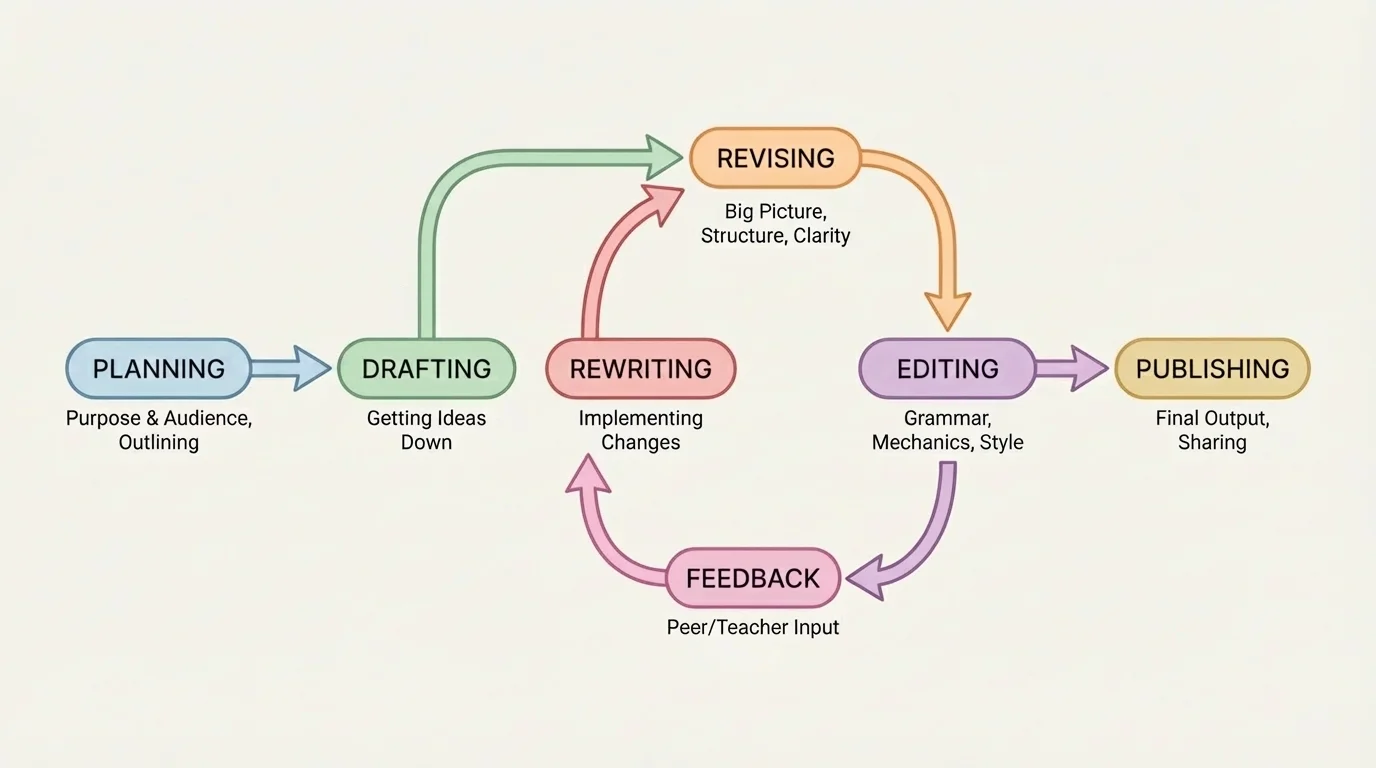
A useful plan answers several questions: What is my central idea? What information or evidence do I need? In what order should readers encounter my points? What background knowledge does the audience need? Where might readers disagree or become confused?
For an argument essay, planning may include identifying a claim, selecting credible evidence, anticipating counterarguments, and arranging points from strongest to most logical. For a literary analysis, planning may involve selecting a theme, gathering quotations, and deciding how each paragraph connects back to the thesis. For a narrative, planning may mean choosing which scenes to include and where the emotional turning point occurs.
Thesis development is especially important at this stage. A weak thesis often leads to weak revision because the writer has no clear standard for what belongs in the paper. Compare these examples:
Weak thesis: Social media affects teens.
Stronger thesis: Social media can support teen connection and creativity, but schools should teach students how algorithm-driven platforms increase distraction, comparison, and misinformation.
The second thesis gives the writer direction. It identifies a claim, suggests major points, and implies a more specific purpose.
A draft is a working version, not a finished product. This matters because students sometimes freeze while trying to make every sentence perfect immediately. Drafting works better when the writer focuses first on getting meaningful ideas onto the page.
That does not mean drafting should be careless. Writers still need a clear direction. But they should be willing to leave temporary gaps, mark places where evidence is needed, and adjust the original plan if new thinking emerges. Sometimes the act of writing reveals that the first idea was too broad, too narrow, or not as interesting as another idea that appears during drafting.
Strong drafts usually have a visible line of reasoning. Each paragraph should contribute something distinct. Even if the sentences are rough, the reader should be able to follow the main claim or central purpose. A draft with strong thinking but awkward wording is usually easier to improve than a grammatically neat draft with no real focus.
Paragraph structure still matters. Most academic paragraphs need a controlling idea, supporting evidence or explanation, and a clear connection to the overall purpose of the piece.
Drafting is also the stage when writers begin hearing the piece. Reading sections aloud can reveal repetition, weak transitions, or places where the tone shifts in unintended ways. A sentence may be technically correct but still sound stiff, vague, or unlike the voice the piece needs.
Revision is the stage where a writer improves the substance of the writing. Real revision changes meaning, structure, and emphasis; it is not just fixing small errors. This is where writers ask whether the piece says what it truly needs to say.
[Figure 2] The most effective revision starts with large questions. Is the main idea clear? Is the thesis arguable and specific? Does each paragraph support that purpose? Is there enough evidence, explanation, or detail? Are there sections that repeat the same point? Are important ideas underdeveloped while less important ideas take up too much space?
Writers should revise in order of significance. If the essay lacks focus, solve that before correcting commas. If the organization confuses readers, reorder paragraphs before polishing word choice. If evidence is weak, gather stronger support before spending time on sentence-level style.
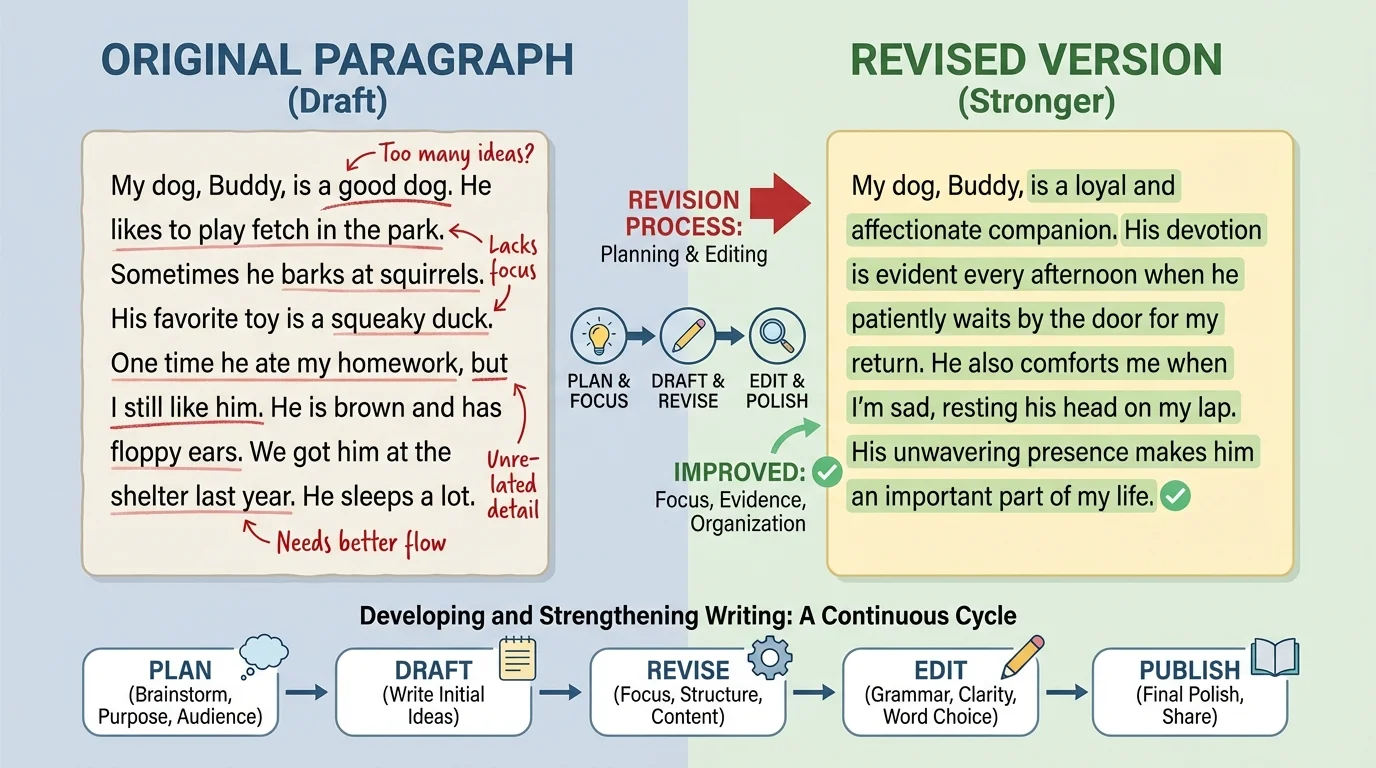
Revision often includes adding, cutting, moving, and rewriting. A writer may add a counterargument to strengthen an argument essay. The writer may cut a clever anecdote that does not support the central point. The writer may move a paragraph earlier because readers need that information sooner. The writer may rewrite a conclusion so it does more than merely repeat the introduction.
Coherence is a major goal of revision. A coherent piece feels connected and purposeful. Ideas build on one another. Transitions help readers follow the logic. Evidence does not appear randomly; it is introduced, interpreted, and tied to the writer's claim.
Revising means deciding what matters most
When teachers say "revise," they usually mean more than "make it longer" or "fix mistakes." Revision asks the writer to judge significance. If the assignment is a persuasive editorial, the most important issue may be whether the argument actually convinces skeptical readers. If the assignment is a college essay, the most important issue may be whether the writing reveals authentic insight and a memorable voice. Effective revision always depends on the specific purpose and audience.
Consider a literary analysis that includes three quotations but barely explains them. The problem is not that the paper is too short. The problem is that the evidence is not interpreted deeply enough. Revising effectively would mean adding analysis, not simply adding more quotations.
Later, when a writer wants to judge whether a paper truly improved, the before-and-after comparison in [Figure 2] remains useful: stronger writing usually has sharper focus, better support, and clearer organization, not just cleaner grammar.
Editing comes after major revision, not before it. Once the ideas, structure, and development are strong, the writer can focus on correctness. Editing improves readability and credibility because readers notice distracting errors. In many contexts, such errors can affect how seriously a piece is taken.
Editing includes checking grammar, punctuation, spelling, capitalization, usage, and formatting. It also includes sentence-level style. A writer may notice wordiness, repeated sentence openings, vague pronouns, or awkward phrasing. Editing is not only about obeying rules; it is also about making prose clearer and more precise.
Proofreading is one part of editing. It means searching carefully for small mistakes, especially the kind you are likely to make repeatedly. Common trouble spots include comma splices, apostrophes, agreement errors, citation formatting, and confusing words such as affect and effect.
| Editing focus | Question to ask | Example of concern |
|---|---|---|
| Grammar and usage | Is the sentence correct? | Subject-verb agreement, pronoun clarity |
| Punctuation | Does punctuation guide the reader clearly? | Run-ons, comma splices, quotation punctuation |
| Word choice | Is the language precise and appropriate? | Vague words, repetition, inflated diction |
| Style | Do the sentences sound effective? | Monotony, passive overuse, awkward rhythm |
| Formatting | Does the document meet expectations? | Title, spacing, citations, headings |
Table 1. Common editing concerns and the questions writers should ask during final polishing.
Editing works best when done slowly and strategically. Reading backward sentence by sentence can help catch surface errors because it prevents the brain from rushing through familiar meaning. Reading aloud can reveal awkward syntax. Printing a draft or changing the font can also make mistakes easier to see.
Sometimes a draft is not improved by patching individual sentences. Sometimes it needs rebuilding. This is where rewriting becomes necessary. Rewriting does not mean failure; it means the writer has recognized that the current structure cannot fully accomplish the purpose.
A new approach may be needed if the draft begins in the wrong place, uses the wrong tone, or organizes ideas in a weak sequence. For example, an argumentative essay might become much stronger if it opens with a surprising statistic instead of a broad general statement. A narrative may improve if it starts at the moment of conflict rather than with unnecessary background. A research-based article may need subheadings because the current structure overwhelms readers.
Trying a new approach can also mean changing genre or mode within an assignment. A writer who is explaining a complex issue might add comparison, analogy, or a brief case study. A writer whose conclusion feels generic may rewrite it to end with implications, not repetition. A writer addressing a resistant audience may shift from accusatory language to a more measured and solution-focused tone.
When rewriting is the smarter choice
Original problem: A student writes an essay about community service that lists several activities but never develops a clear central insight.
Ineffective fix: Correcting grammar and adding a few adjectives. The essay is cleaner, but still shallow.
Better solution: Rewrite around one core idea: how working at a food pantry changed the student's understanding of dignity and need. Then choose scenes and reflections that support that idea.
The rewritten version is stronger because it has a real focus, not just improved wording.
Advanced writers understand that deleting pages can sometimes be a sign of growth. It takes confidence to replace what is merely adequate with what is more effective.
Feedback is information that helps a writer decide what to improve next. Good feedback does not simply praise or criticize; it identifies strengths, questions, confusions, and next steps.
[Figure 3] Useful feedback can come from teachers, peers, mentors, or the writer's own self-assessment. Different readers notice different things. A peer may catch places where the explanation is confusing. A teacher may notice a weak claim or missing analysis. The writer may realize, after reading aloud, that the voice sounds forced.
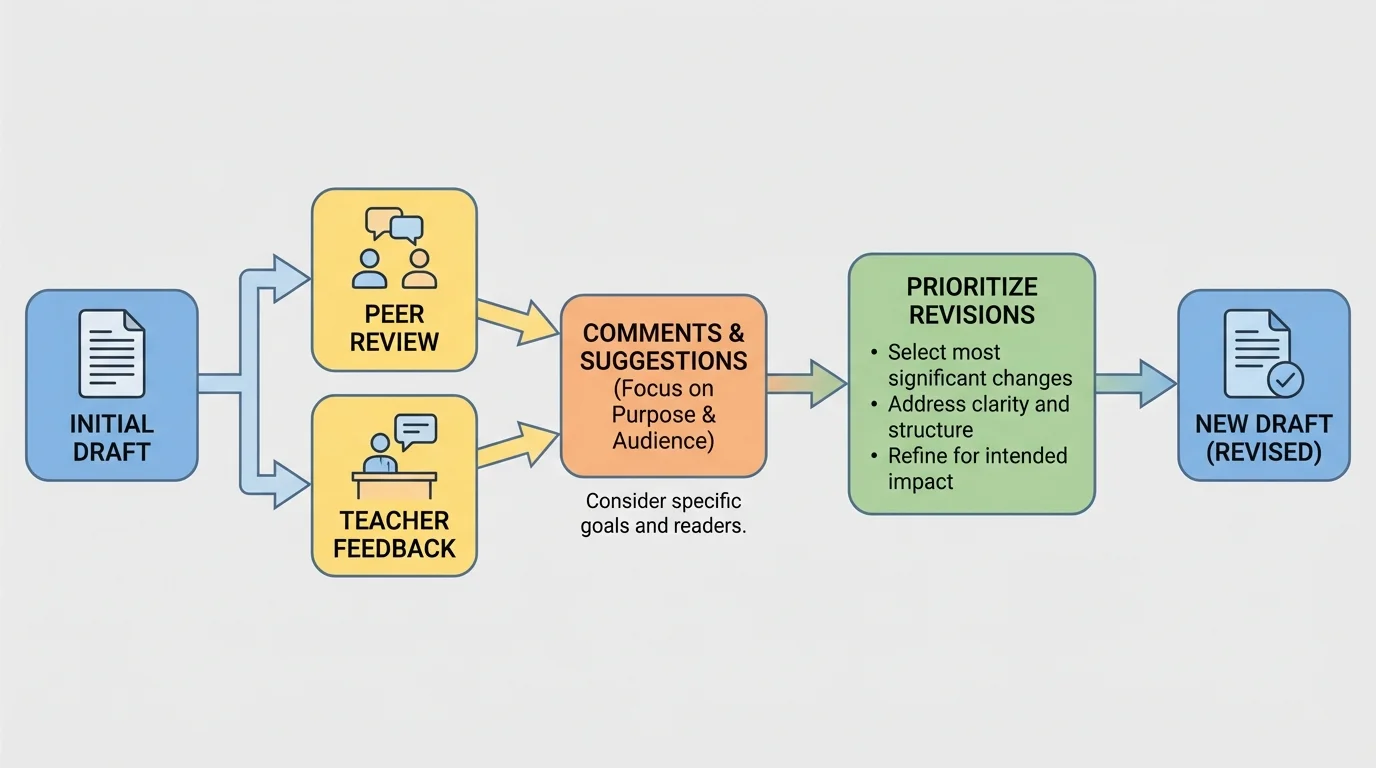
Not all feedback should be followed automatically. Strong writers evaluate comments. If three readers are confused by the same paragraph, that issue probably needs attention. If one suggestion would pull the paper away from its purpose, the writer may choose not to use it. Feedback is most helpful when the writer asks focused questions such as, "Where does my reasoning feel unclear?" or "Which paragraph seems least necessary?"
Feedback becomes especially powerful when combined with reflection. After reviewing comments, writers should identify patterns. Are readers unsure about the thesis? Do they want more evidence? Are they reacting well to the introduction but losing interest in the middle? These patterns help writers prioritize revision.
Later in the process, the loop in [Figure 3] remains important because writing is rarely finished the moment someone else reads it. Publication, submission, or sharing often leads to more response, and effective writers stay open to thoughtful improvement.
Many professional publications require multiple rounds of revision before anything is printed or posted. Even experienced writers are expected to respond to editorial feedback, fact-checking, and structural suggestions.
Ongoing feedback also matters in digital spaces. An article posted online may be updated for accuracy. A group presentation script may change after rehearsal. A shared document may go through several versions before the final submission. Writing is often more dynamic than students expect.
Some writing is individual, and some is collaborative. In solo writing, the writer controls every decision, but still benefits from outside response. In shared projects, multiple writers must coordinate purpose, structure, voice, and deadlines. Collaborative writing demands not only writing skill but also communication and organization.
Groups should decide roles early. One person may gather evidence, another may draft the introduction, another may format citations, and another may review for consistency. However, the group still needs a unified voice. If each section sounds like a different person, the finished product may feel uneven.
Shared writing works best when teams agree on a central claim, audience, formatting style, and timeline for revision. Version control also matters. If several people edit the same file, the group needs a system for tracking changes and avoiding confusion about which draft is current.
The recursive model from [Figure 1] applies here as well. A collaborative project may return to planning after a peer workshop, revise after teacher comments, and edit again just before publication.
Writing often has a destination: submission to a teacher, posting to a website, presentation to an audience, entry into a contest, or inclusion in a portfolio. Publishing means making writing public or final enough for its intended audience. But "published" does not always mean permanently fixed.
In many real-world contexts, writing is revised after publication. News organizations correct errors. Businesses update reports. Researchers respond to peer review. Students can also think this way by improving portfolio pieces over time, revising a speech after practice, or updating a digital article after receiving comments.
This matters because strong writing is not only produced; it is also maintained. A writer should ask whether the piece still fits its purpose, whether new evidence matters, and whether audience needs have changed. Writing can remain alive after the first submission.
"Easy reading is damn hard writing."
— Nathaniel Hawthorne
That quote captures an essential truth: when writing seems natural and clear, it is often because the writer has made many thoughtful decisions behind the scenes.
Although the core process remains similar, different tasks require different emphasis. In a research paper, planning and source selection are especially important. In a literary analysis, revision often focuses on interpretation and integration of evidence. In a personal statement, voice, authenticity, and selective detail matter greatly. In a speech, sentence rhythm and clarity for listeners become more important because the audience will hear the words instead of rereading them.
Digital writing also changes some expectations. Online readers often need clearer headings, shorter paragraphs, and faster movement to the main point. Shared digital documents make feedback immediate, but they also require writers to be careful about version history and collaborative edits.
For timed writing, the process becomes compressed, not eliminated. Even under time pressure, writers still need to plan briefly, draft with a clear purpose, revise the most important content, and edit key errors. The stages happen faster, but they still matter.
| Writing situation | What matters most | Likely revision priority |
|---|---|---|
| Argument essay | Claim, evidence, reasoning | Strengthen logic and address counterarguments |
| Literary analysis | Interpretation and textual support | Deepen analysis, not just summary |
| Personal narrative | Focus, voice, meaningful detail | Cut unnecessary background and sharpen reflection |
| Research report | Accuracy, organization, citation | Clarify structure and integrate sources smoothly |
| Speech or presentation | Clarity for listeners, pacing, emphasis | Simplify syntax and improve transitions |
Table 2. How the writing process shifts depending on the type of writing task.
Strong writers develop habits that make improvement more likely. They begin early enough to revise meaningfully. They save drafts. They ask specific questions when seeking feedback. They reread with purpose instead of only glancing over the page. They separate revision from editing. They are willing to cut sentences they like if those sentences do not serve the piece.
They also understand that writing quality is not measured by how quickly a draft appears. It is measured by how effectively the final piece fulfills its purpose for its audience. Sometimes the best move is a small edit. Sometimes it is a major rewrite. Sometimes it is a completely new approach.
The goal is not perfection on the first attempt. The goal is deliberate improvement. Writing becomes stronger when the writer knows what matters most, makes changes that match that priority, and stays responsive to feedback throughout the process.
