A weak search can bury you in thousands of results, while a smart one can uncover exactly the evidence you need in minutes. That difference matters far beyond school. Journalists, scientists, lawyers, engineers, and voters all depend on the same skill: finding reliable information, testing its value, and using it responsibly. Research is not just "looking things up." It is a disciplined process of asking a question, locating credible answers, comparing what sources say, and building a clear, honest response.
When you write a research paper, you are doing more than collecting facts. You are joining a conversation. Other writers have already made claims, offered evidence, and sometimes disagreed with one another. Your job is to understand that conversation well enough to answer a question or solve a problem. Strong research gives your writing credibility, depth, and precision.
Good research also protects you from common mistakes. A source may sound convincing but rely on outdated data. A polished website may hide a strong agenda. A statistic may be accurate but irrelevant to your actual question. Careful researchers do not just gather information; they judge it.
Research question is the focused question that guides your investigation. Authoritative source means a source created by a credible author, organization, or publisher with demonstrated expertise. Citation is the formal record of where information came from. Plagiarism is presenting someone else's words, ideas, or structure as your own without proper acknowledgment.
At the high school level, strong research usually requires more than one source because no single source can fully explain a complex issue. If your question is about whether schools should start later in the day, for example, you may need medical research on sleep, policy reports on school schedules, budget information from districts, and news coverage of real schools that changed their start times.
A broad topic like "social media" is not yet researchable. A strong question narrows the field and makes it easier to find useful evidence. Compare these:
A focused question helps you decide what kinds of sources you need. If your question concerns causes, you may need studies and expert analysis. If it concerns solutions, you may also need case studies and policy reports. If it concerns literature, you may need both primary texts and scholarly criticism.
It also helps you choose better search terms. Instead of searching one broad phrase, you can break the question into key ideas. For the example above, useful concepts might include teenage mental health, screen time, anxiety, sleep, and adolescents.
From earlier writing instruction, you already know that a claim needs evidence. Research adds a new level: you must choose evidence carefully, not just find any evidence. The quality of your sources affects the quality of your argument.
Before searching, write your question in one sentence and underline its essential concepts. Then list synonyms and related terms. "Teenagers" might also appear as "adolescents" or "high school students." "Mental health" might overlap with "well-being," "anxiety," or "depression." This small step often improves search results immediately.
Researchers use both print and digital materials. Digital sources include library databases, online journals, government websites, digital newspapers, and ebooks. Print sources include books, journals, magazines, and reference works found in libraries or classrooms. Even when a source appears online, it may still be part of a respected print publication.
Not all sources serve the same purpose. A textbook can provide background. A scholarly article can offer detailed evidence. A government report may supply statistics. A newspaper article may explain current events. A documentary or interview might provide firsthand or expert perspective. Strong researchers match source type to research need.
A database is often better than a general web search because it allows you to search within curated collections of articles, reports, and reference materials. School and public libraries often provide access to databases that include filters for subject, date, source type, and reading level.
Understanding the difference between a primary source and a secondary source is important in many projects. A primary source is direct evidence from the time or event being studied, such as a speech, letter, law, data set, experiment, interview, or original literary text. A secondary source interprets or analyzes primary material, such as a scholarly article or history book. Many research projects use both.
Typing a full question into a search bar sometimes works, but advanced searching is far more powerful because it lets you refine a search step by step, as [Figure 1] shows. Strong searches combine carefully chosen keywords, exact phrases, operators, and filters to move from a huge pool of information to a manageable set of relevant results.
Start with keywords, not entire sentences. Suppose your question is: How do later school start times affect teenage academic performance and sleep? Basic keywords might be "later school start times teen sleep academic performance." Then refine from there. Put exact phrases in quotation marks when word order matters, such as "school start times" or "academic performance."
Use Boolean operators to control relationships among terms. AND narrows results by requiring both terms. OR broadens results by allowing alternatives. NOT excludes unwanted topics, though it should be used carefully. For example:
Advanced searches also use filters. You can limit by publication date if you need current evidence, by source type if you need peer-reviewed articles, or by domain if you are searching the web. Domain limits can help. A search such as site:.gov youth vaping data focuses on government websites, while site:.edu may locate university research pages. These limits do not guarantee quality, but they can reduce noise.
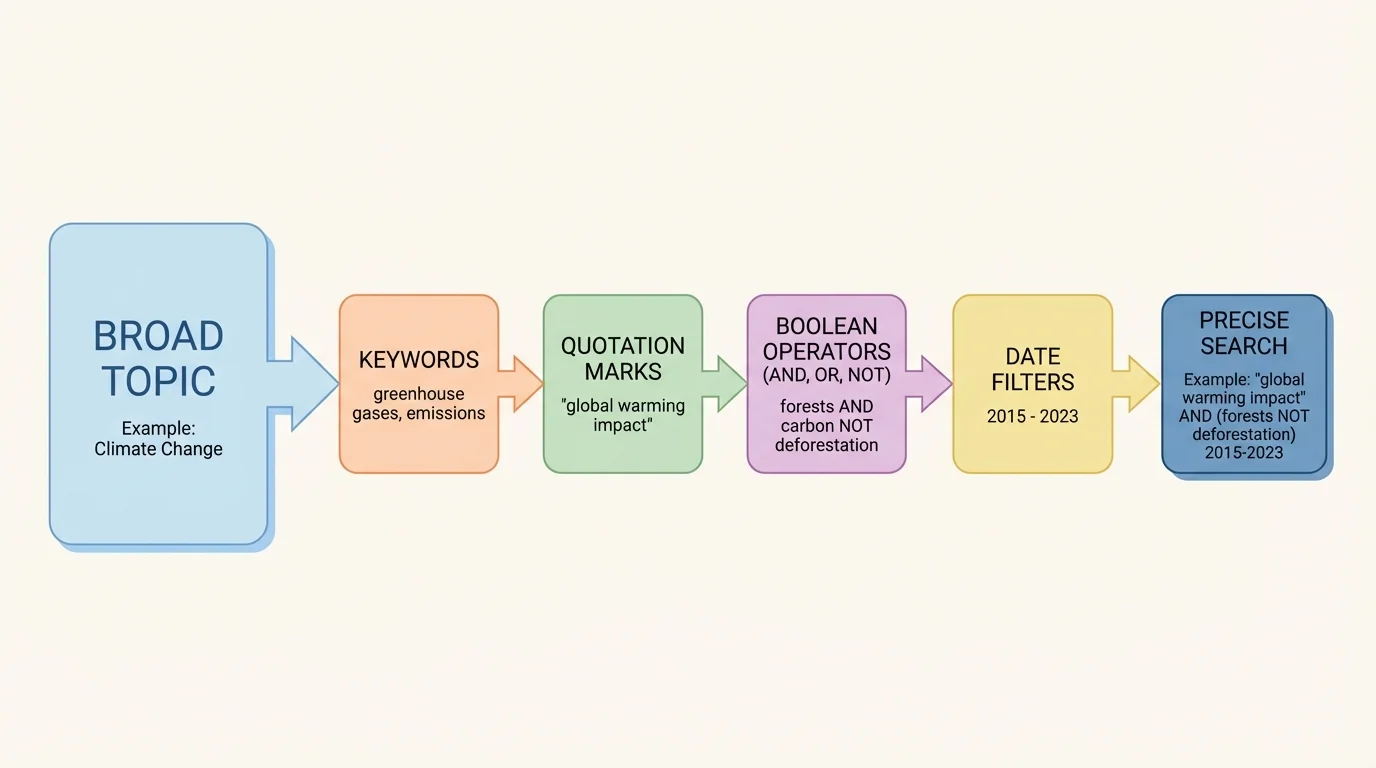
Another useful strategy is keyword refinement. If your results are too broad, add a specific term. If they are too narrow, replace a specialized term with a broader one or add an alternative with OR. For instance, if "adolescents circadian rhythm school start time" gives too few results, try "teen sleep school schedule" instead. Good researchers expect to revise searches several times.
Many databases also let you search by subject heading, abstract, or title. These features can be more precise than a full-text search. If an article is especially useful, scan its bibliography for additional sources. This technique often leads you to highly relevant materials faster than starting from scratch again.
Professional researchers often spend a large part of their time refining search terms rather than simply reading the first results. Efficient searching is a learned skill, not a lucky guess.
As you continue searching, keep track of terms that work well. A strong researcher builds a running list of useful keywords, authors, organizations, and source titles. This record saves time and makes later citation much easier.
Finding a source is only the beginning. To answer a research question well, a source must be both trustworthy and relevant, as [Figure 2] illustrates. A source can be reliable but not useful for your exact question, and a source can be closely related to your topic but still be weak or misleading.
Start with authorship. Who wrote the source, and what qualifies that person or group to speak on the issue? A medical researcher writing about adolescent sleep carries a different level of authority than an anonymous blog writer. Also consider the publisher. University presses, major newspapers, government agencies, and peer-reviewed journals usually have stronger review processes than random websites.
Next, examine evidence. Does the source provide data, citations, expert testimony, or close analysis? Or does it mostly rely on opinion? A strong source usually shows where its information comes from. Check the date as well. On fast-changing topics such as technology, health, or public policy, recent sources may be especially important. On historical or literary topics, an older source can still be valuable if it remains influential.
Then ask whether the source directly addresses your question. This is the issue of relevance. A detailed article about sleep in adults may be credible, but if your question is about teenagers, its usefulness is limited. A source that only defines a topic may help with background, but it may not help you prove a claim.
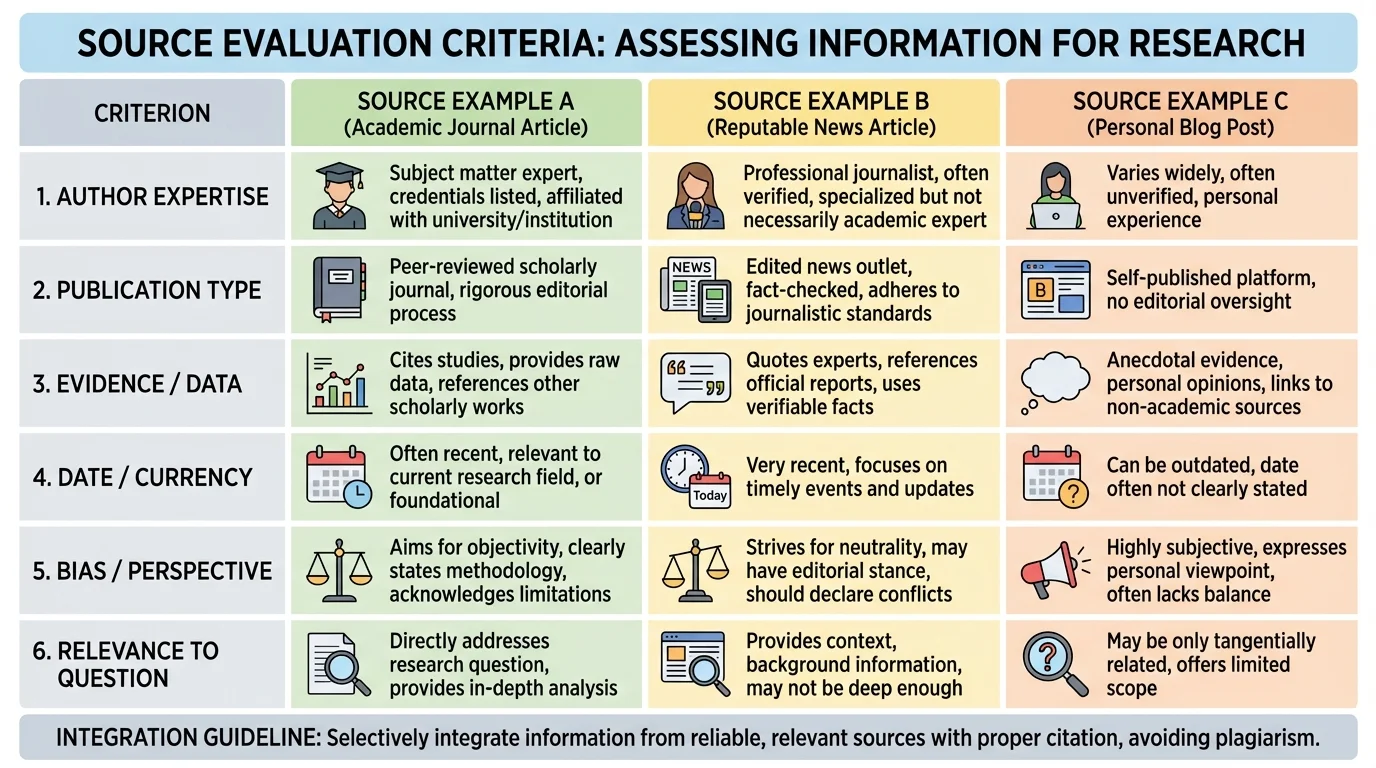
You should also look for bias, which means a tendency to present information from a particular perspective or interest. Bias does not automatically make a source useless. An advocacy group's report might still contain important data. However, you should recognize its purpose and compare it with sources from other perspectives. Ask: Is the goal to inform, persuade, sell, or entertain?
A helpful way to evaluate sources is to use a set of questions consistently:
When several sources repeat the same fact, check whether they all trace back to one original report. If so, you may not truly have multiple independent sources. Strong synthesis depends on comparing genuinely different materials, not just copies of the same information.
Authority and usefulness are not identical. A source can be highly authoritative but only slightly useful for a specific claim, and a source can seem useful at first but turn out to be weakly supported. Effective research depends on evaluating both at the same time.
Later in the research process, you may return to [Figure 2] when deciding which sources deserve space in your paper. Not every source you find belongs in your final draft.
Synthesis is crucial because research writing is not a list of separate summaries. Synthesis means combining ideas from multiple sources to produce a clearer, richer answer than any one source could provide alone. You are looking for patterns, agreements, disagreements, and unanswered questions.
Suppose one study finds that later school start times improve attendance, another finds improved sleep but only modest test-score changes, and a district report warns about transportation costs. A strong paper does not treat these as unrelated facts. It explains that later start times may support student well-being and attendance while also creating practical scheduling challenges. That is synthesis.
Taking organized notes helps. One useful method is to create categories based on your question, such as health effects, academic effects, financial concerns, and community response. Then place information from each source into those categories. This lets you compare sources directly instead of reading them one by one in isolation.
| Source | Main claim | Evidence type | Usefulness for the question |
|---|---|---|---|
| Medical journal article | Later start times improve teen sleep duration | Peer-reviewed study | Strong for health evidence |
| School district report | Schedule changes affect transportation and budgets | Local administrative data | Strong for implementation concerns |
| Newspaper feature | Students and parents report mixed experiences | Interviews and reporting | Useful for local perspective, weaker for scientific proof |
Table 1. Comparison of source types and their usefulness for a research question about later school start times.
When sources disagree, do not panic. Disagreement is often where the most interesting thinking begins. Ask why they differ. Did they study different age groups? Use different methods? Focus on different locations or time periods? Research becomes stronger when you explain those differences rather than hiding them.
Once you have gathered strong sources, the next challenge is using them well. Selective integration means choosing only the information that serves your purpose and weaving it into your own sentences so the writing stays clear and coherent, as [Figure 3] shows. Research writing should not feel like a pile of borrowed lines. Your ideas should guide the paragraph.
There are three common ways to bring in source material: summary, paraphrase, and quotation. A summary condenses the main idea of a larger passage or source. A paraphrase restates a specific idea in your own wording and sentence structure. A quotation uses the source's exact words. Each has a different purpose.
A paraphrase matters because many students confuse it with simply changing a few words. Real paraphrasing requires you to fully understand the original, set it aside, restate the idea from memory, and then check that you preserved the meaning accurately. Even when you paraphrase, you still need a citation because the idea came from a source.
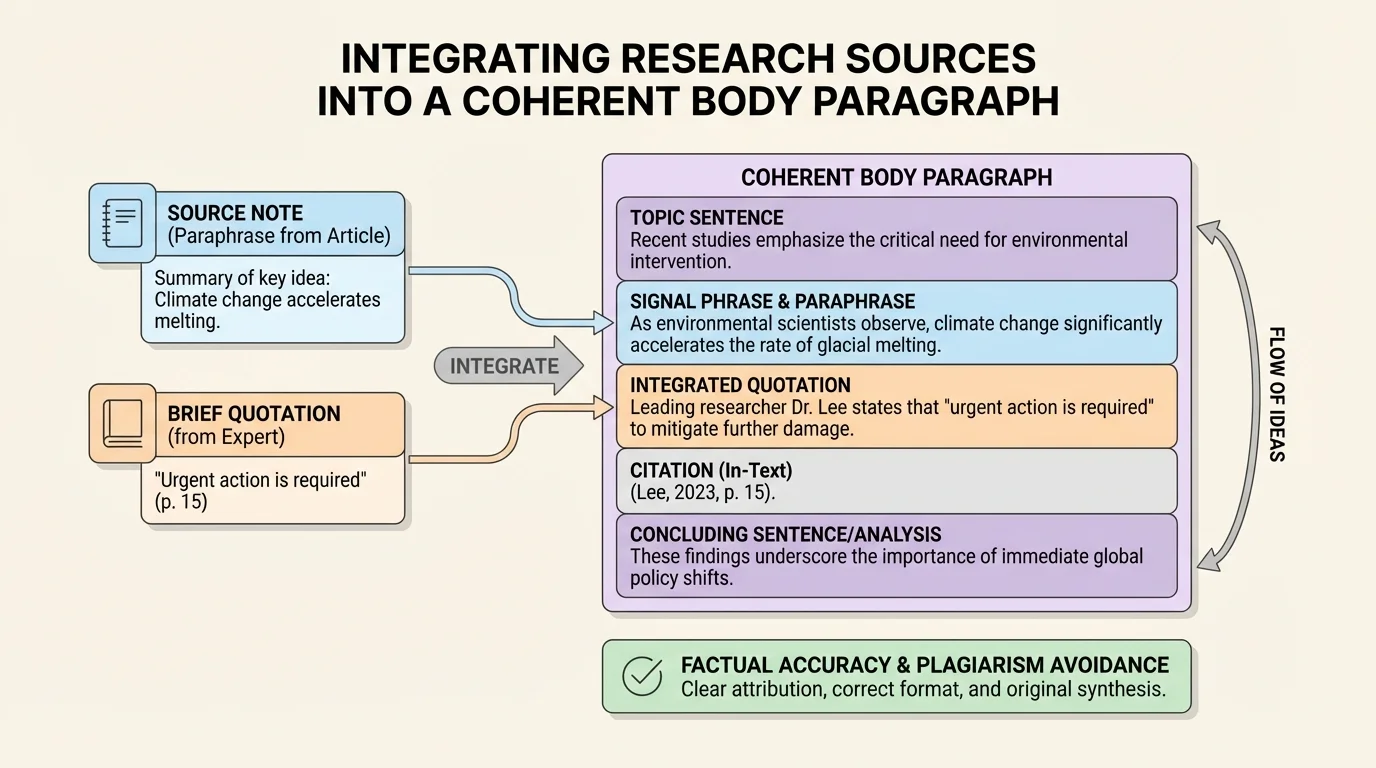
Use direct quotations sparingly. Quote when the exact wording is especially powerful, precise, or worth analyzing. In most research papers, paraphrasing and summarizing should do more of the work because they let you maintain your own voice and keep the paragraph moving.
Signal phrases help integrate evidence smoothly. These are introductions such as "According to the Centers for Disease Control and Prevention," or "Sleep researcher Kyla Wahlstrom argues that ..." A signal phrase tells readers where the information comes from and prepares them for the evidence. After the evidence, explain its significance. Never assume the quote or fact speaks for itself.
Case study: integrating evidence into a body paragraph
Research question: Should high schools begin later in the morning?
Step 1: Start with the writer's claim.
Later high school start times support student learning because they align more closely with adolescent sleep patterns.
Step 2: Add a paraphrased source with a signal phrase.
According to a policy statement from the American Academy of Pediatrics, teenagers naturally tend to fall asleep later, so very early schedules can reduce the amount of sleep they get on school nights.
Step 3: Add a second source that extends the point.
A school district report from Seattle also found that after start times shifted later, many students slept longer and attendance improved.
Step 4: Explain why the evidence matters.
Together, these sources suggest that the issue is not simply student preference; it is connected to measurable patterns in health and school participation.
This paragraph works because the writer uses multiple sources selectively and connects them through a clear controlling idea.
Later, when you shape longer arguments, the pattern shown in [Figure 3] remains useful: introduce the source, present the information, and explain why it matters to your claim.
Plagiarism can happen in obvious ways, such as copying and pasting without quotation marks, but it also happens in subtle ways. If you borrow a source's sentence structure too closely, repeat a unique phrase without quotation marks, or paraphrase an idea without citing it, that is still plagiarism.
Avoiding plagiarism begins with note-taking. When you copy exact words into notes, place them in quotation marks immediately so you do not later mistake them for your own writing. Keep source information attached to every note. If you separate ideas from their source too early, citation problems become much more likely.
One strong habit is to divide notes into three labeled types: direct quotes, paraphrases, and your own thoughts. This helps you see what belongs to the source and what belongs to you. Another useful habit is to draft from notes rather than from an open article, because staring at the original text often leads to accidental copying.
"Writers do not become original by pretending they worked alone. They become original by entering a conversation honestly."
Integrity matters in research because your readers trust you to represent evidence fairly. Citation is not just a rule to avoid punishment. It is a way of showing where ideas come from, giving credit, and allowing readers to follow your path of thinking.
Academic writing uses standard systems such as MLA, APA, or Chicago. Your teacher will usually tell you which one to use. The key principle is consistency. Every source you use should be cited in the correct format both in the text and in the final list of sources.
In-text citation refers to the brief citation that appears in the sentence or paragraph where the source is used. A Works Cited page or reference list gives the full publication information at the end. The exact details depend on the citation style, but the purpose stays the same: readers should be able to identify and locate the source.
For example, a paper in MLA style often includes the author's last name and page number in parentheses after a quote or paraphrase, while APA style often includes the author's last name and year of publication. Digital sources may not always have page numbers, so the format can vary. What matters most is following the assigned style accurately.
You should also cite when using statistics, unique ideas, data, images, charts, and information that is not common knowledge. "The Earth revolves around the Sun" is common knowledge and usually needs no citation. "Teens who start school later gain an average of a certain number of minutes of sleep in a particular study" is specific evidence and does require citation.
Standard format creates accountability. Citation styles may seem picky, but they make academic conversations possible. A consistent format lets readers verify evidence, compare sources, and build on previous work.
Always proofread citations carefully. Small errors in punctuation are less serious than missing information, but missing author names, dates, titles, or publication sources can make your references incomplete. Citation tools can help you start, but you should still check the final result yourself because automatic generators often make mistakes.
Consider a student researching this question: Should cities limit single-use plastic bottles in public buildings? The student begins by identifying key concepts: cities, single-use plastic bottles, public buildings, environmental impact, cost, and public policy. Then the student searches library databases, city government reports, environmental studies, and credible news coverage.
Some sources are immediately rejected. A company blog promoting reusable bottles may be relevant but too promotional on its own. A government waste audit may be highly useful because it provides local data. A peer-reviewed environmental study may explain how plastic waste affects landfills and waterways. A newspaper article may show public reaction and policy debate.
As the student compares sources, a pattern emerges: environmental studies support reducing plastic waste, city reports emphasize costs and logistics, and community sources raise concerns about access to clean drinking water. The final argument becomes more nuanced. Instead of claiming simply that plastic bottles are "bad," the student argues that limits work best when cities also install refill stations and provide equitable access to safe water.
That is what strong research does. It moves a writer from a broad opinion to a supported, defensible conclusion based on selective use of multiple authoritative sources.
