A single word family can unlock an entire page of difficult reading. If you know conceive, you are already partway to understanding conception, conceivable, and inconceivable. That matters for high school readers because advanced texts often build ideas through related word forms rather than repeating the same word over and over. A historian may write about a nation's expansion, a scientist may discuss the expansive effects of heat, and a critic may say a writer expands an argument. The words are different, but the pattern connects them.
Strong readers do not depend only on dictionaries. They also use word structure. When you identify patterns of word change, you can infer meaning, recognize the part of speech, and understand how a sentence works. This strategy is especially useful in narrative, argumentative, and informational texts, where authors often use formal academic vocabulary.
[Figure 1] English has thousands of words, but many of them belong to families. A word family includes related forms built from the same core meaning. Learning these patterns helps you read more efficiently because you do not have to treat every unfamiliar word as completely new.
For example, if you know the verb derive, you can often make sense of derivative and derivation. In each case, the word points back to the idea of coming from or being developed from something else. The exact meaning changes, and the part of speech changes, but the core idea remains connected.
Why morphology helps comprehension
When readers analyze word parts, they use morphology, the study of how words are formed. Morphology helps you do three things at once: identify the likely meaning of an unfamiliar word, identify its role in the sentence, and connect it to words you already know.
This matters in different kinds of texts. In a narrative, a writer may describe a character's perception. In an argumentative essay, an author may ask readers to perceive a problem differently. In an informational text, a psychologist may explain perceptual bias. Recognizing the family relationship makes all three texts easier to understand.
Words are often built from parts. To analyze a word, you should know four important ideas: a root, a base word, a prefix, and a suffix.
A root is the core part of a word that carries its basic meaning. A base word is a form to which prefixes or suffixes can be added. A prefix comes at the beginning of a word and usually changes meaning. A suffix comes at the end of a word and often changes either meaning, part of speech, or both.
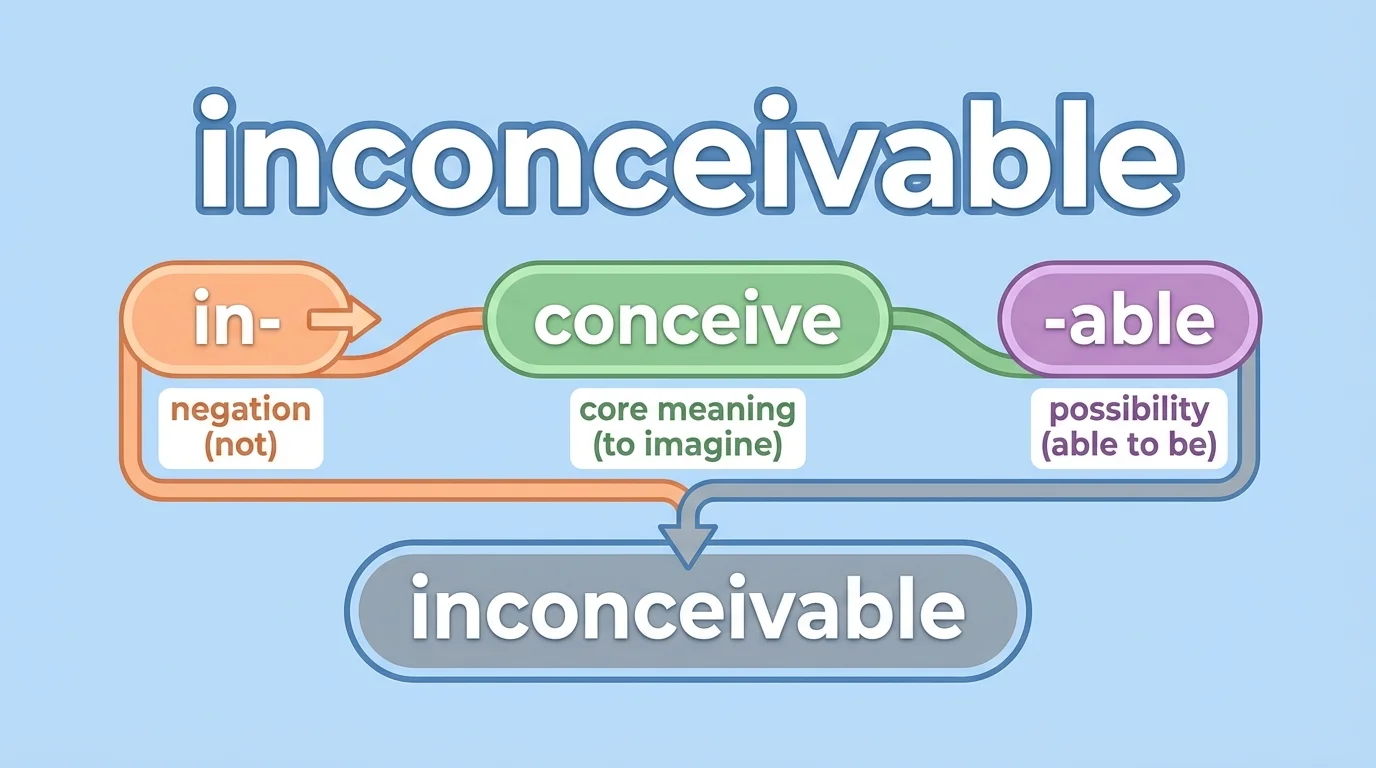
Root, base word, prefix, suffix are key structural units for analyzing word formation. The root or base carries the central meaning, while prefixes and suffixes modify that meaning or change how the word functions in a sentence.
Consider the set conceive, conception, conceivable, and inconceivable. The core idea involves forming, imagining, or understanding something. The suffix -tion helps create the noun conception. The suffix -able creates the adjective conceivable, meaning capable of being understood or imagined. The prefix in- changes that adjective to its opposite: inconceivable.
Once you start seeing these parts, unfamiliar words become less intimidating. You may not know every definition immediately, but you can often make a strong first guess based on structure.
Many word changes act like grammar signals. If you can recognize these signals, you can often tell whether an unknown word is functioning as a noun, verb, adjective, or adverb before you fully define it.
Some suffixes strongly suggest a noun. Common noun endings include -tion, -sion, -ment, -ity, -ness, and -ance. For example, inform becomes information, decide becomes decision, and important becomes importance. These noun forms often name a thing, process, quality, or state.
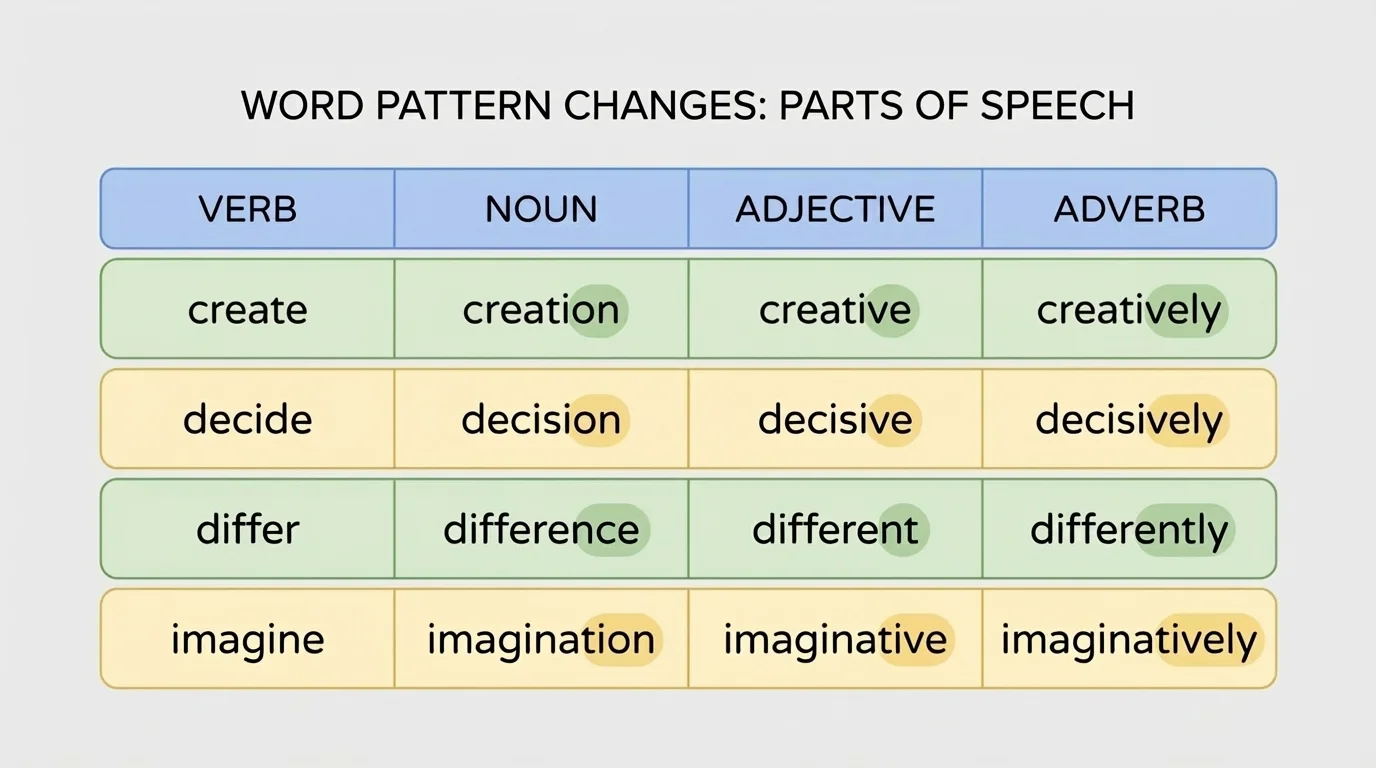
Other suffixes often signal an adjective. Common adjective endings include -able, -ible, -al, -ous, -ive, and -ful. Words like reasonable, visible, regional, dangerous, creative, and helpful describe nouns.
Adverbs frequently end in -ly, as in carefully, precisely, and logically. These words often modify verbs, adjectives, or other adverbs. Many adverbs are formed by adding -ly to an adjective, such as fortunate to fortunately.
Verbs can also be marked by common endings such as -ize, -ate, or -ify, as in realize, activate, and classify. However, verbs are often easiest to identify from sentence position. If the word expresses an action, event, or state of being, it is likely functioning as a verb.
| Common Pattern | Likely Part of Speech | Example | Use in a Sentence |
|---|---|---|---|
| -tion, -sion | Noun | creation | The creation surprised the audience. |
| -ment | Noun | achievement | Her achievement earned respect. |
| -able, -ible | Adjective | conceivable | The outcome seems conceivable. |
| -ive, -al, -ous | Adjective | decisive | It was a decisive moment. |
| -ly | Adverb | logically | He argued logically. |
| -ize, -ify, -ate | Verb | classify | Scientists classify organisms. |
Table 1. Common suffix patterns that help identify a word's likely part of speech.
These patterns are not perfect rules, but they are highly useful clues. As you read, combine word endings with context. A suffix pattern gives you a likely category; the sentence confirms or corrects that guess.
Word changes do more than shift part of speech. They also affect meaning. Prefixes are especially important here because they often add ideas such as negation, direction, repetition, degree, or relationship.
For example, the prefix un- usually means "not," turning certain into uncertain. The prefix re- means "again" or "back," changing consider into reconsider. The prefix sub- often suggests "under" or "below," as in submarine or substandard. The prefix inter- suggests "between," as in international or interact.
Meaning shift within a word family
Look at the family built from act.
Step 1: Start with the verb
Act means to do something.
Step 2: Add a suffix
Action is the noun form; it names the thing being done.
Step 3: Add a different suffix
Active is the adjective form; it describes someone or something engaged in action.
Step 4: Add a prefix
Inactive changes the meaning by adding negation.
The forms are related, but each one does a different job and carries a slightly different meaning.
Suffixes can also shift meaning. The difference between child and childish is not just grammatical. Childish usually suggests immaturity, not simply a connection to children. Similarly, economy, economic, and economical are related but not interchangeable. Economic usually refers to the economy or economics, while economical usually means efficient and not wasteful.
That is why structure matters, but context matters too. Two related words can share a root and still develop distinct meanings.
Some patterns appear again and again in academic English. Recognizing them gives you a practical reading advantage.
One frequent pattern moves from verb to noun: conceive to conception, decide to decision, expand to expansion, inform to information. In many of these pairs, the noun names the result, process, or product of the action.
Another pattern moves from verb to adjective: conceive to conceivable, depend to dependable, compel to compelling. These adjective forms often describe a quality related to the original action.
A third pattern moves from adjective to adverb: clear to clearly, logical to logically, serious to seriously. This pattern is especially common in argumentative and analytical writing because adverbs help writers express manner and degree.
There are also families with several common academic forms:
| Verb | Noun | Adjective | Adverb |
|---|---|---|---|
| conceive | conception | conceivable | conceivably |
| decide | decision | decisive | decisively |
| analyze | analysis | analytical | analytically |
| respond | response | responsive | responsively |
| presume | presumption | presumable | presumably |
Table 2. Examples of related word forms across parts of speech.
Many academic English words come from Latin and Greek roots, which is why families like construct, instruction, and destruction share patterns even when their meanings branch in different directions.
As you read more challenging texts, these patterns become easier to spot. Over time, your brain begins to notice them automatically.
Related words do not always change in neat, predictable ways. Sometimes the spelling shifts when a suffix is added. These changes can make a family harder to recognize, but the connection is still there.
One common pattern involves dropping a final e. For example, conceive becomes conceivable, and create becomes creative. Another pattern changes y to i, as in vary to variation or rely to reliable. Sometimes consonants change or sounds shift: decide becomes decision, and permit becomes permission.
There are also cases where the relationship is less obvious. Analyze and analysis are clearly connected in meaning, but the ending changes significantly. Pronounce and pronunciation are another pair students often misread or misspell because the base form changes more than expected.
If you already know how to identify nouns, verbs, adjectives, and adverbs by sentence position, morphology gives you an additional tool. Grammar tells you what job the word is doing; word structure helps you predict which form belongs in that job.
This is why careful readers stay flexible. You should look for familiar roots, but you should also expect some changes in spelling and sound.
[Figure 3] The same family can appear in very different ways depending on genre and can shift across narrative, argumentative, and informational writing. Skilled readers adjust by asking not only "What does this word mean?" but also "Why did the writer choose this form here?"
In a narrative, word forms often help describe characters, emotions, and actions. A novelist might write, "Her hesitation was noticeable," using the noun hesitation and the adjective noticeable to shape tone and characterization.
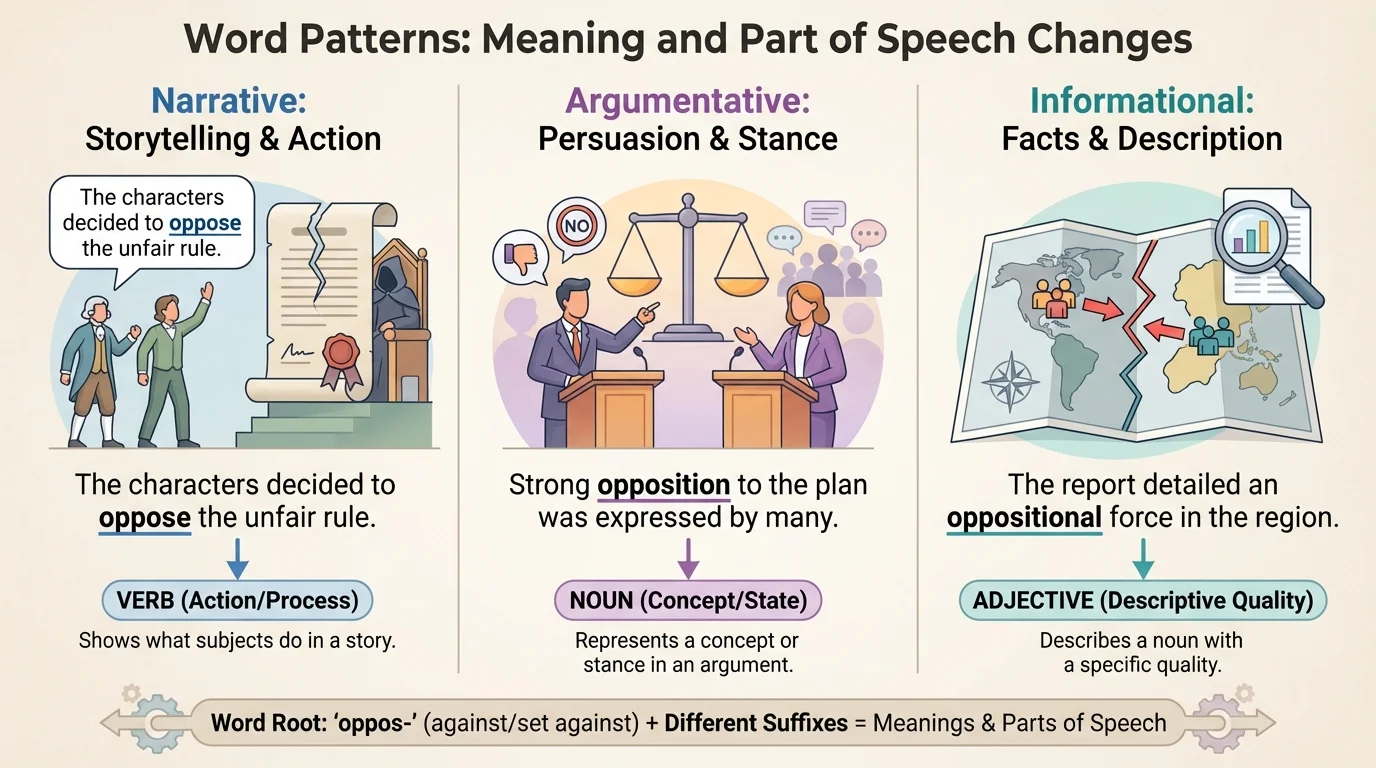
In an argumentative text, authors often rely on nouns and adjectives that sound formal and precise: assumption, validity, reasonable, persuasive. These forms help writers state claims, judge evidence, and build analysis. These patterns remain useful here because many of these forms follow common suffix patterns.
In an informational text, authors often use technical nouns and adjectives built from shared roots. A biology text may use adapt, adaptation, and adaptive. A government article may use elect, election, and electoral. Recognizing these families helps readers move through dense academic information more efficiently.
The comparison in [Figure 3] also highlights an important truth: the same root can support description, explanation, or persuasion depending on the form the writer chooses. That is one reason morphology is a reading strategy, not just a spelling skill.
Understanding patterns is not enough if you cannot use the correct form yourself. When writing, you must match the form of the word to the sentence's grammar and meaning.
Suppose you want to complete this sentence: "The scientist presented a convincing ___." The article a and the adjective convincing signal that a noun should follow. Argue would not fit because it is a verb. Argument works because it is a noun. In contrast, in the sentence "The scientist argued convincingly," the adverb convincingly modifies the verb argued.
Choosing the correct form from context
Consider the family observe, observation, observant, and observably.
Step 1: Read the sentence frame
"Her careful ___ of the data revealed a pattern."
Step 2: Identify the needed part of speech
The possessive her and the adjective careful suggest a noun should fill the blank.
Step 3: Select the correct form
Observation fits because it is the noun form.
Step 4: Test another sentence
"She was highly observant during the experiment." Here the word after was must describe she, so the adjective observant fits.
Sentence clues often tell you which member of a word family belongs in a specific context.
This skill matters in school writing. Teachers often expect precise academic language, and many errors come not from weak ideas but from choosing the wrong form of a related word.
Word patterns are powerful, but they are not magic. Some words look related when they are not, and some related words have meanings that have drifted apart over time. For example, historic and historical are related, but they are not interchangeable. Sensible and sensitive may seem similar because of their endings, yet they express very different ideas.
You should also be careful with assumptions about suffixes. Most words ending in -ly are adverbs, but not all are. Friendly, lovely, and likely are usually adjectives. That means you must check how the word functions in the sentence, not just how it looks.
Context remains the final test. Morphology helps you make an intelligent prediction; the sentence and passage confirm whether that prediction is correct.
One of the best ways to grow your vocabulary is to learn words in families rather than in isolation. If you memorize only analyze, you know one word. If you understand analyze, analysis, analytical, and analytically, you can read and write with much greater precision.
When you encounter an unfamiliar academic word, pause and ask a series of questions. What is the likely root or base word? Is there a prefix or suffix? What part of speech does the sentence require? Does the surrounding context support your guess? This process turns confusion into investigation.
"The limits of my language mean the limits of my world."
— Ludwig Wittgenstein
That idea is especially true for academic reading. The more patterns you recognize, the larger your usable vocabulary becomes. Instead of seeing a wall of separate difficult words, you begin to see systems, relationships, and meaning.
