A paper can have strong ideas, solid evidence, and thoughtful analysis and still lose credibility if it looks careless or uses sources incorrectly. In school and beyond, readers often judge a piece of writing within seconds. Does it follow the expected format? Can the reader trace the evidence? A style manual helps answer those questions by giving writers a shared set of rules. Learning to use one is not about memorizing random details. It is about making your writing readable, trustworthy, and appropriate for the discipline.
Different fields of study care about different things. A literature teacher may want smooth in-text citations that keep attention on close reading of a poem or novel. A history teacher may want detailed notes that let readers see where facts and interpretations come from. A science teacher may care most about precise reporting and efficient source citation. Style manuals exist because writing happens in real communities, and each community develops conventions that help readers work with texts efficiently.
When a class requires a certain style, it is asking you to join that academic conversation. Following the manual shows respect for your audience. It also builds credibility, because your paper signals that you understand the expectations of the field rather than making up your own system.
Style manual means a published guide that explains how to format writing, cite sources, organize documentation, and make language choices for a particular kind of writing or academic discipline.
Discipline means a field of study such as literature, history, biology, or sociology. Different disciplines often use different writing conventions.
[Figure 1] A style manual does more than tell you where to put commas or page numbers. It shapes how readers move through your work. Clear headings, consistent citation patterns, and standard formatting reduce confusion. Instead of wondering where your source came from, readers can focus on your ideas.
A style manual usually gives rules for several parts of writing. These include page layout, title placement, margins, spacing, font choices if required, headings, quotation formatting, citation methods, and the final list of sources. It may also give guidance about capitalization, abbreviations, numbers, and the treatment of titles.
In other words, style affects both the outside and inside of a paper. It covers the visual design of the document and the way evidence is integrated into sentences. A writer who understands style can make effective choices about where to quote, when to paraphrase, and how to signal the relationship between a claim and its source.
Many students assume style is mainly cosmetic. It is not. Citation format, for example, is tied to how knowledge works in a subject. A paper that lacks proper citation leaves readers unable to verify evidence. A paper with inconsistent citation suggests weak attention to detail.
[Figure 2] Two style systems you are especially likely to encounter in high school are MLA and Turabian. The contrast between them shows that a style is not just decoration; it reflects how a subject presents information. MLA is commonly used in English language arts and other humanities courses that emphasize textual analysis. Turabian, which is based on Chicago style, is often used in history and some research-based writing.
MLA usually relies on brief parenthetical citations in the text and a Works Cited page at the end. Turabian often uses footnotes or endnotes along with a bibliography, especially in history writing. Some versions of Turabian also allow an author-date system, but students most often meet the notes-bibliography form first.
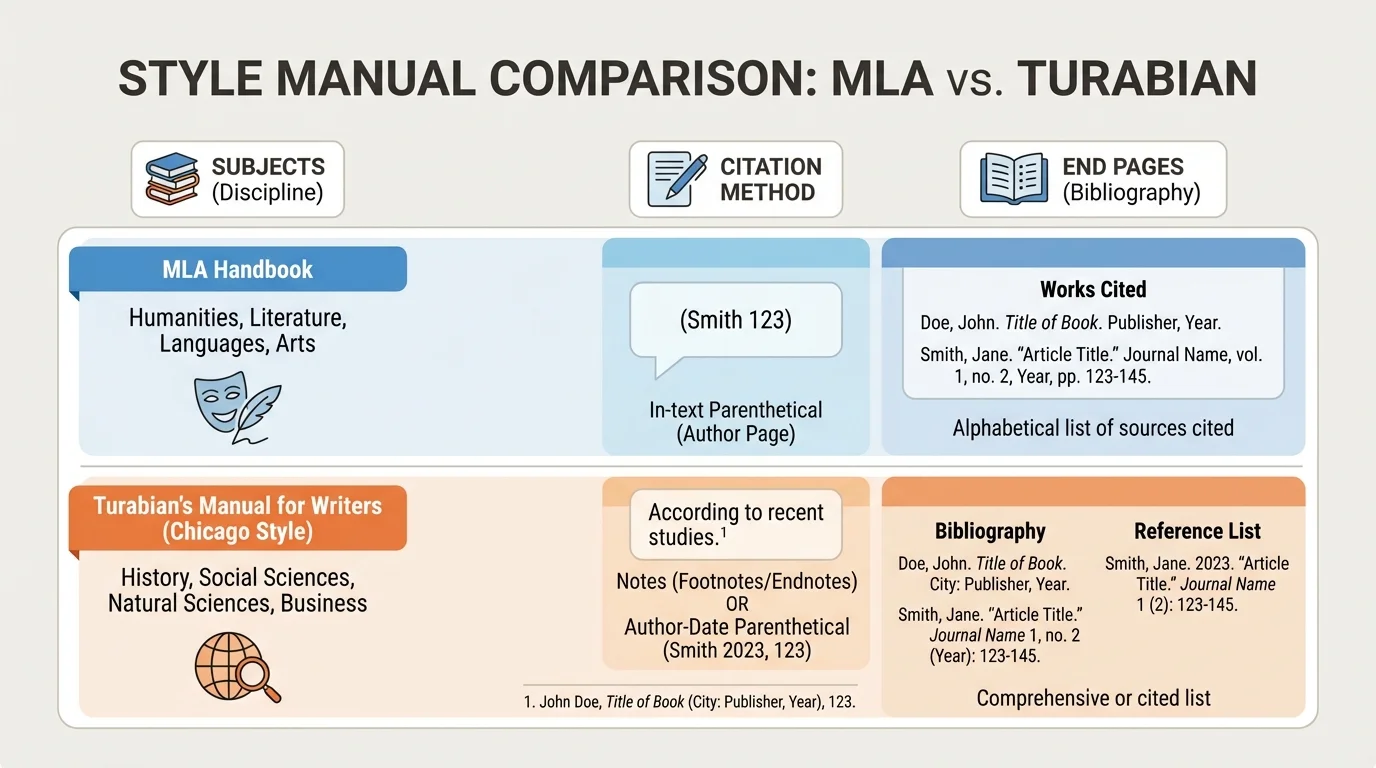
If your teacher does not name a style directly, look at the subject and the assignment. A literary analysis essay will usually fit MLA. An English essay may also fit MLA. A historical research paper may fit Turabian. A lab report might follow a different scientific format depending on the course. The key is that the discipline and writing type work together to determine what is appropriate.
| Style | Common Subjects | How Sources Appear in Text | End Material |
|---|---|---|---|
| MLA | English, literature, humanities | Parenthetical citations | Works Cited |
| Turabian Notes-Bibliography | History, some humanities | Footnotes or endnotes | Bibliography |
| Turabian Author-Date | Some social sciences and research contexts | Parenthetical author-date citations | Reference list |
Table 1. Comparison of common features of MLA and Turabian systems.
Before you format anything, read the assignment carefully. Teachers may specify the style manual, edition, citation method, length, required sources, and document elements. Sometimes a teacher adapts a formal style for classroom use. For example, a teacher may ask for MLA citations but a separate title page, even though standard MLA often does not require one. In that case, the teacher's directions come first.
This is an important writing skill: adapt your language and presentation to context. A style manual gives general rules, but real assignments create local expectations. Good writers do not force every paper into the same template. They ask, "Who will read this, what kind of writing is this, and what format best matches the task?"
When you revise for audience and purpose, you are already making style decisions. A style manual extends that same thinking to formatting, documentation, and academic conventions.
It helps to make a short decision list before drafting: What class is this for? What kind of writing is it? Which citation system is required? What source page belongs at the end? Are there special instructions about headings, title pages, or notes? Answering these questions early prevents major editing problems later.
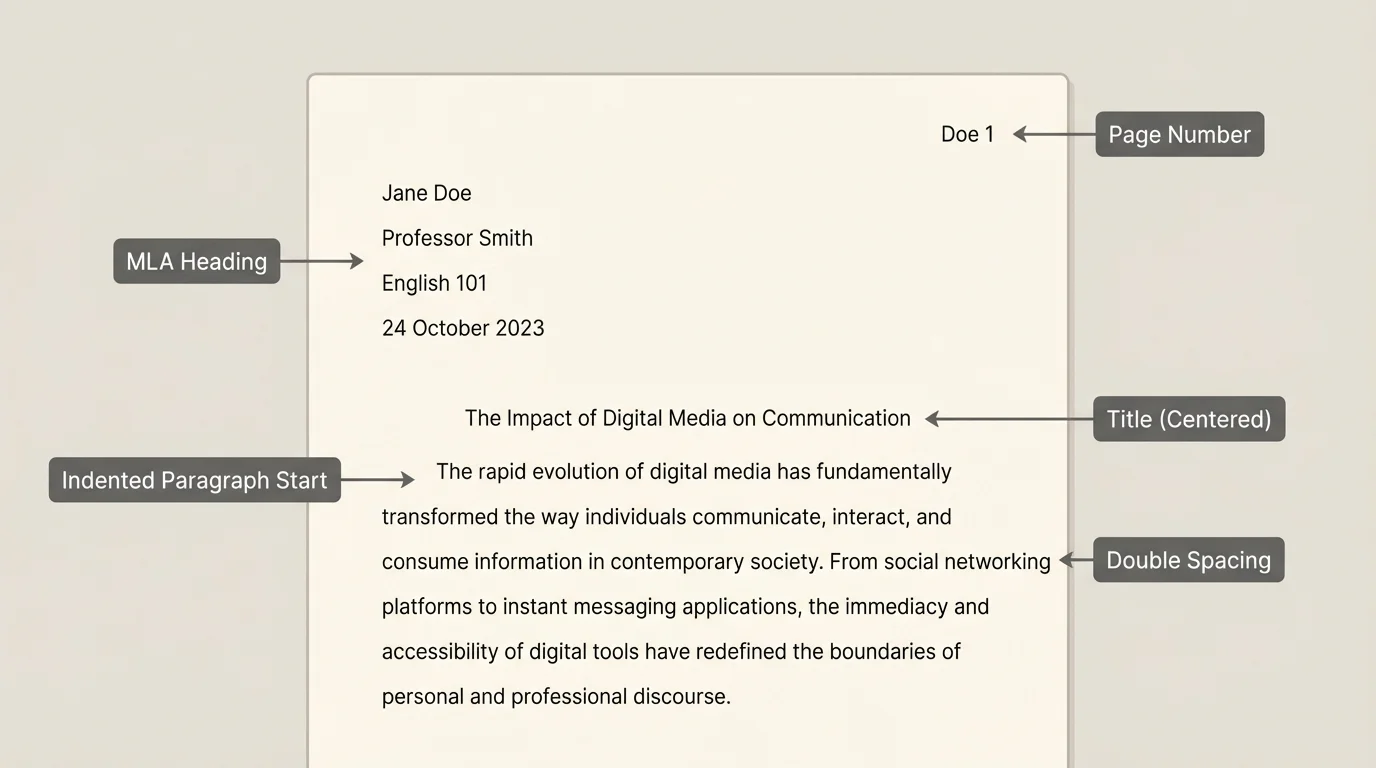
MLA is designed to keep source references brief and readable inside the paper. The overall page design supports that goal by staying clean and consistent. In a typical MLA paper, the page uses readable font, standard margins, double spacing, and a heading with the student name, teacher, course, and date. The title appears centered, and the paper begins immediately below it.
MLA usually places the writer's last name and page number in the header. Paragraphs are indented consistently. The final source page is titled Works Cited. Entries are arranged alphabetically by the author's last name or by title if no author is listed.
In-text citations in MLA often include the author's last name and the page number, such as (Nguyen 42). Notice that the citation is brief. The reader then goes to the Works Cited page for full publication details. This system works well in literary and textual analysis because it does not interrupt the flow of interpretation for long.
MLA also has clear rules for quotations. Short quotations are usually incorporated into your paragraph with quotation marks. Longer quotations may become block quotes, which are set off from the main paragraph and formatted differently. Even then, the quotation still needs a citation. A quotation without documentation is not enough.
Suppose you are writing about Fahrenheit 451. You might write: Bradbury presents entertainment as a force that can weaken thoughtful citizenship, especially when people stop questioning what they consume (Bradbury 58). The parenthetical citation lets the reader locate the exact page while the sentence stays focused on your claim.
Example: improving an MLA citation
Draft sentence: "The novel shows that people become passive when media controls their attention."
Step 1: Add a signal phrase or context.
You can name the author or introduce the text so the evidence feels connected to your analysis.
Step 2: Insert the quotation or paraphrase accurately.
Use the source wording if you quote, or restate the idea faithfully if you paraphrase.
Step 3: Add the MLA parenthetical citation.
Example revision: Bradbury suggests that constant entertainment dulls reflection and civic awareness (58).
The final sentence is more specific, source-based, and MLA-ready.
One common MLA mistake is inconsistency. Students may use page numbers in one citation, forget them in another, and then format Works Cited entries in different ways. Style manuals work only when applied consistently from beginning to end. Later, when you check your whole paper, return to [Figure 2] as a reminder that MLA is a complete system, not a few isolated rules.
[Figure 3] Turabian is especially useful for writing that depends on careful historical sourcing. Instead of placing most source details in parentheses, it often moves them into notes. In the notes-bibliography form, a sentence includes a superscript number that points to a footnote at the bottom of the page or an endnote later in the paper.
This system lets writers include fuller source information without interrupting the flow of the main paragraph. Historians often value this because they work with many kinds of sources, including archives, letters, speeches, and books with editors or translators. Notes can also include brief explanatory comments when needed.
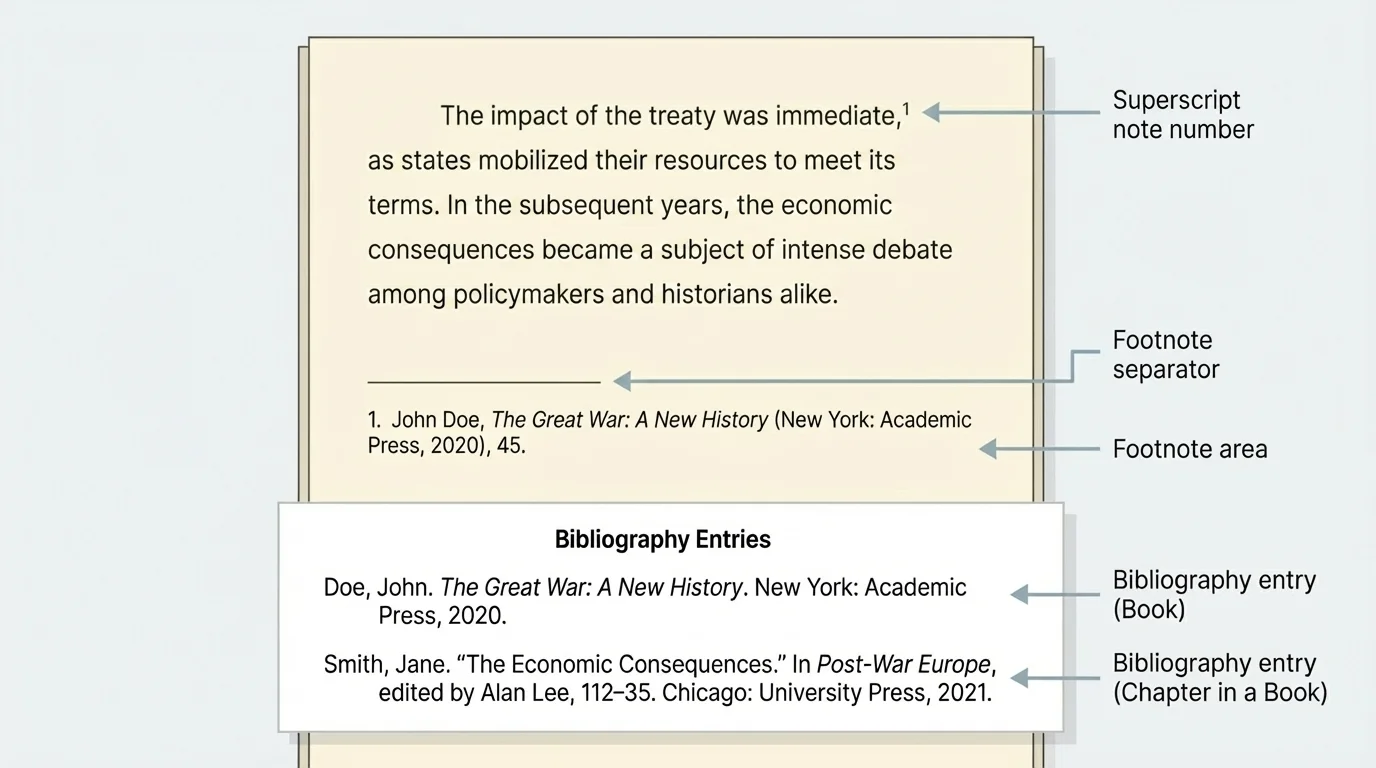
A Turabian paper may also require a title page, depending on the teacher's directions. The final source list is usually called a bibliography. Footnote entries and bibliography entries are related, but they are not formatted exactly the same way. That difference matters. A student cannot simply copy one form into the other without editing.
For example, a footnote might list an author's full name first and include publication details in note form, while the bibliography alphabetizes by last name and changes the punctuation pattern. That is why using a style manual carefully matters: small details signal whether you understand the system.
When writing a history paper, you may need both factual precision and interpretive argument. Turabian helps you support that argument with traceable evidence. The note points to a specific source, and the bibliography helps readers see the overall body of research behind the paper. When you compare this to the MLA layout from earlier, the difference reinforces the point from [Figure 1]: each discipline organizes evidence in ways that fit its priorities.
Using a style manual correctly is closely connected to academic honesty. Plagiarism happens when a writer presents someone else's words, ideas, or structure as if they were original. This can happen intentionally, but it also happens by accident when students take notes carelessly or forget to cite a paraphrase.
A paraphrase is not just changing a few words. It means restating a source idea in your own sentence structure and voice while still crediting the original source. A direct quotation uses the exact words from the source and must be placed in quotation marks or block format, depending on length. Both quotation and paraphrase need citation.
Source use as a writing choice
Quotations are useful when the original wording is especially powerful, precise, or worth analyzing. Paraphrases are useful when you want to compress information, explain a complex point more clearly, or keep the emphasis on your own voice. Strong academic writing usually combines both rather than relying only on one method.
Suppose a source states that young voters often build political identity through online networks. If you quote those exact words, you need quotation marks and a citation. If you restate the idea in your own wording, you still need a citation because the idea came from the source. Style manuals tell you how to give that credit in the correct form.
[Figure 4] Strong writers do not wait until the last five minutes to fix formatting. They use a recursive writing process, returning again and again to drafting, checking, revising, and proofreading. Style editing is not a single final step. You may notice a citation problem while revising a paragraph, or discover that a source is missing when building the Works Cited or bibliography.
Editing for style manual accuracy works best when you move from large issues to small ones. First, confirm that you are using the correct style for the assignment. Next, check whether every source mentioned in the paper appears in the final source list and vice versa. Then review formatting patterns such as heading, spacing, indentation, and note style. Finally, proofread for punctuation, capitalization, and typing errors.
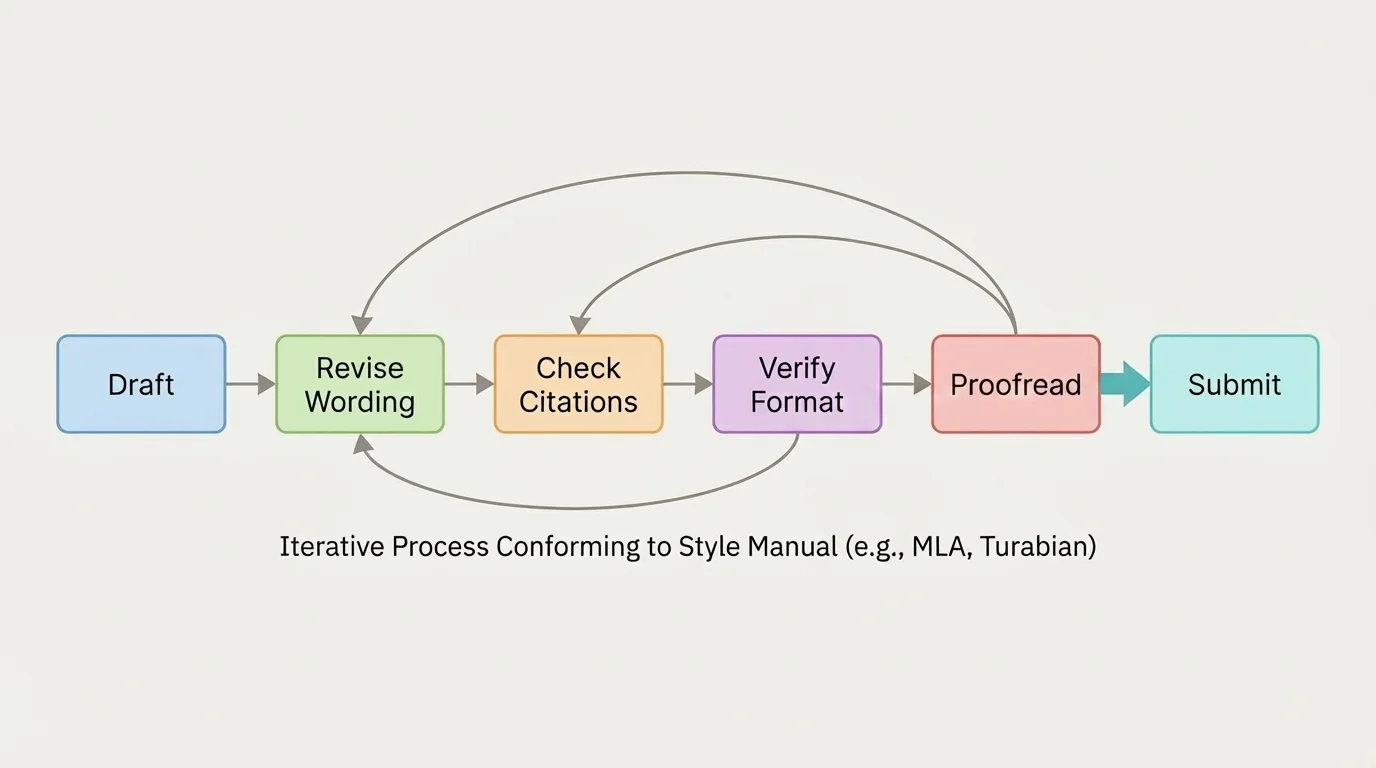
This process is recursive because each correction can reveal another issue. For example, when you add a citation, you may realize the sentence needs a signal phrase. When you add the source to the Works Cited page, you may notice the author's name is spelled differently than it appears in your draft. Good editing means tracing those connections carefully.
| Editing Check | Question to Ask |
|---|---|
| Correct style | Am I following the manual required for this assignment? |
| In-text documentation | Does every quotation and paraphrase have a citation or note? |
| Source list match | Does every cited source appear in Works Cited or bibliography? |
| Formatting consistency | Are spacing, headings, indentation, and titles consistent? |
| Final proofreading | Have I checked punctuation, capitalization, and typing errors? |
Table 2. A practical checklist for editing writing so it conforms to a required style manual.
Example: recursive editing in action
A student finishes a history paragraph and notices a superscript note number is missing after a paraphrase.
Step 1: Add the missing note number.
The writer places the superscript after the sentence that uses the source idea.
Step 2: Check the footnote entry.
The writer confirms that the source details are complete and match Turabian note format.
Step 3: Check the bibliography.
The writer makes sure the same source appears there in bibliography form, not note form.
Step 4: Reread the paragraph.
The writer revises wording so the evidence flows naturally and the citation does not feel dropped in.
This is recursive editing: one correction leads to stronger accuracy and clearer writing at the same time.
Later in the process, [Figure 4] still matters because proofreading is not separate from thinking. If a heading style changes halfway through the paper or a citation pattern shifts, the problem is not just visual. It affects how clearly the reader understands the structure and evidence of your work.
Citation generators, word processors, and online templates can save time, but they are not perfect. A generator may misread a website, place details in the wrong order, or apply the wrong capitalization. Autocorrect can also damage formatting, especially in titles or names. That means technology should assist your judgment, not replace it.
A smart approach is to use tools for efficiency and the style manual for verification. Generate a starting citation if you want, but compare it against an official example. If your word processor builds a hanging indent incorrectly or changes line spacing, fix it manually. Academic writing still requires human attention.
Many citation errors come from copying and pasting source information too quickly. A missing page number, incorrect title capitalization, or broken URL often begins as a note-taking problem long before the final draft.
One of the best habits is to record source information as you research. If you save the author, title, publication information, page range, and access details immediately, formatting later becomes much easier. This habit also lowers the risk of accidental plagiarism.
The same student may need to write very differently in two classes on the same day. In English, the focus may be close analysis of language and theme. In history, the focus may be argument built from evidence across multiple sources. In a shared writing project, the group must also agree on one consistent style so the final product does not look like four separate papers pasted together.
That is why style manuals belong to a larger skill: applying knowledge of language in different contexts. Writers make effective choices not only about words but also about conventions. A paper should sound and look like it belongs in its discipline. That includes tone, evidence, structure, and documentation.
For example, a literary analysis in MLA may integrate short quotations directly into analytical paragraphs. A historical essay in Turabian may use notes to track source details while the main text develops interpretation. In both cases, style supports meaning. It helps readers follow the argument in the way that field expects.
"The purpose of documentation is both to give credit and to guide readers to your sources."
— Core principle of academic writing
When you understand that principle, style rules begin to make more sense. They stop feeling like random formatting commands and start functioning as tools for communication.
Before submitting, read your paper as a reader rather than only as the writer. Look for consistency first. Are all headings in the same form? Are all page numbers present? Are all source entries alphabetized correctly? Does every note or parenthetical citation match the final source page? These checks often catch the small mistakes that lower the quality of an otherwise strong paper.
Then read sentence by sentence. Check punctuation around quotations. Make sure titles are styled correctly. Confirm that spacing, indentation, and font remain consistent after revisions. If the piece is being shared or published digitally, make sure formatting still holds when the file is opened on another device or platform.
The strongest final drafts combine ideas, evidence, clarity, and correctness. A style manual cannot create insight for you, but it helps present your insight in a form readers can trust and use.
