A strong piece of writing can open a college door, win a scholarship, explain a scientific discovery, persuade a community, or damage a writer's credibility in seconds. The difference often is not whether the writer has an interesting idea, but whether that idea is communicated clearly. Clear and coherent writing is not accidental. It is the result of choices—what to say, how to say it, how to arrange it, and who needs to understand it.
When teachers, employers, editors, or online readers say writing should be clear and coherent, they mean more than "free of mistakes." Clear writing expresses ideas in a way readers can understand without confusion. Coherent writing holds together. Each sentence connects to the next, each paragraph contributes to the whole, and the writing feels guided rather than random.
Writing is one of the main ways people prove what they know. A student may understand a novel deeply, run a precise lab, or care intensely about a social issue, but if the writing is disorganized or vague, that knowledge stays trapped in the writer's mind. Good writing makes thinking visible.
Clear writing also shows respect for the reader. Readers should not have to guess the writer's point, hunt for the main idea, or decode an inconsistent tone. Whether the task is an analytical essay, a research report, a speech draft, an editorial, or a shared digital document, the writer's job is to guide the audience through the message.
Clear writing communicates ideas in a direct, understandable way. Coherent writing is logically connected, so the parts fit together and build meaning. Development is the amount and quality of detail, evidence, explanation, and analysis used to build ideas. Organization is the arrangement of ideas so readers can follow them. Style is the writer's way of using language, including tone, word choice, sentence structure, and level of formality.
These qualities do not exist separately. A paper may have strong evidence but weak organization, making it hard to follow. Another may sound polished but lack development, leaving readers unconvinced. Effective writing brings development, organization, and style into alignment with the writer's task, purpose, and audience.
Every strong draft begins with three key decisions: task, purpose, and audience. These choices shape the entire piece through the way they lead to decisions about evidence, structure, tone, and format. Before writing a sentence, a writer should know what the assignment requires, why the piece is being written, and who will read it.
[Figure 1] The task is what the writer has been asked to do. Compare two texts? Explain a process? Argue a claim? Reflect on an experience? Different tasks call for different structures. A literary analysis needs claims and textual evidence. A lab report needs procedure, data, and interpretation. A proposal needs a clear problem and a realistic solution.
The purpose is the writer's goal. A writer may want to inform, explain, analyze, argue, entertain, or motivate action. Purpose affects what information belongs in the piece and how strongly the writer should state claims. If the purpose is to persuade, evidence and counterargument become especially important. If the purpose is to inform, precision and accuracy matter most.
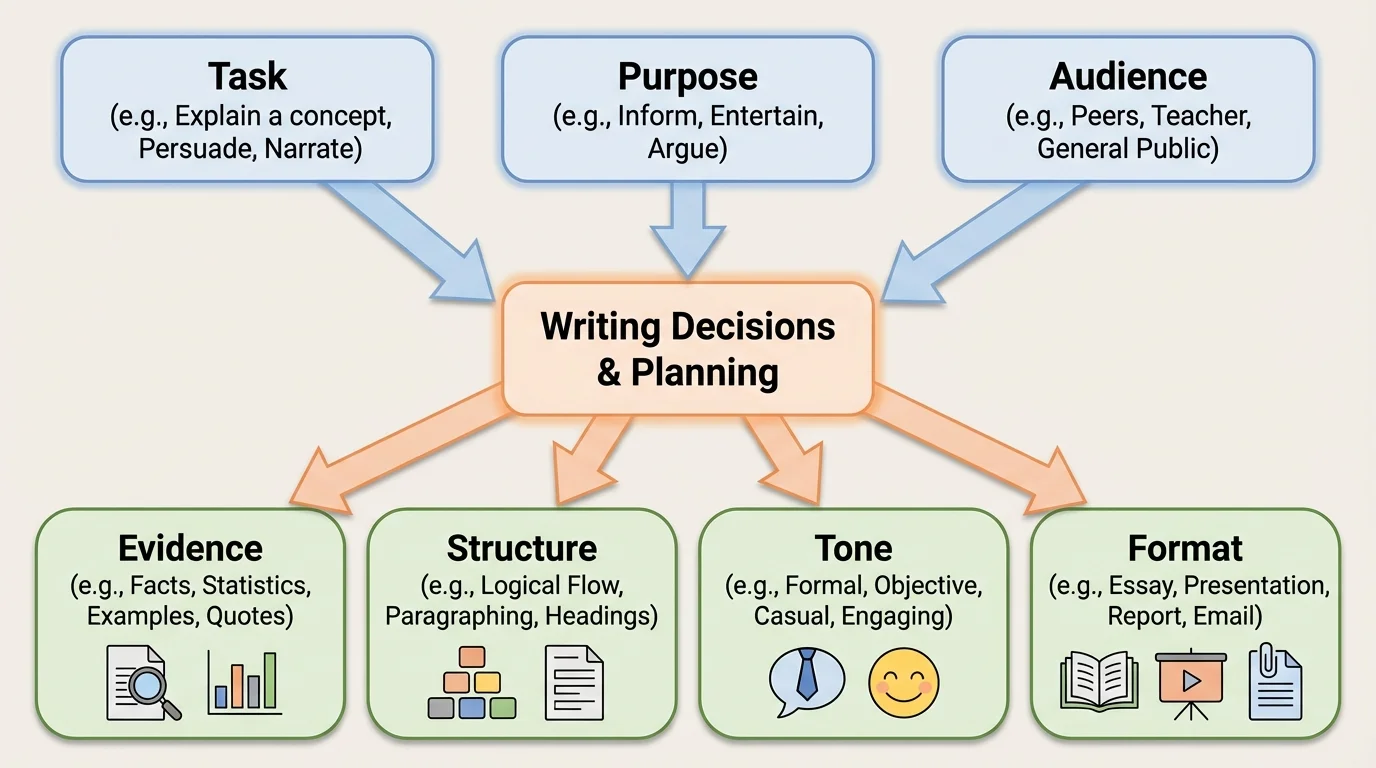
The audience is the intended reader or readers. Writing for a teacher is different from writing for younger students, community members, or a public online audience. Audience affects background explanation, vocabulary, examples, and tone. A science article for experts might use technical language efficiently, while a public health post needs clearer definitions and more accessible phrasing.
Consider the topic of sleep deprivation. If a student writes a biology report, the focus may be on brain function and research findings. If the same student writes a speech for classmates, the focus may shift to homework, sports, jobs, and mental health. The topic stays the same, but the writing changes because the task, purpose, and audience change. That same flexibility appears again later in [Figure 4], where one topic is reshaped for different readers.
Strong writing does not merely state ideas; it develops them. Development means giving readers enough to understand not only what the writer thinks, but why. A claim without support feels thin. A detail without explanation feels dropped into the paragraph. A quotation without analysis becomes decoration instead of evidence.
Writers develop ideas by using examples, facts, observations, quotations, data, reasoning, and explanation. The exact kind of support depends on the task. In a history essay, development may come from primary and secondary sources. In a literary analysis, it comes from textual evidence and interpretation. In an argumentative piece, it includes evidence, logic, and response to opposing views.
One common mistake is confusing summary with development. Summary repeats what happened or what a source says. Development explains significance. For example, writing "The author uses repetition" is only a starting point. Stronger development explains what is repeated, how often, what effect it creates, and why that effect matters to the text's larger meaning.
From weak development to strong development
Weak version: School start times should be later because teens are tired.
Step 1: Add specific evidence.
School start times should be later because many teenagers do not get the recommended amount of sleep on school nights.
Step 2: Explain why the evidence matters.
Lack of sleep can reduce attention, memory, and reaction time, which makes learning harder and can even affect student safety during early commutes.
Step 3: Connect the point to the larger claim.
Because school is meant to support learning, schedules that consistently work against adolescent sleep patterns can weaken academic performance rather than strengthen it.
The stronger version gives readers a reason, evidence, explanation, and significance.
Development also requires balance. If one body paragraph contains rich explanation and another contains only two broad sentences, the paper may feel uneven. Effective writers ask whether each main point has enough support and whether the support clearly connects back to the thesis or controlling idea.
Even strong ideas can fail if they are arranged poorly. Organization gives readers a path, and that path often moves from introduction to body paragraphs to conclusion through deliberate transitions. Good organization is not just about having a beginning, middle, and end. It is about placing information where readers need it.
[Figure 2] At the whole-piece level, organization usually begins with a focused introduction. The introduction prepares the reader by establishing context and presenting the central claim, question, or idea. Body paragraphs then develop that central idea in a logical order. The conclusion does more than repeat; it clarifies the importance of what the writing has shown.
At the paragraph level, organization depends on unity and progression. A paragraph should center on one main point, often expressed in a topic sentence. The sentences that follow should develop that point rather than wander into a new one. When a paragraph tries to do too much at once, coherence breaks down.
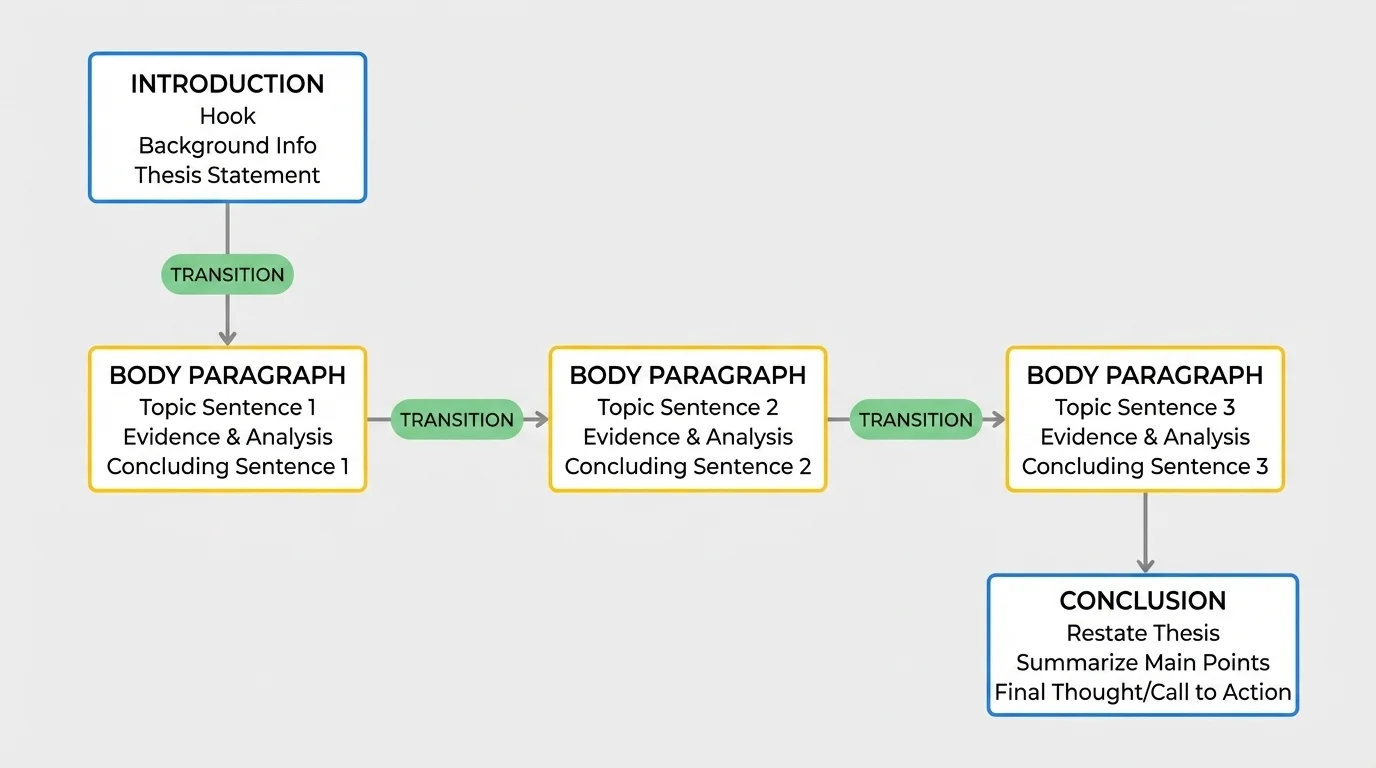
Transitions help readers move from idea to idea. Words and phrases such as however, for example, in contrast, as a result, and therefore signal relationships between ideas. But transition words alone do not create coherence. The ideas themselves must actually connect. If a paragraph begins with "however" but does not contrast with the previous point, the writing feels mechanical.
Writers can organize information in several useful patterns. They may use chronological order for narratives or historical sequences, cause-and-effect order for scientific or social analysis, compare-and-contrast order for evaluating similarities and differences, or problem-solution order for proposals. The best structure depends on the task and purpose, not on habit.
| Organizational pattern | Best use | Example |
|---|---|---|
| Chronological | Events or processes over time | Explaining how a protest movement grew |
| Cause and effect | Showing why something happens and what follows | Analyzing the effects of social media on elections |
| Compare and contrast | Examining similarities and differences | Comparing two poems or two economic systems |
| Problem and solution | Arguing for change | Proposing ways to reduce food waste at school |
| Order of importance | Building emphasis | Ranking the strongest reasons in an editorial |
Table 1. Common organizational patterns and the kinds of writing tasks they support.
When revising, writers should test organization by asking simple but powerful questions: Does each paragraph belong where it is? Does each one connect clearly to what comes before and after? Would moving a paragraph improve the reader's understanding? These questions often matter as much as grammar corrections.
Later, when checking final drafts, the structure in [Figure 2] remains useful because it reminds writers that readers need both large-scale direction and sentence-level flow.
Style is where writing becomes more than correct—it becomes effective for a specific situation. Style includes tone, word choice, sentence length, sentence variety, and level of formality. A text message to a friend, a scholarship essay, and an editorial on environmental policy should not sound the same.
One important element of style is tone, the writer's attitude toward the subject and audience. Tone may be serious, analytical, urgent, respectful, skeptical, reflective, or enthusiastic. Tone should fit the purpose. An argument about public safety should not sound sarcastic. A literary reflection should not sound like a lab manual.
Diction, or word choice, also affects style. Precise words create clarity. Vague words create fog. Compare "things got worse" with "attendance dropped, conflicts increased, and the program lost funding." The second version tells the reader what "worse" actually means. Precision is especially important in analytical and informational writing.
Sentence variety matters too. If every sentence has the same length and pattern, writing can sound flat or robotic. On the other hand, sentences that are too long and packed with ideas can become hard to follow. Skilled writers vary sentence structure while keeping meaning clear. They may use a short sentence for emphasis after a longer, more developed one.
Appropriate style is a match, not a personality test. Students sometimes think style means sounding impressive at all costs. In reality, effective style means matching language to the writing situation. Sometimes the best sentence is elegant and complex. Sometimes the best sentence is plain and direct. The goal is not to sound smart; the goal is to communicate well.
Formality is another style choice. Academic writing usually avoids slang, unexplained abbreviations, and overly casual phrasing. That does not mean it should sound stiff or artificial. Strong academic prose can still sound energetic and confident. The key is control: the writer chooses language deliberately rather than drifting into whatever sounds conversational in the moment.
Many students are taught writing as a straight line: brainstorm, draft, revise, edit, submit. In reality, effective writing is recursive, and writers often loop backward as they improve their work. A writer may discover a stronger idea while drafting, reorganize body paragraphs during revision, and return to research after noticing a weak section.
[Figure 3] This matters because writing improves through rethinking, not just through fixing mistakes. Planning helps a writer set direction. Drafting gets ideas onto the page. Revising re-sees the content—adding, cutting, reorganizing, and clarifying. Editing focuses on correctness, grammar, punctuation, and sentence-level polish. Publishing shares the work with readers. Updating allows the writer to improve the text after feedback, new information, or changing purpose.
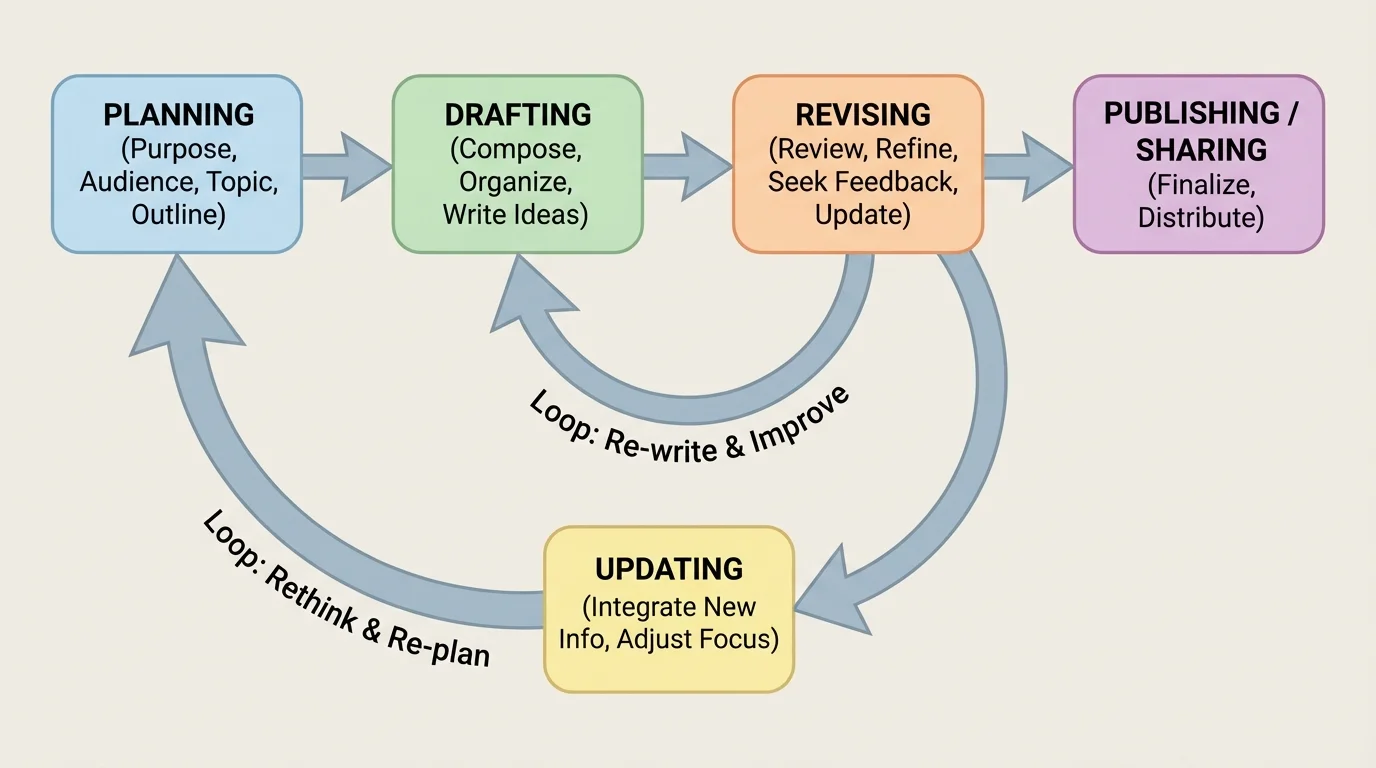
Revision is often the stage where clarity grows the most. During revision, writers ask whether the thesis is focused, whether evidence is sufficient, whether paragraphs are ordered effectively, and whether the style fits the audience. Editing comes later. A grammatically perfect paragraph that belongs in the wrong place is still ineffective.
This recursive approach is especially important in digital environments. Online writing is often updated after publication. A shared class document, school website article, or collaborative report may go through multiple revisions by multiple writers. The ability to revisit and improve writing is not a sign of weakness; it is how strong writing is made.
The cycle in [Figure 3] also explains why experienced writers rarely produce their best work in one attempt. They refine ideas by moving back and forth among stages.
The same information does not belong in every piece of writing in the same way. Audience awareness changes detail, vocabulary, tone, and format by comparing one topic across several writing situations. This is one of the clearest signs of mature writing: the writer adjusts rather than using the same voice for every assignment.
[Figure 4] Suppose the topic is a student-designed garden on school grounds. In a science report, the writer might explain soil quality, water access, local species, and data on pollinators. In a letter to the principal, the writer might emphasize cost, student involvement, and benefits to the school community. In a social media post for students, the writer might use brief, energetic language and highlight ways to join the project.
None of those versions is automatically better than the others. Each is effective only if it suits its purpose and audience. That is why writers must think not only about what they want to say, but about what their readers need in order to understand and respond.
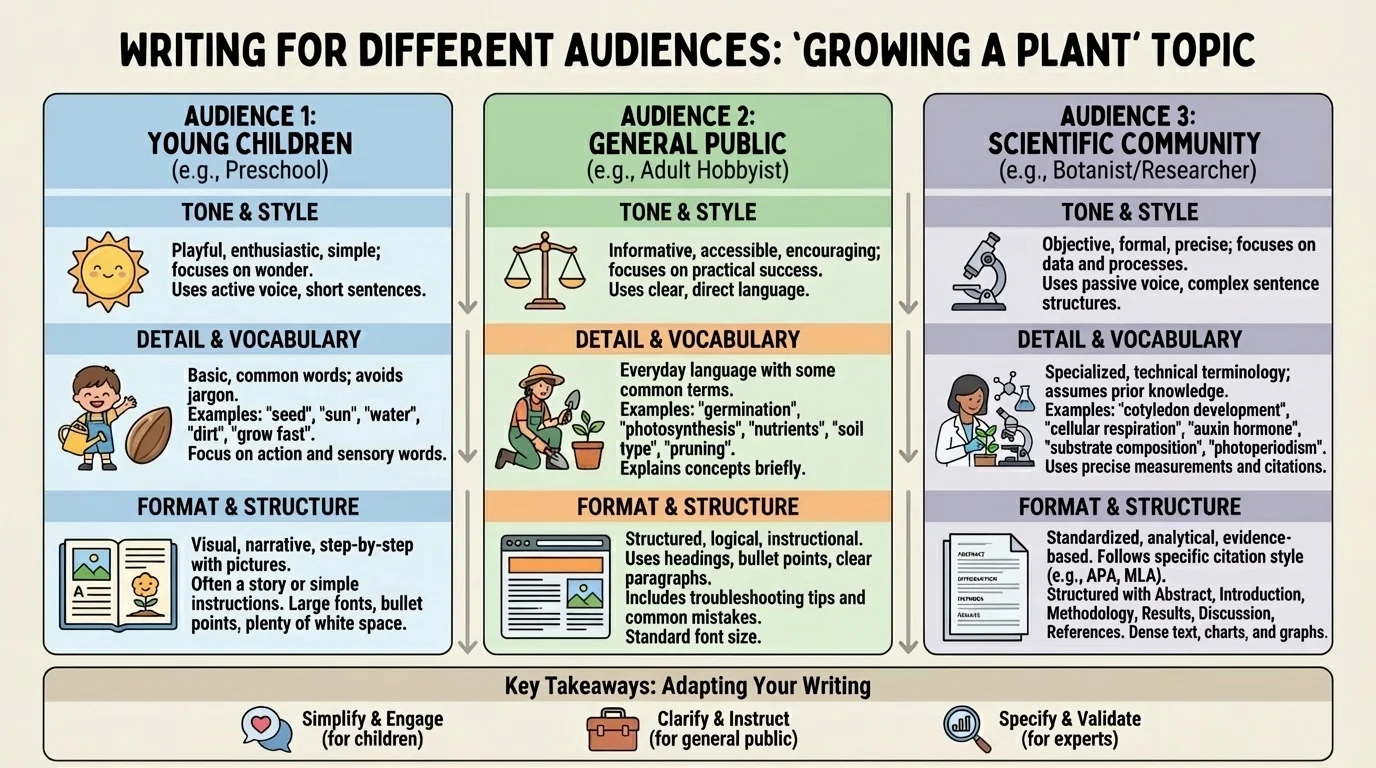
If a writer ignores audience, the result can be strange. A highly technical explanation may confuse general readers. An overly casual style may weaken credibility in a formal proposal. A piece that assumes too much background knowledge may leave readers behind. The comparison in [Figure 4] makes this visible by showing how the same core idea shifts across contexts.
One idea, three audience-specific openings
Topic: reducing plastic waste at school
Version 1: Formal proposal to administrators
Our school can reduce single-use plastic waste by replacing disposable cafeteria utensils with durable alternatives and by adding clearly labeled refill stations for water bottles.
Version 2: Informational article for students
Every lunch period creates a surprising amount of plastic waste, but small changes in what students use each day can make a noticeable difference.
Version 3: Announcement for a community event
Join us this Friday to help launch a school-wide effort to cut plastic waste and build cleaner habits that last beyond one week.
The core topic stays the same, but the language and focus shift to fit each audience and purpose.
Writers should also remember that audiences may include multiple readers at once. A research paper may be read by a teacher now and by peers later during discussion. A published article may reach readers with different levels of prior knowledge. Strong writing anticipates these differences and remains accessible without becoming simplistic.
Several patterns frequently weaken student writing. One is the vague claim: a statement so broad that it says little. Another is list-like writing, where points are mentioned one after another without explanation or connection. A third is tone mismatch, such as using humor in a context that requires seriousness or using inflated language that sounds unnatural.
Another common problem is evidence without analysis. Students sometimes insert quotations or facts and assume the point is made. But evidence does not explain itself. The writer must interpret it, connect it to the claim, and show why it matters. Readers need the bridge between detail and idea.
Writers also lose coherence through sudden shifts. A paragraph may begin with one point and end with another. A draft may move from formal analysis to casual opinion. Pronouns such as "this," "they," or "it" may appear without clear antecedents. These are not small problems because they interrupt the reader's ability to follow the argument or explanation.
Professional writers in journalism, science, business, and publishing are revised constantly by editors, collaborators, and by their own second thoughts. Strong writing in the real world is usually the result of multiple rounds of improvement, not instant perfection.
Clarity often improves when writers read their work aloud. Sentences that looked fine on the page may sound awkward, repetitive, or unclear when spoken. Reading aloud can reveal missing words, weak transitions, and overloaded sentences that the eye skipped past.
Modern writing often happens in shared spaces: group presentations, collaborative research documents, discussion posts, websites, and multimedia projects. In these settings, coherence depends not only on individual skill but also on coordination. Writers must agree on purpose, audience, structure, and style so the final product sounds unified.
In collaborative writing, one student may be strong at research, another at structure, another at editing. Those strengths can help a group—but only if the group keeps the piece consistent. A report with three completely different tones or repeated information feels stitched together instead of composed.
Updating writing after publication is also part of modern composition. A writer may correct errors, include new evidence, respond to audience feedback, or revise wording for accuracy. This is especially important in informational writing, where outdated facts can mislead readers. Good writers understand that publication is often a stage in communication, not the last possible step.
From earlier writing study, recall that a strong paragraph usually includes a central idea, supporting details, and explanation. This paragraph-level skill remains essential even in longer essays, articles, reports, and multimedia scripts.
Version history, comments, and tracked changes can make the recursive process visible. Instead of treating revision as invisible, digital tools show how a piece evolves. That can help writers make smarter decisions about what to keep, what to cut, and what to rethink.
Before calling a piece finished, writers should test it against its task, purpose, and audience. Does the draft actually answer the assignment? Is the purpose obvious? Will the intended audience understand the vocabulary, references, and level of detail? A beautiful paragraph that does not serve the assignment is still off target.
Next, writers should examine development. Are claims supported? Are examples specific? Does each quotation or fact receive explanation? Is the line of reasoning complete, or does the draft expect the reader to make too many connections alone?
Then comes organization. Does the introduction establish direction? Do body paragraphs build logically? Are transitions meaningful? Does the conclusion leave readers with significance rather than simple repetition? Finally, writers should assess style: tone, diction, sentence clarity, and formality. The strongest final drafts sound intentional from beginning to end.
Clear and coherent writing is not about sounding complicated. In many cases, the most effective sentence is the one that makes an idea easiest to understand. Strong writers choose complexity only when it serves the idea. They revise not to impress readers with difficulty, but to make meaning precise, powerful, and readable.
