A short paragraph can mention a topic. A strong informative text can make a reader truly understand it. That difference matters everywhere: in a science report explaining gene editing, in a history essay about industrialization, in a technical article about cybersecurity, or in a policy analysis explaining a meaningful issue. Readers do not just need information; they need well-developed information that is selected carefully, organized clearly, and explained fully enough to make sense.
When a writer develops a topic thoroughly, the writing does more than list facts. It helps readers see relationships, grasp causes and effects, understand definitions in context, and recognize why the topic matters. A paper about renewable energy, for example, becomes much stronger when it does not simply say that solar power is useful. It should explain how solar panels convert sunlight into electricity, why this reduces dependence on fossil fuels, what limitations exist, and where the technology is already changing communities.
Thorough development also builds credibility. If a writer makes a claim but gives little support, the reader may doubt the writer's knowledge. If the writer provides strong evidence, accurate explanation, and carefully chosen examples, the reader is more likely to trust the text. In academic writing, this trust is essential.
Develop the topic thoroughly means to explain a subject in enough depth and detail that readers can understand it clearly and accurately. This involves selecting the most important and relevant information, organizing it logically, and analyzing that information rather than merely listing it.
Relevant information directly supports the topic, purpose, and audience needs. Significant information is information important enough to improve understanding in a meaningful way.
Strong development is not the same as writing as much as possible. Length alone does not create quality. A paragraph filled with repeated ideas or random facts may be long, but it is still weak. Thorough development means that each detail has a purpose.
To develop a topic thoroughly, a writer usually combines several moves. First, the writer introduces a clear main idea. Second, the writer expands that idea with information such as facts, examples, definitions, and quotations. Third, the writer explains the meaning of that information. This final step is often the difference between average writing and excellent writing.
Consider the difference between these two sentences: "Artificial intelligence is changing medicine." That statement is true, but it is broad. A more developed explanation might add that artificial intelligence can help radiologists detect patterns in medical images, can support doctors in predicting patient risk, and can speed up data analysis in drug research. Then the writer should explain why those uses matter, such as improving early diagnosis and increasing efficiency. The topic becomes understandable because the writer has moved from a claim to support and then to analysis.
Development also depends on scope. If your topic is broad, such as climate change, you cannot explain every aspect in one essay. Thorough development does not mean covering everything. It means covering the most important parts of your chosen focus well. A writer might narrow the topic to the effect of climate change on coastal cities, then use targeted evidence to develop that focus in depth.
One of the most important writing decisions is selection. Writers often gather more information than they can use. The skill is not simply finding sources; it is deciding what deserves space in the final piece. Ask: Does this fact help the reader understand the topic? Does this example clarify an idea? Does this quotation add insight that my own words cannot provide as effectively?
Significance matters because not all facts are equal. Suppose you are writing about the Great Depression. A detail about unemployment rates is highly significant because it helps explain the scale of economic hardship. A detail about the color of a politician's tie at a speech is almost certainly not. Even if a fact is true, it may be too minor to matter.
Relevance matters because a fact can be interesting without actually supporting your point. If your essay focuses on how social media affects teen sleep, a paragraph about the entire history of the internet may be only loosely connected. Good writers resist the temptation to include facts just because they found them. They include facts because those facts serve the writing's purpose.
Writers should also check for accuracy and source quality. A thoroughly developed topic depends on trustworthy evidence. A peer-reviewed scientific article, a respected news investigation, a government report, or a primary historical source usually carries more weight than an unsourced social media post. Strong development is built on strong material.
Professional journalists often gather far more information than appears in the final article. What makes the article effective is not the total amount collected, but the discipline of choosing the details that most clearly answer the reader's questions.
Another key question is balance. If one detail gets far more attention than its importance deserves, the writing can become distorted. Thorough development means proportion: major ideas receive major explanation, while minor points stay brief.
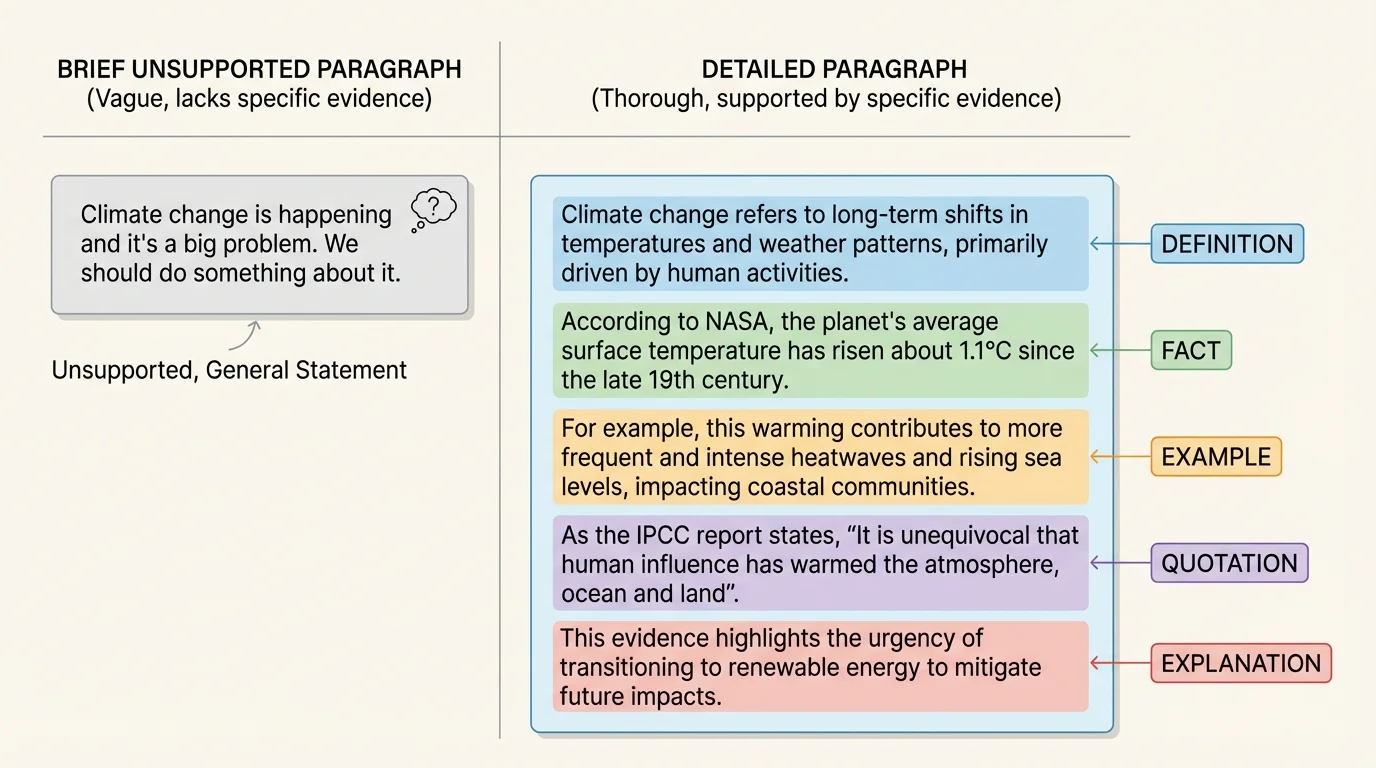
A thoroughly developed explanation usually layers different forms of support together, as [Figure 1] illustrates. A writer may begin with an extended definition, add a fact or statistic, include a concrete example, and then explain the importance of all that evidence. This layered method gives writing depth because it reaches the reader in more than one way.
Extended definition goes beyond a dictionary meaning. It explains a term's parts, function, significance, or context. For example, if you define inflation only as "rising prices," readers get a starting point. But an extended definition would explain that inflation refers to a general increase in prices across an economy over time, which reduces purchasing power. That deeper explanation helps readers understand not only what inflation is, but why it matters in daily life.
Concrete details make abstract ideas more understandable. Instead of saying that drought harms agriculture, a writer might explain that low rainfall can leave soil dry, reduce crop yields, raise food prices, and force farmers to change irrigation practices. These details let readers picture real consequences instead of facing only a vague statement.
Facts and statistics are useful when they are interpreted. A number by itself may not do much. If a writer says that a city's average summer temperature has increased over several decades, the writer should explain why that increase matters. Does it affect health, infrastructure, water use, or energy demand? Development happens when the writer connects data to meaning.
Quotations can also strengthen an explanation, especially when the exact language of an expert, witness, or primary source matters. But quotations should not be dropped into a paragraph without context. A writer should introduce the source, present the quotation, and explain what it shows. If a historian writes that factory labor "disciplined time itself," a student should explain that industrial work changed daily life by forcing workers to follow strict schedules instead of seasonal or task-based rhythms.
Examples are especially powerful because they turn general ideas into specific cases. A discussion of algorithmic bias becomes more meaningful when the writer mentions a real case in which facial recognition software performed less accurately on some groups than others. The example gives the reader something concrete to analyze.
As we saw in [Figure 1], strong development often looks less like a single supporting sentence and more like a small structure: claim, evidence, explanation, and connection. The reader should not have to guess why the detail is there.
Good informative writing always considers the audience's knowledge. The same topic must be developed differently for different readers. If you are writing for classmates who know basic biology, you may mention DNA replication with limited explanation. If you are writing for a general audience, you should define terms and explain processes more carefully.
Audience awareness affects vocabulary, background information, and the amount of detail needed. An expert audience may want precise technical distinctions. A younger or less specialized audience may need analogies, simpler explanations, and more context. Neither approach is automatically better. Effective development depends on fit.
For example, if you are explaining blockchain technology to beginners, it helps to define the system in plain language and describe it as a shared digital record that is difficult to alter without network agreement. If you are writing for computer science students, you might discuss distributed ledgers, consensus mechanisms, and security trade-offs. In both cases, the topic can be developed thoroughly, but the details chosen should match what the readers need.
Depth changes with audience knowledge
Thorough development does not mean using the most advanced words possible. It means giving readers enough information to understand the subject clearly. Sometimes that requires more technical detail. Sometimes it requires better explanation of basic ideas. The writer's job is to bridge the gap between the topic and the reader.
A useful test is to ask what questions a reader is likely to have. If a paragraph leaves basic questions unanswered, it probably needs more development. If it answers questions the audience never had, it may be drifting away from relevance.
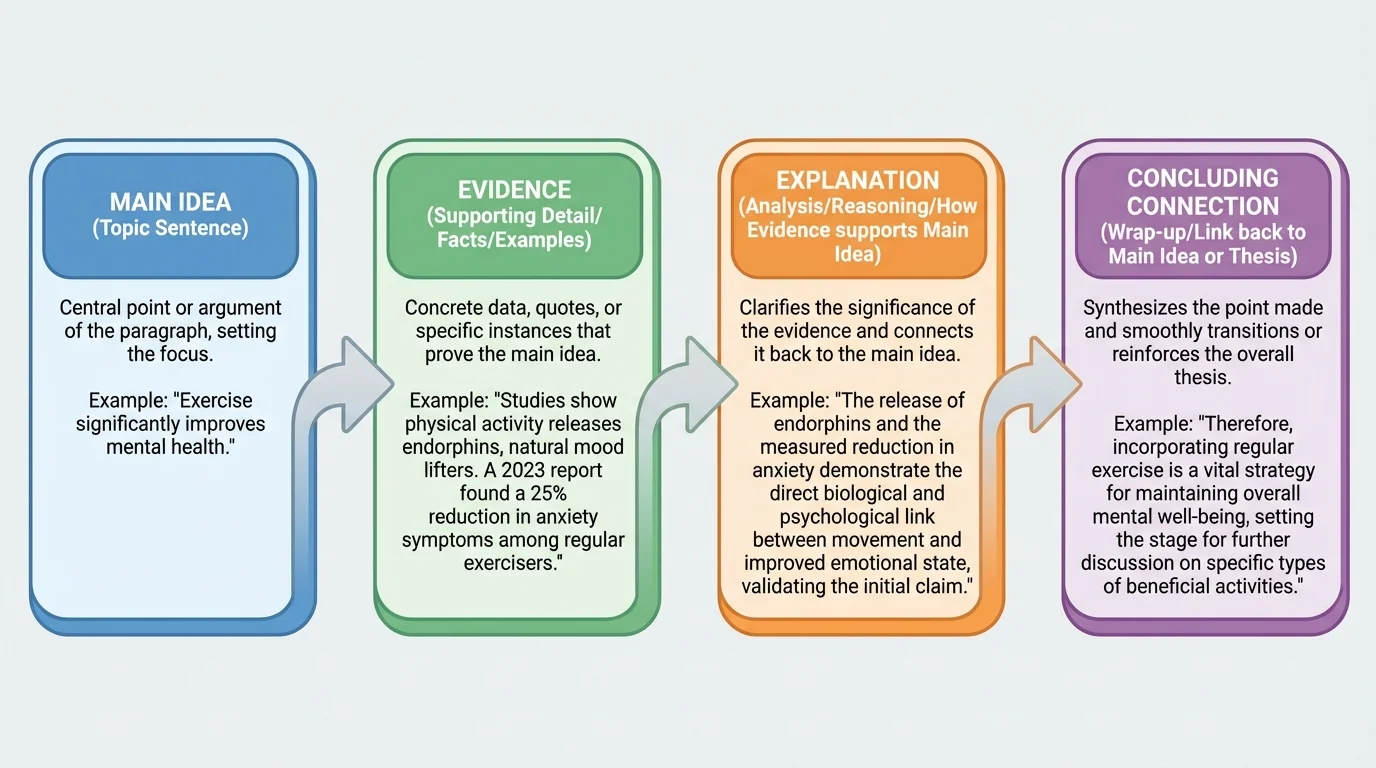
Even strong information can fail if it is arranged poorly. Organization helps readers follow a complex idea, and [Figure 2] shows how a paragraph often moves from a main claim to support and then to explanation. Thorough development depends not only on what you include, but also on the order in which readers encounter it.
One common pattern is general to specific. A writer starts with a broad statement, then narrows into evidence and explanation. Another pattern is cause and effect, which works well for topics like deforestation, economic recession, or disease spread. A problem and solution structure fits issues such as plastic pollution or urban traffic congestion. Compare and contrast helps when explaining differences between systems, ideas, or historical periods.
Within a paragraph, a strong topic sentence introduces the focus. Supporting sentences then add evidence. After that, the writer explains what the evidence means. Too many students stop after presenting a fact. However, explanation is the part that transforms information into understanding.
Transitions also matter. Words and phrases such as for example, in contrast, as a result, more specifically, and this suggests guide readers through the logic. They act almost like road signs in a long trip: without them, readers may still move forward, but the route feels confusing.
Later, when revising, writers can use [Figure 2] as a mental model: does each paragraph actually move from idea to evidence to explanation, or does it wander? Effective organization creates momentum.
Revision often means adding depth, not just adding length, through a before-and-after comparison. A weak paragraph usually contains broad statements with little support. A stronger paragraph adds carefully chosen information and explains it.
Case study: revising a weak paragraph
Weak version: Climate change is a serious problem for cities. It causes many issues, and leaders should do something about it.
Step 1: Add a clearer focus.
Instead of discussing all cities and all issues, narrow the paragraph to one major effect, such as heat in urban areas.
Step 2: Add significant facts and concrete details.
Explain that dark pavement and dense building materials absorb and retain heat, which can make cities warmer than nearby rural areas. Mention how this increases health risks during heat waves.
Step 3: Add explanation.
Show why the evidence matters: hotter neighborhoods can raise energy use, strain power systems, and endanger people who lack access to air conditioning.
Step 4: Add a solution or implication if it fits the purpose.
Describe how planting trees, creating reflective roofs, and expanding cooling centers can reduce risk.
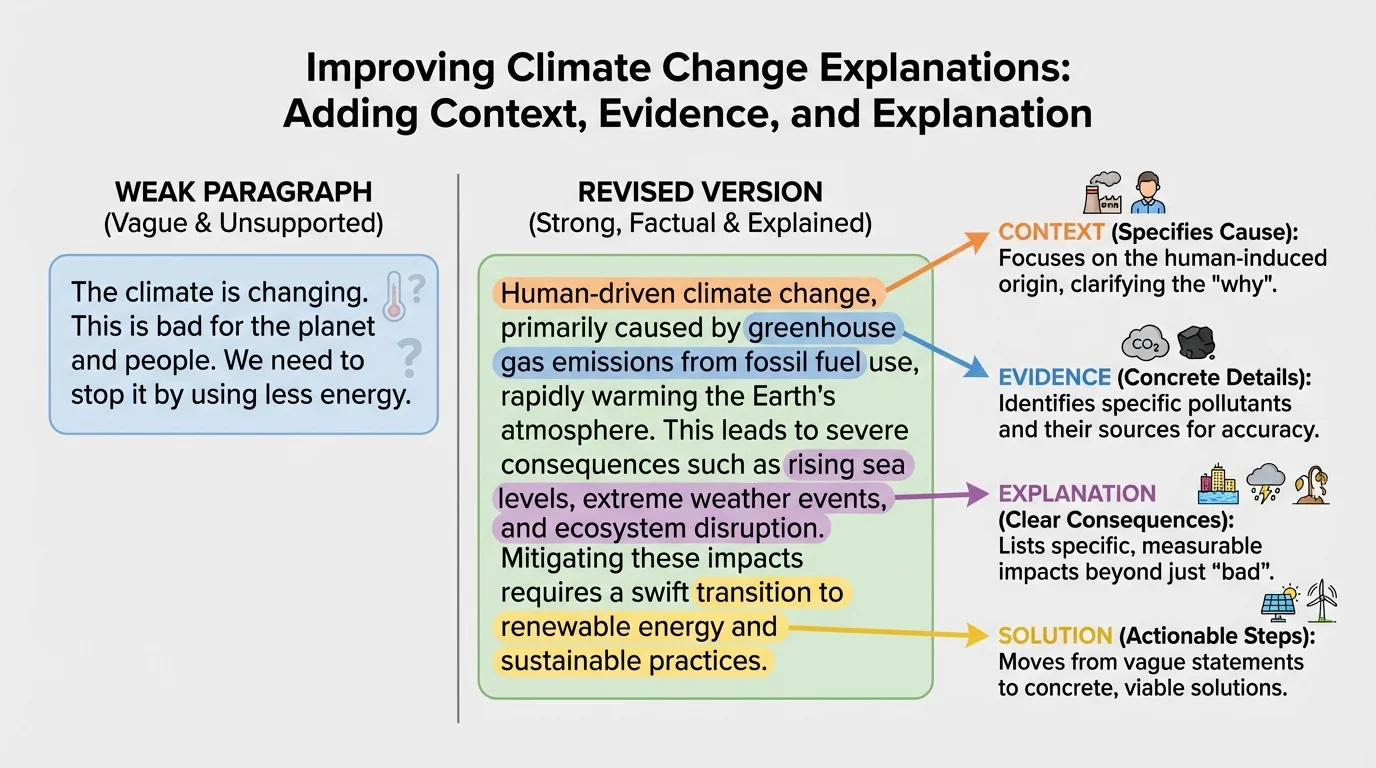
Revised version: Climate change creates a serious challenge for cities by intensifying urban heat. Streets, sidewalks, and rooftops often absorb and hold solar energy, causing densely built neighborhoods to remain hotter than surrounding areas long after sunset. During heat waves, this pattern can increase the risk of dehydration, heat exhaustion, and death, especially for older adults and low-income residents without reliable cooling. Because extreme heat also raises electricity demand, city governments must think about both public health and infrastructure. Strategies such as tree planting, reflective building materials, and accessible cooling centers can reduce the danger.
[Figure 3] The revised paragraph is better not because it is simply longer, but because it is more focused, more specific, and more informative. It gives the reader causes, effects, and responses. It also avoids vague language like "many issues."
That same improvement process applies in every subject. A literature response should not only state that a symbol is important; it should explain how the symbol functions in the text. A history essay should not only mention a law; it should explain its causes and consequences. A science explanation should not only name a process; it should explain how the process works and why it matters.
One common problem is repetition without progress. Writers sometimes repeat the same point in slightly different words, hoping that this sounds thorough. It does not. Thorough writing moves forward by adding new understanding.
Another problem is the list effect: one fact after another, with little connection or explanation. This can make a paragraph feel like notes rather than finished writing. Readers need help seeing how the pieces fit together.
A third problem is irrelevant detail. A paragraph can lose power when it wanders into information that does not clearly support the main idea. If you are explaining vaccination, a long side note about the architecture of hospitals may distract from the topic unless it directly contributes to your point.
Writers also weaken paragraphs when they use quotations as substitutes for explanation. A quotation should support the writer's thinking, not replace it. After presenting a quotation, the writer should interpret it. What does it reveal? Why is it important? How does it connect to the main idea?
From earlier writing study, remember the difference between evidence and analysis. Evidence is the supporting material. Analysis is the writer's explanation of what that material means and how it supports the point. Strong development requires both.
Finally, some writing stays too general. Words such as things, stuff, a lot, and very important usually signal that a writer needs more precise language. Precision helps depth because it forces the writer to identify exactly what is happening.
A useful model is simple: state, support, explain, connect. First, state the main idea. Next, support it with a fact, detail, example, or quotation. Then explain what that support shows. Finally, connect it back to the larger topic or purpose.
For instance, in a paragraph about sleep and learning, a writer might state that sleep improves memory. The support could include research showing that the brain strengthens certain neural pathways during sleep. The explanation would show that this process helps students retain vocabulary, procedures, or concepts learned earlier. The connection might point out that regular sleep habits affect academic performance, not just physical health.
This pattern does not make writing mechanical. Instead, it ensures that the paragraph does real explanatory work. Once students master the pattern, they can adapt it flexibly to different subjects and purposes.
"The greatest enemy of knowledge is not ignorance, it is the illusion of knowledge."
— Daniel J. Boorstin
This quotation matters for writers because shallow development can create that illusion. A paragraph may appear informed if it uses advanced words or mentions a few facts, but if it lacks explanation and depth, readers do not actually gain much understanding.
In science, thorough development often requires process explanation, accurate terminology, and cause-and-effect relationships. A paragraph about photosynthesis should not stop at saying plants make food from sunlight. It should explain that plants use light energy to convert \(CO_2\) and \(H_2O\) into glucose and oxygen, and it should clarify why that process supports ecosystems. If a chemical equation is relevant, it should be presented clearly: \[6CO_2 + 6H_2O \rightarrow C_6H_{12}O_6 + 6O_2\]. The equation alone is not enough; the explanation gives it meaning.
In history, thorough development often depends on context and consequences. If you mention the Marshall Plan, readers need to know when it was proposed, what problem it addressed, and how it influenced postwar Europe. Historical writing becomes stronger when it connects events rather than isolating them.
In literature, strong development includes textual evidence and interpretation. If you claim that a narrator is unreliable, you should point to contradictions, omissions, or unusual language in the text, then explain how those features shape the reader's understanding.
In technical and civic writing, development often requires clarity about systems and effects. If you are writing about water treatment, cybersecurity, voting access, or public transportation, readers need definitions, process explanations, examples, and evidence of impact. Thorough development helps citizens make informed decisions in the real world.
College professors and employers often identify underdeveloped writing not by grammar errors first, but by missing explanation. The writer may have found solid information, but the piece still feels incomplete because it never shows the reader how the parts connect.
The strongest informative writing respects the reader. It does not assume that one fact is enough. It builds understanding carefully, step by step, using information that is important, relevant, accurate, and well organized. That is what it means to develop a topic thoroughly.
