A strong argument is not just a collection of good points. Think about a courtroom lawyer, a journalist writing an editorial, or a scientist defending a conclusion: even when the evidence is powerful, the argument fails if the reader cannot follow how one idea leads to the next. The difference between writing that feels convincing and writing that feels scattered often comes down to connection. Skilled writers make those connections visible.
[Figure 2] In argument writing, readers need more than information. They need guidance. A writer may have a clear position, several reasons, useful examples, and a thoughtful response to the other side, but if those parts are not connected, the reader has to do too much work. That weakens the argument.
Cohesion is the quality that makes a text hold together. A cohesive argument helps readers see how the introduction leads into the main claim, how each body paragraph develops a reason, how evidence supports that reason, and how a counterclaim is acknowledged and answered. Cohesion does not happen by accident. It is built through precise language choices and careful sentence structure.
Claim is the position or conclusion the writer wants the audience to accept.
Reason is a main explanation for why the claim is valid.
Evidence is the support for a reason, such as facts, data, examples, quotations, or observations.
Counterclaim is an opposing viewpoint or challenge to the writer's claim.
Rebuttal is the writer's response to the counterclaim.
When these parts are clearly linked, readers are more likely to trust the writer. They can see not only what the writer believes, but also why and how that belief is supported.
An effective argument has an internal logic, and [Figure 1] shows that logic as a set of relationships rather than separate pieces. The claim stands at the center, reasons branch from it, evidence supports those reasons, and a counterclaim introduces tension that the writer must answer. Good linking language makes those connections explicit.
For example, compare these two versions:
Weak connection: School start times should be later. Teenagers need sleep. Research shows sleep affects concentration.
Clear connection: School start times should be later because teenagers need more sleep than many current schedules allow. In fact, research on adolescent sleep patterns shows that insufficient rest reduces concentration, memory, and reaction time.
In the stronger version, the reader does not have to guess how the ideas fit together. The word because links the claim to the reason, and in fact introduces evidence that strengthens the point.
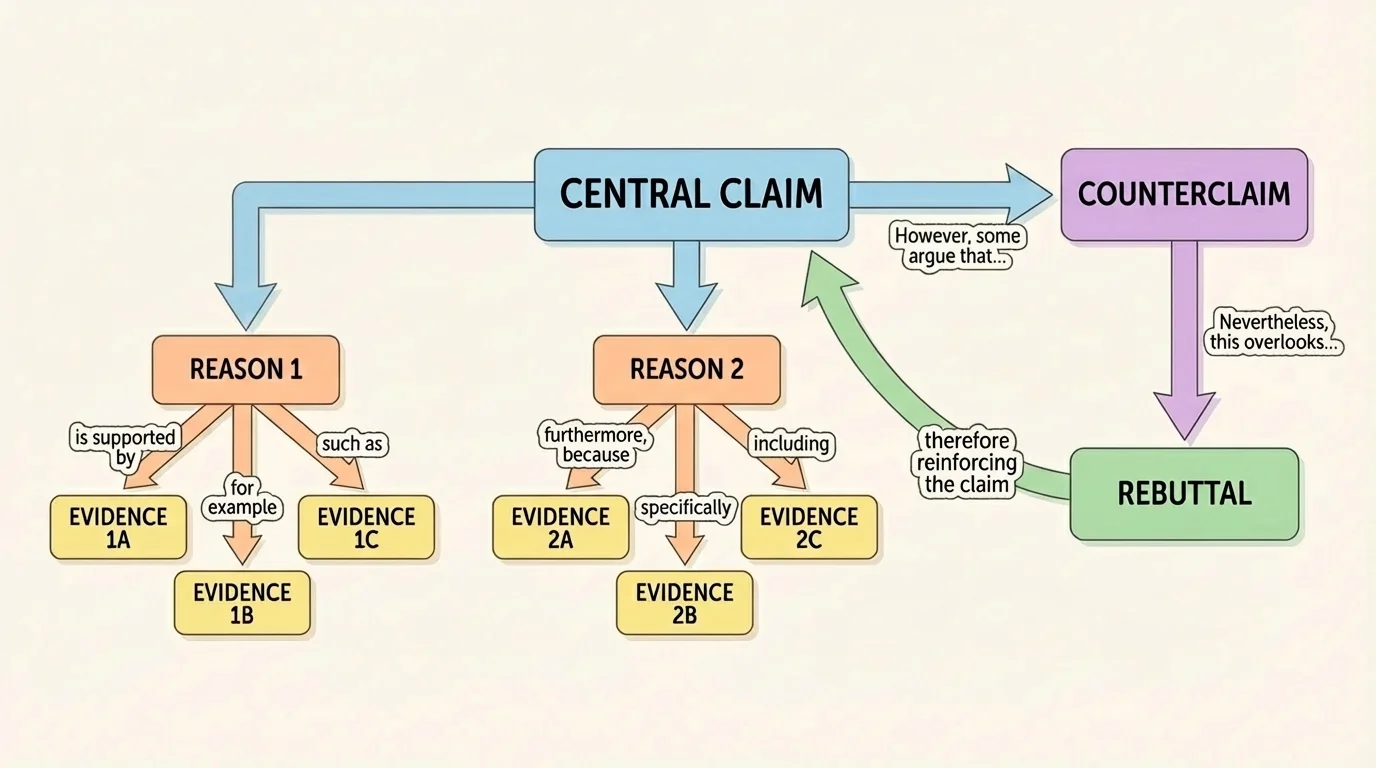
A writer must also make the relationship between claim and counterclaim clear. If a paragraph suddenly presents the opposing side without signaling that shift, readers may think the writer has changed positions. Signals such as however, some critics argue, opponents claim, and although this view has merit help readers recognize that the writer is considering another perspective.
This is especially important in academic writing because mature argument does not pretend disagreement does not exist. Instead, it acknowledges complexity and responds to it. As we see again in [Figure 1], the counterclaim is not an interruption of the argument; it is part of the argument's overall design.
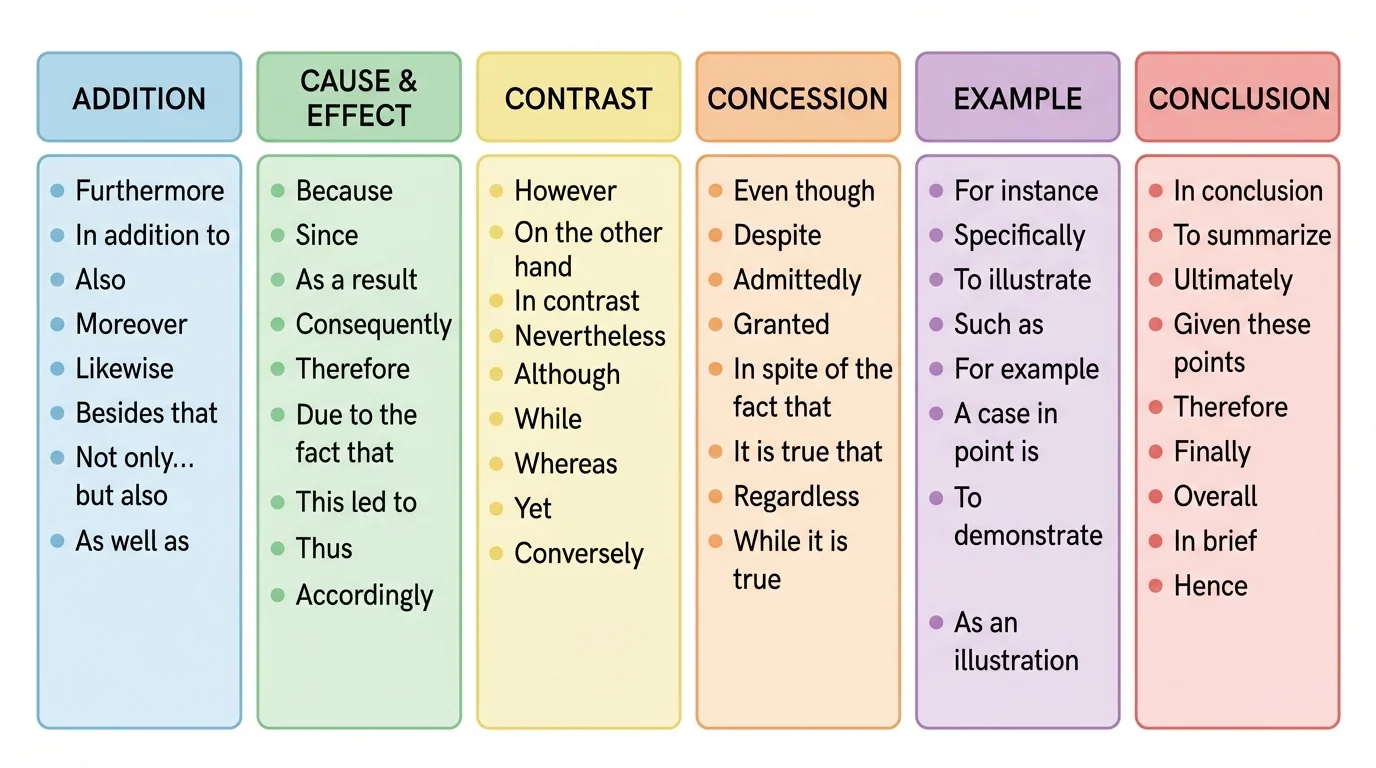
Writers use transitions, sentence openings, and embedded clauses to help readers track meaning. Different linking choices signal different logical relationships, so choosing the right one matters.
Some linkers show addition: furthermore, in addition, also, moreover. These tell the reader that a new point supports the same general direction.
Some show cause and effect: because, therefore, as a result, since, consequently. These are especially useful in arguments that explain why something happens or what policy should follow from a problem.
Others show contrast or concession: however, on the other hand, although, even though, nevertheless, still. These help distinguish the writer's view from an opposing one or show that one idea remains valid despite a complication.
Linking can also happen through phrases and clauses, not just single transition words. Consider these examples:
Word: The policy is costly; however, it may save money long term.
Phrase: Despite the initial expense, the policy may save money long term.
Clause: Although the policy requires an initial investment, it may save money long term.
Each version connects the same ideas, but the effect is slightly different. Single-word transitions are direct. Phrases can sound more polished. Clauses let the writer shape emphasis by placing one idea in a subordinate position and another in the main clause.
Linking is not decoration. Transitional language should reveal logic, not simply make writing sound formal. If a student inserts therefore where the second sentence does not actually follow from the first, the transition confuses the reader. Strong linking depends on real relationships between ideas.
That point matters because overusing transitions can create the illusion of organization without actual reasoning. A paragraph full of furthermore, therefore, and however still fails if the evidence does not match the reason or if the counterclaim is misrepresented.
[Figure 3] Students often learn to connect individual sentences but forget to connect larger sections. Yet readers also need bridges between the introduction, body paragraphs, counterclaim section, and conclusion. A full argument should move clearly from position to support to response to final significance.
The introduction should lead naturally into the claim. A broad opening about a problem should not suddenly jump to a specific thesis without guidance. A sentence such as For this reason, schools should... or These concerns point to a larger question: can help the shift feel deliberate.
Body paragraphs should also connect to one another. Instead of presenting each reason as if it appeared from nowhere, writers can signal sequence and development: The first reason..., Beyond academic benefits..., An equally important concern.... These transitions show whether the next paragraph adds a new reason, deepens a previous one, or changes focus.
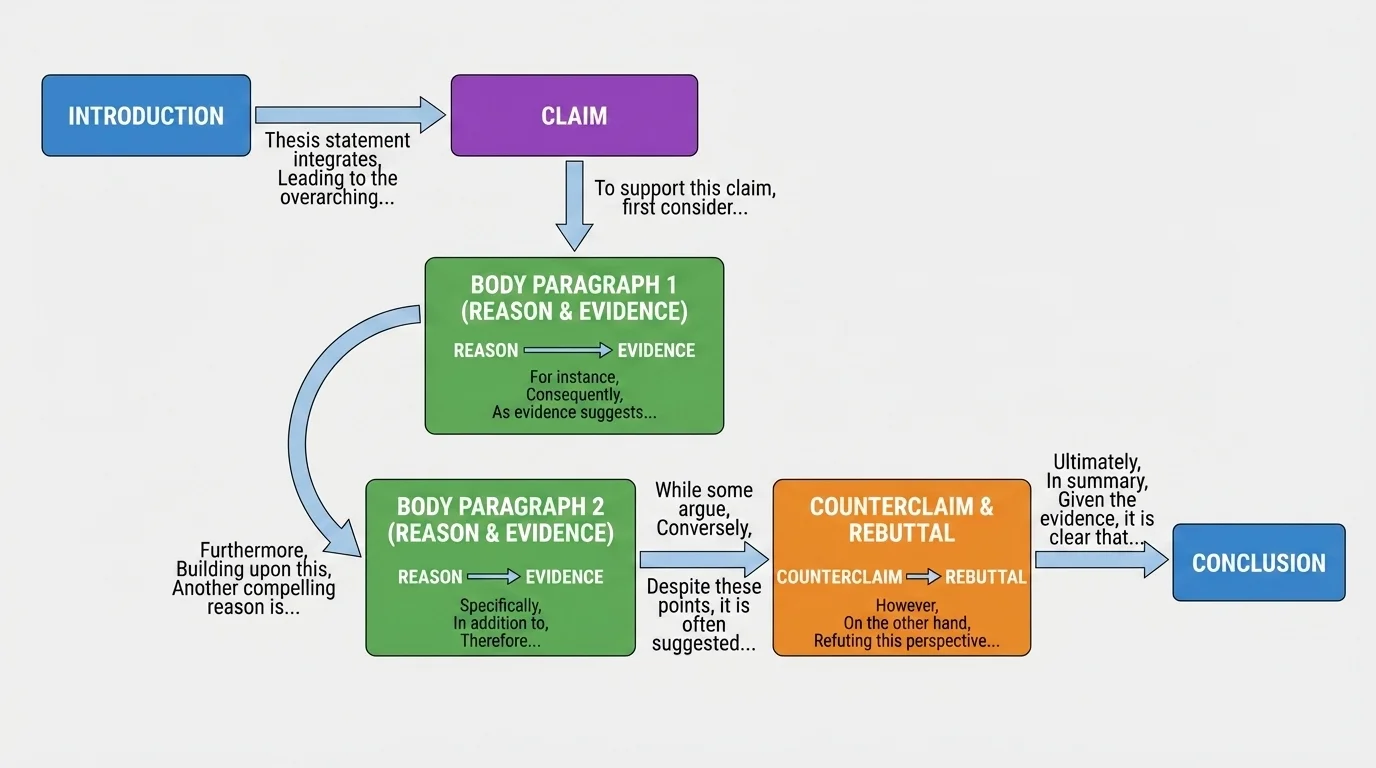
The shift into a counterclaim deserves special attention. This move should feel intentional, not abrupt. Useful bridges include Some people argue, however, that..., Critics of this position often point out..., or While this argument is persuasive to some readers.... Such phrases prepare the reader for a different perspective.
Then the rebuttal should clearly reconnect to the original claim. A sentence like This concern is understandable; however, it overlooks... both respects the opposing view and reestablishes the writer's position. Later, the conclusion should not merely repeat the thesis. It should show how the earlier reasons and evidence lead to a final judgment. That is why cohesive conclusions often begin with phrases such as Taken together, When the evidence is considered as a whole, or Because these factors affect....
When a whole essay is linked well, the reader feels guided from one stage of reasoning to the next rather than pushed through a list of disconnected points.
Syntax means the arrangement of words and clauses in a sentence, and [Figure 4] illustrates that writers can express the same idea with different patterns to create different emphasis. In argument writing, varied syntax is not just about sounding sophisticated. It helps clarify relationships among ideas.
Consider these sentences about the same topic:
Simple progression: Social media can spread information quickly. It can also spread misinformation quickly.
Compound sentence: Social media can spread information quickly, but it can also spread misinformation just as fast.
Subordinated sentence: Although social media can spread useful information quickly, it can also amplify misinformation.
Emphatic opening phrase: Because false claims travel rapidly online, users need stronger media literacy skills.
The second, third, and fourth versions make the relationship between ideas more visible. The coordinating conjunction but signals contrast. The subordinating conjunction although signals concession. The opening clause beginning with because signals cause.
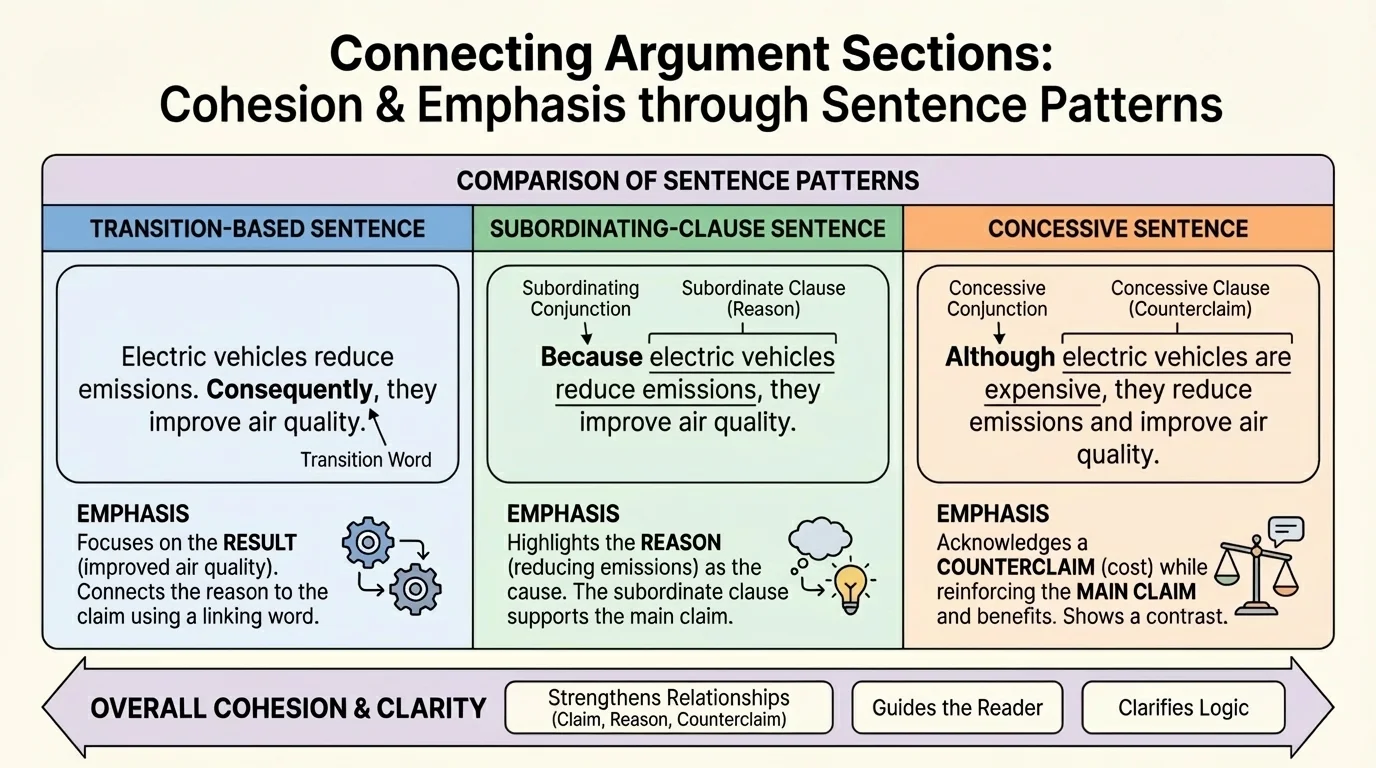
Sentence variety also helps control pace. Short sentences can emphasize key claims. Longer sentences with subordinate clauses can explain nuance. For example, a short sentence like The evidence is clear. has force. A longer sentence like Although some districts worry about transportation costs, multiple studies suggest that later start times improve attendance and alertness, which can support academic performance over time carries complexity.
Writers should vary syntax purposefully. If every sentence begins with Furthermore or follows the same structure, the writing becomes predictable and flat. As shown earlier in [Figure 4], changing sentence form changes emphasis, which changes how readers understand the logic.
Many professional editors spend less time fixing factual content than fixing unclear relationships between ideas. Often, the problem is not weak evidence but weak signaling of how the evidence connects to the claim.
That is why revision often focuses on sentence openings, clause placement, and paragraph transitions. Small changes in syntax can make a major difference in clarity.
Not every transition fits every situation. A writer needs to match the linker to the exact relationship being expressed. If the relationship is cause, use cause language. If the relationship is concession, use concessive language. Precision matters.
| Purpose | Useful linkers | Example |
|---|---|---|
| Add a supporting point | furthermore, in addition, moreover | Public transit reduces traffic; furthermore, it lowers emissions. |
| Show cause | because, since, as a result | Ridership increased because fares were reduced. |
| Introduce evidence | for example, for instance, according to | According to a city report, average wait times fell. |
| Show contrast | however, by contrast, on the other hand | Cars offer privacy; however, they increase congestion. |
| Show concession | although, even though, while | Although the plan is expensive, it may produce long-term savings. |
| Conclude | therefore, thus, taken together | Taken together, these findings support the proposal. |
Table 1. Common linking purposes in argument writing with example expressions.
A common mistake is using a conclusion transition where the sentence actually adds evidence. For example, writing therefore before a quotation from a source can be misleading if the quotation is not a conclusion but support. The transition must match the job the sentence is doing.
A good paragraph usually starts with a clear point, develops that point with evidence, and explains how the evidence supports the argument. Each stage needs linking.
Here is a pattern that often works well: reason → evidence → explanation → connection to claim. This pattern gives readers a path through the paragraph instead of leaving them with isolated facts.
Model paragraph with explicit linking
Claim: Cities should invest more in public transportation.
Step 1: State the reason.
One major reason cities should invest more in public transportation is that reliable transit expands access to jobs.
Step 2: Add evidence with a clear signal.
For example, when bus and rail systems run frequently and connect more neighborhoods, workers without cars can reach employment centers more easily.
Step 3: Explain the evidence.
This matters because limited transportation can prevent qualified people from applying for jobs or arriving consistently.
Step 4: Reconnect to the claim.
Therefore, transit funding is not only a transportation issue but also an economic opportunity issue.
Notice that the paragraph does not simply place a fact after a claim. It shows the reader how to interpret the fact. That explanatory step is where many arguments become stronger or weaker.
Paragraph cohesion also depends on reference words being clear. Pronouns such as this, these, and it should refer to something specific. In a sentence like This proves the policy works, the word this can be vague unless the previous sentence clearly states what exactly is being referenced.
One common problem is the list effect: students present claim, reason, evidence, and counterclaim as separate pieces without showing the relationship among them. The writing may contain strong content, but it reads like notes instead of a developed argument.
A second problem is transition overload. If every sentence starts with a formal transition, the prose can sound mechanical. Strong writing balances explicit signals with natural flow. Sometimes repeating a key term, using parallel structure, or building from one sentence to the next is enough.
A third problem is weak evidence integration. Students sometimes drop in a quotation or statistic without framing it. Instead of writing a quotation alone, introduce it and explain it: According to..., This suggests..., The data matters because....
From earlier writing study, remember that a paragraph needs unity as well as support. Every sentence should contribute to the paragraph's main point. Linking language works best when the paragraph already has a clear focus.
A fourth problem is unclear concession. When responding to a counterclaim, some writers attack a weaker version of the opposing view instead of the real one. Effective rebuttal begins by presenting the other side fairly, then showing its limits.
Consider this short argumentative passage:
Schools should require media literacy education because students encounter digital information constantly. According to recent studies, teenagers often struggle to distinguish sponsored content from independent reporting. Although some educators argue that schedules are already too crowded, media literacy can be integrated into existing English, history, and science courses. For that reason, adding media literacy does not necessarily require a separate class, yet it can still strengthen students' judgment.
This passage works because each sentence has a clear job and a clear link to the next. The word because links the claim to the reason. According to introduces evidence. Although signals a counterclaim. For that reason shows the rebuttal's conclusion.
Its syntax also helps. The concessive clause beginning with Although acknowledges an objection without giving it the final word. The main clause that follows keeps control of the argument. This is one of the most useful patterns in academic writing: concede something valid, then redirect.
Revision comparison
Less effective: Media literacy should be taught in schools. Students use the internet a lot. There are studies about this. Some teachers say there is no time. It can fit into classes.
More effective: Media literacy should be taught in schools because students encounter digital information constantly. Moreover, research suggests many teenagers struggle to evaluate online sources. Although some teachers argue that schedules are already crowded, these skills can be taught within existing courses. As a result, schools can improve critical thinking without redesigning the entire school day.
The second version is more convincing not because the writer suddenly became smarter, but because the relationships among ideas are visible.
Linking choices also shape how a writer addresses the audience's values and possible biases. If readers may be skeptical, a writer often benefits from respectful concession: While concerns about cost are reasonable.... If readers care about fairness, the writer may connect evidence to that value directly: Because access remains unequal, the policy raises questions of equity.
Formal argument usually avoids casual linkers such as plus or vague ones such as stuff like that. Instead, it uses precise, academic language that still sounds natural. The goal is not to sound stiff. The goal is to sound deliberate and trustworthy.
"Good writing is clear thinking made visible."
— A principle of academic argument
In advanced writing, cohesion often comes from a combination of techniques: transition words, repeated key terms, pronoun reference, parallel structure, strategic sentence variety, and paragraph sequencing. When all of these work together, the argument feels unified from beginning to end.
The result is more than smooth writing. It is clearer reasoning. Readers can see where the writer stands, why the reasons matter, how the evidence supports those reasons, and why the counterclaim does not overturn the claim.
