A single sentence can start an argument, solve a problem, win support, or cause complete confusion. That is one reason writing matters far beyond English class. A scholarship essay, a lab report, a public statement, a job application email, and a social media post may all use words, but they do not use them in the same way. Strong writers understand that effective writing is not just about having ideas. It is about shaping those ideas so that the right audience can understand them, trust them, and respond to them.
When writing is clear, readers do not have to guess what the writer means. When writing is coherent, ideas connect in a logical way so the piece feels unified rather than random. In school, that affects grades. Outside school, it affects relationships, credibility, and opportunity. A confusing set of directions can waste time. A weak proposal can lose funding. A vague argument can fail to persuade even when the writer has a good point.
Clear and coherent writing gives readers a path to follow. It signals what matters, explains how ideas connect, and uses a style that fits the situation. In academic writing, that often means precise language, logical structure, and evidence-based reasoning. In other situations, it may mean directness, warmth, urgency, or restraint. The key is always the same: write with intention.
Clarity means expressing ideas so they are easy to understand. Coherence means the ideas fit together in a logical, connected way. Development is the depth and support given to ideas. Organization is the arrangement of ideas so readers can follow them. Style is the writer's way of using language, including tone, word choice, and sentence patterns.
These qualities work together. A paper can have interesting ideas but still fail if it jumps from point to point. It can be organized but still weak if the explanation is too thin. It can have strong evidence but sound careless if the tone does not fit the audience. Effective writing depends on all of these elements working as a system.
Good writing is not simply longer writing or more complicated writing. In fact, students sometimes mistake complexity for quality. They use inflated vocabulary, overloaded sentences, or unnecessary filler because they think formal writing must sound difficult. Usually, the opposite is true. Strong writing makes complex ideas understandable without oversimplifying them.
Clarity begins with exact thinking. If a writer is not sure what the main point is, the draft will often become vague. Readers may encounter broad words like "things," "stuff," "important," or "good" without being told what, exactly, is meant. Coherence comes from relationships between ideas. A coherent paper does not merely list information; it builds meaning, one idea leading naturally to the next.
For example, compare these two statements: "School uniforms are bad because students do not like them. Also, expression matters. Uniforms cost money. Another issue is rules." This is not coherent because the ideas are underdeveloped and disconnected. A more coherent version would be: "School uniforms can limit student self-expression, create extra costs for families, and shift attention away from more meaningful school improvements. Because of these effects, some students and parents oppose uniform policies." The second version groups related ideas, shows a clear claim, and presents a logical sequence.
One of the most important decisions a writer makes is how to shape the message for the situation. The same topic may need to sound very different depending on the task, the purpose, and the audience, as [Figure 1] illustrates through contrasting versions of the same subject. A scientific explanation for classmates is not written the same way as a persuasive letter to a school board. A reflective narrative is not organized like a research report.
Task refers to what kind of writing you are being asked to do. Are you analyzing a text, explaining a process, arguing a position, telling a story, or responding to feedback in a shared document? Each task has expectations. An analytical essay needs interpretation and evidence. An informational article needs accurate explanation. A narrative needs meaningful sequencing and detail.
Purpose refers to what the writing is meant to accomplish. A writer may aim to inform, argue, entertain, reflect, request, or evaluate. Purpose affects what details belong in the piece. If your purpose is to persuade, your evidence and reasoning must be central. If your purpose is to inform, clarity and completeness matter more than emotional intensity.
Audience refers to the readers. Writers must consider what readers already know, what they care about, what questions they may have, and what level of formality they expect. Writing for a teacher often requires explicit explanation and textual evidence. Writing for peers may allow shared assumptions. Writing for a public audience usually requires even more context because readers may come from many backgrounds.
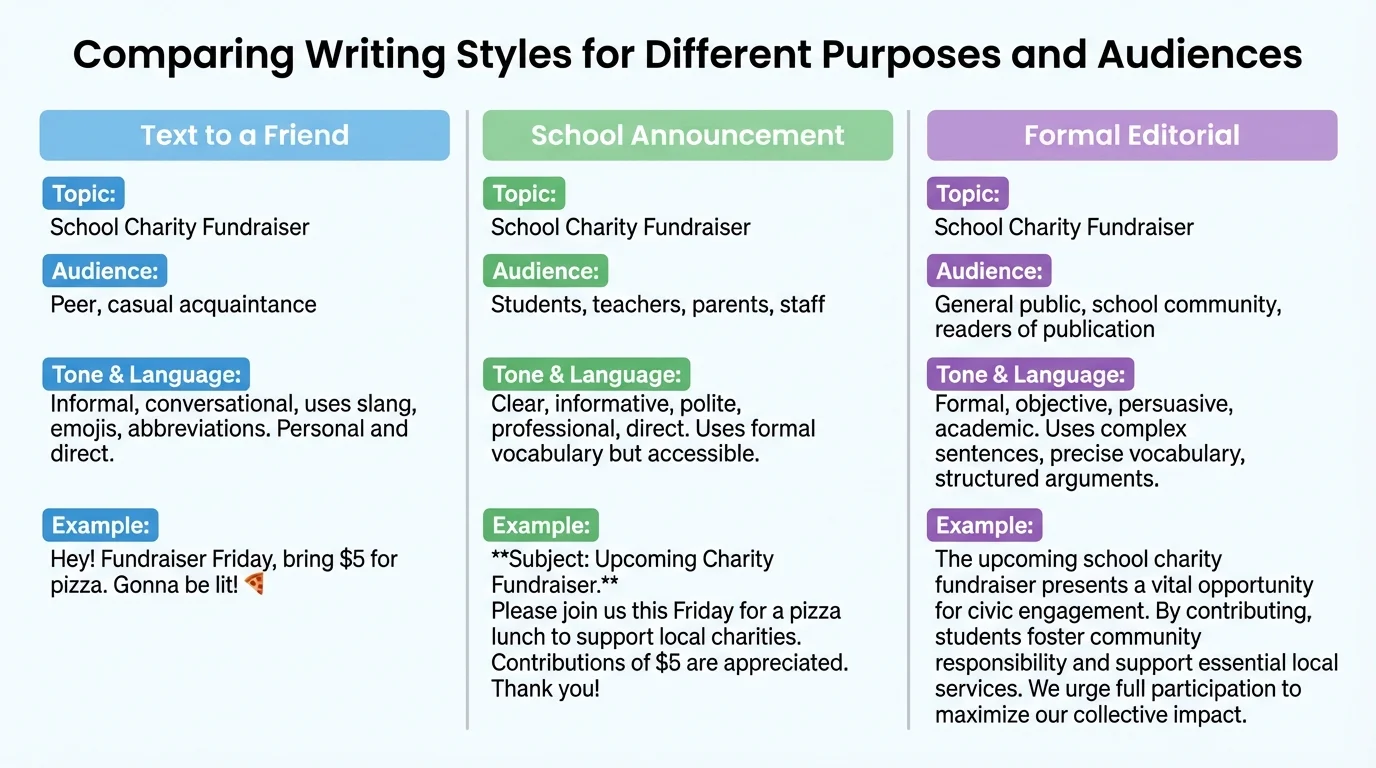
Consider one topic: reducing plastic waste at school. If you text a friend, you might write, "We should really stop using so many plastic bottles at lunch." If you write a school announcement, you might say, "Students are encouraged to bring reusable water bottles to help reduce campus waste." If you write an editorial for the school newspaper, you would likely include data, address objections, and use a more formal tone. The subject is the same, but the writing changes because the rhetorical situation changes.
Professional writers rarely write for a vague "everyone" audience. Journalists, scientists, advertisers, and policy writers constantly adjust language, detail, and tone based on who will read the piece and what action they hope those readers will take.
This is why effective writing is situational. There is no single "best" style for all writing. There is only writing that is appropriate or inappropriate for a specific purpose and audience.
Development is the process of building ideas so that readers understand not just what you think, but why. Strong development includes claims, evidence, explanation, examples, and details. Weak development happens when a writer states a point but does not support it enough.
In argument writing, development often follows a pattern: make a claim, support it with evidence, and explain how the evidence proves the claim. Students often stop too early. They add a quotation or statistic and assume the evidence speaks for itself. Usually it does not. Readers need commentary. They need to see the connection between the evidence and the writer's reasoning.
Suppose a student writes, "Later school start times improve learning. According to one study, students with later start times earned higher grades." That is a useful start, but it is incomplete. Better development would continue: "According to one study, students with later start times earned higher grades. This suggests that additional sleep improves attention and memory during the school day. As a result, schedule changes may support both academic performance and student health." The writer does more than report evidence. The writer interprets it.
Development also means choosing the right amount of detail. Too little detail leaves readers unconvinced. Too much unrelated detail buries the main point. Strong writers include material that advances the purpose of the piece. They ask whether each example, quotation, and explanation is necessary and connected.
Case study: weak versus strong development
Weak version: "Community service is good for teens because it helps people and looks good on resumes."
Step 1: Identify what is missing
The sentence gives a claim, but it does not explain how service helps teens develop skills, connections, or civic awareness. The reasoning is thin.
Step 2: Add evidence or specific examples
A stronger version might mention leadership experience, exposure to community needs, or improved communication skills.
Step 3: Explain significance
Stronger version: "Community service can benefit teenagers by building leadership, empathy, and problem-solving skills. For example, students who organize food drives or tutor younger children learn how to communicate clearly and take responsibility. These experiences help others, but they also prepare teens for college, work, and active citizenship."
In literary analysis, development means moving beyond plot summary. Instead of retelling what happened, the writer explains how a character, symbol, or structural choice creates meaning. In informational writing, development means explaining ideas accurately and clearly, often by defining terms, providing context, and using examples. In narrative writing, development often depends on vivid detail, pacing, reflection, and meaningful moments rather than just a list of events.
Strong organization guides readers from one idea to the next, as [Figure 2] shows through several common structures. It answers an important question: in what order should this information appear so the reader can understand it most easily and effectively?
Many pieces of writing begin with an introduction that establishes context and presents a controlling idea such as a thesis, central claim, or focus. The body then develops that idea through logically arranged points. The conclusion does more than stop the paper; it reinforces significance, extends the idea, or leaves the reader with a final understanding.
Writers can organize body paragraphs in different ways depending on purpose. Common patterns include chronological order, compare-and-contrast, cause and effect, problem and solution, and claim with supporting reasons. Transitions help readers move through these structures. Words and phrases like "for example," "however," "in contrast," "as a result," and "therefore" signal relationships between ideas.
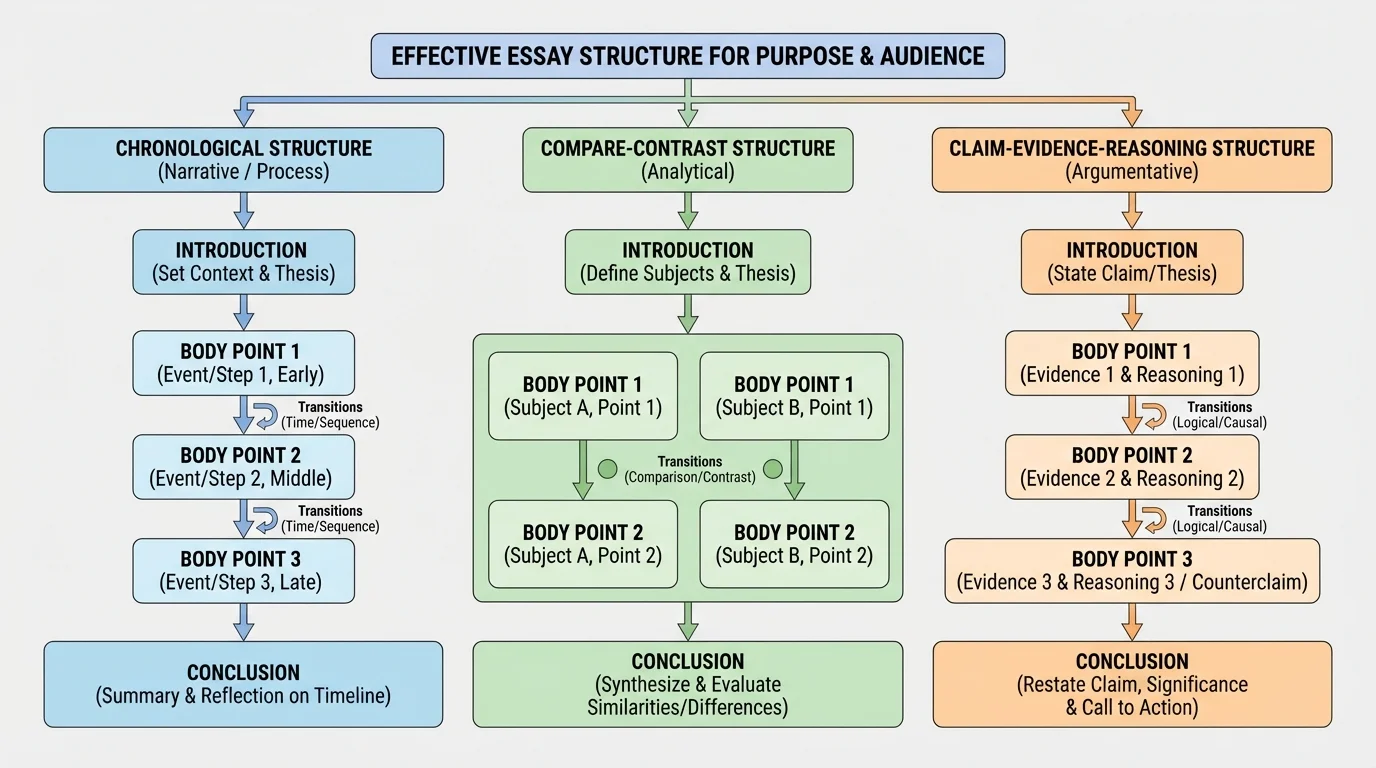
Paragraph structure matters too. A strong paragraph usually centers on one main idea. It includes a topic sentence or clear focus, supporting details, and an ending that connects the paragraph back to the larger argument. If a paragraph tries to do too much, readers may lose the thread.
Good organization also creates emphasis. Placement matters. The first paragraph frames expectations. The order of body points can make an argument feel stronger or weaker. A conclusion that merely repeats earlier sentences may feel flat, while a conclusion that shows why the discussion matters leaves a lasting effect. As the organizational models in [Figure 2] make clear, structure is not decorative. It shapes meaning.
| Pattern | Best Used For | Example |
|---|---|---|
| Chronological | Processes, histories, narratives | Explaining how a protest movement developed over time |
| Compare and contrast | Showing similarities and differences | Comparing two energy sources or two characters |
| Cause and effect | Explaining why something happens and what follows | Showing how sleep loss affects learning |
| Problem and solution | Addressing an issue and proposing responses | Reducing food waste in a school cafeteria |
| Claim and reasons | Persuasive or argumentative writing | Arguing for later school start times |
Table 1. Common organizational patterns and the kinds of writing situations they fit best.
Style is not just decoration. It shapes how readers experience the writing. Style includes diction, tone, sentence variety, emphasis, and level of formality. A strong style supports the writer's purpose instead of distracting from it.
In academic writing, style usually values precision, control, and clarity. That does not mean it must sound dull. It means the language should fit the context. Slang, vague wording, and exaggerated claims can weaken credibility in a formal essay. At the same time, writing that is stiff, repetitive, or overloaded with unnecessary jargon can also be ineffective.
Tone is especially important. Tone is the attitude the writing conveys toward the topic or audience. It may be serious, analytical, concerned, respectful, skeptical, or reflective. If a student writes about a serious social issue using sarcastic humor, the mismatch may damage the message. If a student responds to feedback defensively in a shared writing project, collaboration may break down.
Sentence variety also affects style. If every sentence begins the same way and has the same length, the writing can become monotonous. Varying sentence openings and structures helps create flow. For example, compare: "The policy has benefits. The policy has costs. The policy affects students. The policy should be reviewed." A more effective version might read: "Although the policy offers some benefits, it also creates costs that directly affect students. For that reason, the policy deserves careful review."
"Good writing is clear thinking made visible."
Writers also make stylistic choices about point of view, use of figurative language, and degree of directness. A narrative may rely on sensory detail and reflection. A research-based argument usually depends more on concise wording and logical precision. The best style is the one that helps readers receive the message exactly as the writer intends.
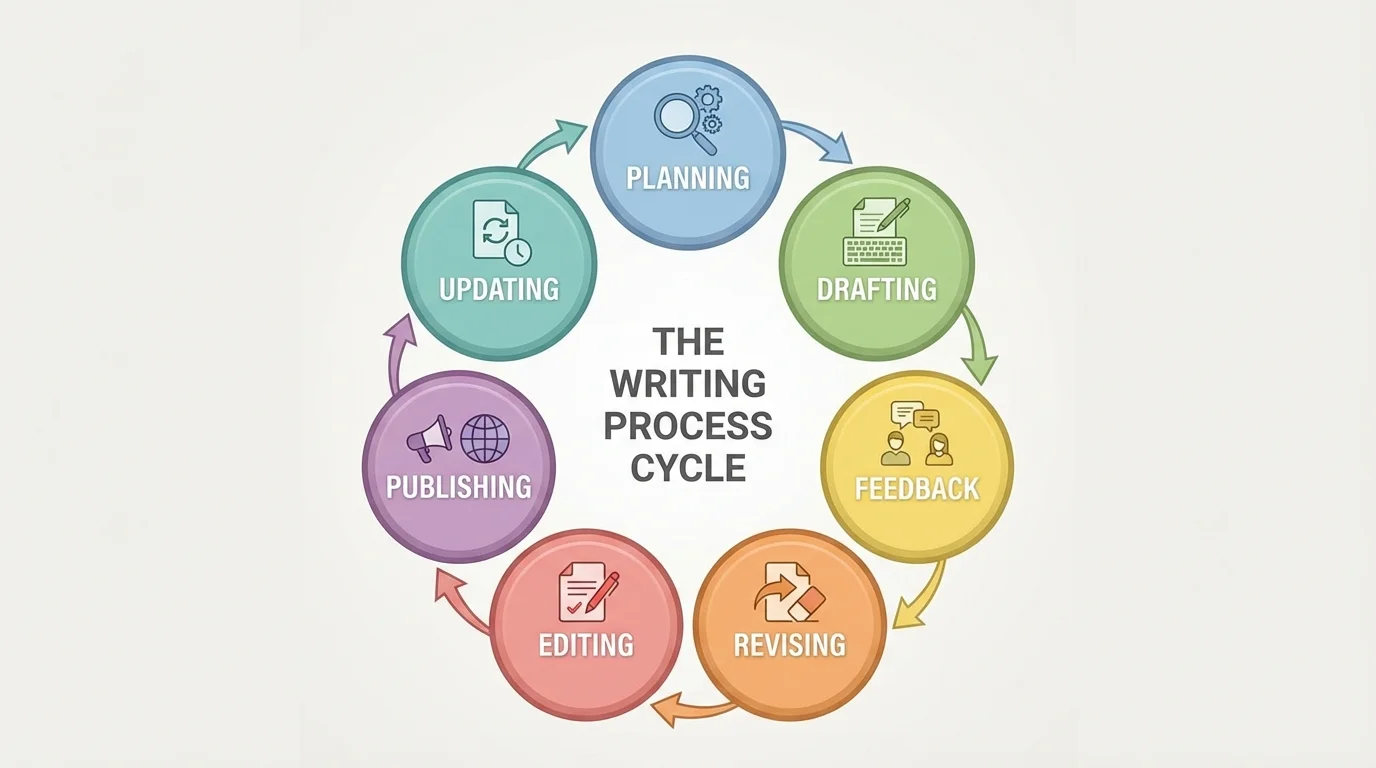
Many students are taught writing as a straight line: plan, draft, revise, edit, submit. In reality, effective writing is recursive, as [Figure 3] illustrates. Writers often move back and forth among stages. They discover new ideas while drafting. They reorganize after getting feedback. They return to research when evidence is weak. They continue refining even after publication when the audience or purpose shifts.
The recursive writing process usually includes planning, drafting, revising, editing, publishing, and sometimes updating. Planning may involve brainstorming, outlining, researching, or asking what the audience needs to know first. Drafting turns ideas into sentences and paragraphs. Revising means rethinking meaning, structure, and support. Editing focuses on correctness, clarity at the sentence level, and conventions such as grammar, punctuation, and spelling.
Feedback is central to this process. Strong writers do not treat feedback as a final judgment. They treat it as information. A teacher may notice weak reasoning. A peer may point out confusing transitions. A group member may identify parts of a shared document that sound inconsistent. These responses help the writer see the draft from the reader's point of view.
Publishing no longer means only printing a final paper. It may mean submitting to a class discussion board, posting to a school website, sharing a collaborative document, or presenting a speech. In digital spaces, writing is often updated after publication. An article may be revised for clarity. A team document may be reorganized as new information appears. A public statement may be rewritten after audience response. That ongoing revision reflects real-world writing.
Revision is not the same as editing
Editing fixes surface-level issues such as punctuation, spelling, usage, and formatting. Revision changes meaning and structure. A writer revises by adding explanation, cutting repetition, reorganizing paragraphs, sharpening a thesis, or changing tone for a new audience. Skilled writers usually revise before they edit so they do not polish sentences that may later be removed.
The loop in [Figure 3] matters because writing quality improves when writers stay flexible. A first draft is not a finished thought. It is a working version that becomes stronger through reflection and response.
Different writing situations call for different choices even when the expectations of clarity and coherence stay the same. In a literary analysis, the writer presents an interpretation and supports it with textual evidence. In an informational essay, the writer explains a topic accurately and thoroughly. In an argument, the writer makes a claim, supports it with evidence, and often addresses a counterclaim. In a narrative, the writer develops experiences through sequence, detail, and reflection.
Collaborative writing introduces another challenge: multiple writers must create a unified voice. Shared documents can become uneven when one section is formal, another casual, and another repetitive. Writers in groups need to align tone, formatting, evidence standards, and structure. They may also need to update writing over time as feedback continues.
The audience comparison introduced earlier in [Figure 1] matters here as well. A formal research summary for a science class should sound different from a community outreach flyer, even if both discuss the same issue. Effective writers know how to carry the same core information into different forms without losing accuracy.
Context comparison: same idea, different forms
Topic: phone use during class
Step 1: Informational purpose
"Many schools limit phone use during instruction because notifications can interrupt attention and reduce participation."
Step 2: Persuasive purpose
"Schools should create clearer phone policies during instruction because constant notifications distract students and make discussion less focused."
Step 3: Reflective purpose
"I did not realize how often I checked my phone in class until I counted the interruptions and saw how much attention I was losing."
Each version is clear, but each one uses different development, organization, and style because the writer's purpose changes.
Writers improve when they can diagnose problems. One common issue is vagueness. If a sentence says, "This shows something important about society," the reader may ask, "What something?" Better writing names the exact idea. Another common issue is weak connection between paragraphs. If the draft leaps from one point to another without transitions or logical order, coherence suffers.
Another problem is evidence without explanation. Students may insert a quotation and move on. But evidence becomes meaningful only when the writer interprets it. Some writers also repeat the same point in slightly different wording, creating the illusion of development without actually advancing the argument.
Audience mismatch is another serious issue. A college application essay that sounds careless, a lab report filled with emotional exaggeration, or a community speech overloaded with technical jargon all fail to meet audience needs. Writers should ask: What background knowledge can I assume? What tone fits this situation? What will this audience find convincing or useful?
One more challenge is patchwriting, which happens when a writer stays too close to a source and changes only a few words. That weakens originality and may cross into plagiarism. Strong writers read, think, and then restate ideas in their own structure and language while properly crediting sources.
Readers cannot respond to ideas they cannot follow. Topic sentences, transitions, evidence, and commentary are not separate tricks. They are tools that help a reader track the writer's thinking from start to finish.
At the sentence level, writers can fix many issues by reading aloud, checking for repeated wording, and testing whether each sentence clearly connects to the one before it. At the paragraph level, they can ask whether each paragraph has one central job. At the whole-piece level, they can examine whether the structure suits the task and whether the conclusion leaves a clear final impression.
Effective writing develops ideas fully enough to satisfy the reader's needs, organizes those ideas in a purposeful order, and uses a style that fits the situation. It is aware of audience. It is guided by purpose. It is shaped through revision rather than produced in one attempt. It respects conventions not because rules are the goal, but because conventions help communication.
When writers think carefully about what they are trying to do, who they are trying to reach, and how readers will move through the piece, their writing becomes more powerful. That is true in essays, reports, narratives, speeches, digital posts, and collaborative documents. Clear and coherent writing is not a formula. It is a disciplined set of choices.
