Every day, people make claims online about health, history, technology, politics, and culture. Some are accurate, some are misleading, and some sound convincing only because they are repeated often. Research is the skill that lets you separate noise from knowledge. It is not just about finding information; it is about asking a meaningful question, choosing trustworthy evidence, and building an answer that can stand up to scrutiny.
In high school, research becomes more than gathering facts for a report. You are expected to investigate a question or solve a problem, adjust your approach when necessary, and combine information from several sources into a clear, defensible conclusion. That process matters far beyond school. Scientists design studies, journalists verify evidence, engineers solve design problems, and citizens evaluate public claims. All of these activities depend on disciplined inquiry.
A strong research project begins with curiosity, but it succeeds through structure. Curiosity asks, "Why is this happening?" or "What should be done?" Structure turns that interest into a process: define the issue, gather evidence, compare perspectives, and reach a reasoned conclusion.
Research also helps you move beyond first impressions. If a student says, "School start times should be later because teens are tired," that may be true, but it is only a beginning. A research-based approach asks what experts say, what studies show, whether the issue affects attendance and performance, and what obstacles schools face when changing schedules. Research transforms opinion into argument supported by evidence.
Research question is the focused question a project seeks to answer. Inquiry is the process of investigating that question through evidence. Synthesis is the act of combining information from multiple sources to create a fuller understanding or a stronger conclusion than any single source provides.
Because research is a process, it is rarely perfectly linear. Skilled researchers often revise a question, change search terms, replace weak sources, or adjust their focus after learning more. That flexibility is a strength, not a mistake.
As [Figure 1] shows, a research question should be specific enough to answer thoughtfully but broad enough to matter. Researchers often begin with a large topic and then narrow it into a manageable line of inquiry. "Climate change," "artificial intelligence," and "mental health" are topics, not yet research questions.
To create a strong question, start by identifying a subject that genuinely interests you. Then ask what part of that subject can be investigated. A weak question might be, "What is social media?" That can be answered with a simple definition. A stronger question might be, "How does late-night social media use affect sleep quality in high school students?" That question is focused, researchable, and meaningful.
Self-generated questions are especially powerful because they grow from your own observation or concern. You might notice that students at your school rely heavily on energy drinks, that local streams flood more often after storms, or that a novel assigned in class presents conflicting ideas about justice. Those observations can become research questions when they are sharpened into something answerable.
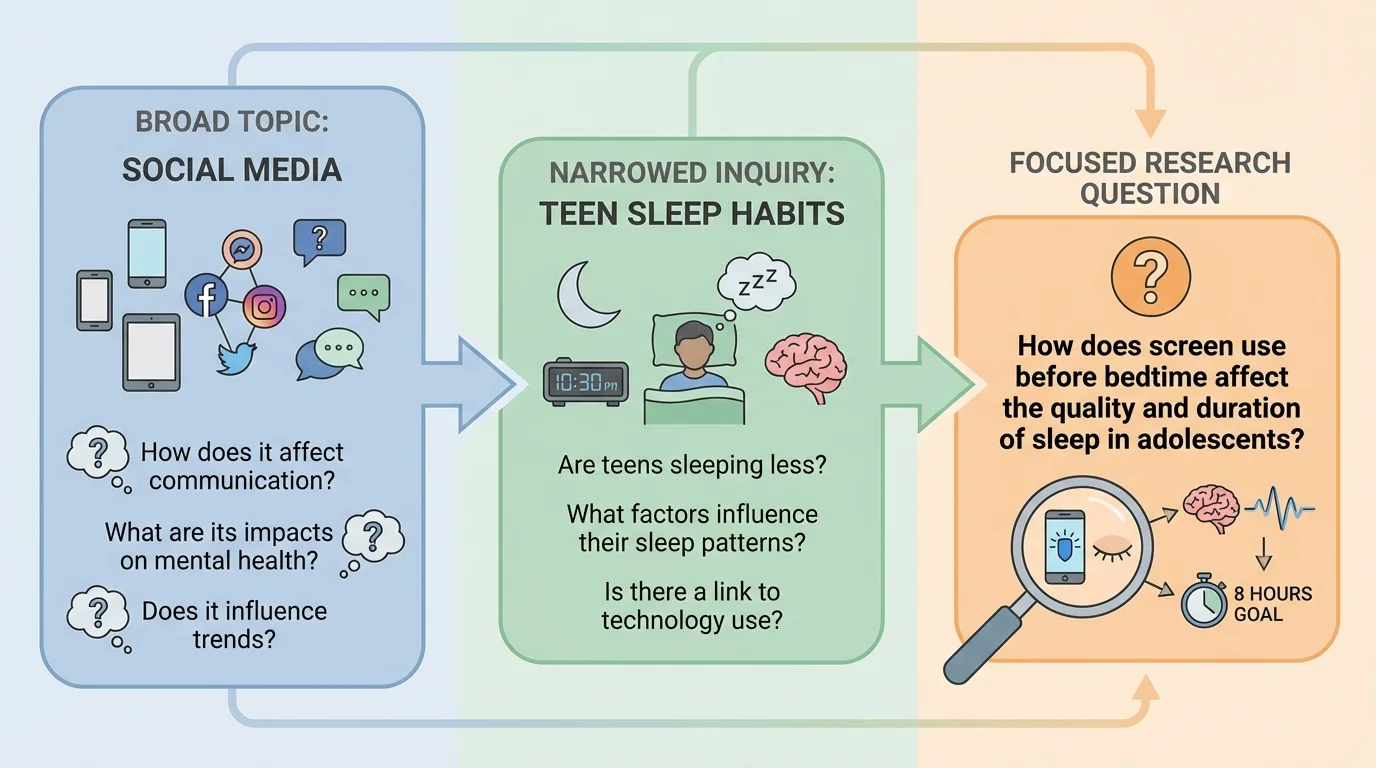
Good research questions often include a clear relationship, cause, effect, comparison, or problem. Examples include: "Which strategy best reduces cafeteria food waste in a high school?" "How accurately does a historical film represent the events it portrays?" and "What factors make some renewable energy projects more practical than others in rural areas?" Each question gives direction to the investigation.
Not every first draft of a question works. If a question is too broad, the project becomes shallow because there is too much to cover. If it is too narrow, you may struggle to find enough evidence. One sign of a workable question is that it invites explanation, not just a one-word answer.
Research projects vary in scale. A project involving sustained research develops over a longer period and usually involves a more complex question, more sources, and deeper synthesis. A short research task, by contrast, may be completed in one class period or a few days. Both require careful thinking, but they differ in scope.
A short research project might ask you to compare how two news outlets report the same event, investigate the origin of a literary allusion, or find evidence about whether a city policy has been effective. The goal is focused inquiry. You still need reliable sources and clear organization, but the range is limited.
A sustained project goes further. You may need to build background knowledge, refine your question several times, consult a range of source types, and organize evidence into sections or claims. For example, a project about whether schools should use facial recognition technology would require legal, ethical, technical, and privacy-related evidence. That kind of research cannot be done well by rushing to the first three search results.
Choosing the right scope means matching the size of your question to the time, evidence, and space available. Short projects work best when the question is narrow and specific. Sustained projects are appropriate when the issue is complex enough to require multiple angles, competing viewpoints, and extended analysis.
The difference is not just length. It is depth. A short project may answer a single focused question with a few strong sources. A sustained project usually develops an argument or solution through layered evidence and more deliberate synthesis.
Once you have a question, you need a plan. That plan begins with identifying what kinds of information are necessary. If you are researching teen sleep, you may need scientific studies, school schedule data, expert commentary from sleep researchers, and perhaps local information about student routines. If you are studying a literary question, you may need the text itself, scholarly criticism, historical context, and reviews or essays that offer different interpretations.
Inquiry design includes deciding where to search, what keywords to use, and what subquestions will guide the process. A project on renewable energy in rural communities might involve subquestions such as: What types of renewable energy are most common? What are the economic barriers? What environmental benefits and drawbacks exist? These smaller questions help organize the investigation.
Research is rarely perfect on the first attempt, so you must know when to narrow or broaden the inquiry. Narrow the inquiry when the topic produces too much unrelated information. If you search "pollution," results may range from air quality to plastics to chemical spills. Narrowing to "microplastic pollution in freshwater ecosystems" creates focus. Broaden the inquiry when you find too little evidence or when the question is so specific that only one or two sources address it. A question about one exact local policy change may need to widen into a study of comparable districts or similar programs.
Adjusting a question is not failure. It shows that you are responding to evidence. Skilled researchers revise because they learn. The goal is not to defend your first wording at all costs; the goal is to arrive at a question that can actually be answered well.
Not all sources deserve equal trust. A source becomes an authoritative source when it demonstrates expertise, uses evidence responsibly, and is relevant to your question. Credibility depends on several factors working together, not just on whether a source looks polished or professional.
When evaluating a source, consider the author's qualifications, the publisher or sponsoring organization, the date of publication, and the evidence used. A peer-reviewed journal article often carries strong authority in scientific or academic topics because other experts have reviewed the work before publication. A government report may be useful for public data. A respected newspaper may provide timely reporting. A personal blog may offer perspective, but unless the writer has expertise and evidence, it is usually weaker for formal research.
You should also examine bias. Bias does not always mean a source is useless. It means the source may present information from a particular perspective or with a particular purpose. An advocacy organization may provide valuable data, but you must read carefully to see whether opposing evidence is ignored or minimized.
Authority also depends on context. A literary scholar may be highly authoritative when analyzing a novel, but not when discussing medical treatment. A recent source may be essential in technology or science, while an older source may remain important in history or literature if it is foundational.
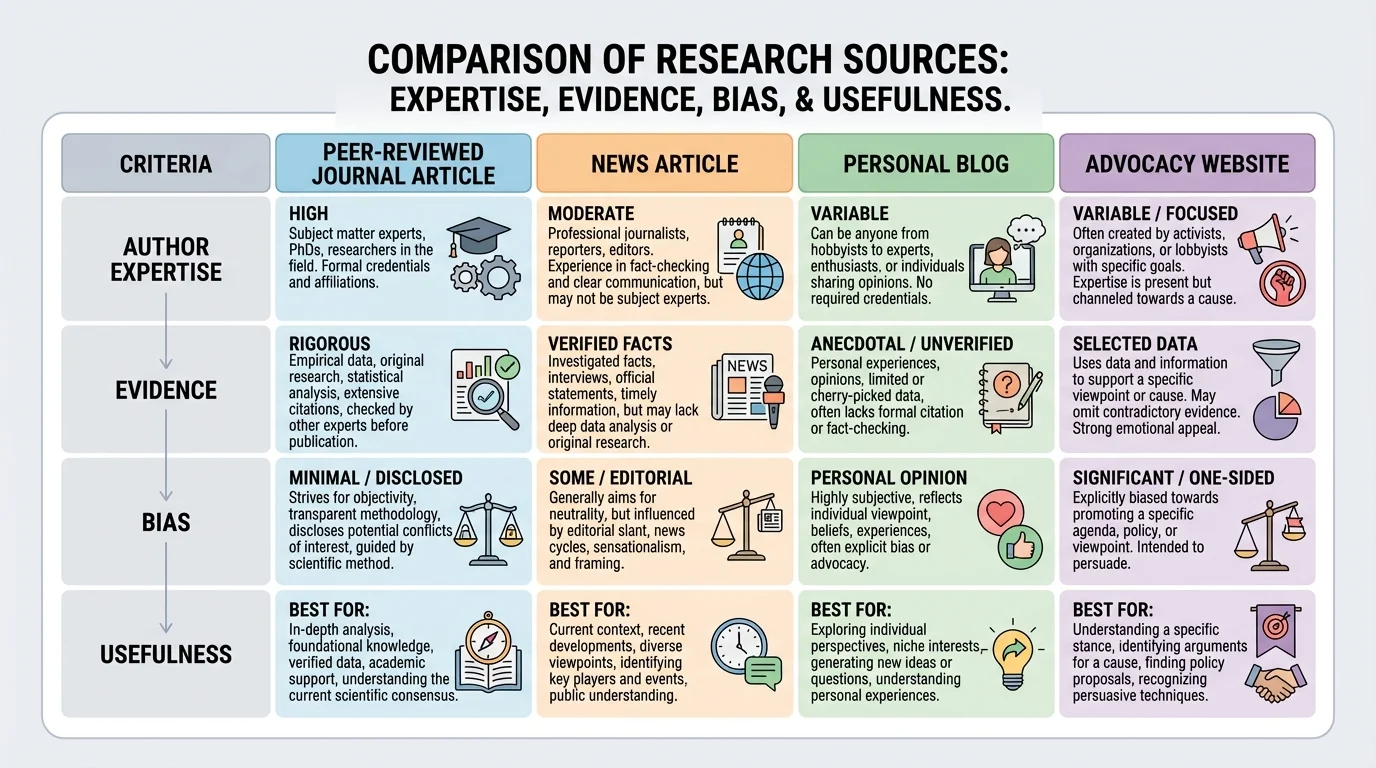
One of the strongest habits in research is consulting different kinds of credible sources rather than relying on a single type. For example, a project about vaping among teenagers might use public health data, scientific studies, policy reports, and news coverage. Each source type contributes a different piece of the picture.
Some of the most convincing misinformation online imitates the appearance of trustworthy writing. Professional design, charts, and confident language can make weak evidence seem strong, which is why credibility must be judged by authorship, evidence, and purpose rather than appearance alone.
In literary research, authoritative sources can include both primary sources and secondary sources. The poem, novel, speech, or play itself is the primary source. Scholarly articles, critical essays, biographies, and historical studies that interpret or contextualize the work are secondary sources. Strong literary inquiry often depends on using both.
Good research can collapse if notes are messy. When you gather information, record not only the idea but also where it came from. That includes the author, title, publication details, page numbers if available, and the date you accessed the source when relevant. If you do not keep track of this information, citing later becomes difficult and accidental plagiarism becomes more likely.
Paraphrasing means restating a source's idea in your own words and sentence structure while preserving the original meaning. Quoting uses the exact words from the source and should be reserved for language that is especially precise, powerful, or important to analyze. Whether you paraphrase or quote, you still need citation because the idea came from someone else.
Effective note-taking is not copying paragraphs into a document. Instead, organize evidence by subtopic, claim, or question. If you are researching school start times, categories might include health effects, academic performance, transportation challenges, and district case studies. This structure helps you see patterns across sources instead of treating each source separately.
Evidence is strongest when it is both relevant and sufficient. One dramatic example may be memorable, but it does not automatically prove a larger claim. Research depends on patterns, context, and support from multiple pieces of credible evidence.
A useful strategy is to create a chart with columns for source, main claim, evidence, reliability, and connection to your question. This approach makes synthesis easier because you can compare sources side by side instead of rereading everything from the beginning.
As [Figure 3] shows, Synthesis is where research becomes intellectual work instead of information collecting. Synthesis means placing sources into conversation with one another: identifying where they agree, where they conflict, and what each one contributes that the others do not.
Students sometimes think synthesis means mentioning several sources in one paragraph. That is not enough. True synthesis builds a unified understanding. Instead of writing one paragraph on Source A, one on Source B, and one on Source C, you organize by idea. For instance, if three sources discuss teen sleep, you might create a paragraph about biological sleep patterns, another about school performance, and another about scheduling challenges. Within each paragraph, the sources interact.
Suppose one study finds that later start times improve attendance, another reports improved mood and reduced sleep deprivation, and a district case study shows transportation costs rising after the change. A synthesized conclusion would not ignore the transportation issue or treat the benefits as separate facts. It would explain that later start times appear to support student well-being and attendance, but implementation may require logistical trade-offs. That is a richer understanding than any single source provides.
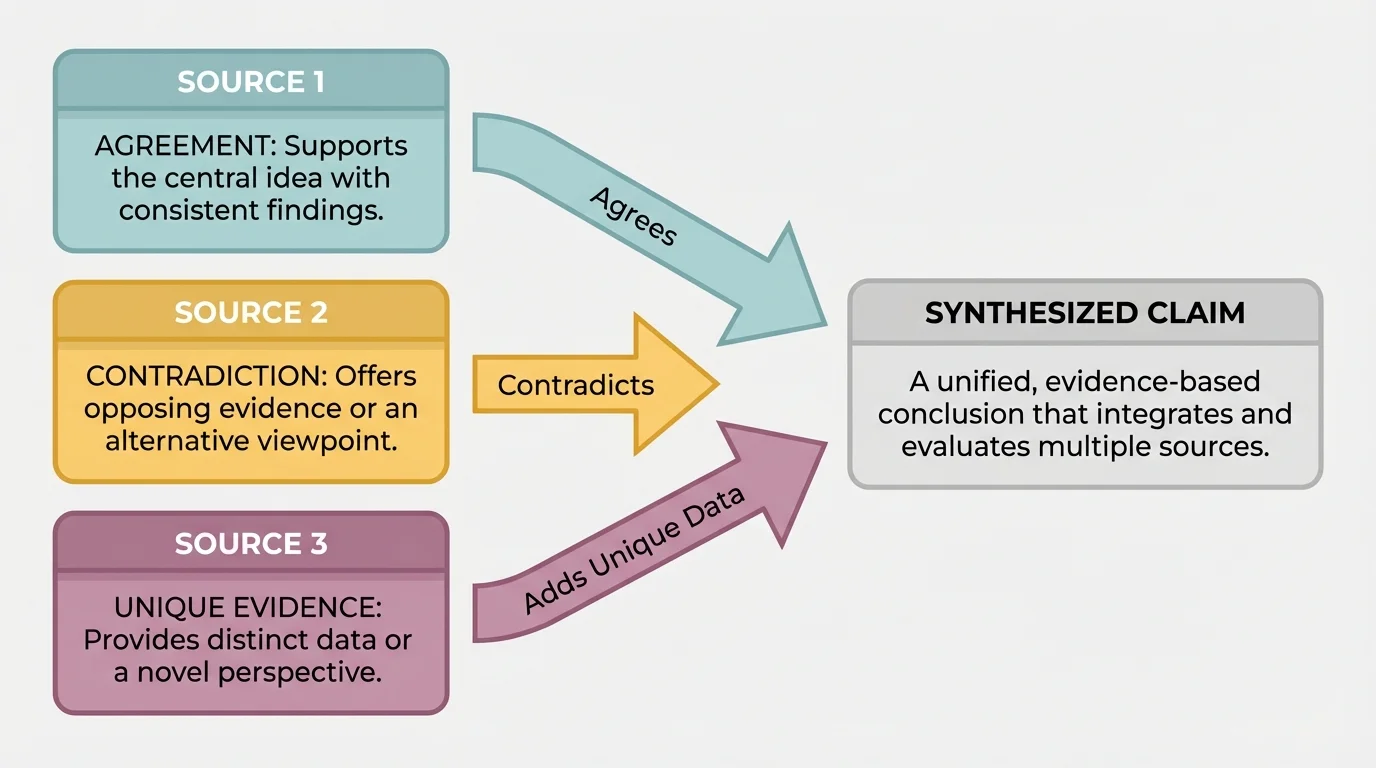
Synthesis also involves recognizing gaps. If most sources discuss urban schools but your question concerns rural districts, then your evidence may not fully transfer. If critics disagree sharply about a literary character's motives, your task is not to erase disagreement but to interpret it and explain which reading is better supported.
When you synthesize well, your own voice becomes the guide. The sources provide evidence, but you determine how the pieces fit together. This is why strong research writing sounds purposeful rather than like a stack of borrowed statements.
Case study: Synthesizing sources on school start times
Question: Should a high school begin classes later in the morning?
Step 1: Gather contrasting but credible evidence.
Source 1 is a medical organization statement about adolescent sleep cycles. Source 2 is a district report on attendance after a schedule change. Source 3 is a transportation budget analysis.
Step 2: Group the evidence by issue, not by source.
Create categories such as health, academics, attendance, transportation, and extracurricular impact.
Step 3: Write claims that integrate the sources.
A strong claim might state that later start times are associated with better sleep and improved attendance, but local costs and bus scheduling must be addressed for the policy to work effectively.
The final answer does not simply repeat each source. It combines them into a supported judgment.
Later in a project, the same visual pattern from [Figure 3] still matters: the best conclusions often emerge where several credible sources overlap, but the most thoughtful analysis also accounts for contradictions and limitations.
A research project should answer the question it sets out to investigate. That answer may be a conclusion, an interpretation, or a proposed solution depending on the task. What matters is that the answer grows logically from evidence.
If your project investigates a historical question, your conclusion may explain why an event happened or how different interpretations compare. If your project addresses a practical problem, your conclusion may recommend a solution and defend why it is the most effective option. For example, a project about reducing school food waste might conclude that changing lunch scheduling and offering share tables are more effective than awareness posters alone.
Good conclusions are careful. They avoid exaggeration and acknowledge limits. If the evidence is mixed, say so. If your answer applies mainly to one age group, one region, or one type of school, make that clear. Precision makes your argument stronger, not weaker.
To defend a conclusion, connect each major claim to evidence from more than one source whenever possible. If you are recommending a policy, include data, expert reasoning, and real-world examples. If you are interpreting literature, support your claim with textual evidence and critical commentary. Defensible research does not ask the reader to trust your opinion; it shows the reader why the conclusion makes sense.
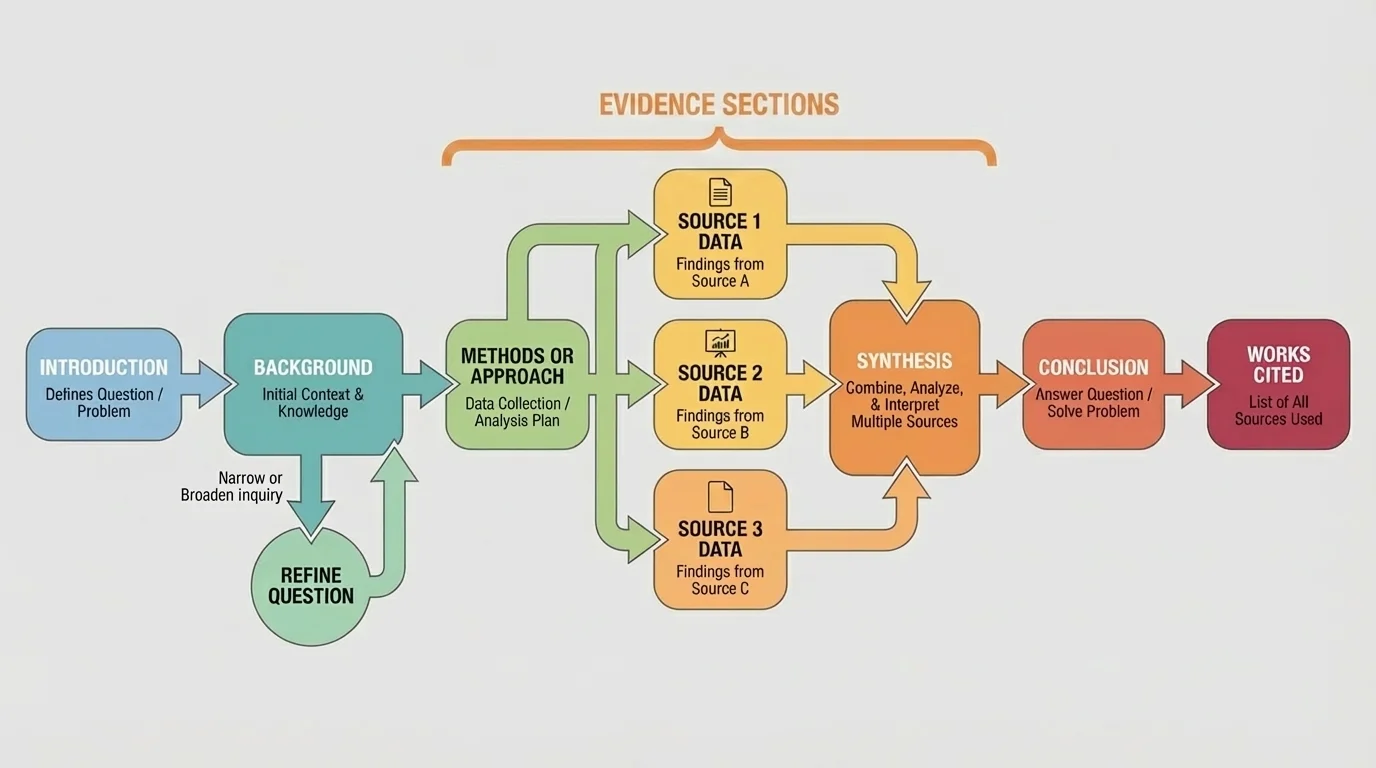
As [Figure 4] demonstrates, even excellent evidence can lose force if the writing is disorganized. A strong research product has a structure that readers can follow through the movement from question to conclusion. The organization may vary by assignment, but the logic should always be clear.
Most research writing includes an introduction that presents the question or problem, some background or context, body sections organized by claim or subtopic, and a conclusion that answers the question or proposes a solution. Many projects also include a works cited or references page to document the sources used.
Transitions matter because they show relationships between ideas. Words and phrases such as however, in contrast, similarly, as a result, and despite this help readers understand whether evidence supports, complicates, or challenges a claim. These small signals are part of strong reasoning.
Documentation is also essential. Citation gives credit, allows readers to verify information, and strengthens credibility. Different classrooms may use different citation styles, but the underlying principle is the same: borrowed ideas and language must be attributed clearly.
Revision is not only about grammar. It includes checking whether the question remains focused, whether sources are integrated smoothly, whether evidence truly supports the claims, and whether the conclusion answers the question fully. When you reread your draft, ask whether the paper sounds like a connected argument or just a sequence of notes.
Consider a short project based on the question, "How accurately does a film portray a historical event?" A student might use the film itself as one source, a historian's article as another, and a museum or archive source as a third. The student would compare specific scenes to documented facts and explain where the film is accurate, where it changes details, and why those changes might matter. Even in a brief project, synthesis is necessary because no single source provides the full answer.
Now consider a sustained project on whether cities should replace some parking areas with protected bike lanes. This inquiry may begin broadly with transportation policy but later narrow to questions of safety, local business impact, traffic flow, and environmental benefits. The student may need urban planning studies, public health data, city reports, interviews or local statements, and news coverage. If too much information appears, the project may narrow to one city or one district. If too little appears, it may broaden to include comparable cities. That flexibility is a core research skill.
Case study: Narrowing and broadening during a sustained project
Initial question: Should cities build more bike lanes?
Step 1: Identify why the question is too broad.
It could involve safety, cost, climate, tourism, accessibility, commuter behavior, and politics across many different places.
Step 2: Narrow the inquiry.
Revise the question to: How have protected bike lanes affected cyclist safety and nearby business activity in mid-sized U.S. cities?
Step 3: Broaden only if evidence is too limited.
If few sources discuss mid-sized cities, expand to include large cities with similar transportation patterns, while stating that limitation clearly in the final project.
This process keeps the investigation manageable without losing its importance.
Much later in drafting, the organizational pattern shown in [Figure 4] becomes practical: each section of the paper should move the reader from background, to evidence, to synthesis, and finally to a defended answer.
One common mistake is choosing a question that secretly asks for a predetermined answer. If you start with "Why are video games harmful?" you have already assumed the conclusion. A better question would be, "How does video game use affect attention, stress, or social interaction among teenagers?" Research should remain open to evidence.
Another mistake is relying too heavily on the first source that appears to agree with your view. This is a form of confirmation bias. Strong researchers intentionally look for complications, counterarguments, and exceptions. Doing so does not weaken the project. It makes the final answer more credible.
Weak synthesis is another problem. Students sometimes summarize source after source without connecting them. To avoid this, keep returning to your question. Ask what each source contributes, what it leaves out, and how it changes your understanding of the issue.
Finally, strong research depends on habits: keeping source records, reading carefully, adjusting the scope when needed, checking credibility, and revising for clarity. The best research projects are not built by collecting the most information. They are built by asking the right question and using evidence with precision and judgment.
"The important thing is not to stop questioning."
— Albert Einstein
A thoughtful researcher does more than report what others have said. A thoughtful researcher investigates, evaluates, connects, and concludes. That is what turns information into knowledge.
