A single unfamiliar word can change your understanding of an entire article, speech, lab report, or novel chapter. In high school and beyond, vocabulary is not just about memorizing definitions; it is about gaining access to complex ideas. The difference between partly understanding a text and fully understanding it often comes down to knowing how language works, why an author chose a certain term, and how to figure out meaning when no one is there to explain it for you.
College, careers, and civic life all depend on precise language. A future nurse must understand specialized medical terms. A welder must interpret technical instructions. A lawyer must notice subtle differences between words like claim, evidence, and justification. A college student reading history, biology, or economics must move confidently through challenging texts filled with abstract and specialized vocabulary. Strong readers and communicators do not know every word automatically, but they do know how to gather vocabulary knowledge independently and use it accurately.
Academic vocabulary gives you access to complex thinking. Words such as analyze, significant, interpret, factor, establish, and contrast appear across many subjects. These are not tied to just one class. Instead, they help you read instructions, understand explanations, and express ideas in more precise ways.
Domain-specific vocabulary is equally important, but it is tied to a particular field. In biology, you may need words such as osmosis or photosynthesis. In government, you may encounter federalism or ratification. In literature, you might analyze motif or foreshadowing. If academic vocabulary is the toolkit used in many rooms, domain-specific vocabulary is the specialized equipment needed in one room.
Vocabulary matters in all four language domains. In reading, it helps you unlock meaning. In writing, it helps you communicate with clarity and authority. In speaking, it allows you to explain ideas accurately and participate in serious discussion. In listening, it helps you follow lectures, directions, debates, and presentations without losing the thread of meaning.
Academic vocabulary is language that appears across many subjects and tasks, especially in formal reading and writing.
Domain-specific vocabulary is language used mainly within a particular subject, profession, or field of study.
Students sometimes think vocabulary growth means collecting longer words. That is not enough. True growth means understanding when a word fits, what shade of meaning it carries, and how it functions in different situations. A student who uses significant correctly in science, history, and English demonstrates stronger command than a student who only memorizes the definition.
[Figure 1] The contrast between these two kinds of vocabulary becomes clearer when you compare them directly. General academic words help you perform intellectual tasks across disciplines, while subject-specific terms let you participate in the language of a field.
Consider the word evaluate. In English, you evaluate the effectiveness of a symbol. In history, you evaluate the causes of a revolution. In science, you evaluate the reliability of data. The word remains useful across classes because it names a type of thinking. Now compare that with isotope, which belongs mainly to chemistry, or allusion, which belongs mainly to literary analysis.
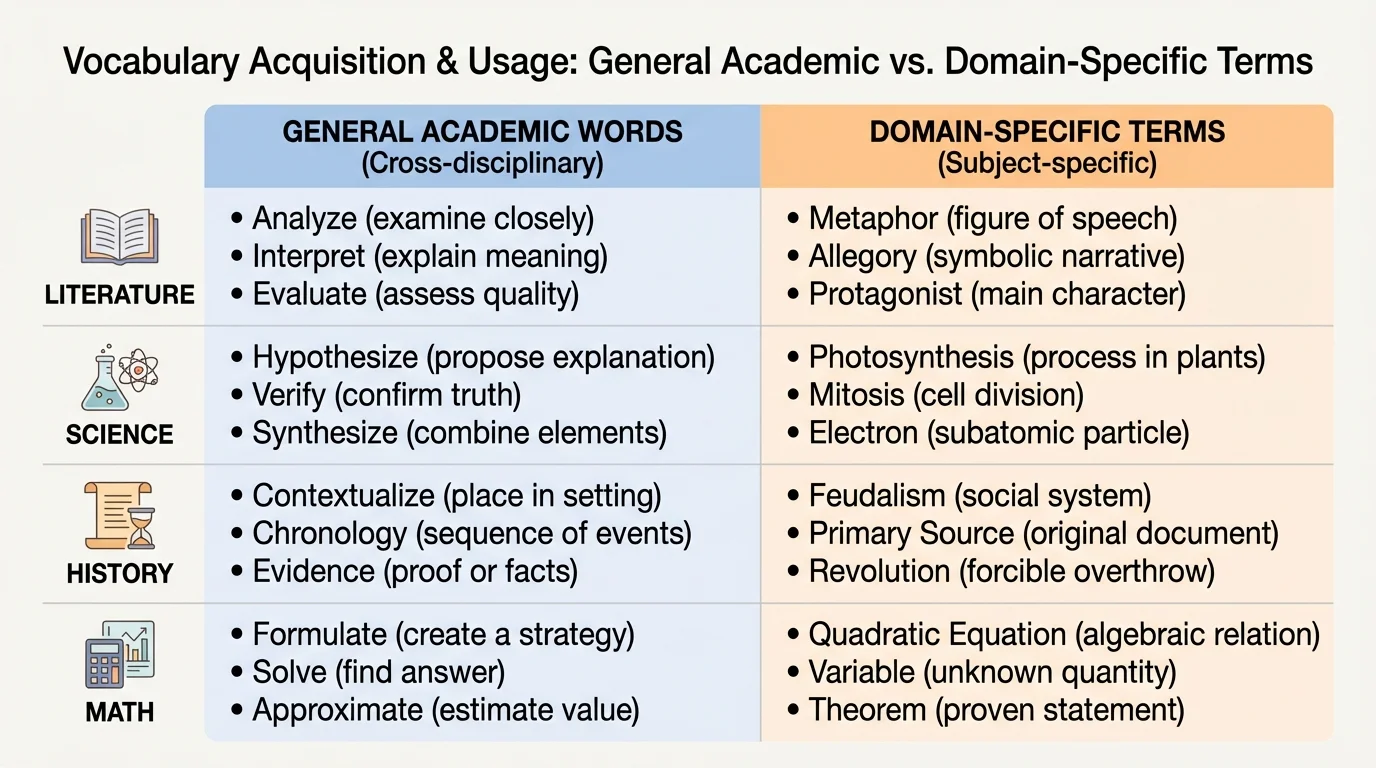
A strong vocabulary includes both categories. If you know the domain-specific term but not the academic verbs in a prompt, you may still misunderstand the task. For example, a student may know what a thesis is but struggle if asked to refine, substantiate, or synthesize ideas. On the other hand, knowing only general academic words is not enough when a text depends on specialized concepts.
One reason these categories matter is that they interact. A science textbook may ask you to analyze experimental results involving diffusion. An argumentative essay may ask you to justify a position using counterclaims and rebuttal. Mastery comes from understanding how general academic actions and domain-specific concepts work together.
Text type influences which words readers should notice first, as [Figure 2] illustrates. Narrative, argumentative, and informational texts all use language differently, so the vocabulary that matters most changes with the purpose of the text.
In a narrative text, language often shapes character, setting, mood, and conflict. A novelist may describe a room as dim, cramped, and airless instead of simply saying it is small. Those choices affect the reader's emotional understanding. Vocabulary in narratives often carries strong connotations and helps readers infer what is not stated directly.
In an argumentative text, readers should pay attention to words that signal claims, evidence, reasoning, and qualification. Terms such as therefore, however, consequently, moreover, and nevertheless guide the logic. Modifying words such as likely, some, most, or rarely can change the strength of a claim. Missing these signals can lead to misunderstanding an author's position.
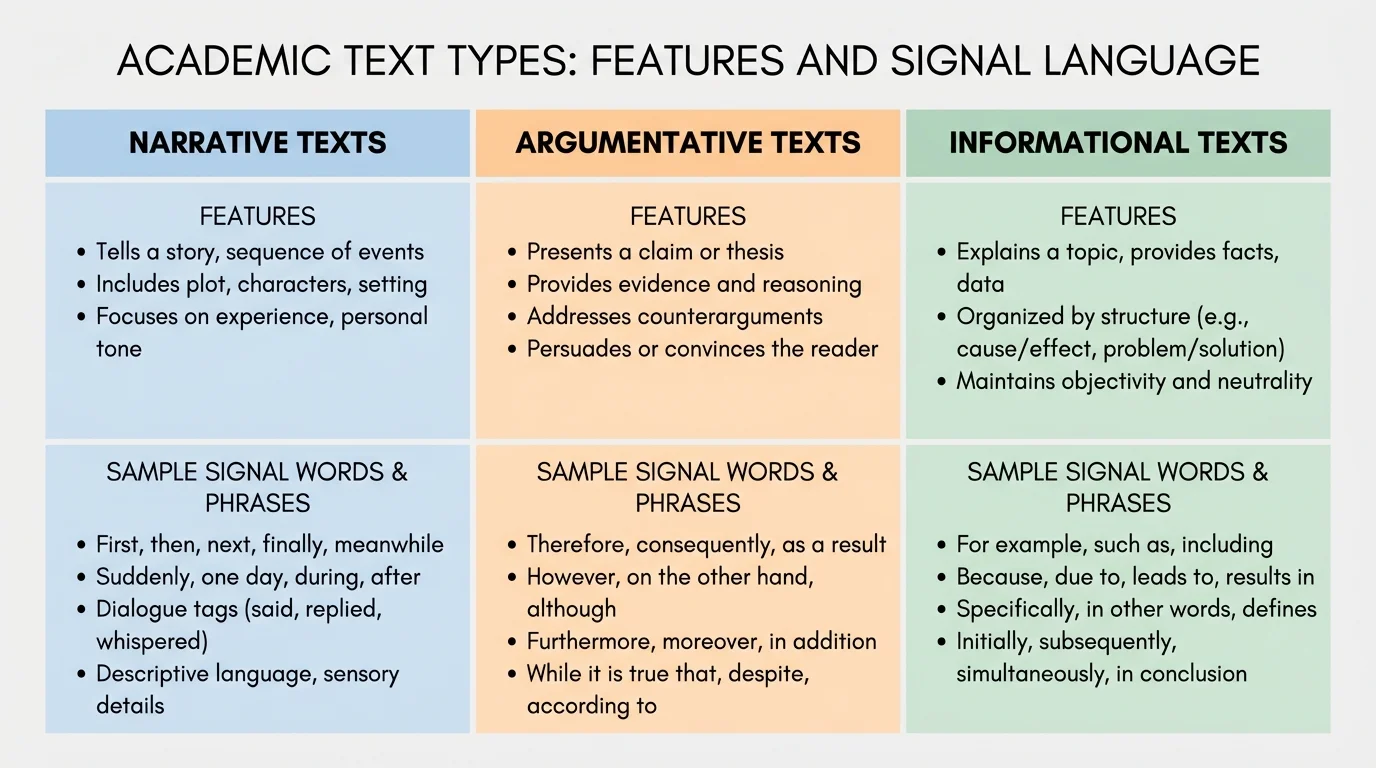
In an informational text, vocabulary often emphasizes explanation, classification, sequence, and precision. Words such as process, component, function, category, and structure help organize knowledge. In a technical manual, one misunderstood term may cause a reader to perform a step incorrectly. In a textbook chapter, unfamiliar content words may prevent a student from seeing how ideas connect.
Authors also shape meaning through formal and informal language, repetition, figurative language, and strategic word choice. A speech might use repeated phrases to build urgency. A news article may rely on neutral-seeming terms that still carry subtle implications. A memoir may use sensory language to make events vivid. To comprehend deeply, readers must notice not only what words mean but what they do.
Later, when you compare different sources, the distinctions shown in [Figure 2] help you adjust your reading. You do not read a poem, an editorial, and a lab report in exactly the same way because each uses vocabulary to achieve a different purpose.
[Figure 3] Knowing a word deeply means more than being able to match it with a dictionary definition. Real word knowledge includes denotation, connotation, tone, grammatical function, and the way a word relates to other words.
Denotation is a word's basic dictionary meaning. Connotation is the feeling or association that comes with it. For example, slender and skinny may point to a similar physical trait, but the first often sounds positive while the second may sound critical. Readers who miss connotation miss part of the author's message.
Tone is the attitude a speaker or writer conveys. A phrase like the proposal is ambitious can sound admiring in one context and skeptical in another. Register refers to the level of formality appropriate to a situation. You might say commence in a formal speech but start in everyday conversation. Knowing vocabulary includes knowing when each choice fits.
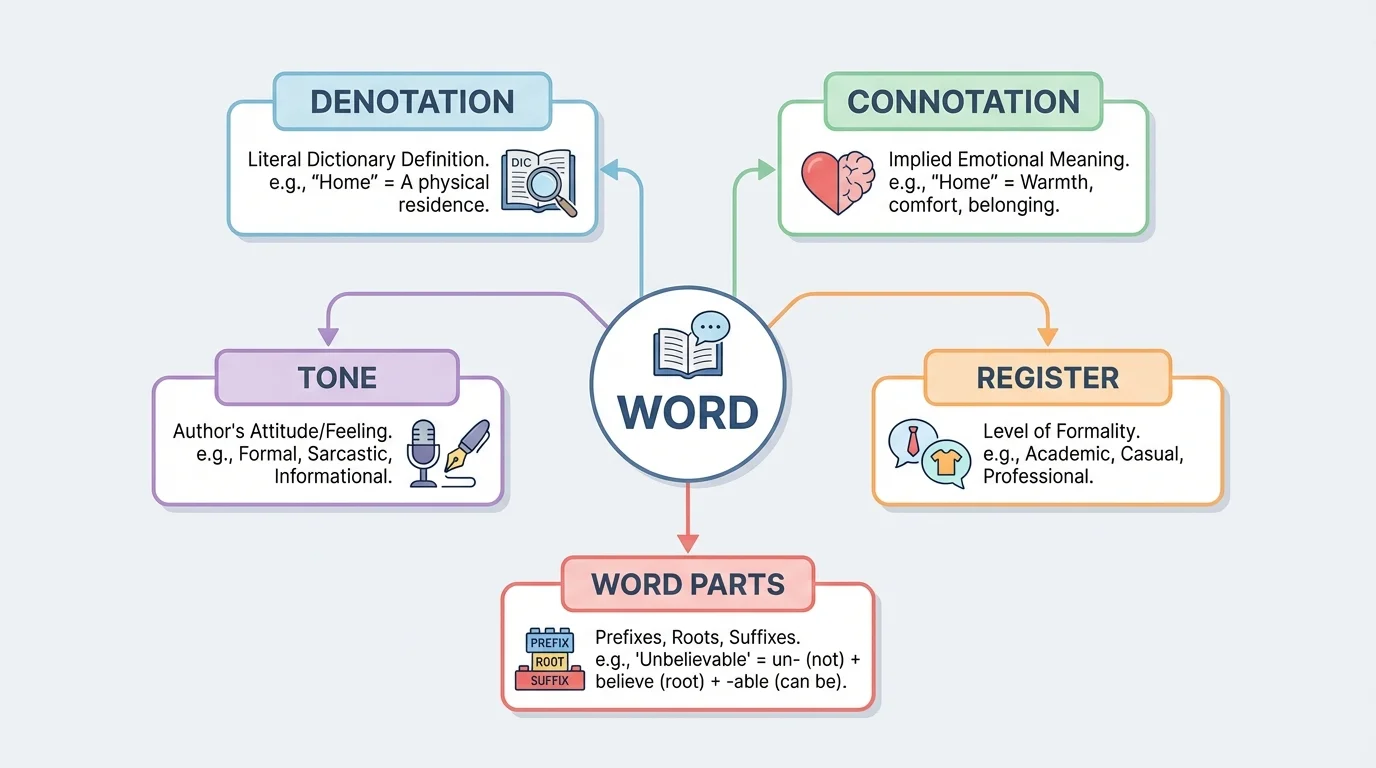
Deep knowledge also includes morphology, the study of word parts and how they create meaning. Prefixes, roots, and suffixes can help you unlock unfamiliar words. If you know that bio means life and -logy means study of, then biology becomes easier to interpret. If you know that inter- means between, then interact, interstate, and interconnected become more understandable.
Knowing a word deeply also means recognizing multiple meanings. The word draft might mean a current of air, a preliminary version of writing, or compulsory military service. The correct meaning depends on context. Skilled readers stay flexible rather than attaching only one definition to a word.
Depth of word knowledge means understanding not only what a word means, but also how it functions, what it suggests, where it belongs, how it changes form, and how it behaves in different contexts. This depth helps students read more accurately and express ideas with greater precision.
The layers in [Figure 3] matter most when texts become more sophisticated. In advanced reading, the challenge is often not a completely unknown word, but a familiar-looking word used with a sharper meaning, a different tone, or a more formal register than you expected.
[Figure 4] Independent readers do not stop every time they meet an unfamiliar word. Instead, they follow a process of noticing, inferring, checking, and confirming. This independence is essential for college and career readiness because adults constantly encounter new vocabulary in manuals, articles, training documents, legal forms, and professional conversations.
One major strategy is using context clues. These are hints in the surrounding sentences that help reveal meaning. An author may define a term directly, provide an example, show contrast, or offer a cause-and-effect relationship. If a passage says, "Unlike the chaotic first draft, her final essay was coherent and logically organized," the contrast suggests that coherent means orderly and connected.
Another strategy is analyzing word parts. If you encounter malnutrition, you can break it into mal- meaning bad, nutri relating to nourishment, and -tion indicating a condition or process. Even if you are not perfectly certain, morphology helps you make a strong first guess.
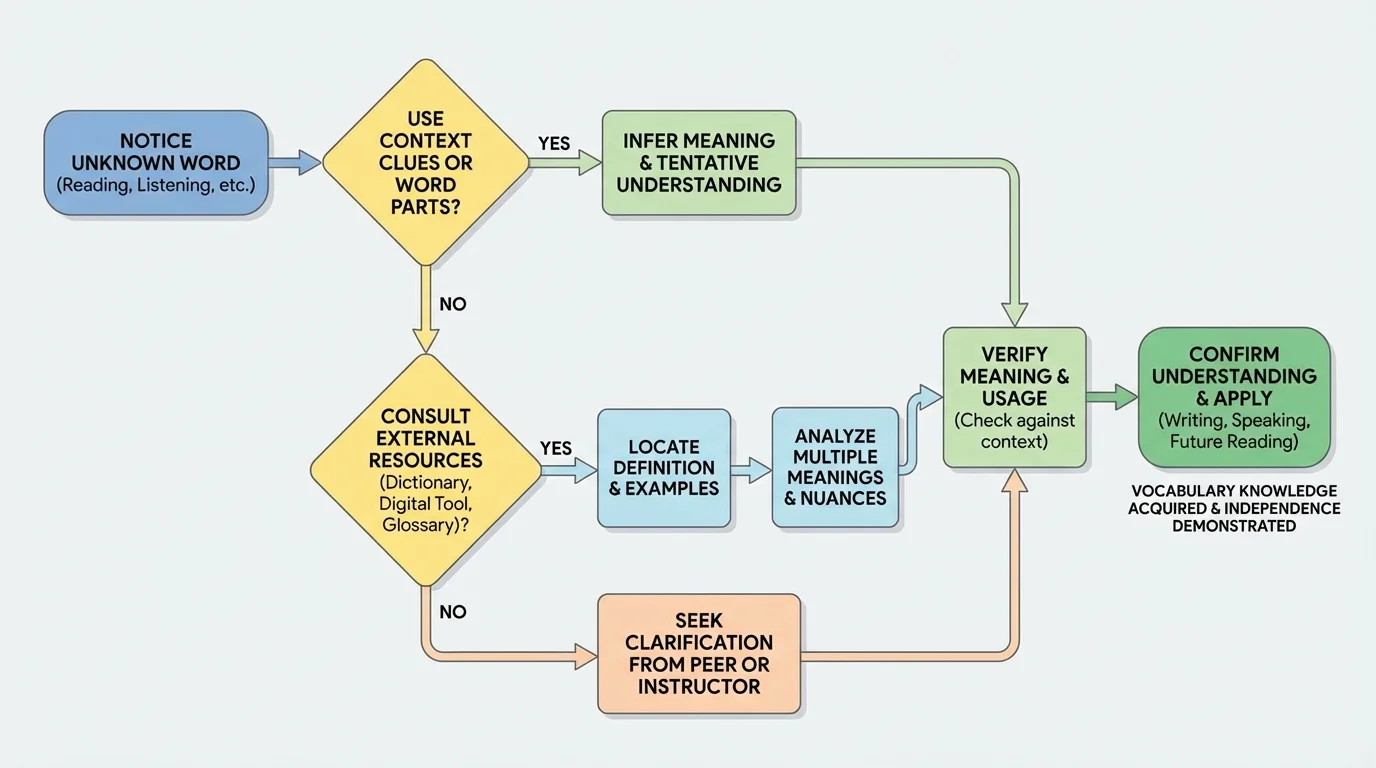
Reference tools matter too. A dictionary can provide denotation, pronunciation, part of speech, and sample usage. A thesaurus can help you compare related words, though it should be used carefully because synonyms are rarely exact replacements. Glossaries, footnotes, sidebars, and digital annotation tools also support understanding.
Strong readers cross-check. Suppose an informational text describes a machine as obsolete. Context may suggest that it is outdated. A dictionary can confirm that meaning. Then you should reread the sentence to see whether the confirmed meaning fits naturally. Independent vocabulary learning is not guesswork alone; it is informed verification.
Using multiple strategies together
Read this sentence: "Because the witness gave inconsistent statements, the jury questioned her credibility."
Step 1: Use context.
The phrase inconsistent statements suggests the witness said different things at different times.
Step 2: Infer meaning.
If her statements do not match, the jury may doubt whether she is believable.
Step 3: Confirm with a reference tool.
A dictionary would confirm that credibility refers to believability or trustworthiness.
The word becomes understandable because context, reasoning, and confirmation work together.
The process in [Figure 4] also helps when context is misleading. Sometimes a sentence gives only a weak hint, so readers must combine clues from nearby paragraphs, text features, and prior knowledge before deciding on meaning.
[Figure 5] True mastery means carrying vocabulary across reading, writing, speaking, and listening. A word is not fully learned when you can only recognize it on a quiz. It is learned when you can understand it in a lecture, use it correctly in an essay, respond to it in discussion, and notice when someone else uses it imprecisely.
In writing, accuracy matters more than decoration. Using a sophisticated word incorrectly weakens your credibility. For example, writing "The scientist fabricated the results" is serious because fabricated can mean invented dishonestly, not simply created. Precision means choosing the word that matches your idea exactly.
In speaking, academic vocabulary helps you sound thoughtful and specific. Compare "I kind of disagree" with "I disagree because the evidence is insufficient." The second statement is clearer because it includes a reason and uses more precise language. In seminars, presentations, and interviews, vocabulary signals how carefully you think.
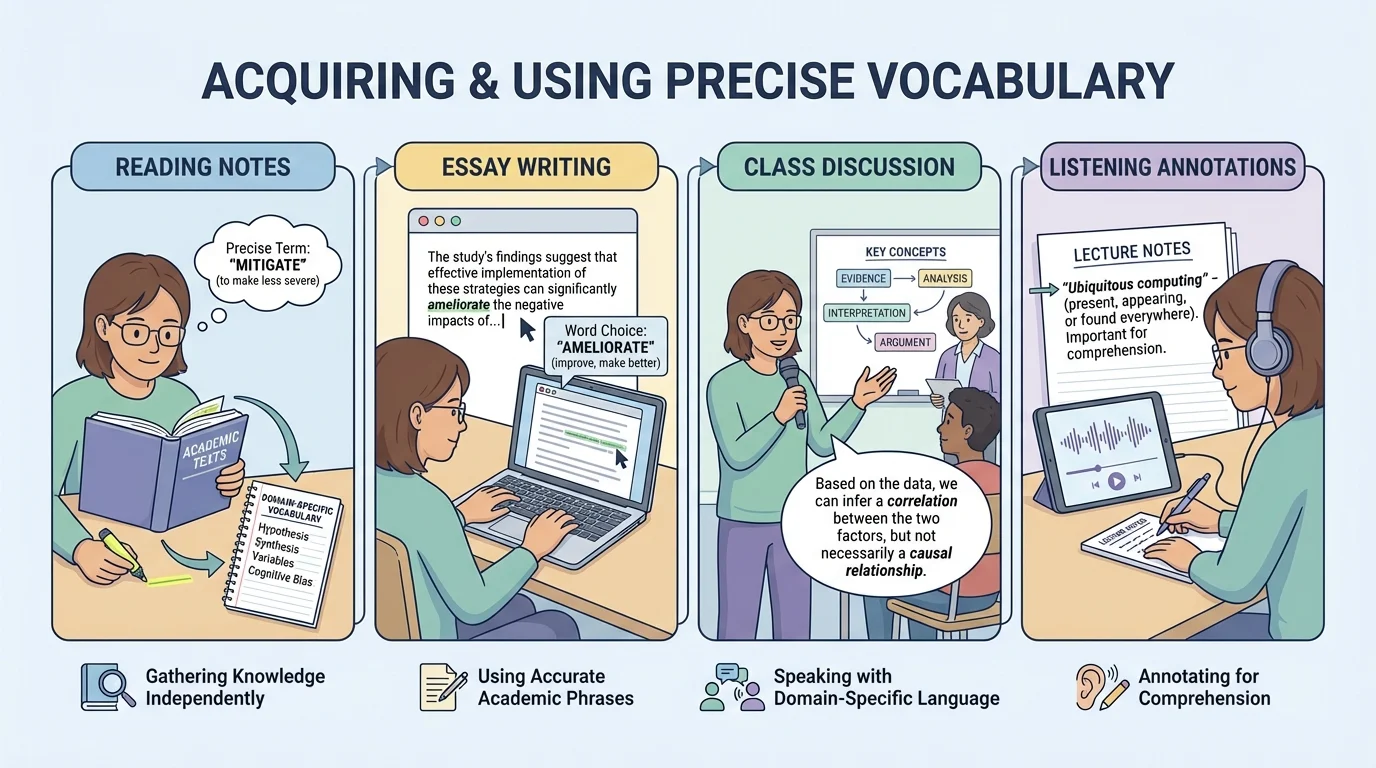
In listening, vocabulary knowledge helps you keep up with complex information. During a lecture, if a speaker says a result is correlated rather than caused, that distinction matters. Missing the vocabulary can lead to misunderstanding the argument or the evidence.
Audience and purpose also shape word choice. A lab report, scholarship essay, job interview, and conversation with friends require different levels of formality. The same student may use domain-specific terms confidently in a robotics competition and shift to more general academic language in a reflective essay. Skilled communicators make those adjustments intentionally.
Many of the most common words on college entrance exams and in first-year textbooks are not obscure words at all. They are often high-utility academic words such as analyze, infer, justify, and synthesize, which appear across subjects.
The transfer shown in [Figure 5] is one of the clearest signs of readiness for adult-level communication. Real learning happens when vocabulary moves from recognition into purposeful use.
Vocabulary growth is cumulative. You do not master college- and career-level language in a week. You build it by reading widely, listening carefully, asking questions, and paying attention to words that seem important to comprehension or expression.
One productive habit is to notice words that repeat across classes. If you encounter interpret in history, science, and English, that is a signal that the word has high value. Another habit is to record not just the definition but also an example sentence, a synonym, an antonym, a related form, and the context where you found it. That creates stronger memory connections.
It also helps to study words in families. Learning analyze, analysis, analyst, and analytical gives you a network rather than a single isolated item. Likewise, noticing roots can connect many words at once. A student who understands the root struct, meaning build, can better understand construct, structure, destruction, and infrastructure.
Independent learners ask a key question while reading: Is this word important enough to stop and investigate? Not every unfamiliar word deserves equal attention. If the word is central to the author's argument, repeated throughout the text, or essential to expressing your own idea, it deserves closer study. If it is minor and the main meaning remains clear, you may keep reading and return later.
| Situation | Useful Vocabulary Move | Why It Helps |
|---|---|---|
| Reading a novel | Notice connotation and tone | Improves inference about characters and mood |
| Reading an editorial | Track claim and evidence words | Clarifies the argument's logic |
| Reading a science article | Identify domain-specific terms and definitions | Improves understanding of key concepts |
| Writing an essay | Choose precise academic verbs | Makes analysis clearer and more credible |
| Listening to a lecture | Note repeated technical terms | Helps capture main ideas accurately |
Table 1. Common situations where vocabulary choices affect comprehension and expression.
As you become more experienced, you begin to recognize patterns quickly. You notice signal words in arguments, figurative language in narratives, and technical terms in explanations. This growing awareness makes reading faster, writing sharper, and speech more confident.
"The limits of my language mean the limits of my world."
— Ludwig Wittgenstein
That idea matters because vocabulary expands not only what you can say, but what you can understand and think about. The more accurately you know words, the more precisely you can engage with ideas, evaluate claims, and participate in serious conversations.
