A single sentence can sound confident, rude, persuasive, intelligent, awkward, or completely out of place depending on where it is spoken and who hears it. That is why strong speakers do more than "say what they think." They shape their words for a situation. In school, at work, in civic life, and online, people are judged not only by their ideas but also by how well they match their speech to a purpose and an audience.
Context means the situation surrounding communication: who is involved, what is happening, why the message matters, and how it is being delivered. A student answering a question in class, speaking at a school board meeting, recording a podcast, and talking with friends may discuss similar topics, but the language, tone, and structure should not be identical. Skilled speakers know how to adjust without losing their message.
This ability matters because spoken communication is tied to credibility. If a speaker sounds too casual in a formal setting, listeners may doubt the speaker's seriousness. If a speaker is stiff and overly technical in a peer discussion, listeners may stop engaging. Adapting speech is not "being fake." It is a form of awareness, respect, and precision.
Speech changes because people do not all need the same thing from a message. An audience of classmates may need clear explanation and relevant examples. A principal may need concise recommendations and evidence. A hiring manager may want professionalism, confidence, and direct answers. A community audience may need a speech that is understandable, respectful, and connected to real concerns.
Every speaking task also has a different goal. Some tasks are meant to inform, such as presenting research findings. Some are meant to persuade, such as arguing for a policy change. Some are collaborative, such as a seminar or discussion. Others are ceremonial, such as a welcome address or tribute. The goal affects how much detail, evidence, and emotional appeal a speaker should use.
Formal English is a style of language that follows standard grammar, precise word choice, and a respectful, professional tone. Register is the level of formality or informality used in language, depending on audience and situation.
Because speech is social, listeners constantly interpret clues. They notice word choice, volume, pace, politeness, and whether a speaker seems prepared. Even when the facts are correct, poor adaptation can weaken the message. Strong speakers understand that effective communication depends on both content and delivery.
[Figure 1] The most reliable way to adapt speech is to think through four factors: audience, purpose, occasion, and medium. As [Figure 1] shows, one topic may be expressed in very different ways depending on these four factors. A speaker who ignores them may give accurate information but still fail to connect with listeners.
Audience means the people receiving the message. Their age, background knowledge, interests, values, and expectations matter. Speaking to experts allows for more specialized vocabulary. Speaking to a general audience requires clearer explanation and less jargon.
Purpose means what the speaker wants to achieve. If the goal is to explain, the speaker should focus on clarity and sequence. If the goal is to persuade, the speaker should combine evidence with reasoning and perhaps a stronger call to action. If the goal is to build discussion, the speaker should leave room for questions and responses.
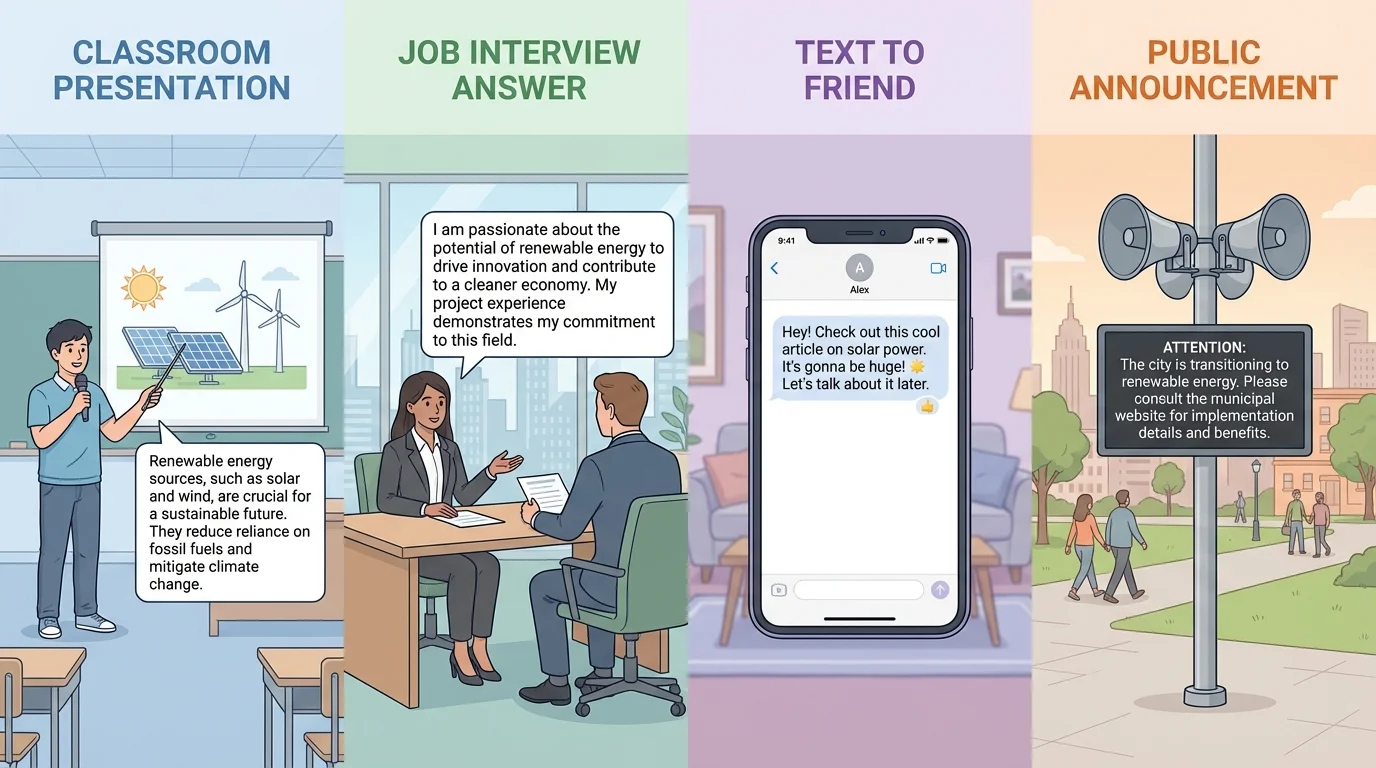
Occasion refers to the setting and level of seriousness. A class presentation, an assembly, a debate, and an interview all create different expectations. A serious occasion often calls for more formal language, a tighter structure, and more careful transitions.
Medium is the format used to communicate. Spoken communication may happen live, on video, in a podcast, through slides, or in a panel discussion. Each medium shapes what works best. In a live speech, vocal delivery and eye contact matter greatly. In a multimedia presentation, visuals and timing become more important. In an audio-only format, wording and vocal clarity carry more of the message.
When students prepare speeches, they often focus only on what they want to say. Effective speakers also ask: Who needs this information? What do they already know? What tone fits this moment? What format will help them understand? Those questions turn raw ideas into purposeful communication.
[Figure 2] Formal English is especially important when the situation requires professionalism, authority, or public credibility. As [Figure 2] illustrates, formal and informal speech differ in vocabulary, sentence patterns, and tone. Formal English is usually appropriate in academic presentations, speeches to adults or public groups, interviews, debates, official announcements, and presentations based on research.
Formal English does not mean sounding robotic or unnatural. It means using complete ideas, standard grammar, precise words, and a respectful tone. For example, saying, "The evidence suggests that school start times affect student performance" sounds more formal and specific than saying, "It's like, school start times totally matter for grades."
Informal English has a place too. In small-group brainstorming with close classmates, a more relaxed style can help conversation flow. In a reflective discussion or creative workshop, a less rigid tone may invite honesty and participation. Good speakers are flexible enough to shift between styles without confusing them.
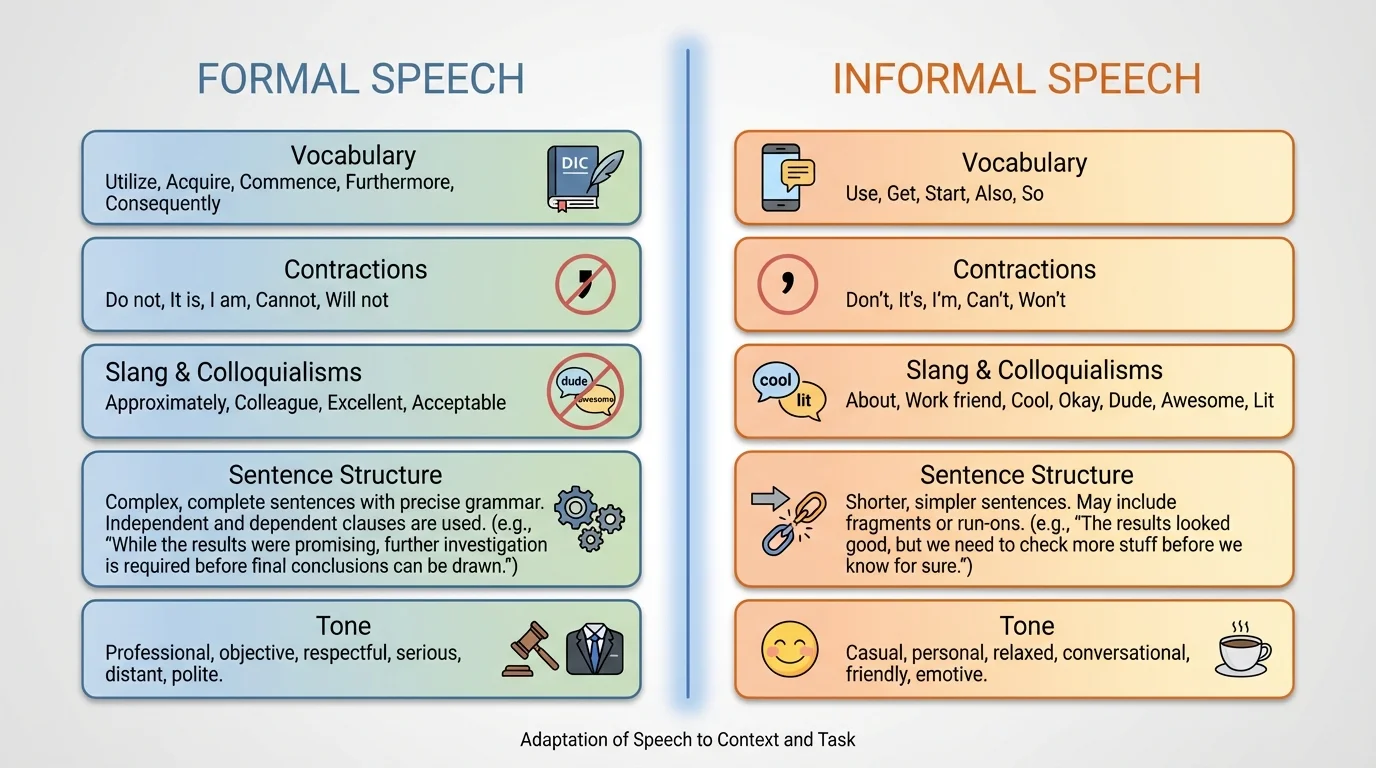
Some signs of formal English include limited slang, fewer filler words, careful pronunciation, and organized sentence structure. Contractions may still appear in formal speech, especially when they sound natural, but the overall style remains polished. A speaker should avoid speaking so casually that the language seems careless.
Consider how the same idea can be adapted: "I think the policy is bad" may work in casual conversation, but in a school board comment, "I oppose the policy because it reduces student access to after-school support" is stronger, clearer, and more appropriate. The difference is not only formality. It is also precision.
Tone is the attitude a speaker's language conveys. It may sound respectful, urgent, skeptical, enthusiastic, calm, or critical. Diction means word choice. Register is the overall level of formality. These three elements work together.
If a student gives a scientific presentation, the tone should usually be objective and confident, the diction should be accurate, and the register should lean formal. If the same student leads a peer discussion on a school event, the tone may be more conversational, the diction more familiar, and the register less formal. The speaker still needs clarity, but not the same level of distance.
Word choice shapes how listeners respond. Precise language strengthens authority. Vague language weakens it. Compare these examples:
The second version sounds more credible because it is more specific. Specificity often makes speech sound more mature and trustworthy.
Matching language to the moment means balancing clarity with appropriateness. A speaker should not use complicated words only to sound smart. The goal is not to impress people with difficulty; it is to communicate in the clearest way the audience will understand and respect.
Speakers also adapt sentence length and style. Short, direct sentences work well when making a strong claim or giving instructions. Longer, more developed sentences help explain complex ideas. Effective speaking usually blends both. Too many short sentences can sound abrupt. Too many long ones can become confusing.
Delivery affects tone as much as wording does. A respectful sentence spoken with sarcasm becomes disrespectful. A persuasive claim delivered in a monotone loses energy. Adaptation is therefore verbal and vocal at the same time.
The structure of a speech should match the task. A research presentation usually needs an introduction, a clear claim or question, organized evidence, and a conclusion that reinforces significance. A debate needs a claim, reasons, evidence, counterargument, and rebuttal. An interview answer should be focused, relevant, and brief enough to stay sharp.
Different tasks also require different levels of explanation. In a classroom seminar, a speaker may build ideas gradually and respond to others. In an announcement, the speaker should quickly answer practical questions such as what, when, where, and why. In a ceremonial speech, the speaker may focus more on tribute, shared values, and emotional resonance.
Transitions help listeners follow the speaker's thinking. Phrases such as "first," "in contrast," "for example," "as a result," and "to conclude" guide an audience through the message. In more formal contexts, transitions become especially important because they make the speech sound organized and intentional.
Case study: one topic, three speaking tasks
A student is speaking about teen sleep and school start times.
Step 1: In a class presentation, the student says, "Research on adolescent sleep suggests that later school start times may improve attention, attendance, and mood."
Step 2: In a small-group discussion, the student says, "I noticed a lot of us are exhausted first period, and research backs that up."
Step 3: In a public comment to school leaders, the student says, "I support later start times because evidence suggests they improve student well-being and readiness to learn."
The core idea stays the same, but the style changes to fit the task and audience.
Effective organization also respects time. A speaker in a short presentation must choose the most relevant points rather than trying to say everything. Adapting speech includes deciding what to leave out. That choice shows audience awareness.
[Figure 3] Strong speaking depends on reliable content, not just smooth delivery. As [Figure 3] shows, a speaker often moves through a process: finding sources, checking credibility, selecting useful facts, and shaping them for a particular audience and format. This is especially important when presenting research, making claims, or speaking on issues that affect others.
A credible source is trustworthy, accurate, and relevant. Credibility may come from expertise, evidence, careful reporting, or publication by respected institutions. Students should ask who created the source, whether the information is current, whether claims are supported, and whether other reliable sources agree.
Accurate information must then be adapted to the audience's needs. A speaker should not dump statistics into a speech without explanation. Instead, the speaker should choose evidence that listeners can understand and connect to the purpose. For a student audience, one well-explained data point may be more effective than ten rushed statistics.
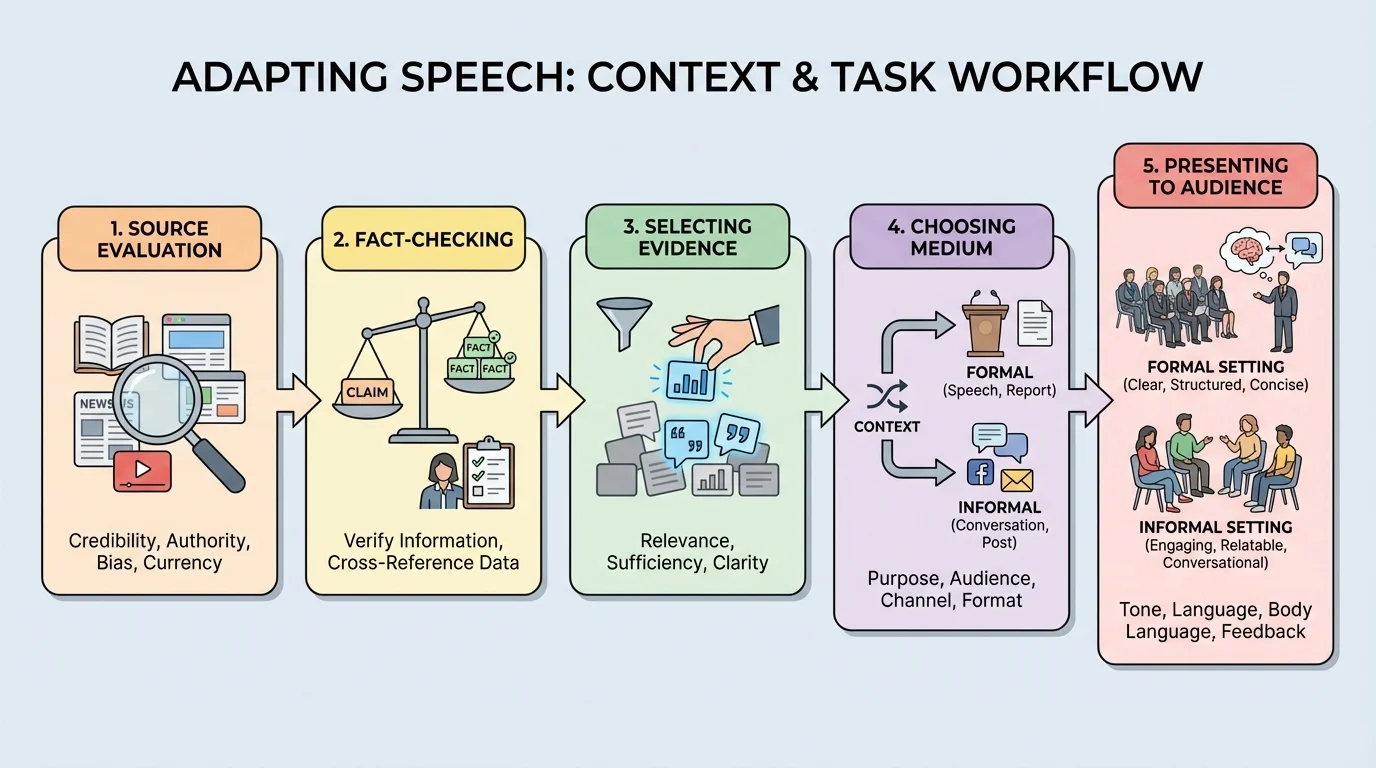
Different media formats call for different uses of information. In a slide presentation, a speaker may show a simple chart while explaining the meaning aloud. In a podcast, the speaker must describe the evidence clearly because listeners cannot see a graph. In a live speech, the speaker may quote an expert briefly and then translate the idea into accessible language.
Citing sources orally also matters. Phrases such as "According to the Centers for Disease Control and Prevention" or "A study published in a peer-reviewed journal found" help listeners understand where information comes from. Oral citation builds trust and shows that the speaker's ideas are grounded in evidence.
| Speaking Situation | Best Type of Information | How to Present It |
|---|---|---|
| Research presentation | Data, expert findings, definitions | Explain clearly and cite sources aloud |
| Persuasive speech | Facts, examples, expert testimony | Connect evidence directly to the claim |
| Panel discussion | Key points and brief evidence | Speak concisely and respond to others |
| Multimedia presentation | Visual data and short quotations | Use visuals that support, not replace, speaking |
Table 1. How different speaking situations call for different kinds of evidence and presentation choices.
When students overload a speech with information, listeners may remember very little. The goal is not maximum quantity. It is accurate, relevant, audience-centered communication. As we also see in [Figure 3], good speaking transforms research into understanding.
In a classroom presentation, students should usually use formal English, define unfamiliar terms, maintain a clear structure, and support points with evidence. In a seminar, students may use a slightly more conversational style, but they still need to engage thoughtfully with texts, ideas, or data.
In a job interview, the speaker should be especially aware of tone, posture, clarity, and professionalism. Answers should be specific but concise. Slang, one-word responses, and vague claims like "I'm good with people" are weaker than clear examples such as "I work well in teams because I listen carefully and follow through on responsibilities."
In a public or civic setting, respectful formality is essential, even when the speaker strongly disagrees. A speaker can sound firm without sounding rude. Saying, "I disagree with this decision because it may limit access for students who rely on the program," is far more effective than attacking people personally.
In peer discussion, adaptability works differently. The speaker may use more natural rhythms and a warmer tone, but still needs active listening, thoughtful responses, and enough structure to stay clear. Informality should never become disrespect, laziness, or confusion.
Many professionals spend significant time practicing how they say something, not just what they say. Lawyers, doctors, engineers, journalists, and public officials all adjust their language depending on whether they are speaking to experts, clients, patients, students, or the general public.
Multimedia speaking adds another challenge. When slides, video, or audio are involved, the speaker must avoid reading directly from the screen. The media should support the message, not compete with it. Strong speakers guide the audience through visuals with clear explanation and selective emphasis.
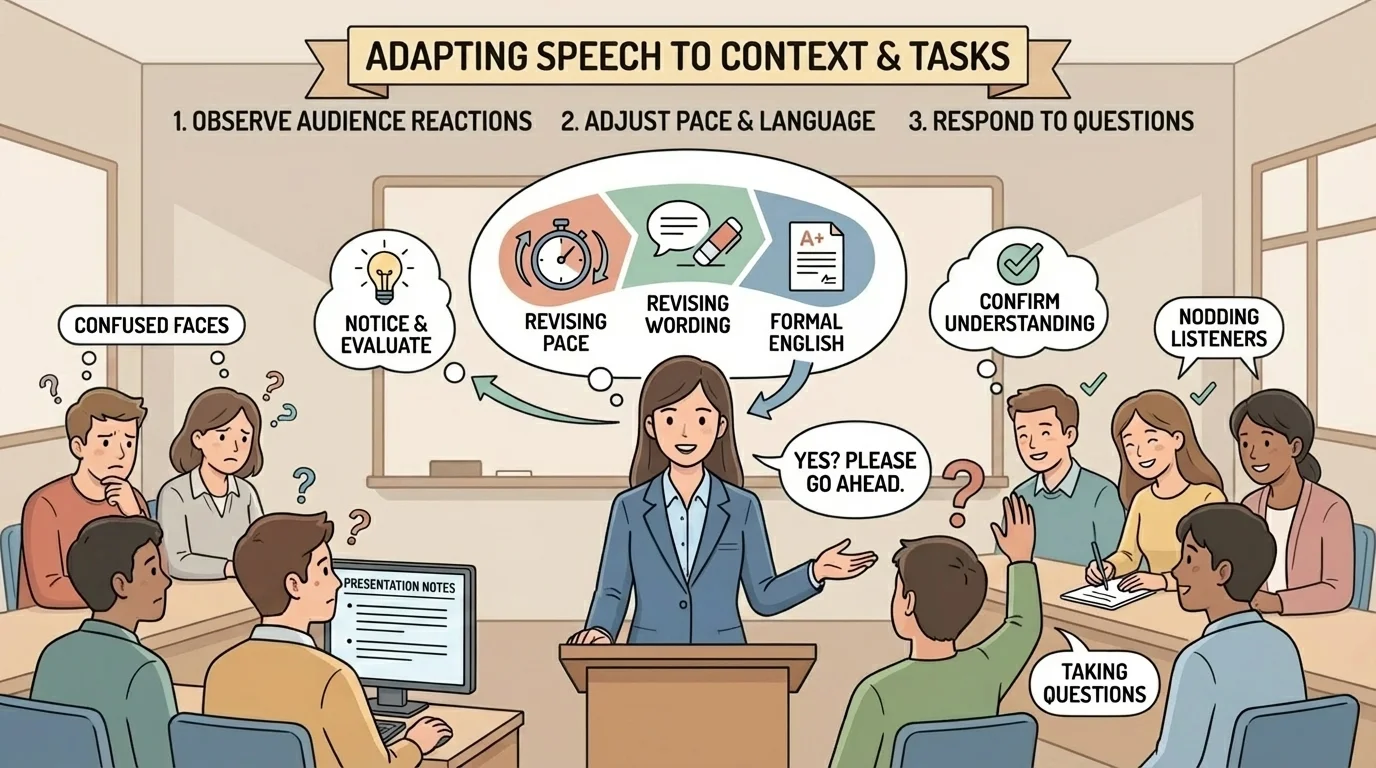
[Figure 4] Adapting speech is not only a planning skill. It is also a live skill. Audience reactions provide constant feedback, and [Figure 4] illustrates how a speaker reads confusion, interest, agreement, or disengagement through faces, posture, and questions. Effective speakers notice these cues and adjust.
If listeners look confused, the speaker may slow down, define a term, or offer an example. If listeners seem restless, the speaker may shorten an explanation and move to the next point. If listeners respond strongly to one idea, the speaker may expand it. This kind of adjustment shows control, not weakness.
Listening matters especially in discussions, interviews, and question-and-answer sessions. A speaker who ignores what others say cannot adapt effectively. Good oral communication includes responding to real comments rather than delivering a memorized script no matter what happens.
Vocal choices also shift in real time. A speaker may need to change volume, pause more often, or vary emphasis. When presenting complex information, strategic pauses give the audience time to think. As seen earlier in [Figure 4], responsive speaking depends on attention to the room, not just attention to notes.
Strong communication always begins with active listening. If you cannot tell what your audience knows, needs, or feels, you cannot fully adapt your speech to them.
Revision after speaking is part of adaptation too. Reflecting on what worked, what felt awkward, and where listeners seemed most engaged helps speakers improve over time. Adaptability grows through practice and reflection.
One common mistake is using the same speaking style in every situation. A student who speaks to a teacher exactly as they speak in a private group chat may sound disrespectful, even without intending to. Another mistake is overcorrecting and sounding so stiff that the speech loses energy and authenticity.
Another problem is relying on fillers such as "like," "um," and "you know" so often that they distract from the message. Occasional fillers are normal, but too many can make a speaker seem underprepared. Practicing aloud helps reduce them.
Speakers also weaken themselves when they use unsupported claims. Saying "everyone knows this is true" is not evidence. A stronger speaker uses examples, data, or expert support and explains why the evidence matters. Credibility comes from both the source and the speaker's handling of that source.
Finally, some speakers mistake complex language for effective language. Overly technical words, long sentences, or unnecessary jargon can make a speech less clear. Good adaptation means choosing language that fits both the subject and the audience.
Becoming an adaptable speaker requires awareness, preparation, and practice. Before speaking, ask four questions: Who is my audience? What is my purpose? How formal should I be? What information and format will best meet the audience's needs? These questions create a foundation for strong choices.
It also helps to rehearse in the style you plan to use. If the situation is formal, practice using formal transitions, clear pronunciation, and complete explanations. If the task includes discussion, practice answering follow-up questions. If visuals are involved, practice speaking with them rather than reading them.
Over time, strong speakers develop range. They can sound academic without sounding artificial, conversational without sounding careless, persuasive without sounding aggressive, and evidence-based without overwhelming listeners. That range is a sign of communication maturity.
"The right word may be effective, but no word was ever as effective as a rightly timed pause."
— Mark Twain
Adapting speech to context and task is one of the most practical communication skills students can build. It prepares them for school success, professional opportunities, public participation, and everyday human interaction. Command of formal English, used when appropriate, is not about showing off. It is about showing judgment.
