A discussion can change completely because of one sentence: "The article actually says something different." In strong classrooms, discussions are not guessing contests or battles of confidence. They are places where students test ideas, challenge assumptions, and refine their thinking using evidence. The students who make those discussions stronger are usually not the loudest. They are the ones who arrive having read carefully, thought deeply, and prepared to connect what they know to what others say.
Coming prepared does not simply mean finishing the reading. It means entering the conversation with enough understanding to contribute meaningfully and enough flexibility to reconsider your thinking. In academic discussion, your ideas matter, but the strength of those ideas depends on what supports them. Evidence from assigned texts, class materials, and outside research helps move a conversation from opinion to analysis.
This skill matters far beyond school. In college seminars, workplace meetings, community forums, and even everyday conversations about current events, people are expected to know the issue before speaking about it. Preparation makes your voice more credible. It also shows respect for the time, thinking, and effort of everyone else in the conversation.
A prepared discussion is different from an unprepared one in both tone and depth. When people have done the reading and research, they can move past surface-level reactions and examine how ideas work. They can compare authors, question assumptions, identify patterns, and notice contradictions. Instead of saying, "I just think this is unfair," a prepared student might say, "The author presents this policy as fair, but the data in paragraph 8 suggest that the impact is uneven across income groups."
That shift matters because thoughtful discussion depends on evidence. Evidence is the information that supports a claim. In discussion, evidence may come from a novel, poem, historical document, scientific article, speech, documentary, interview, chart, or credible outside source. Without evidence, discussion often becomes repetitive, vague, or emotional without being persuasive.
Preparation also makes listening better. When you know the material, you can recognize what others are referring to, spot gaps in reasoning, and make genuine connections. Instead of waiting for your turn to talk, you can respond to what was actually said. That is one of the main goals of collaborative discussion: building knowledge together rather than speaking in isolation.
Preparation in discussion means reading and researching the topic in advance, identifying key ideas and evidence, and arriving ready to use that knowledge in conversation.
Claim is a position or argument a speaker or writer makes.
Textual evidence is support drawn directly from a text, such as a quotation, detail, or paraphrased idea.
Research is information gathered from credible sources beyond the main class text in order to deepen understanding of an issue.
Strong preparation does not guarantee that you will always be right. In fact, good discussions often reveal that a first interpretation was incomplete. But preparation gives you something solid to work from. It lets you test your thinking against the text, the research, and the reasoning of others.
Many students hear "be prepared" and think it means "have something to say." Academic preparation is more specific than that. It means you have read actively, marked important passages, noted confusing points, and identified at least a few ideas worth discussing. Strong preparation turns reading into usable notes through categories like claim, evidence, question, and connection.
[Figure 1] One useful method is to track four things while reading: the author's main claim, the evidence used to support that claim, questions or uncertainties you have, and connections to other texts or issues. This helps you avoid a common problem: remembering the topic generally but forgetting the details that make discussion meaningful.
For example, if your class is discussing whether social media improves civic participation, an unprepared student may remember only the general idea that "people use it for activism." A prepared student might arrive with notes such as: the article argues that social media increases political awareness among younger voters; the author cites survey data from first-time voters; a second source warns that misinformation spreads quickly on the same platforms; and a question remains about whether online engagement leads to real-world action.
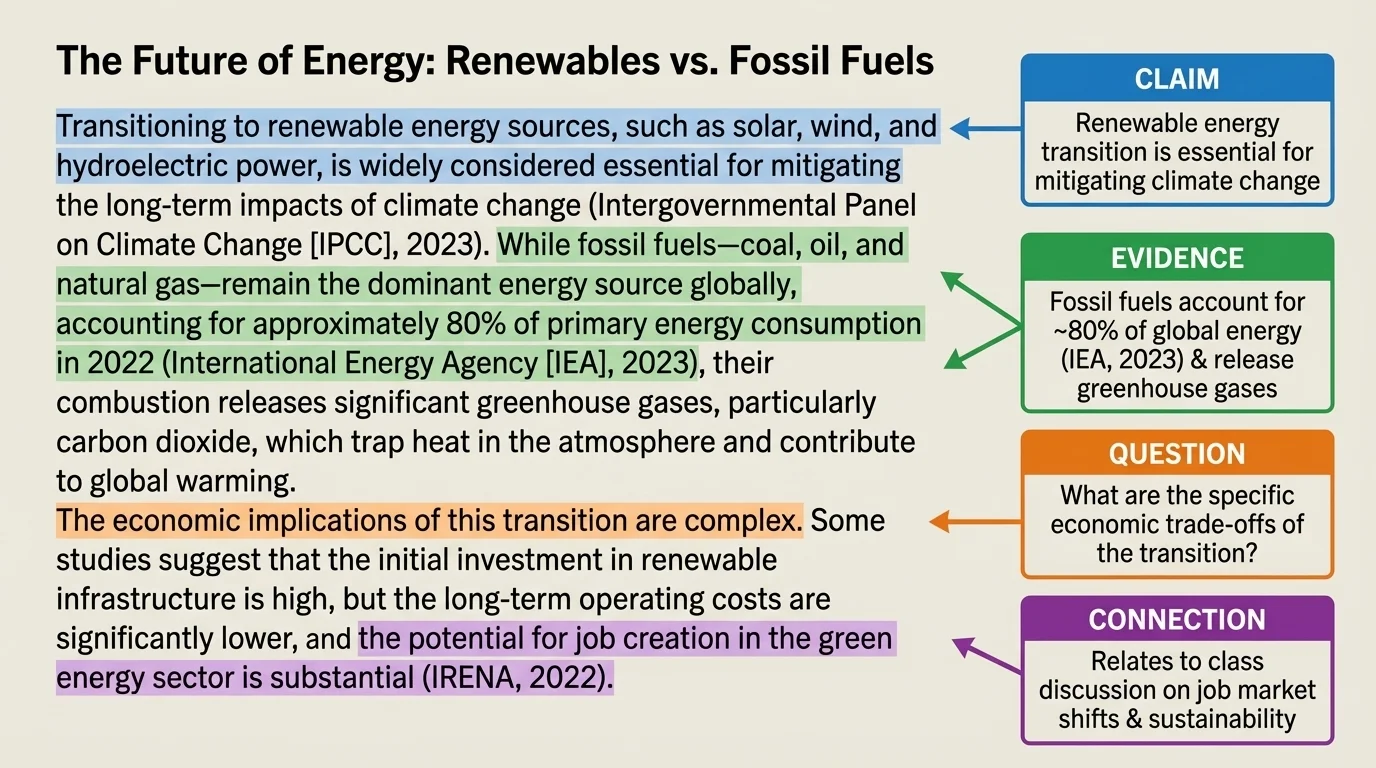
Preparation also includes understanding context. In literature, that might mean knowing the speaker, setting, tone, and conflict. In history, it might mean knowing when a document was written, who wrote it, and for what purpose. In science, it may involve understanding the method, variables, and limitations of a study. In every subject, context shapes interpretation.
Another part of being prepared is recognizing what you do not yet understand. Good notes include uncertainty. A question such as "Is the author describing correlation or causation here?" can become one of the most valuable contributions to a discussion because it invites deeper analysis.
Research on discussion-based classrooms consistently shows that students learn more deeply when they must explain and defend ideas with evidence rather than only recall facts. Explaining your thinking aloud helps you discover both strengths and gaps in your understanding.
Prepared students often have a few pieces of evidence ready before class begins. They may have marked a quotation, copied a statistic, or written down a comparison to another text. That does not mean memorizing a speech. It means carrying into the room enough material to think with.
Using textual evidence well is not just a matter of dropping in a quote. It is a process of selecting, introducing, explaining, and connecting support. The point of evidence is not to prove that you read; it is to help the group think more carefully about the issue.
[Figure 2] There are several ways to bring evidence into discussion. You can quote directly when exact wording matters. You can paraphrase when you want to restate an idea in your own words. You can summarize when you need to present the main point of a longer section. Each method is useful, but each must stay accurate to the source.
Suppose your class is discussing Ray Bradbury's Fahrenheit 451. A weak comment might be, "Books matter because they help people think." A stronger comment would be, "Bradbury suggests that books matter not only because they contain information but because they preserve complexity. When Faber says there is 'quality' in books, he means they hold the details and contradictions that fast entertainment leaves out." The second comment refers to a specific idea in the text and interprets it.
Outside research can strengthen discussion even more when it is relevant. If the class is discussing censorship in the novel, a student might connect Bradbury's ideas to a recent article about book bans or school library debates. That move broadens the discussion from literary analysis to a current issue while still grounding the comment in evidence.
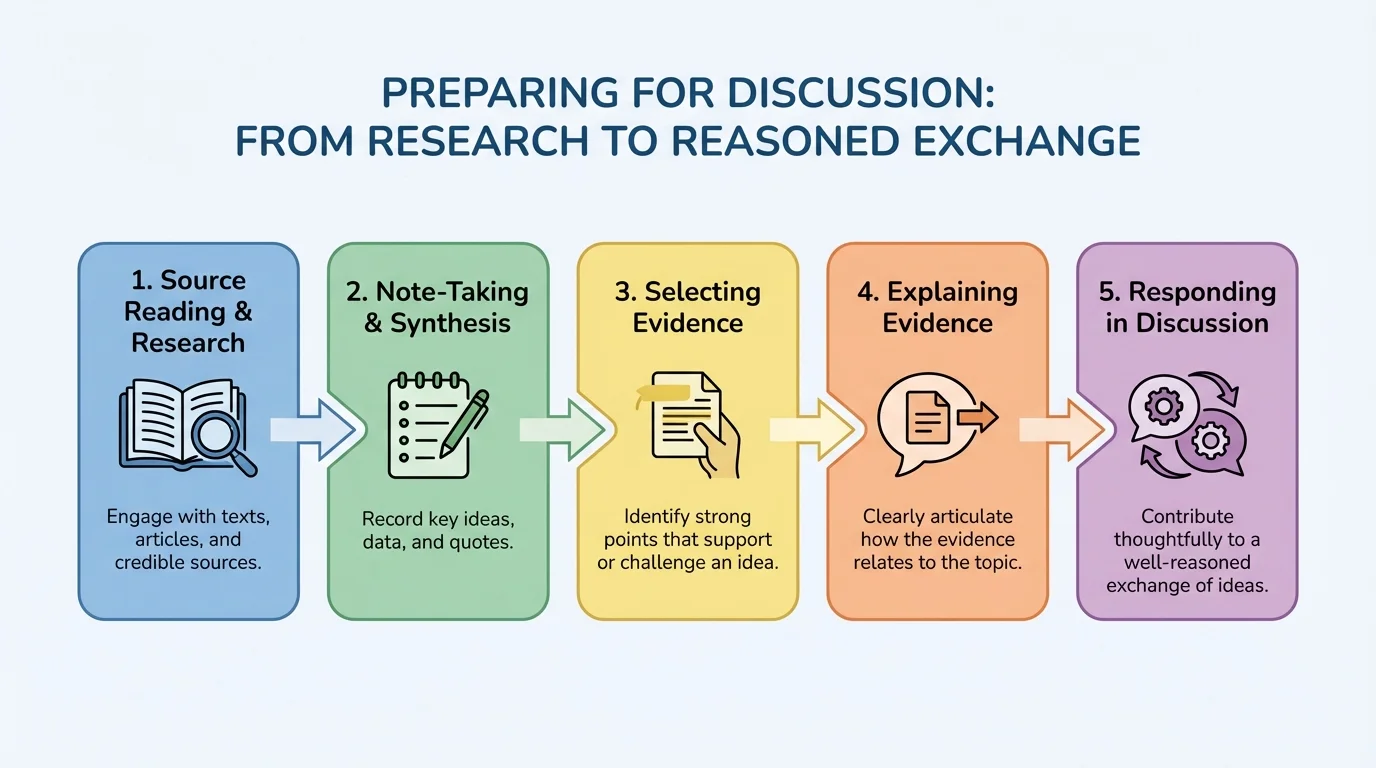
Effective evidence use often follows a simple pattern: state the idea, refer to the source, explain the significance, and connect it to the discussion. For example: "I agree that the speaker is trying to inspire action, but the speech also creates fear. In the second paragraph, the repeated warnings about national decline make the audience feel urgency, which supports the argument through emotion as well as logic."
This is where paraphrase and synthesis become powerful. Paraphrasing lets you present evidence clearly in your own words. Synthesis means combining ideas from multiple sources or speakers to create a deeper understanding. For instance, you might say that one historian emphasizes economic causes of a revolution while another stresses political exclusion, and together those sources show that no single cause fully explains the event.
As with the note categories in [Figure 1], the best evidence is not random. It is chosen because it answers a question, supports a claim, or complicates an oversimplified point. Prepared students know which evidence is worth bringing forward and why.
Example: Turning reading notes into a strong discussion comment
Topic: Should schools start later in the morning?
Step 1: Identify the claim
A source argues that later start times improve student health and learning.
Step 2: Select relevant evidence
The article cites sleep research showing that teenagers' natural sleep cycles often shift later, making very early wake-up times difficult.
Step 3: Add explanation
Instead of only repeating the fact, explain why it matters: if students are biologically less alert early in the morning, school schedules may work against effective learning.
Step 4: Connect to the wider discussion
A strong discussion comment might be: "The argument for later start times is stronger than just 'teens like more sleep.' The research suggests that adolescent sleep cycles naturally run later, so early schedules may reduce alertness and learning. That changes the issue from preference to biology and school policy."
Notice that the comment does more than insert a fact. It explains what the evidence means and why the group should care about it. That is the difference between mentioning evidence and using it.
A collaborative discussion is a collaborative discussion, not a set of mini-speeches placed next to one another. The exchange works best when students listen carefully, respond directly, and help the group explore multiple positions through the movement of ideas between speakers.
[Figure 3] This means your preparation serves two purposes. First, it gives you your own ideas. Second, it helps you react intelligently to others. You might agree and extend a point, disagree and offer counterevidence, ask for clarification, or connect two classmates' ideas that seemed separate at first.
Consider a discussion of whether civil disobedience is justified. One student refers to a historical speech arguing that unjust laws should be resisted. Another student points out that lawbreaking can create instability. A strong third response might be, "Both points matter. The historical text argues that legality and justice are not always the same, but the concern about instability suggests that the method of resistance also matters. Maybe the discussion is not whether resistance is acceptable at all, but under what conditions it becomes ethically justified."
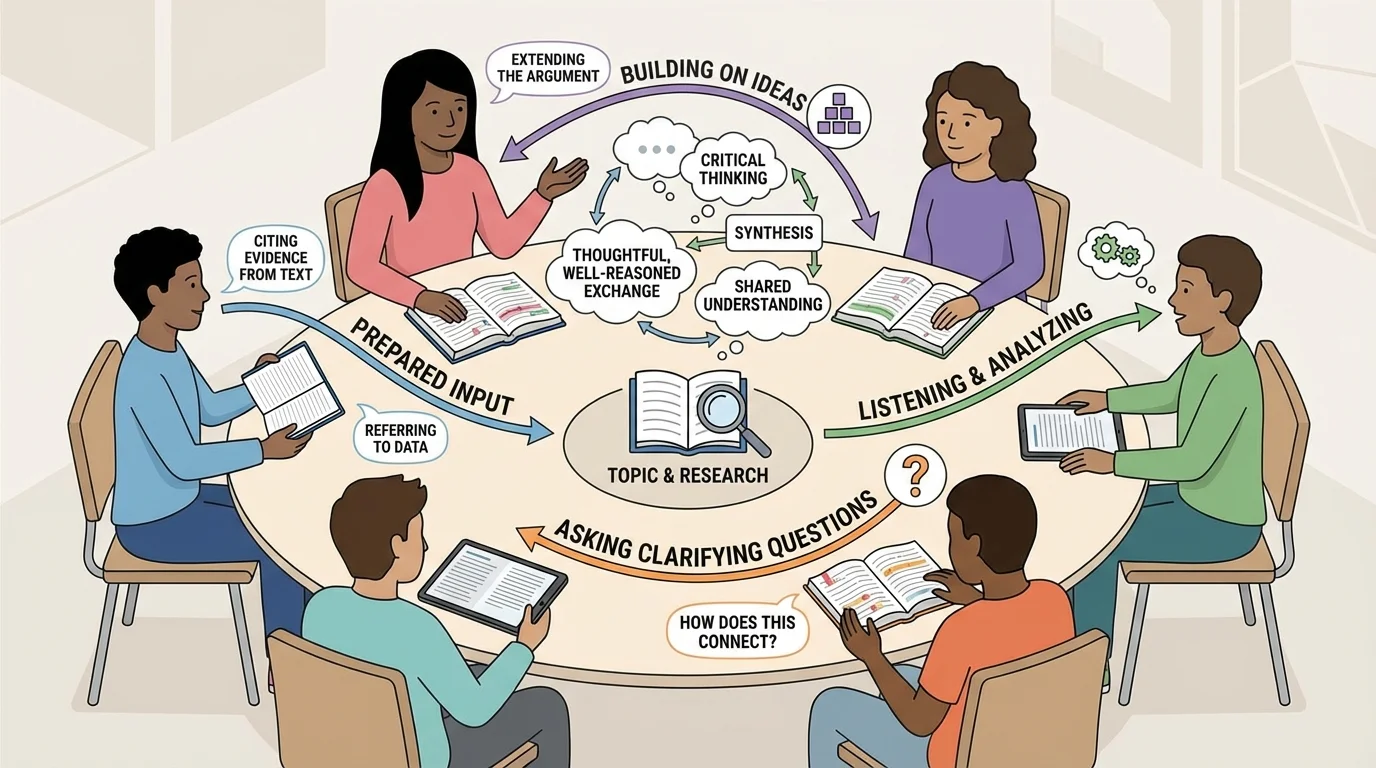
That response shows preparation because it draws on the text, listens to the group, and advances the conversation. It does not simply restate a personal opinion. It reframes the issue using evidence and reasoning.
Effective discussion also requires balance. If you speak often but never acknowledge others, you are not collaborating. If you listen quietly but never contribute, your preparation cannot help the group. Productive participation means entering the conversation at the right moments, keeping comments focused, and making space for other voices.
Discussion as shared thinking
In strong academic conversations, students do not treat discussion as performance. They treat it as a way to test and improve ideas. That means listening for reasoning, not just waiting to reply; asking questions that move the conversation forward; and adjusting your view when stronger evidence appears.
Later in a discussion, the pattern in [Figure 3] becomes even more important. A good conversation keeps circling through listening, evidence, response, and revision. The strongest students are often those who can change their minds responsibly because the discussion has revealed something they had not considered.
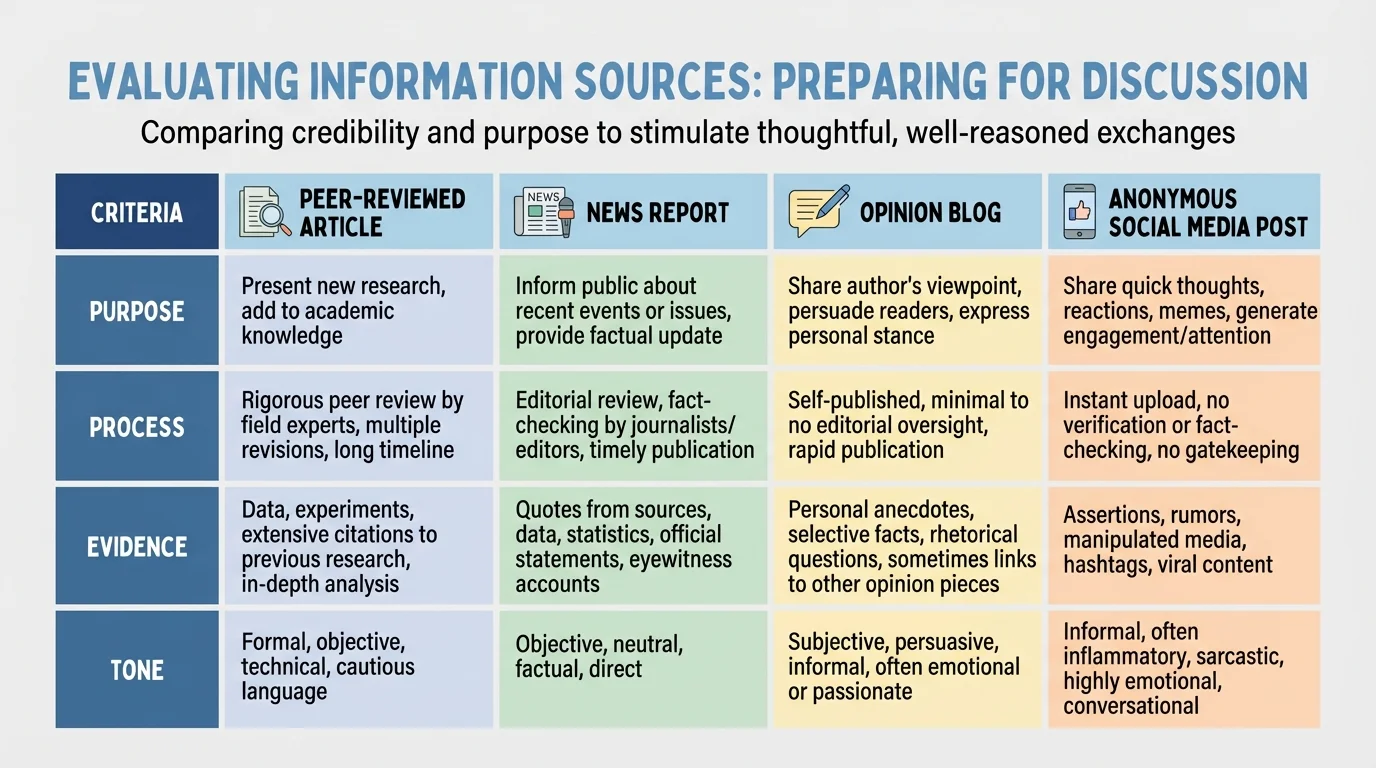
Preparation is not only about having sources. It is about having credible sources. Not all information deserves equal trust when different source types are compared by expertise, evidence, date, and bias. If you bring weak research into a discussion, your argument may sound confident but still lack reliability.
[Figure 4] To evaluate a source, ask several questions. Who is the author, and what qualifies them to speak on this topic? When was the source published, and is that date important? What evidence does the source provide? Is the purpose to inform, persuade, entertain, or provoke? What biases may shape the presentation? Bias does not automatically make a source useless, but it does mean you should read it carefully.
| Source Type | Strengths | Possible Limits |
|---|---|---|
| Peer-reviewed journal article | Expert authors, evidence-based, often detailed | Can be technical or narrow in focus |
| Major news report | Timely, professionally edited, often includes multiple perspectives | May simplify complex issues due to length |
| Opinion essay | Clear viewpoint, useful for analyzing argument and rhetoric | May rely on selective evidence |
| Anonymous social media post | Shows public reaction or popular opinion | Often lacks verification, context, and accountability |
Table 1. Comparison of common source types and their strengths and limitations in discussion.
If your class is discussing climate policy, for example, a government data report, a peer-reviewed scientific study, and a newspaper editorial all play different roles. The data report may establish measurable facts. The scientific study may explain mechanisms and findings. The editorial may reveal how arguments are framed for the public. A prepared student knows not only what each source says but also what kind of authority each source carries.
Evaluating positions also means recognizing the difference between a strong claim and a weak one. A strong claim is specific, debatable, and supportable with evidence. A weak claim is vague, absolute, or unsupported. Saying "Technology is bad" is too broad to discuss well. Saying "Heavy reliance on recommendation algorithms can narrow users' exposure to opposing viewpoints" is more precise and easier to test with evidence.
When you challenge a source or claim, do so with reasoning. Instead of saying, "That article is biased," explain how the bias appears and how it affects the argument. Instead of saying, "I disagree," explain which evidence is incomplete, misleading, or contradicted by another source. This keeps disagreement academic rather than personal.
Good academic disagreement focuses on ideas, evidence, and reasoning. It does not attack the speaker. Respectful challenges make discussions stronger because they test whether claims can stand up to scrutiny.
When you later refer back to source quality, the comparison in [Figure 4] remains useful. It reminds you that "I found this online" is not enough. Prepared discussants know where information comes from and how much weight it deserves.
Prepared students often sound different because they use language that reveals careful reading and thoughtful listening. Their comments tend to be specific, connected, and purposeful. They refer to texts and research directly, but they also guide the group toward analysis.
Some useful discussion moves include: "The author's main claim seems to be..."; "A detail that supports that idea is..."; "I want to build on what you said by adding..."; "Another source complicates that point because..."; "Can we go back to the evidence in paragraph...?"; and "What changes if we consider the issue from another perspective?" These sentence patterns are not scripts to memorize mechanically. They are tools for making evidence-based thinking visible.
Different settings call for slightly different forms of preparation. In a one-on-one discussion, you may need to respond quickly and deeply to a single partner. In a small group, you may need to track several viewpoints and help organize the conversation. In a teacher-led discussion, you may need to connect class materials to a question that evolves in real time. In all cases, preparation gives you the flexibility to adapt.
Example: Stronger and weaker responses in discussion
Topic: Is protest art effective?
Weaker response: "Yes, because art is powerful."
This is too general. It gives no evidence, no text reference, and no explanation.
Stronger response: "The article on mural movements argues that protest art becomes effective when it is both visible and connected to community action. That helps explain why some images spread widely but do not lead to change, while others become symbols within larger movements."
This response identifies a source, presents an idea accurately, and explains why it matters.
Notice that the stronger response is not longer just for the sake of being longer. It is more useful because it is anchored in material under study and invites further discussion.
One common mistake is relying on vague references such as "the text says" or "research shows" without explaining which text, what research, or what part matters. Specificity makes your contribution clearer and more persuasive.
Another mistake is using evidence inaccurately. A quotation taken out of context can distort an author's point. A statistic without explanation can be misleading. Preparation should help you avoid these errors by making you slow down and understand what the source is actually saying.
A third mistake is treating discussion as competition. Students sometimes interrupt, dominate, or argue only to win. But academic discussion is not strongest when one voice overpowers the rest. It is strongest when a full range of positions is heard and examined carefully. That requires patience, attention, and willingness to let ideas develop.
Some students make the opposite mistake: they under-participate because they worry their ideas are not perfect. Preparation helps here too. If you have read closely and gathered evidence, you already have something valuable to contribute. A question, a clarification, or a connection between sources can be just as important as a fully formed argument.
"The test of a first-rate intelligence is the ability to hold two opposing ideas in mind at the same time and still retain the ability to function."
— F. Scott Fitzgerald
That idea fits discussion well. Prepared students can hold multiple possibilities in mind because they are working from evidence, not just instinct. They can consider opposing interpretations without feeling threatened by them.
In literature, preparation may mean tracking themes, symbols, characterization, and key passages. In history, it may mean comparing primary and secondary sources, noting point of view, and identifying cause and effect. In science, it may involve understanding claims, methods, data, and limitations. In social studies or current events discussions, it may mean combining class texts with credible, up-to-date research.
For example, in a history discussion about the causes of World War I, a prepared student might compare alliance systems, nationalism, militarism, and imperial competition rather than insisting on a single cause. In a science discussion about gene editing, a prepared student might refer both to the scientific possibilities and to ethical concerns raised by policy or philosophy sources. In an English discussion about a poem, a prepared student may connect word choice, structure, and tone to a larger interpretation rather than commenting only on personal reaction.
The pattern stays the same across subjects: read carefully, research thoughtfully, select evidence, listen actively, and contribute in ways that deepen collective understanding. The exact content changes, but the intellectual habits remain constant.
Students who consistently contribute well in discussion tend to develop a few dependable habits. They annotate or take notes while reading. They identify a few passages or facts worth raising. They write down one or two questions before discussion begins. They review previous class notes so they can connect old ideas to new ones. And they remain open to revising their thinking as the discussion unfolds.
These habits matter because preparation is not a one-time act. It is a routine. Over time, the routine makes discussion less stressful and more interesting. You stop scrambling for something to say and begin entering conversations with genuine insight.
At the highest level, being prepared means more than protecting your own grade or performance. It means helping create a classroom culture in which ideas are taken seriously. When students arrive ready to use evidence, respond carefully, and consider multiple viewpoints, discussion becomes one of the most powerful ways to learn.
