People argue every day about school policies, social media, public health, sports, and technology. But the strongest arguments are not the loudest ones. They are the ones built on a clear idea, careful reasoning, and solid evidence. In academic writing, that begins with a strong claim. A weak argument says, "Phones are bad." A strong one says exactly what policy should change, why it matters, and how evidence supports it.
An argument is not just a collection of feelings. It is a structured attempt to convince a reader that a position is reasonable. At the center of that effort is a claim: the main position the writer wants the reader to accept. A good claim gives the essay direction. Without it, even strong evidence can feel scattered.
In argument writing, your job is not only to state what you believe. You must show that your position is informed, important, and stronger than competing ideas. That means your claim should be specific enough to defend, significant enough to matter, and debatable enough to invite discussion.
Claim is the central assertion a writer argues for. Counterclaim is an opposing viewpoint that challenges the main claim. Rebuttal is the writer's response to that opposing viewpoint, using reasoning and evidence to show why the original claim still stands.
A claim is different from a fact. A fact can be verified directly, such as the date a law passed or the number of hours in a school day. A claim goes beyond simple reporting. It interprets information, proposes a judgment, or recommends action. It must be supported.
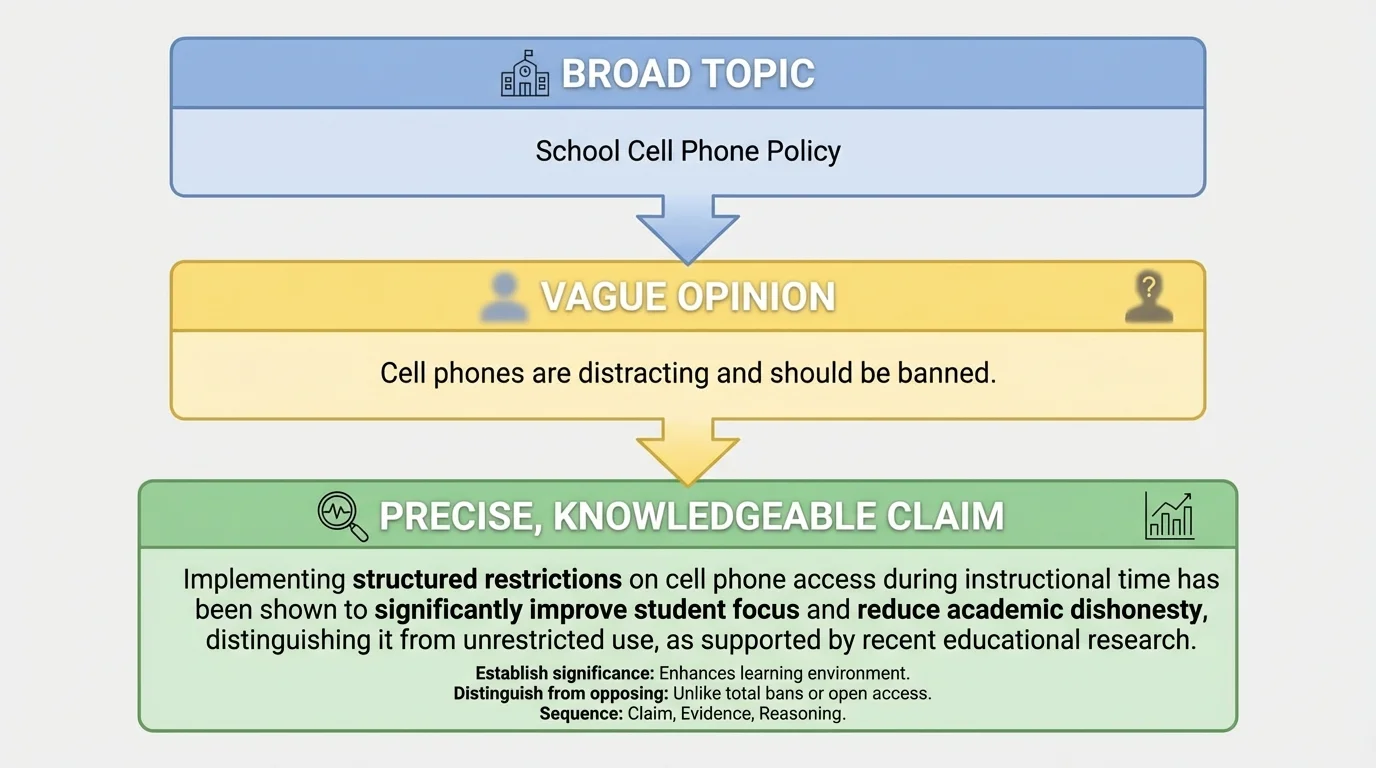
A strong academic argument often begins by narrowing a broad issue into a defensible position, as [Figure 1] shows with the shift from a general topic to a specific claim. Students often confuse a topic, an opinion, and a claim, but they are not the same thing.
A topic is broad: the use of cell phones in schools. An opinion is personal but underdeveloped: cell phones should not be allowed. A precise, knowledgeable claim is specific and informed: high schools should allow teachers to permit limited cell phone use during research-based class activities because controlled access can increase efficiency without weakening classroom management.
Notice what makes that final version stronger. It identifies the setting, the action, and the reason. It avoids vague language. It also sounds informed rather than impulsive. A well-informed claim suggests that the writer understands the issue well enough to make a careful judgment.
Precision matters because vague claims are hard to prove. If a writer says, "Social media is harmful," the reader may ask: harmful to whom, in what way, under what conditions, and compared with what? A more precise claim might say that excessive social media use among teenagers can worsen sleep quality and concentration when use continues late into the night. That version gives the writer a clearer path for evidence.
Knowledgeable claims also avoid exaggeration. Absolute words such as always, never, and everyone can weaken credibility unless the evidence truly supports them. Strong writers choose language that is confident but accurate, such as often, in many cases, tends to, or is more likely to when appropriate.
Another mark of a strong claim is that it is arguable. If nobody could reasonably disagree, then the statement is not functioning as an argument. For example, "Students attend school" is factual, not arguable. But "Schools should begin later in the morning to improve student learning and health" is arguable because reasonable people may disagree about cost, transportation, scheduling, and benefits.
Comparing weak and strong claims
Step 1: Weak claim
"Homework is bad."
Step 2: Why it is weak
The wording is too broad, too emotional, and too unclear. It does not explain what kind of homework, for which students, or why it is harmful.
Step 3: Stronger claim
"High school teachers should limit nightly homework in non-advanced classes because excessive assignments can reduce sleep and lower the quality of student learning."
The stronger version is specific, debatable, and ready for evidence.
A claim should not only be clear; it should also seem worth the reader's attention. This is what it means to establish significance. A reader may understand your position and still wonder, "Why does this matter?" Strong writers answer that question early.
Significance can be established in several ways. You can show that the issue affects many people, influences important decisions, raises ethical concerns, changes future outcomes, or reveals something important about a text or historical event. The best choice depends on your topic and audience.
For example, if you are arguing that schools should start later, significance might come from the connection to teen sleep, mental health, and academic performance. If you are analyzing a novel, significance may come from showing how a character's choices reveal larger themes such as power, justice, or identity. In each case, the writer moves beyond "I think this" to "This matters because..."
How writers establish significance
Writers make a claim significant by connecting it to broader consequences, values, or patterns. A strong argument shows what changes if the claim is accepted, what is misunderstood if the claim is ignored, or what larger issue the claim helps explain.
Significance is especially important when the topic seems familiar. Many readers have heard arguments about testing, uniforms, climate policy, or social media before. To hold attention, the writer must show what is at stake. A useful question is: What larger problem, principle, or consequence is connected to this claim?
When writing about literature or other texts, significance often comes from interpretation. A claim such as "The protagonist is brave" may be too simple. But a more meaningful claim might argue that the protagonist's public bravery hides private fear, which reveals the text's deeper message about courage and vulnerability. That version matters because it adds insight.
Serious argument writing does not pretend that only one side exists. It recognizes other views and responds to them fairly. This is where counterclaim becomes essential. A counterclaim is not an enemy to mock. It is a real position that deserves accurate representation.
To distinguish your claim from an opposing one, begin by stating your own position clearly. Then identify the main alternative. For example, if your claim is that schools should begin later, an opposing claim might be that earlier schedules better match transportation systems, athletic programs, or parents' work hours. Presenting that alternate claim honestly makes your writing more credible.
The goal is not simply to say "Some people disagree." Instead, explain how they disagree and on what reasoning they rely. This lets the reader compare the claims directly. In strong writing, the difference between positions becomes easy to see.
Fairness matters. If you misrepresent the opposing side to make it sound foolish, you create a straw man, a weak or distorted version of the other side that is easy to knock down. That may feel persuasive at first, but careful readers notice the unfairness. Academic argument requires intellectual honesty.
Once you have presented the counterclaim, you respond with a rebuttal. A rebuttal does not ignore the strongest objection. It answers it. Sometimes the best rebuttal concedes part of the opposing view before showing why your claim is still more convincing. For example: transportation changes may create difficulties, but those difficulties can be managed, while the health costs of chronic sleep deprivation are harder to justify.
Legal arguments, scientific debates, and public policy writing all depend on this skill. Professionals are often judged not by whether they mention opposing views, but by how accurately and effectively they address the strongest one.
Distinguishing your claim from alternate claims also helps sharpen your own thinking. When you understand the other side, you are less likely to rely on oversimplified reasoning. You become more precise about what exactly you support and why.
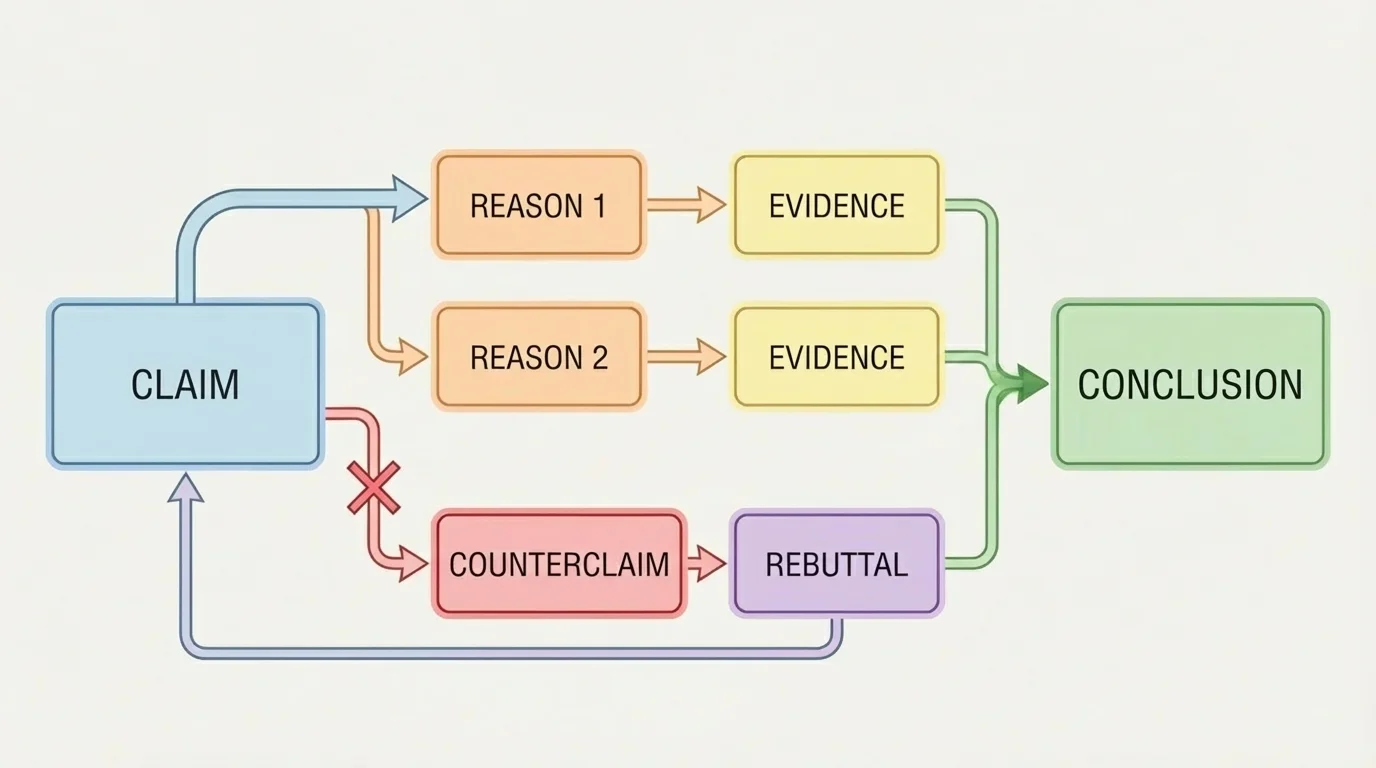
A strong argument does not just contain good parts; it puts those parts in the right order. Logical organization helps readers follow the movement of thought, and [Figure 2] presents the basic flow that many effective arguments use. Even a strong claim can lose impact if evidence appears randomly or if the counterclaim interrupts the paper at the wrong moment.
Most arguments begin with an introduction that presents the issue, gives needed context, and states the claim. After that, body paragraphs usually develop the reasons supporting the claim. Each reason should be connected to evidence. Then the essay addresses one or more counterclaims and offers rebuttals. Finally, the conclusion reinforces the significance of the argument rather than merely repeating earlier sentences.
One useful pattern is this sequence: claim, reason, evidence, explanation, next reason, evidence, explanation, counterclaim, rebuttal, conclusion. The exact order can vary, but the logic should be easy to follow. Readers should never have to guess why a quotation, statistic, or example appears in a paragraph.
Paragraph-level organization matters too. A body paragraph often begins with a topic sentence that connects directly to the claim. Then it introduces evidence, explains how that evidence supports the reason, and links back to the larger argument. The explanation is crucial. Evidence alone does not argue; the writer argues by interpreting it.
Writers sometimes place the counterclaim near the end because it allows the essay to establish the main case first. In other situations, especially when an objection is obvious and important, addressing it earlier can build trust. The best placement depends on strategy and audience.
Transitions make organization visible. Words and phrases such as for example, in contrast, however, because, therefore, and despite this show relationships among ideas. These are not decorative. They help readers track whether you are adding support, shifting to another perspective, or answering an objection.
| Part of Argument | Purpose | Questions It Answers |
|---|---|---|
| Claim | States the position | What am I arguing? |
| Reason | Explains why the claim is valid | Why should the reader believe it? |
| Evidence | Supports the reason with facts, examples, or sources | What proof do I have? |
| Counterclaim | Presents a competing view | What would a thoughtful opponent say? |
| Rebuttal | Responds to the competing view | Why is my claim still stronger? |
| Conclusion | Shows importance and final insight | Why does this argument matter? |
Table 1. The main parts of an argument and the role each one plays in helping readers follow the writer's reasoning.
Effective argument depends on evidence that is both relevant and sufficient. Relevant evidence directly connects to the claim. Sufficient evidence is enough to make the case convincing. One example may begin the discussion, but a serious argument often needs multiple forms of support.
Writers can use facts, statistics, expert testimony, historical examples, observations, and quotations from texts. In literary analysis, evidence often comes from details in the text itself: language, imagery, characterization, structure, and dialogue. In social or scientific topics, evidence may come from studies, reports, or credible journalism.
Not all evidence has equal value. A random online comment is not as strong as a peer-reviewed study or a government report. A single anecdote may be vivid, but it cannot automatically prove a broad trend. Strong writers evaluate sources by asking who created them, how current they are, whether they have expertise, and whether the information can be verified.
Reasoning links evidence to the claim. Even strong evidence will not persuade unless the writer explains how the proof supports the point being made. The sentence after a quotation or statistic is often where the real argument happens.
Reasoning should be valid, which means the support actually leads to the conclusion. If the logic is weak, the argument may contain a fallacy. Common fallacies include hasty generalization, false cause, circular reasoning, and straw man arguments. Learning to spot these makes your writing stronger and your reading sharper.
For example, if one student cheats using a phone, it does not logically follow that all phones should always be banned in every context. That would be a hasty generalization. A stronger argument would ask whether repeated evidence shows a broader pattern and whether a targeted policy would address the actual problem.
Evidence, explanation, and reasoning in one paragraph
Claim: High schools should begin later in the morning.
Step 1: Reason
Teenagers often struggle to get enough sleep because their sleep cycles shift later during adolescence.
Step 2: Evidence
A study from a major medical organization reports that many adolescents do not meet recommended sleep levels on school nights.
Step 3: Explanation
This evidence matters because it shows the problem is not simply poor self-control by a few students. It suggests a broader pattern that school scheduling can either worsen or reduce.
Step 4: Link to claim
If school systems know that early schedules conflict with adolescent sleep patterns, then later start times become a reasonable policy response rather than a convenience.
Arguments are written for readers, not for empty space. That means the writer must think about audience. Different audiences care about different values. Some prioritize efficiency; others prioritize fairness, safety, cost, freedom, or tradition. Strong writers consider these values when shaping claims and choosing evidence.
An argument for students may emphasize daily experience and learning conditions. An argument for school board members may need stronger attention to budgets, transportation, and policy outcomes. The claim may stay similar, but the presentation changes.
Writers should also recognize bias, both in sources and in themselves. Bias is a tendency to favor one side, interpretation, or set of assumptions. Bias does not always mean dishonesty, but it can affect what evidence someone notices or trusts. Careful writers test their own assumptions instead of simply searching for proof that confirms what they already believe.
Addressing audience values does not mean manipulating readers. It means understanding what concerns they will likely bring to the issue. If an audience worries about cost, you should address cost directly. If an audience values fairness, you should explain how your claim supports fair treatment. This is one reason the counterclaim section is so important: it shows respect for the reader's possible doubts.
As we saw earlier in [Figure 2], organization helps here as well. When a writer places the counterclaim and rebuttal strategically, the essay can answer the audience's most likely concerns before they become reasons for rejection.
A full essay works best when each part has a clear role, and [Figure 3] lays out that blueprint by showing where the claim, body reasons, counterclaim, and conclusion fit together. Seeing the whole structure helps writers avoid repetition and imbalance.
Consider an essay arguing that schools should teach media literacy as a required course. The introduction might begin with the spread of misinformation online and then present the claim that media literacy deserves required status because students must learn to evaluate digital sources, identify manipulation, and participate responsibly in civic life.
The first body paragraph could focus on source evaluation. Its reason would be that students encounter massive quantities of information each day. The evidence might include examples of misleading headlines, altered images, or unreliable sources spreading quickly online. The explanation would show why knowing how to verify information is now a basic academic and civic skill.
The second body paragraph could focus on persuasion and manipulation. It might analyze algorithms, emotional appeals, or targeted content. Here, the significance expands: the claim is not only about classroom instruction but also about democracy, public trust, and informed decision-making.
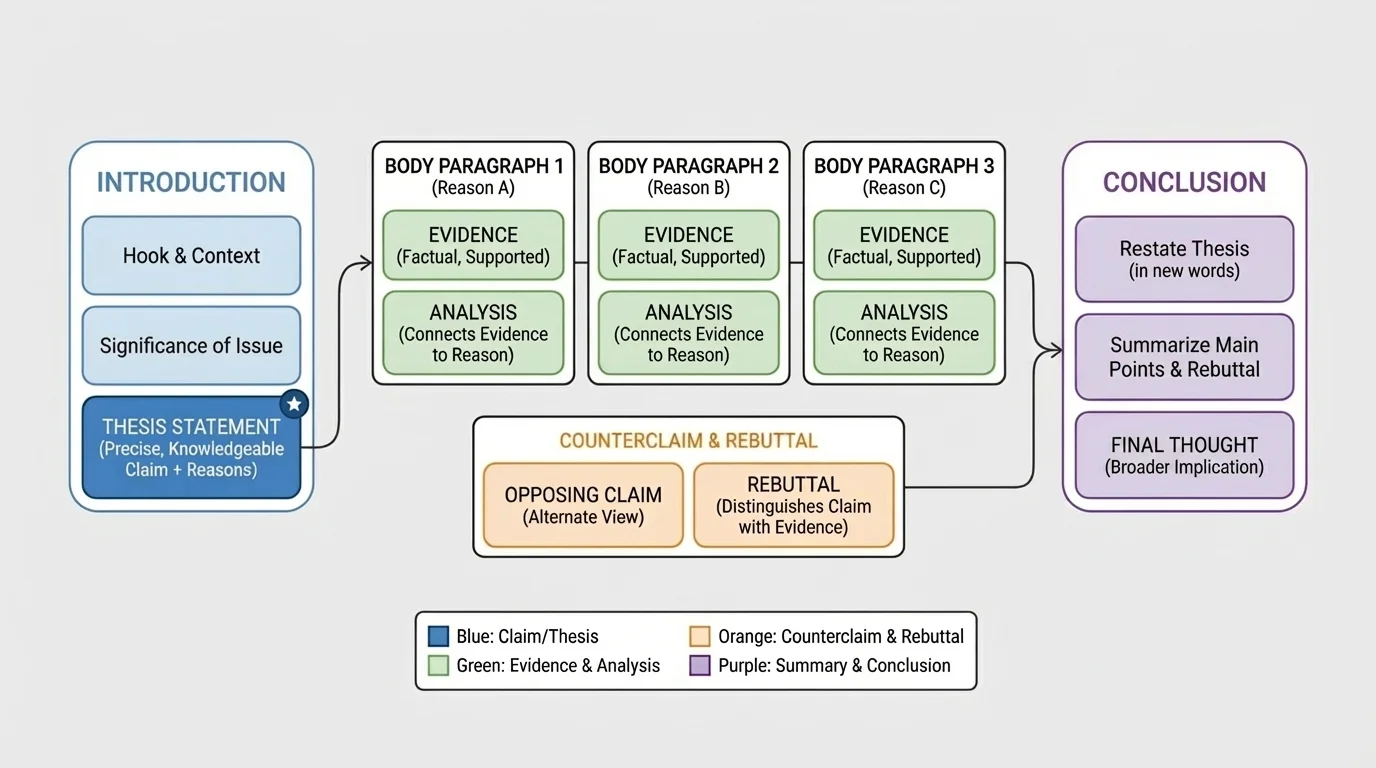
A counterclaim paragraph might argue that schools already have too many graduation requirements and that media literacy should be folded into existing English or history courses. That is a reasonable concern. The rebuttal could concede that course schedules are crowded, then argue that the scale of digital misinformation is large enough to justify dedicated study rather than occasional mention.
The conclusion would not merely restate the claim word for word. Instead, it would return to the larger significance: students who cannot evaluate information are vulnerable not only as learners, but also as citizens. That gives the argument weight.
"The aim of argument, or of discussion, should not be victory, but progress."
— Joseph Joubert
[Figure 1] remains useful here because the final essay depends on the original move from broad topic to precise claim. "Media and the internet" is not enough. The paper succeeds only when the writer takes a defensible position on what schools should do and why.
Likewise, the sequence shown in [Figure 3] reminds writers that body paragraphs should not all perform the same job. Some develop reasons, one may answer objections, and the ending should widen the lens to significance.
One common mistake is writing a claim that is too broad. If your argument could apply to nearly everything, it probably needs narrowing. Another mistake is writing a claim that is merely personal preference, such as "I like online learning better." Revision can turn preference into argument: "Schools should maintain some online course options because they expand access for students with scheduling, medical, or transportation challenges."
A second problem is evidence without explanation. Students sometimes insert quotations or statistics and assume the proof speaks for itself. But readers need to know why that evidence matters. After each piece of support, ask: What does this show, and how does it advance my claim?
A third mistake is treating the counterclaim too briefly or too unfairly. If the opposing side is obviously important, ignoring it makes the essay seem weak. If you distort it, the essay seems dishonest. Strong revision often means strengthening the counterclaim paragraph before strengthening the rebuttal.
Another issue is poor sequence. If the essay introduces a counterclaim before readers understand the main claim, confusion can result. If the conclusion adds a brand-new reason, readers may feel the essay is unfinished. Logical order helps each part build on the one before it.
Revision example
Original claim: "School uniforms are good."
Step 1: Add specificity
"Middle and high schools should allow uniform policies..."
Step 2: Add reasoning
"...because they can reduce visible economic differences among students..."
Step 3: Add a limit or qualification
"...as long as the policies include affordable options and respect students' religious and cultural needs."
Revised claim: "Middle and high schools may adopt uniform policies because they can reduce visible economic differences among students, as long as the policies remain affordable and respectful of religious and cultural needs."
Strong arguments are built through revision. Writers often discover the best version of a claim after testing evidence, considering objections, and reorganizing paragraphs. That is not failure. It is the real work of argument.
