A well-researched piece of writing can still fail if the reader feels lost halfway through. This occurs more often than many writers expect. Strong evidence and insightful analysis are not enough by themselves; readers also need guidance. In informative and explanatory writing, transitions provide that guidance. They help a reader move from one idea to the next without confusion, especially when the subject is layered, technical, or abstract.
When you write about a complex topic, you are not just placing information on a page. You are leading a reader through a sequence of ideas. A transition is a word, phrase, sentence, or structural move that shows how one part of a text connects to another. Some transitions are short, such as however, therefore, or for example. Others are longer and more subtle, such as a sentence that repeats a key term from the previous paragraph and then redirects the discussion.
The larger purpose of transitions is cohesion, which is the sense that a text holds together as a unified whole rather than a pile of separate statements. In academic writing, cohesion matters because readers must understand not only individual facts but also the relationships among them. If one section explains a problem and the next section presents a solution, the shift should be clear. If one paragraph introduces a theory and the next one limits or complicates that theory, the transition should make that change visible.
Transitions are signals that connect ideas, sentences, paragraphs, and sections of a text. Cohesion is the overall connectedness that helps writing feel unified and logical. Relationship among ideas refers to the specific way concepts connect, such as sequence, comparison, contrast, cause and effect, or qualification.
Transitions are especially important in explanatory writing because such writing often deals with ideas that cannot be physically seen. A reader cannot automatically tell whether your next paragraph is adding evidence, presenting an exception, shifting from background to analysis, or moving from a local example to a global one. The writer has to signal that movement clearly.
[Figure 1] At the level of major sections, transitions work like signposts. They tell the reader whether the discussion is continuing in the same direction or turning toward something new. A reader needs signals that indicate whether a new section adds to a point, contrasts with it, explains its cause, shows its result, or qualifies it with a limitation. Without those signals, even accurate writing can feel abrupt.
One common relationship is sequence. A writer may move from background to current conditions, from one step in a process to the next, or from short-term effects to long-term effects. Transitions such as first, next, afterward, meanwhile, and finally help readers follow order. In a paper about vaccine development, for instance, a writer might move from laboratory research to clinical trials to public distribution. Each section should announce its place in the process.
Another major relationship is contrast. Writers use contrast when they show how two theories differ, how one period changed from another, or how an expected outcome differs from the actual result. Transitions like however, in contrast, on the other hand, and nevertheless help readers understand that the text is not simply continuing but changing direction.
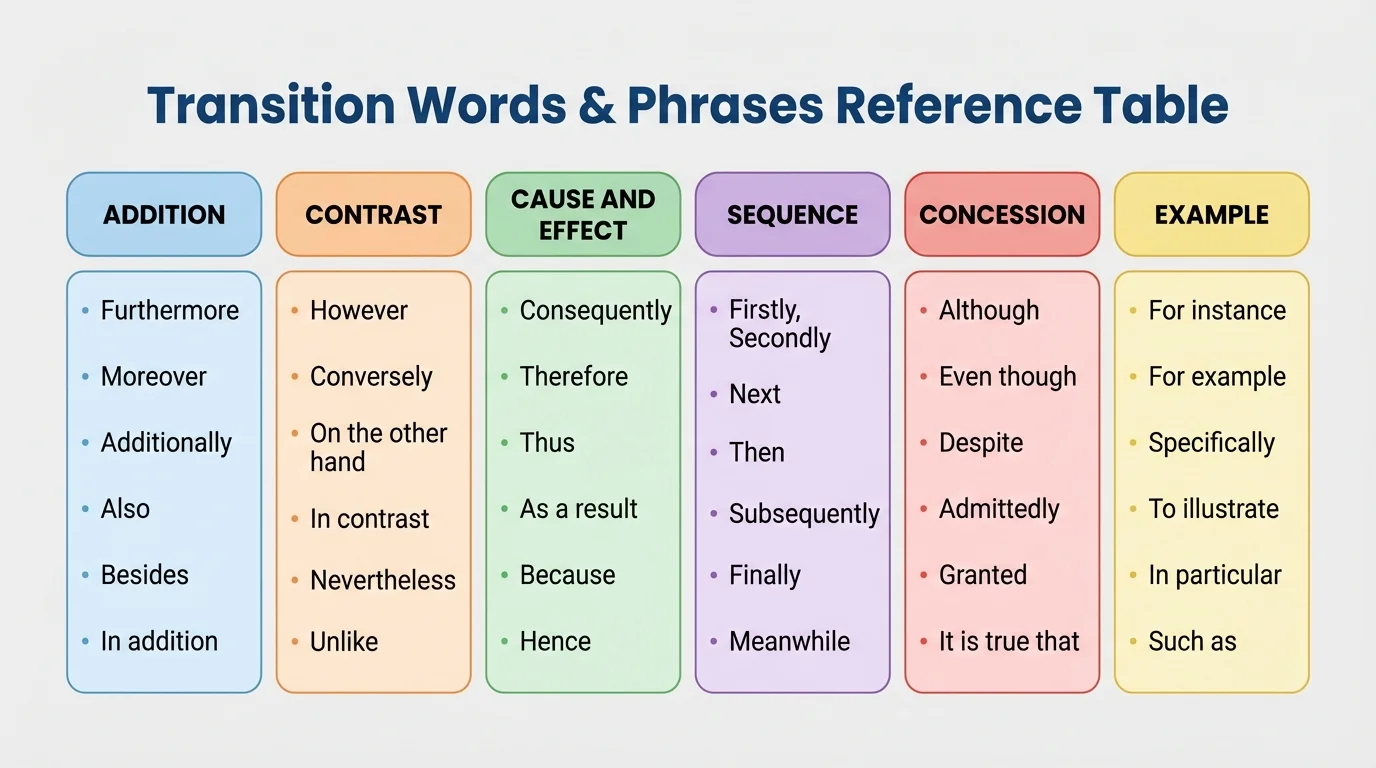
Another common relationship is cause and effect. In a text about climate migration, one section might explain rising sea levels, while the next section discusses population displacement. A transition such as as a result or because of this shift tells the reader that the second idea grows out of the first. Similarly, explanatory writing often moves into examples through transitions like for instance or to illustrate.
Some of the most powerful transitions signal qualification. Qualification means that the writer is narrowing, limiting, or complicating a claim. Instead of saying, "This technology solves the problem," a careful writer may say, "Although the technology improves efficiency, it remains expensive in rural areas." This type of transition is essential in serious academic writing because complex subjects rarely fit into simple either-or categories.
Many students think transitions are just single words placed at the beginning of sentences. That is only one form. Effective transitions operate at several levels.
Word and phrase transitions are the most familiar. Examples include similarly, therefore, for example, by contrast, in addition, and as a result. These are useful when the relationship is straightforward and needs to be stated directly.
Sentence transitions are longer. A writer may end one paragraph by naming a problem and begin the next with a sentence such as, "This financial pressure becomes even more serious in low-income communities." That opening sentence connects backward through the phrase this financial pressure and forward by introducing the next area of discussion.
Structural transitions connect major sections through repeated concepts, parallel phrasing, or deliberate organization. For example, a writer examining social media and mental health might organize a paper into three sections: effects on attention, effects on sleep, and effects on self-image. The repeated phrase effects on creates a consistent framework, which itself acts as a transition pattern.
Transitions are not decorations. They do not merely make writing sound formal. Their real job is to reveal logic. If the reader can easily answer the question "How does this new section relate to the one before it?" then the transitions are doing their work.
Writers also create cohesion by repeating key terms carefully. Suppose a paragraph ends with a discussion of renewable energy storage. The next paragraph might begin, "This storage challenge has pushed researchers toward new battery designs." The repeated term storage links the paragraphs, while the new phrase new battery designs advances the discussion. This is smoother than dropping in a random transition word that does not match the actual idea.
The most important rule is simple: choose the transition that matches the real relationship between ideas. Weak writers often use broad connectors such as also or another thing even when the relationship is more precise. Strong writers identify exactly what is happening.
If the second section adds similar information, use an addition transition: furthermore, in addition, also. If it presents an example, use an example transition: for instance, specifically, to illustrate. If it changes direction, use contrast: however, by contrast, despite this. If it leads to a consequence, use cause-and-effect language: therefore, consequently, as a result.
Accuracy matters. Consider these two versions:
Weak: "Solar power use has increased in many cities. Also, installation costs remain high for some homeowners."
Stronger: "Solar power use has increased in many cities. However, installation costs remain high for some homeowners."
The first version suggests simple addition, but the real relationship is tension between progress and limitation. The second version identifies that more clearly.
Example: matching transition to purpose
Original idea pair: A city expanded public transit. Car traffic in the downtown area decreased.
Step 1: Identify the relationship.
The second statement is an outcome of the first, so the relationship is cause and effect.
Step 2: Choose a transition that signals result.
Good options include as a result, therefore, or consequently.
Step 3: Write the connection clearly.
"The city expanded public transit. As a result, car traffic in the downtown area decreased."
The transition works because it tells the reader exactly how the second idea grows from the first.
Matching transitions to relationships becomes even more important when ideas are abstract. If one section discusses the theory behind artificial intelligence and the next section discusses its ethical risks, the shift may involve both continuation and complication. A transition like Yet these advances raise serious ethical questions is more accurate than a simple next.
[Figure 2] Strong texts do not just move forward; they connect backward and forward at the same time. Effective writers often end one paragraph by preparing the reader for what comes next, then begin the next paragraph with a sentence that picks up that thread. This creates a bridge instead of a jump.
One useful strategy is the topic sentence. A topic sentence does more than introduce a paragraph's main point. It can also connect the paragraph to the previous section. For example, after a paragraph explaining the economic benefits of tourism, the next paragraph might begin, "These economic gains, however, often come with environmental costs." The phrase these economic gains points backward, while environmental costs opens the new section.
Another strategy is the transition sentence at the end of a paragraph. Suppose a paper is explaining the causes of food insecurity and is about to shift into possible solutions. The final sentence of the causes section might say, "Understanding these structural causes is essential before any policy response can succeed." That sentence closes one idea while preparing the next. The move feels intentional rather than sudden.
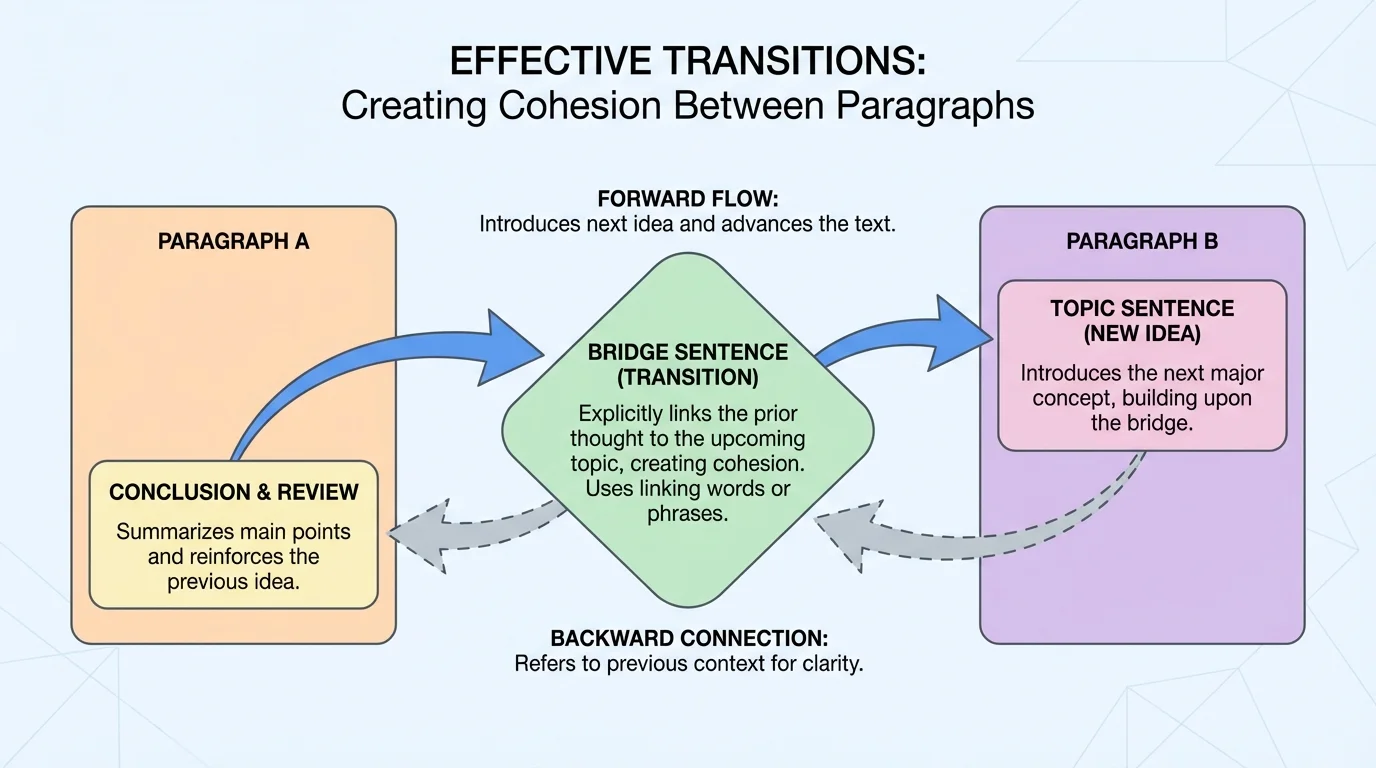
Section openings need the same care. When a new section begins, the first paragraph should not sound as if it belongs to a completely different essay. If the previous section examined the spread of misinformation online, the next section might open with, "Because misinformation travels quickly through digital networks, educators have begun focusing on media literacy." The phrase because misinformation travels quickly links the old topic to the new one.
This kind of bridging is especially valuable in long essays, research reports, and articles with several major ideas. Readers may not remember every detail from several paragraphs back. Good transitions refresh what matters and then move the discussion ahead. The same principle applies beyond the paragraph level: section-to-section writing also depends on handoff and continuation.
Informative and explanatory texts often deal with complexity in at least three ways: they present multiple causes, compare multiple perspectives, or explain ideas at different scales. Transitions make those layered relationships readable.
In science writing, a writer may move from a process to its implications. For example, a text might explain how greenhouse gases trap heat and then shift to effects on weather patterns. A transition such as this process has significant consequences helps the reader understand that the second section is not separate but connected to the first.
In history writing, a writer may move from events to interpretation. A paragraph may describe industrial growth in the late nineteenth century, while the next analyzes labor conditions. A transition like behind this economic expansion, however, lay difficult working conditions signals that the new section complicates the earlier one rather than abandoning it.
In policy writing, transitions often manage multiple viewpoints. A section may present the advantages of facial recognition technology in public safety, and the next may address privacy concerns. Here, a concession transition such as although supporters emphasize security benefits, critics warn about surveillance and bias allows both sides to exist in the same logical frame.
Professional writers in journalism, law, and science often spend more revision time on paragraph openings and closings than on body sentences because those points control how readers interpret the structure of the whole piece.
Even literary analysis uses explanatory transitions. A student writing about a novel might move from character behavior to theme, or from imagery to social context. The transition should show whether the second idea explains, deepens, or challenges the first. For instance, "This recurring image of winter does more than set mood; it also reflects the character's emotional isolation." That sentence moves from observation to interpretation.
[Figure 3] Not every transition improves a text. Some make the structure harder to follow through abrupt, repetitive, or misleading connections. One common problem is a loss of coherence caused by abrupt jumps. If a writer ends one paragraph on urban planning and begins the next on water quality without any link, the reader must guess the connection.
Another problem is repetition. If every paragraph begins with also or another important fact, the writing sounds mechanical and the differences among relationships disappear. Readers may start to miss the logic because all transitions look the same.
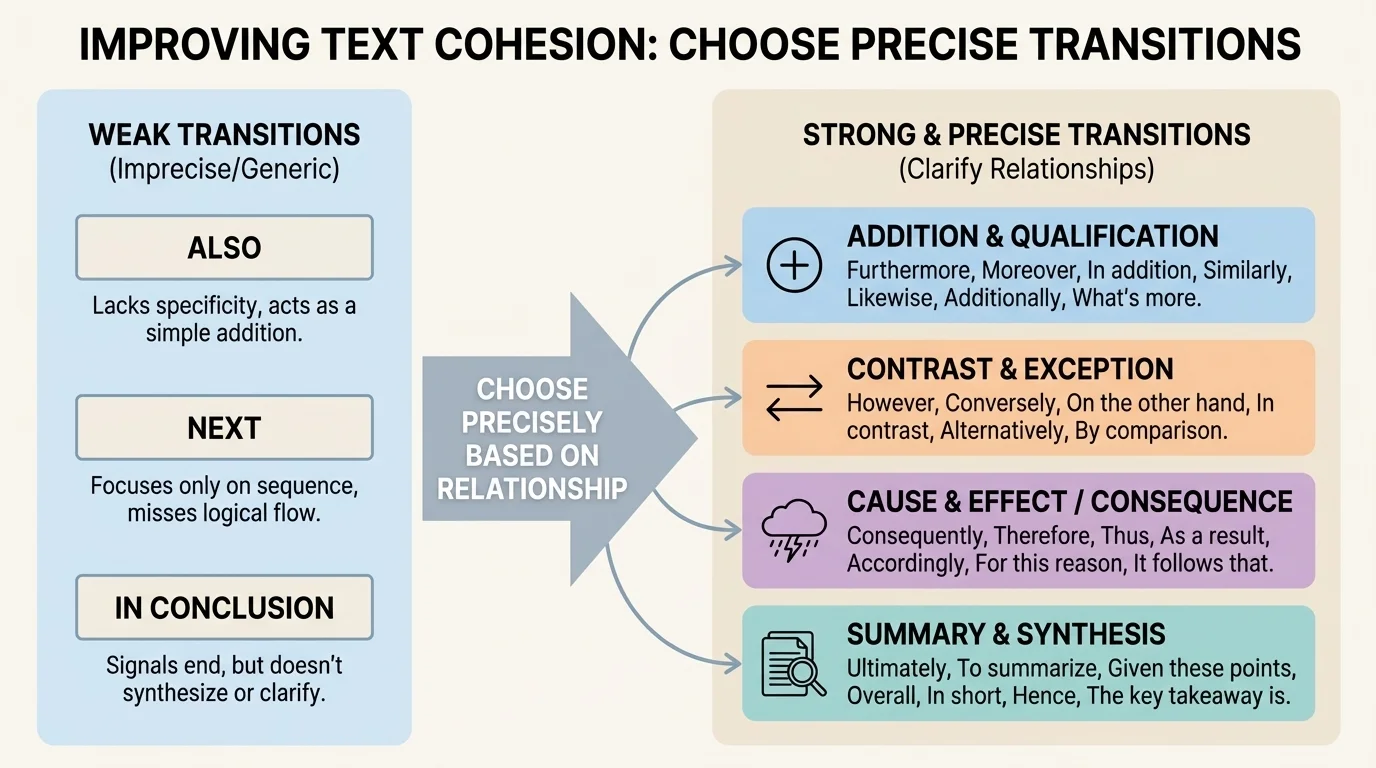
A third problem is mismatch. A writer may use therefore when the second idea is not truly a result, or for example when the second section actually contradicts the first. Misleading transitions are worse than no transitions because they train the reader to expect the wrong relationship.
Writers should also avoid forcing transitions where none are needed. If every sentence begins with a formal connector, the prose becomes heavy. Sometimes cohesion comes from repeated key terms, logical order, or pronouns that clearly refer to earlier ideas. In other words, transitions should support structure, not substitute for it.
Revision example: improving a section shift
Original version: "Plastic waste has increased rapidly in oceans. Also, many governments are banning single-use bags."
Step 1: Identify the problem.
Also suggests simple addition, but the second sentence is actually a response to the first.
Step 2: Choose a more accurate transition.
A cause-and-response relationship fits transitions such as in response, as a result, or to address this problem.
Step 3: Revise the sentence pair.
"Plastic waste has increased rapidly in oceans. In response, many governments are banning single-use bags."
The revision makes the policy connection clear and improves the logic of the passage.
The issue is not elegance alone; it is precision. Academic writing becomes stronger when each transition tells the truth about how one idea relates to another. That is why the improved examples are more than stylistic changes. They sharpen meaning.
Transitions are often easiest to improve during revision. During drafting, writers focus on gathering ideas. During revision, they can examine how those ideas connect.
One strategy is to read only the first and last sentence of each paragraph. If the progression feels broken, a transition may be missing or weak. Another strategy is to label the relationship between each paragraph and the next: addition, contrast, example, result, qualification, sequence, or shift in scale. Once the relationship is named, the writer can choose language that matches it.
It also helps to look for overused transitions. If the same connector appears repeatedly, replace it with more precise alternatives or revise the sentence so the connection is built into the wording. For example, instead of repeating however, a writer may use despite these gains, even so, or a full sentence that specifies the limitation.
Writers should also check whether each major section begins with orientation. A reader should know why this section appears here, how it connects to the previous one, and what new part of the explanation is starting. The bridge pattern shown earlier in [Figure 2] is especially useful for this kind of revision because it reminds writers that effective structure depends on both backward reference and forward movement.
Clear organization and strong evidence are still essential. Transitions cannot rescue a paper with weak ideas or random order. They work best when the writer already has a logical structure and then uses transitions to make that structure visible to the reader.
The goal is not to make writing sound fancy. The goal is to make thinking visible. When transitions are accurate and varied, readers can follow even difficult material with confidence. They understand not just what the writer knows, but how the writer's ideas fit together.
