One word can make a person sound heroic, reckless, confident, arrogant, stubborn, or determined—even when all of those words point to roughly the same basic idea. That is why strong readers do more than ask, "What does this word mean?" They also ask, "Why this word and not another one that means something similar?" The answer often reveals tone, attitude, bias, emotion, and even the writer's larger purpose.
Many words share a similar core meaning, but they are not true copies of one another. Consider words with a similar denotation in everyday use. A person can be called frugal, thrifty, or stingy. All three relate to careful spending, yet each suggests something different. Frugal often sounds practical and wise. Thrifty sounds economical and efficient. Stingy sounds selfish or ungenerous. If an author chooses one of these words, that choice gives the reader information beyond the basic definition.
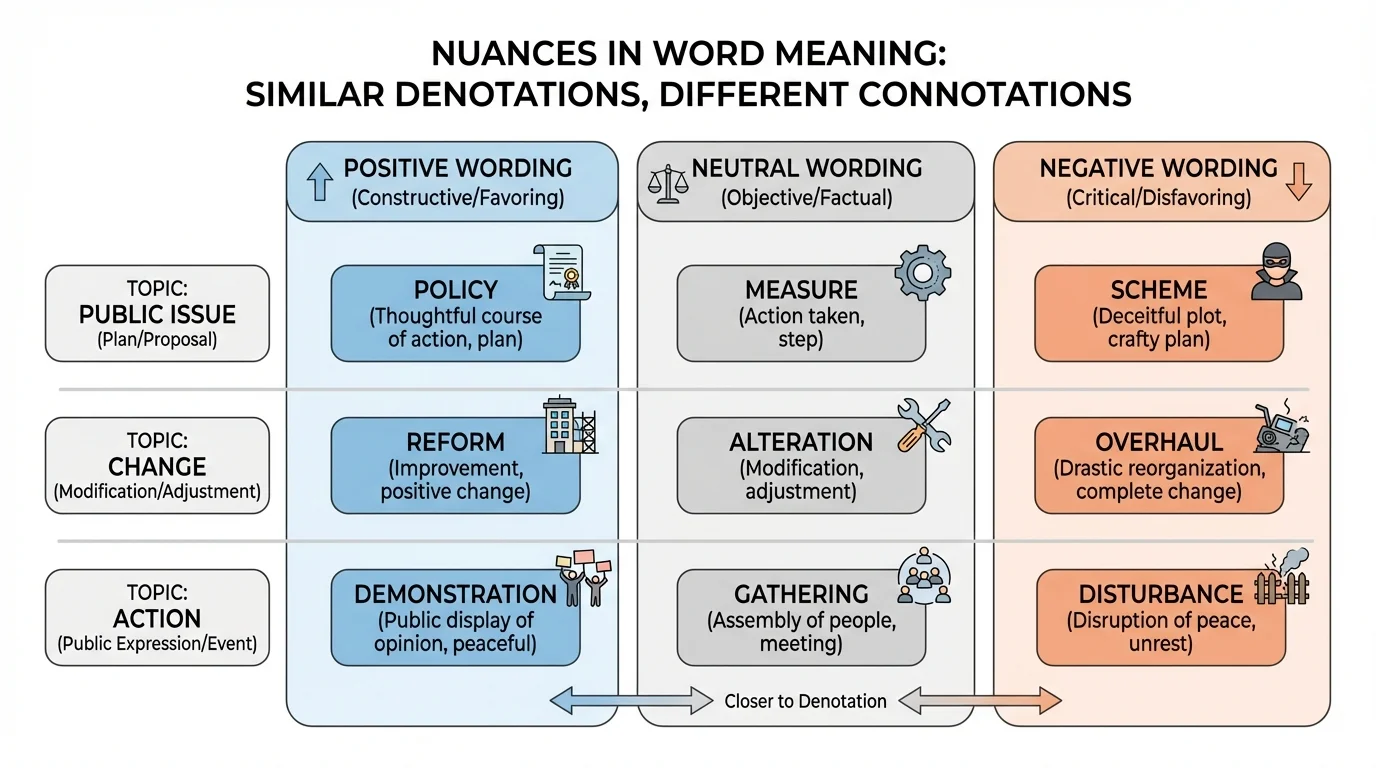
This is especially important in literature, journalism, speeches, essays, and historical writing. In a novel, a character who murmurs does not create the same effect as one who whispers, mutters, or announces. In an editorial, calling a proposal a reform does not feel the same as calling it a scheme. In an informational article, the difference between precise and exact may seem small, but the writer may be signaling a specific level of accuracy.
Denotation is a word's direct, dictionary meaning.
Connotation is the feeling, association, or cultural meaning that comes with a word.
Nuance is a subtle shade of meaning that makes one word slightly different from another word with a similar denotation.
When readers analyze nuance, they move from basic comprehension to deeper interpretation. They begin to notice how language influences mood, persuasion, credibility, and point of view. That skill matters across all kinds of texts, not just poetry or fiction.
A useful way to think about these ideas is to picture three layers. The first layer is the basic dictionary definition. The second layer is the emotional or cultural association. The third layer is the fine distinction that makes a word more fitting in one situation than another. Those fine distinctions are what skilled readers and writers pay attention to.
Take the words home and house. Their denotations overlap because both can refer to a place where people live. But house often sounds more physical and structural, while home often carries warmth, belonging, and emotional connection. Now compare residence. It points to a dwelling too, but with a more formal, detached tone. The denotations are related; the nuances differ.
Nuance often depends on audience and setting. A scientist writing an informational report usually aims for language that is controlled and exact. A novelist may prefer a word with emotional force. A lawyer may choose wording that is technically narrow. A political speaker may deliberately select words that activate strong feelings. The dictionary does not always tell you how those choices work in context.
English has a huge number of near-synonyms partly because it draws vocabulary from different language histories. Words from Old English, French, and Latin can overlap in denotation while carrying different levels of formality and tone.
For example, ask, question, and interrogate all involve seeking information. Yet ask is broad and ordinary, question suggests a more deliberate inquiry, and interrogate can imply pressure, suspicion, or authority. A detective interrogates. A friend asks. A journalist questions. The basic action is related, but the situation and tone are not.
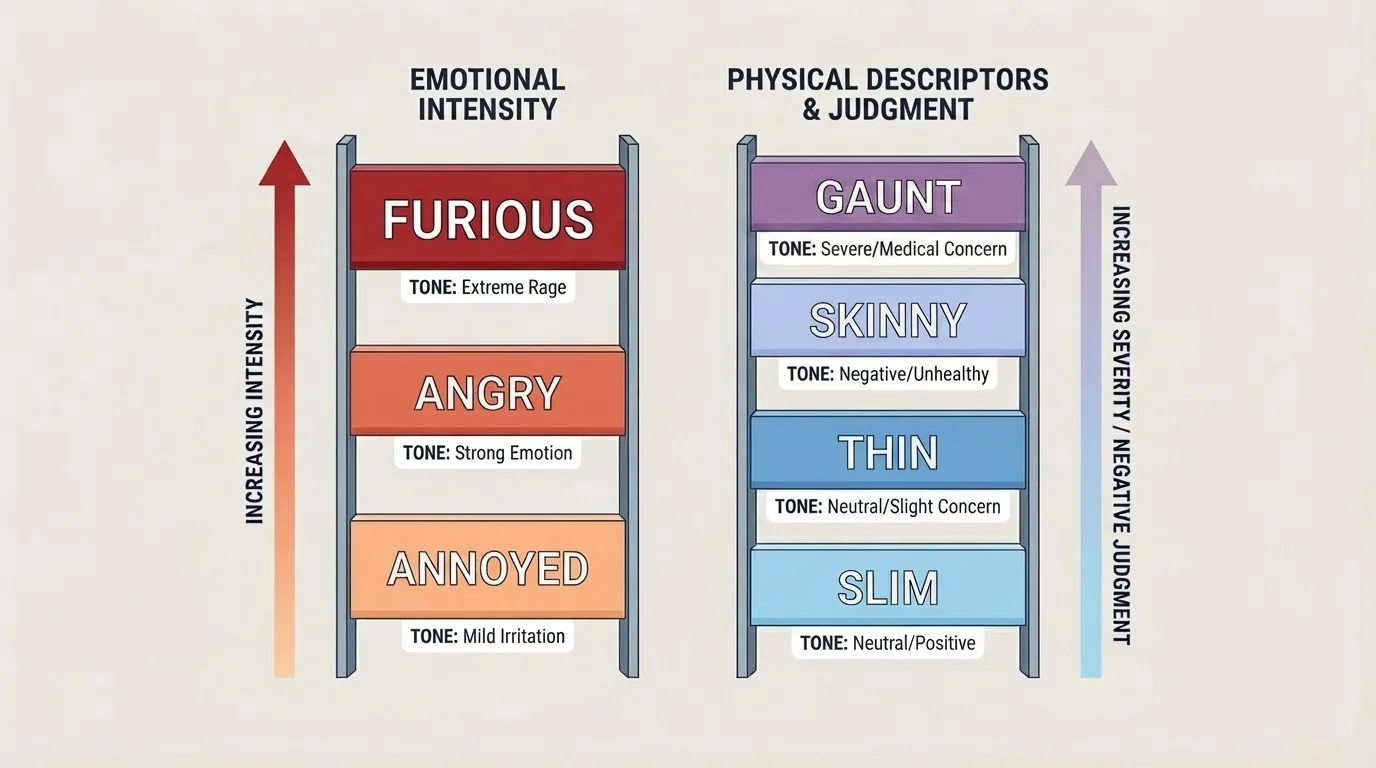
Near-synonyms often differ in intensity, tone, formality, emotional coloring, judgment, and specificity. As [Figure 1] illustrates, words can form a scale rather than a perfect match. A character may be annoyed, angry, furious, or enraged. These all connect to anger, but they do not name the same level of force.
They can also differ in the attitude they imply. Compare slim, thin, skinny, and gaunt. Each refers to a body shape with little fat, but each carries a different judgment. Slim often sounds positive. Thin is more neutral. Skinny can sound critical or informal. Gaunt suggests unhealthy hollowness. The author's choice changes the image in the reader's mind.
Formality matters too. A student might say a movie was good, a reviewer might call it effective, and a scholar might describe it as compelling or significant. Each word evaluates positively, but each fits a different context and audience. If a formal report suddenly uses slang, the shift stands out. If a teenager in a realistic novel speaks in highly academic diction, that may feel unnatural unless the author intends it.
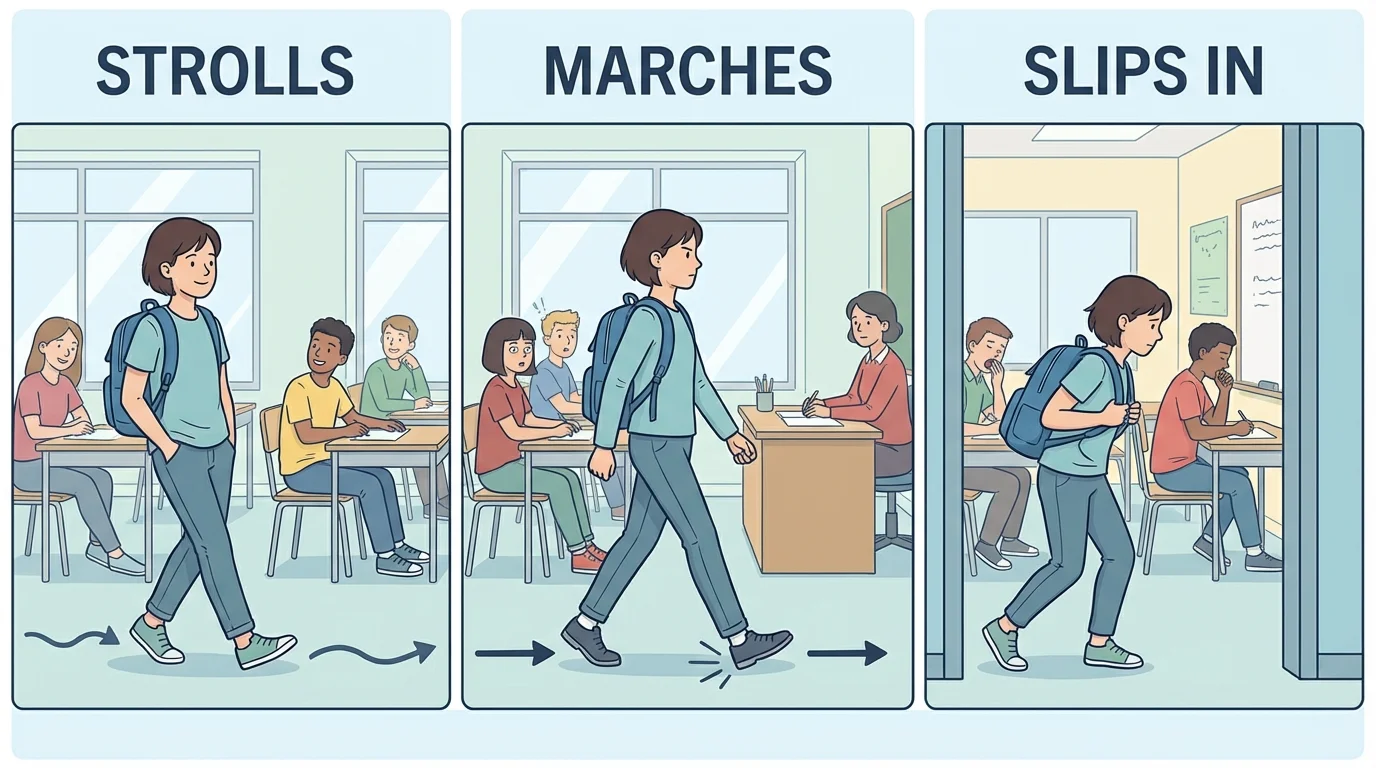
Specificity creates another important kind of nuance. The word walk is broad. But stroll, shuffle, pace, march, and trudge each tell us something extra about speed, mood, posture, or purpose. That "something extra" is nuance.
| Word Set | Shared Denotation | Important Nuance |
|---|---|---|
| childish / childlike | having qualities associated with children | Childish suggests immaturity; childlike suggests innocence or wonder. |
| assertive / aggressive | forceful in action or expression | Assertive is often positive and controlled; Aggressive may imply hostility or excess. |
| curious / nosy | wanting to know | Curious is usually neutral or positive; nosy implies intrusive interest. |
| confident / arrogant | having a strong belief in oneself | Confident suggests healthy self-assurance; arrogant suggests superiority and disrespect. |
| old / ancient | existing for a long time | Old is general; ancient suggests extreme age and often historical distance. |
Table 1. Comparisons showing how words with related denotations differ in implied judgment and tone.
In stories, word choice helps create character, conflict, setting, and mood. As [Figure 2] shows, the same basic action can produce very different impressions depending on the verb a writer selects. If a student strolls into class, the reader may picture ease or confidence. If the student marches in, the reader may sense determination, anger, or theatrical boldness. If the student slips in, the effect may be secrecy, shyness, or lateness.
Writers also use nuance to reveal point of view. If a narrator describes a neighborhood as lively, the tone differs from calling it noisy. If a storm is described as wild, that is different from violent. Both pairs refer to similar realities, but the choice tells us how the narrator feels about them.
Description depends heavily on nuance. Compare these sentences: The dog looked at him. The dog stared at him. The dog glanced at him. The dog watched him. The denotation remains close, yet the timing, intensity, and implied emotion change. Stared feels intense. Glanced feels brief. Watched suggests duration and alertness. Strong readers notice those small signals.
Characterization also depends on labels. A leader can be called determined or stubborn; a speaker can be passionate or dramatic; a planner can be careful or controlling. These are not neutral substitutions. They position readers to admire, doubt, sympathize with, or criticize the character.
Case study: one event, three tones
Consider how nuance changes the reader's response to the same scene.
Step 1: Neutral wording
Maya walked to the podium and began speaking. This reports the event with little added judgment.
Step 2: Admiring wording
Maya stepped confidently to the podium and delivered her remarks. Words like confidently and delivered suggest control and skill.
Step 3: Critical wording
Maya strode to the podium and launched into her speech. Depending on context, strode and launched can suggest forcefulness or self-importance.
The event is nearly the same, but the nuance shifts the reader's impression.
Later in a narrative, those earlier word choices continue to matter. A reader who first sees someone described with harsh diction may interpret later actions more suspiciously. In that way, nuance shapes not only single sentences but also the larger arc of meaning.
Nuance matters just as much outside fiction. In argumentative writing, diction can signal approval, criticism, urgency, doubt, or bias. As [Figure 3] makes clear, two writers can discuss the same issue while guiding readers toward very different reactions. One writer might describe a law as a reform; another might call it an overhaul; a critic might label it an experiment or even a scheme.
Words with emotional charge are often called loaded language. A company can cut costs or slash jobs. A protest can be described as a demonstration, a rally, a disturbance, or an uprising. Those labels do not merely report facts; they frame them.
Informational texts usually aim for greater neutrality, but even there, nuance affects credibility and precision. A historian may write that a decision was controversial rather than disastrous because the first word reports disagreement while the second announces a judgment. A science article may say a result is suggestive, probable, or conclusive, and each term signals a different degree of certainty.
Readers should therefore ask whether a word is mainly descriptive or persuasive. A neutral source tends to choose language that is specific and measured. A persuasive source may choose stronger or more emotionally weighted wording. Noticing that difference helps readers evaluate reliability.
Framing through diction happens when a writer chooses among near-synonyms in a way that steers the audience toward a particular interpretation. The facts being discussed may remain the same, but the wording can make those facts sound admirable, alarming, reasonable, risky, humane, wasteful, or unfair.
Nuance is also essential in academic reading. Words such as claim, argue, suggest, indicate, and prove are not interchangeable. Suggest is weaker than prove. Indicate often signals evidence without final certainty. If you miss those distinctions, you may misunderstand the author's level of confidence.
To analyze nuance well, begin with context. A word's shade of meaning depends on who uses it, where it appears, and what tone surrounds it. The same word can sound humorous in one passage and insulting in another. Context prevents oversimplified interpretation.
A strong method is substitution testing. Replace a word mentally with a near-synonym and ask what changes. If a sentence says a witness claimed she saw the event, what happens if you substitute said, reported, or insisted? Each replacement changes how reliable, intense, or defensive the witness seems. That difference reveals the original word's nuance.
Another strategy is to examine register, the level of formality or informality in language. If a text suddenly shifts from formal to casual diction, that shift may signal a change in audience, attitude, or purpose. In the same way, a single slang word inside a serious article can create irony, distance, or criticism.
When using context clues, look beyond the sentence. Nearby details, the speaker's attitude, the genre, and the topic all help determine a word's exact meaning and force.
You should also watch for patterns. If an author repeatedly uses words with negative associations—such as wasteful, reckless, burdensome, and failed—the pattern shapes tone even before any explicit argument is stated. Likewise, repeated positive diction can create admiration or trust.
Finally, ask why the author did not choose the most neutral option. If a journalist writes insisted instead of said, or admitted instead of stated, the wording may imply defensiveness or guilt. Those implications are often where the deepest interpretation begins.
Some sets of related words appear often in high school reading. Learning to distinguish them will strengthen both comprehension and writing.
House, home, residence: all refer to a place where someone lives. House stresses the building, home often emphasizes belonging, and residence sounds formal or official.
Look, stare, gaze, glare: all involve directing one's eyes. Look is basic, stare can imply rude or intense attention, gaze often sounds lingering or admiring, and glare suggests anger.
Talk, chat, discuss, debate: all involve speaking. Talk is broad, chat is casual and friendly, discuss suggests thoughtful exchange, and debate involves disagreement or opposing positions.
Cheap, inexpensive, economical: these relate to low cost, but not in the same way. Inexpensive is mostly neutral. Economical often praises efficiency or value. Cheap can describe low price, but it may also imply poor quality or meanness.
The earlier scale in [Figure 1] remains useful here: many near-synonyms differ along invisible lines of judgment and intensity. Readers who notice those lines interpret texts more accurately.
Nuance is not limited to literal diction. Figurative language often intensifies subtle shades of meaning. If a writer says a rumor spread, that is fairly neutral. If the writer says it raced like wildfire, the figurative comparison adds speed, danger, and loss of control. The denotation has expanded into a stronger image.
Metaphors and similes can sharpen evaluation. Calling a negotiator a bulldozer suggests force and a lack of sensitivity. Calling that same person a bridge-builder suggests cooperation. Neither term is literal, but each carries powerful nuance.
"The difference between the almost right word and the right word is really a large matter."
— Mark Twain
Idioms also depend on nuance. To say someone is under the weather sounds milder and more conversational than saying the person is ill. To say a student dropped the ball suggests a mistake in an informal, vivid way that differs from saying the student failed to meet responsibilities. Both meaning and tone shift together.
The contrast from [Figure 2] helps here as well: even when the action is similar, the wording can change the emotional movie playing in the reader's mind. Figurative choices often magnify that effect.
A common mistake is to treat synonyms as perfectly equal. Thesauruses are useful, but they can mislead if you ignore context. Replacing one word with another just because the dictionary definitions overlap can produce awkward, inaccurate, or unintentionally funny results.
For example, youthful and juvenile both relate to youth, but they do not function the same way in every context. Youthful energy often sounds positive. Juvenile behavior often sounds critical. Likewise, persistent may praise determination, while relentless may sound admirable or exhausting depending on context.
Readers should therefore avoid asking only, "What does this word stand for?" A better question is, "What exact effect does this word create here?" In argumentative texts, that question reveals bias. In narratives, it reveals characterization and tone. In informational texts, it reveals precision and level of certainty.
Awareness of nuance makes you a better reader because you notice how language shapes meaning. It also makes you a better writer because you learn to choose words that fit your purpose exactly. If you want to sound fair, select measured language. If you want to show admiration, choose positively charged diction. If you want to create suspense, use words that imply uncertainty or tension.
Effective word choice depends on matching the word to the message, the audience, and the genre. A research paper should not sound like a casual group chat. A personal narrative may benefit from vivid, emotionally specific verbs. A strong analysis often depends on choosing the one word that captures the exact shade of meaning the evidence supports.
When you read closely, keep asking: What words could the author have used instead? What would those alternatives suggest? Why is this precise wording the best fit? Those questions lead you beneath surface meaning and into interpretation, where nuance becomes one of the most powerful tools in language.
