A story can cover the same event in two completely different ways: one version makes you feel as if you are standing inside the moment, while the other feels flat and forgettable. The difference is rarely the event itself. A student missing a train, a sister opening an old voicemail, a striker lining up a penalty kick, a scientist waiting for test results: any of these can become compelling if the writer controls how the story is told. Narrative technique is what turns events into experiences.
Strong narratives do more than report what happened. They shape time, select detail, reveal thought, build tension, and connect separate strands of action into a meaningful whole. When writers choose techniques carefully, readers do not simply learn about characters; they understand them. They do not simply witness events; they feel their pressure, consequences, and significance.
When people talk about a story being "good," they often mean that it feels alive. That aliveness comes from craft. A writer decides when characters speak and when they stay silent, which moments deserve a full scene and which should be summarized, what details matter, what a narrator notices, and whether one conflict should stand alone or interact with another. These decisions create mood, rhythm, suspense, and meaning.
Narrative technique refers to the methods a writer uses to shape a story. These methods include the handling of dialogue, pacing, description, reflection, point of view, structure, and plot development.
Plot line is a sequence of related events centered on a conflict or goal. A narrative may have one main plot line or several connected plot lines.
For readers in high school and beyond, the most effective narratives are rarely simple chains of action. They usually combine external events with internal change. A character may be preparing for a championship race while also dealing with grief, guilt, pressure, or family conflict. The event matters, but the meaning of the event matters too.
Five especially important tools for developing experiences, events, and characters are dialogue, pacing, description, reflection, and multiple plot lines. Each serves a different purpose, but the strongest narratives often use them together rather than separately.
Dialogue presents speech between characters. It can reveal personality, conflict, social dynamics, and hidden motives. Pacing controls the speed at which the story moves. Description gives readers sensory and concrete detail. Reflection allows the narrator or character to think about events, interpret them, or connect them to larger ideas. Multiple plot lines create complexity by following more than one thread of action.
None of these techniques is effective on its own just because it appears on the page. Dialogue can be empty. Description can be excessive. Reflection can become repetitive. Multiple plot lines can become confusing. Technique becomes effective when it serves a clear purpose in the narrative.
Readers need both sequence and significance. A narrative should make it clear what happens, but it should also make clear why those events matter to the people involved.
In a strong narrative scene, speech works together with gesture, silence, and implication, as [Figure 1] shows. Effective dialogue does not merely transfer information from one character to another. It reveals tension, attitude, status, affection, fear, dishonesty, or uncertainty.
Consider the difference between these two examples. Weak dialogue: "I am angry because you lied to me about the scholarship interview," Maya said angrily. This line explains too much directly and sounds unnatural. Stronger dialogue: "You said it was canceled." Maya kept her eyes on the trophy case. "Funny how everyone else still showed up." Here, the conflict is clearer because the line sounds more like something a real person might say, and the action beat adds emotional texture.
Notice what happens in the stronger version. The writer does not announce every feeling. Instead, the character's words and behavior allow readers to infer the emotion. That inference creates engagement. Readers become active participants in understanding the scene.
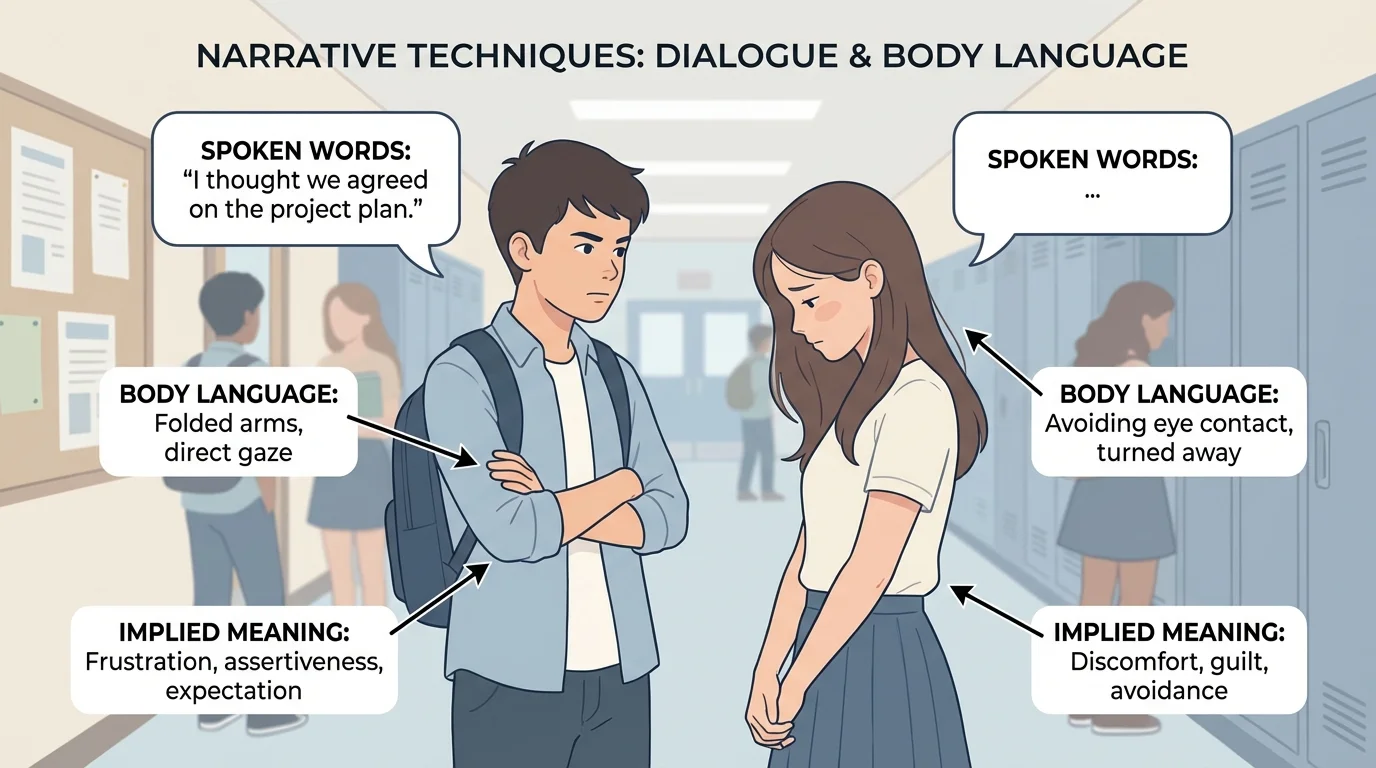
Good dialogue usually has several qualities. It sounds believable without copying real speech exactly. It gives each speaker a distinct voice. It avoids long speeches that exist only to explain background. And it often includes subtext, the meaning beneath the spoken words.
Subtext matters because people often do not say exactly what they mean. A father saying, "You're home late," may actually be expressing worry, anger, disappointment, or fear. A friend saying, "Sure, go with them," may be masking hurt. When writers allow hidden meaning to operate under the surface, characters feel more realistic.
Example: dialogue that develops character
A younger brother has just damaged his sister's car before her driving test.
Step 1: Flat version
"You hit my car," Elena said. "Yes, I did," Marco said. "I am sorry."
Step 2: Revised version with character and tension
Elena stared at the crack running through the taillight. "Tell me that's not from your bike."
Marco adjusted his helmet strap without looking up. "It was already loose."
"Marco."
He swallowed. "I was trying to move it so Dad wouldn't have to back around the trash cans."
Step 3: Why it works
The revised version shows blame, avoidance, and family dynamics through speech patterns and actions. The characters sound different from each other, and the conflict emerges naturally.
As the narrative develops, dialogue can also change to reflect character growth. A character who begins the story sarcastic and evasive may later speak with honesty and restraint. Changes in voice can reveal development just as clearly as major events do.
Later in a narrative, the same interaction of spoken words and body language remains important, as seen earlier in [Figure 1]. Readers often judge a character not only by what is said but by what is avoided, interrupted, or left unfinished.
Writers control a reader's sense of time through expansion and compression, as [Figure 2] illustrates. One hour can pass in a sentence, while three seconds can stretch across a page. Pacing is the speed and rhythm of a narrative, and it strongly affects tension, clarity, and emotional impact.
When a writer wants to move quickly through less important material, summary works well. For example: "Over the next three weeks, Devin ignored the messages, skipped lunch, and told everyone he was busy." This covers time efficiently. But when the story reaches a crucial turning point, the writer often slows down into a scene: "His phone lit up again. This time, instead of her name, it showed the hospital number." The narrowed focus signals importance.
Slower pacing often appears in moments of suspense, discovery, conflict, or emotional change. A writer may break one moment into small physical actions, observations, and thoughts. Faster pacing often appears in transitions, travel, routine, or background sequences that matter but do not deserve full dramatic treatment.
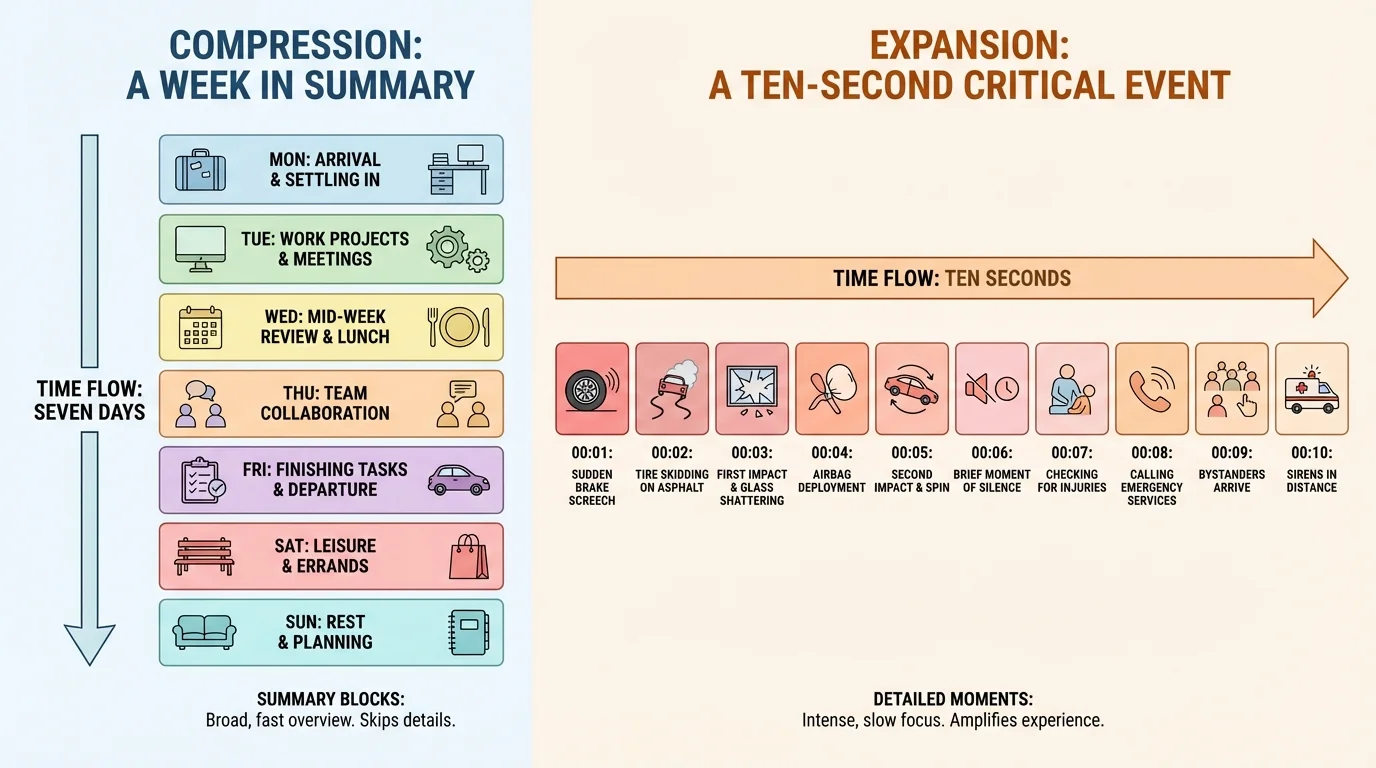
Controlling pace is also about sentence structure. Short sentences can speed up action or sharpen tension. Longer, more layered sentences can slow the reader down and deepen attention. Paragraph length matters too. A paragraph of rapid action may feel urgent; a paragraph that lingers over thought and detail may feel reflective or tense.
Writers should ask a practical question: Which moments deserve time? A basketball player practicing free throws for months may be summarized. The final shot with two seconds left should probably be dramatized in detail. Not every event should receive equal space.
Pacing as emphasis
Readers naturally assume that the amount of space a writer gives an event reflects its importance. Slowing down tells readers, "Pay attention; this changes something." Speeding up tells readers, "This matters, but it is not the center of the story."
Good pacing also prevents two common problems: rushing and dragging. If major emotional shifts happen too fast, readers do not have time to believe them. If minor details pile up without purpose, readers lose momentum. Effective pacing gives each part of the narrative the space it earns.
Sensory detail helps readers see, hear, feel, smell, and sometimes taste the world of the story. But strong description is not a pile of adjectives. It is the careful selection of details that reveal setting, mood, and perspective.
Suppose two writers describe the same room. One writes: "It was a messy room with old things everywhere." Another writes: "A chess clock blinked on the desk beneath three college rejection letters, and the smell of instant coffee had settled into the curtains." The second version is more specific, and because it is specific, it suggests a life. Readers begin to infer pressure, disappointment, habit, and personality.
Description should usually be filtered through a character's point of view. A nervous student entering a principal's office notices different details from those noticed by a student journalist chasing a story. Description is not only about what is there; it is about what the character notices and why.
Readers often remember one sharply chosen detail more clearly than a whole paragraph of general description. A single image such as a cracked violin string, a half-charged ankle monitor, or rainwater dripping through a gym roof can carry mood and meaning at once.
This is why purposeful detail matters. In a suspenseful scene, a writer may focus on sounds, shadows, and restricted vision. In a joyful reunion, the description may open outward toward color, motion, and touch. Description shapes emotional atmosphere.
At the same time, effective narratives avoid overload. If every object in a room is described with equal attention, nothing stands out. Good writers choose details that serve a function: building mood, revealing character, foreshadowing conflict, or grounding action.
| Technique | Weak Use | Strong Use |
|---|---|---|
| Description | Lists many generic details | Selects vivid details that reveal mood or character |
| Setting | Acts as background only | Influences action, conflict, or emotion |
| Sensory detail | Feels random | Matches the scene's purpose and point of view |
Table 1. Comparison of less effective and more effective uses of descriptive writing.
Events become more meaningful when characters interpret them. Reflection is the part of a narrative in which a character or narrator thinks about what has happened, what it means, or how it connects to larger questions. Reflection is often what transforms a sequence of incidents into a story with depth.
Imagine a student cleaning out a locker after transferring schools. Without reflection, the scene might remain purely physical: books, notes, a bent ID card. With reflection, the scene can reveal loss, relief, resentment, or maturity: "He had spent months wanting to leave, but the empty locker still felt like proof that a life could end before anyone admitted it was ending." The event now carries emotional interpretation.
Reflection can appear in many forms: memory, self-questioning, regret, realization, comparison, or insight. It may happen immediately after an event or later, with distance. It can be brief or extended. What matters is that it deepens significance rather than repeating obvious facts.
"Stories teach us not only what happened, but what it felt like to have it happen."
There is a balance to maintain. Too little reflection can make a story feel emotionally thin. Too much reflection can stall movement. Writers should let thought emerge at meaningful moments, especially after conflict, discovery, failure, decision, or change.
Reflection also helps reveal character development. A character at the beginning of a narrative may interpret an event in one way and later understand it differently. That shift in interpretation can be one of the clearest signs of growth.
Example: adding reflection to deepen an event
Base event: A swimmer loses a race by a fraction of a second.
Step 1: Event without reflection
Nia touched the wall and looked up. Her name was second on the board.
Step 2: Event with reflection
Nia touched the wall and looked up. Her name was second on the board. For a second she felt only the clean shock of cold water in her lungs. Then she remembered every morning she had arrived before sunrise just to shave that exact distance from her turn. Losing hurt, but what unsettled her more was realizing she no longer wanted to quit. The race had taken something from her and given something back.
Step 3: Why it works
The reflection reveals effort, disappointment, and a changed understanding of herself. The event becomes part of character development rather than a simple result.
Many memorable narratives ask readers to follow more than one line of action, and those relationships become clearer when the structure is organized, as [Figure 3] shows. A main plot may follow a central conflict, while a subplot develops a relationship, family issue, social pressure, or parallel challenge.
A story about a student preparing for a debate championship might include a main plot about the competition and a subplot about repairing trust with a former friend. At first these seem separate. But eventually the subplot influences the main plot: perhaps the friend has evidence the student needs, or the emotional conflict affects performance. When plot lines intersect meaningfully, the story gains complexity.
Multiple plot lines can be parallel, where separate conflicts reflect each other; intersecting, where characters and events cross directly; or contrasting, where one plot line highlights what the other lacks. In each case, the writer must give readers clear transitions and a sense of purpose.
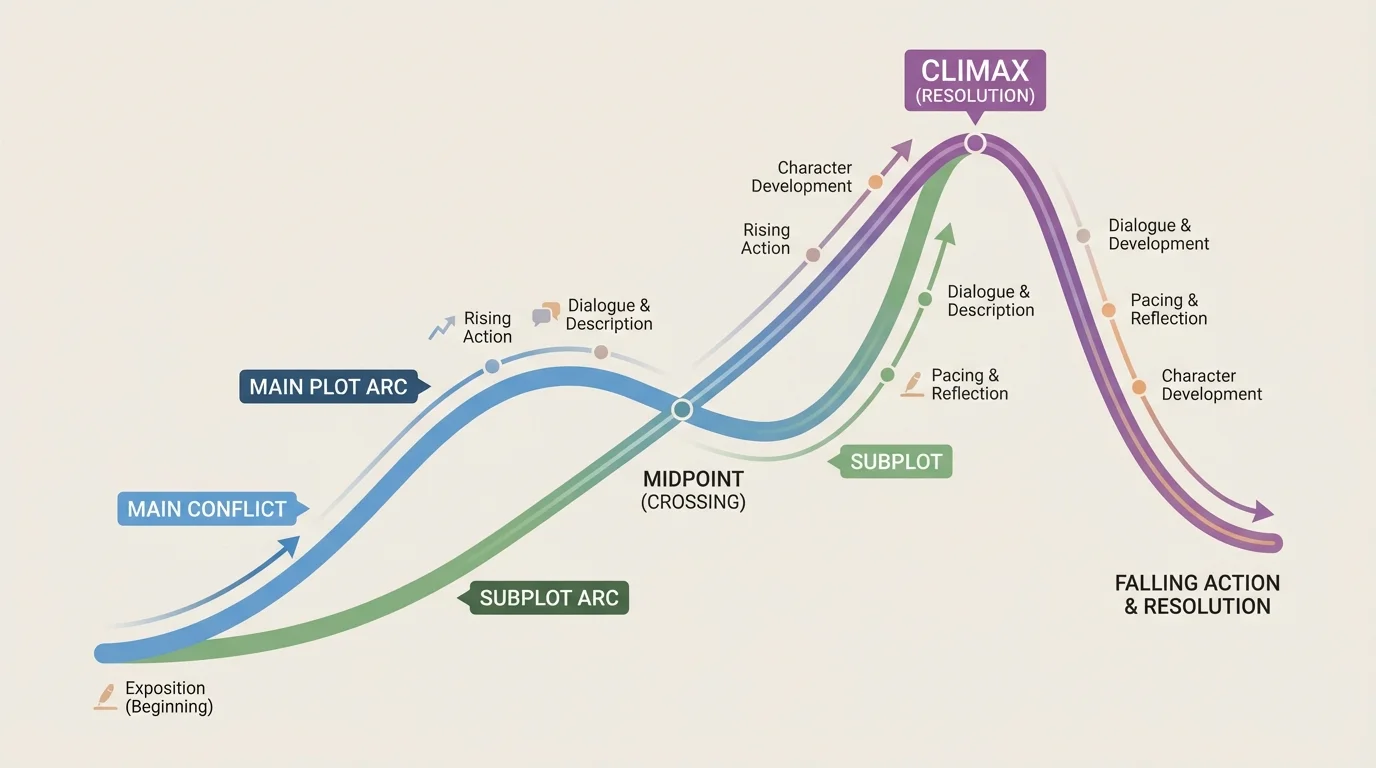
One danger of multiple plot lines is fragmentation. If a subplot does not connect thematically, emotionally, or causally to the main story, it can feel distracting. Readers may wonder why it exists. A strong subplot does more than fill space; it sharpens the main narrative by deepening character, increasing stakes, or echoing the central theme.
Writers also need balance. If one plot line is far more interesting than the other, the weaker line can feel like an interruption. This does not mean every plot line needs equal page time, but each should matter.
Later in a narrative, the crossing structure introduced in [Figure 3] often becomes especially important near the climax. Decisions made in one plot line can trigger consequences in another, creating the sense that the story is converging rather than merely continuing.
Coherence in multiple plot lines
When a narrative contains more than one plot line, readers should still be able to answer three questions at any point: What is happening now? Why does it matter? How is this connected to the larger story? Clear structure keeps complexity from becoming confusion.
In real writing, these techniques are rarely isolated. A powerful scene often combines dialogue, pacing, description, and reflection at once. For example, a narrative about an emergency room volunteer waiting to identify an injured classmate might use quick pacing during the arrival of ambulances, sharp sensory description of fluorescent light and disinfectant, clipped dialogue between staff members, and later reflection on how ordinary the school day had seemed that morning.
What makes the scene effective is not the number of techniques but their coordination. Dialogue may reveal fear without openly naming it. Description may focus on details the narrator cannot stop noticing. Pacing may slow at the moment of recognition. Reflection may come after the crisis, allowing the narrator to understand what changed.
Writers should think in terms of scene design. What is the purpose of this part of the story? Is it introducing conflict, deepening character, building suspense, or showing consequences? Once the purpose is clear, the writer can select techniques that support it.
Case study: combining techniques in a short scene
Scenario: A student opens a long-delayed email about a music conservatory audition.
Step 1: Pacing and description
The writer slows the moment before the email is opened, noticing the laptop fan, the unfinished scales on the music stand, and the cursor hovering over the message. This delay heightens tension.
Step 2: Dialogue
A parent says from the doorway, "You don't have to open it alone." That one line reveals support, worry, and the pressure of expectation.
Step 3: Reflection
After reading the email, the narrator thinks not only about acceptance or rejection, but about how years of effort had narrowed into a single subject line. The reflection gives the event emotional and thematic weight.
Step 4: Plot-line connection
If a second plot line involves the narrator's conflict with a sibling who quit music years earlier, the result of the email can reshape that relationship as well as the future plan, making the scene part of a larger structure.
A well-structured narrative sequence usually moves with intention: introduction of situation, development of conflict, complication, turning point, and consequence. That sequence does not need to be mechanically predictable, but it should feel logical. Readers should sense progression.
Several common issues weaken narratives. One is telling emotion directly without dramatizing it. Writing "he was nervous" is sometimes useful, but if every feeling is simply named, the story loses energy. Another problem is dialogue used only for exposition, where characters say things no real person would say just so readers can receive information.
A third issue is uneven pacing. Some writers rush the most important moment in the story and spend too much time on setup. Others overload scenes with description that does not affect mood or action. Still others add a subplot because it seems sophisticated, but the subplot never meaningfully connects to the main conflict.
The solution is purposeful revision. Writers can ask: Which lines of dialogue reveal character? Which details are doing real work? Where should time slow down? Where should the story move more quickly? What insight follows the event? How does each plot line contribute to the whole?
Strong narratives feel natural when they are carefully constructed. That is the paradox of good storytelling: the more deliberate the craft, the more real the experience seems.
