A single word can make a sentence sound hopeful, threatening, scientific, biased, poetic, or official. Consider the difference between saying a crowd gathered, assembled, swarmed, or mobilized. Each word points to people coming together, but each creates a different picture and a different feeling. Skilled readers pay attention to those differences because authors do not choose words randomly. Word choice shapes what a text means and how it feels.
When you analyze a text closely, you look beyond the basic dictionary definition of a word. You ask what the word suggests, what tone it creates, what kind of audience it assumes, and how it works with other words around it. In literature, this helps you understand character, conflict, and theme. In nonfiction, it helps you detect attitude, bias, precision, and purpose. Whether you are reading a poem, a speech, a court opinion, or a news article, the ability to interpret word choice is one of the most important reading skills you can develop.
Authors create meaning through diction, the deliberate selection of words and phrases. Diction affects not just information but also mood, credibility, and perspective. A writer describing a policy as a reform sounds different from one calling it an experiment or a failure. Even when the topic remains the same, language can push readers toward approval, doubt, fear, admiration, or skepticism.
This matters because reading is not only about understanding what happened. It is also about understanding how a text positions the reader. If a narrator calls a house weathered, that may suggest endurance or charm. If the narrator calls the same house dilapidated, the tone shifts toward decay. The facts may overlap, but the emotional and interpretive effect changes.
Denotation is a word's basic, literal meaning. Connotation is the set of feelings, associations, or cultural meanings attached to a word. Figurative language uses words in non-literal ways to create comparison, emphasis, or imagery. Technical meaning is the specialized meaning a word has in a particular field, such as law, science, medicine, or journalism.
Strong readers learn to separate these layers and then reconnect them. The question is not just "What does this word mean?" but also "Why this word instead of another?" and "What effect does that choice have when repeated across the text?"
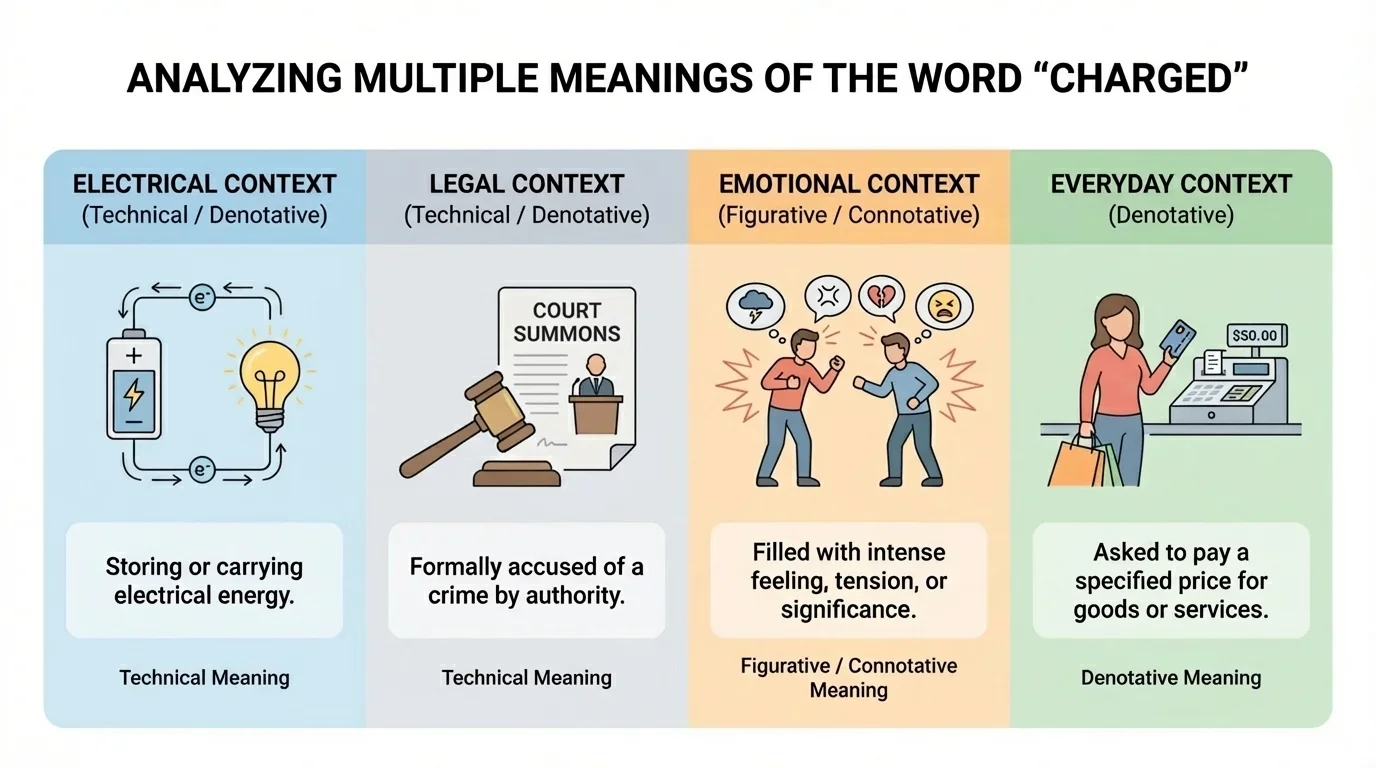
Many words operate on several levels at once, as [Figure 1] illustrates with a single word used in multiple contexts. A word may have a literal definition, a figurative use, an emotional coloring, and a specialized meaning in a discipline. If you miss one layer, you may miss the author's real point.
Take the word cold. Its denotative meaning refers to low temperature. But in a sentence like "She gave him a cold reply," the word is figurative; it suggests emotional distance, not weather. In another context, cold may carry a connotative meaning of harshness, loneliness, or lack of comfort. In medicine, a cold can have a more technical meaning, referring to a mild viral infection.
Now consider the word charged. In everyday speech, a phone can be charged with electricity. In a courtroom, a person can be charged with a crime. In writing about atmosphere, a room can feel charged with tension. The surrounding context tells you which meaning is active. The reader's task is to identify the correct meaning and then explain its effect.
These layers often interact. In a novel, an author might choose a technically precise word to make a character sound educated, detached, or authoritative. In an editorial, a writer may select emotionally loaded words to persuade readers while still seeming factual. Meaning is rarely isolated; words gather force from context, purpose, and pattern.
Context includes the words around a term, the sentence it appears in, the speaker, the situation, and the kind of text you are reading. When a word has multiple possible meanings, context narrows the options. This is why close reading requires attention to entire sentences and paragraphs rather than isolated vocabulary.
If a poem says, "The city never sleeps," no reader assumes the city is literally awake like a person. The context signals that the phrase is figurative and suggests constant activity. If a biology text uses the word cell, context tells you that it does not mean a prison room or a spreadsheet box. Genre matters because certain meanings are more likely in certain kinds of writing.
Syntax also helps. A word's grammatical role can point to meaning. In "They bear the burden," bear is a verb meaning carry or endure. In "A bear crossed the trail," it is a noun. Readers constantly make these decisions, often without noticing, but analytical reading means slowing down and making the process visible.
Context is not a hint; it is evidence. When you explain a word's meaning, point to surrounding details that justify your interpretation. A strong analysis does not merely guess that a word sounds negative or positive. It shows how nearby images, sentence structure, topic, and genre support that reading.
That habit becomes especially important in difficult texts, where authors may use irony, understatement, or specialized terminology. If you rely only on a familiar everyday meaning, you can misread the passage entirely.
Figurative language uses words in imaginative rather than strictly literal ways. Writers rely on it to make abstract ideas vivid, compress complex emotions into images, and create memorable tone. Metaphors, similes, personification, hyperbole, irony, and symbolism all shape the reader's experience.
Suppose a narrator says, "Grief sat on the house like winter." That simile does more than compare sadness to a season. It suggests heaviness, stillness, coldness, and duration. A literal sentence such as "The family was very sad" gives information, but the figurative sentence gives atmosphere. It invites readers to feel the emotional climate of the scene.
Figurative language can also reveal character. If one speaker describes competition as a battle and another describes it as a journey, each metaphor exposes a different mindset. The first suggests aggression and winners versus losers; the second suggests process, endurance, and growth. The figurative choice tells you how the speaker sees the world.
Writers also use figurative language to sharpen tone. Irony can create bitterness, humor, or critique. Hyperbole can intensify admiration or expose exaggeration. Symbolism can give ordinary objects deeper resonance. A river in a text may be more than water; it may represent memory, freedom, danger, or change, depending on how the language around it develops.
Literary analysis example
Consider the line: "The hallway swallowed him."
Step 1: Identify the literal impossibility.
A hallway cannot literally swallow a person, so the phrase must be figurative.
Step 2: Infer the implied meaning.
The verb swallowed suggests being consumed, erased, or overwhelmed.
Step 3: Analyze the effect on tone.
Instead of simply saying he walked away, the line creates a darker, more ominous tone. The setting feels threatening or emotionally oppressive.
The figurative word choice makes the environment feel active and hostile.
As you analyze figurative language, always connect image to impact. Do not stop at naming a metaphor or simile. Explain how the choice affects meaning, tone, and interpretation.
Connotation refers to the associations a word carries beyond its literal meaning. Two words may have similar denotations but very different connotations. For example, slender and skinny both describe thinness, but slender often sounds complimentary while skinny can sound critical. Likewise, persistent may sound admirable, while stubborn may sound frustrating, even if both describe someone who does not give up easily.
Connotation plays a huge role in argumentation and media. A report might describe a group as activists, protesters, demonstrators, agitators, or rioters. These labels do not simply identify people; they shape how readers judge them. The choice of label can imply legitimacy, urgency, disorder, or threat.
Connotations are often cultural and situational. The word ambitious can be praise in one context and criticism in another. A word's effect depends on speaker, audience, and purpose. This is why tone analysis requires careful attention to nuance rather than simple labels.
The same event can sound completely different depending on diction. Historians, journalists, politicians, and novelists may all describe one public event, but their word choices can lead audiences toward very different conclusions about what the event means.
One useful strategy is substitution. Replace a word with a near-synonym and notice what changes. If an author writes gazed instead of looked, the difference may suggest intensity, admiration, or fixation. Small shifts matter.
Technical meaning appears when a word has a precise sense within a specific field. In science, law, medicine, economics, and literary criticism, many familiar words take on specialized meanings. Readers need to recognize when a text is using language this way.
For example, in everyday conversation, theory may mean a guess. In science, a theory is a well-supported explanatory framework. In everyday use, evidence may mean any sign that something is true. In law, evidence involves specific standards for what may be presented to support a claim. In literary study, voice does not mean sound waves from a mouth; it refers to the distinctive style or perspective expressed in writing.
Technical language often creates precision, but it can also create distance. A medical report may sound detached because it values exact terminology over emotional expression. A legal opinion often sounds formal because its words must define responsibilities, precedents, and interpretations carefully. Specialized diction serves purpose and audience.
As we saw earlier in [Figure 1], the same word can move between ordinary and technical use. Strong readers ask whether the author is speaking generally or within a discipline, because that choice changes both meaning and tone.
Tone is not usually created by one dramatic word alone. It grows through accumulation. A passage becomes tense, reverent, skeptical, sarcastic, urgent, or detached because many choices work together: verbs, adjectives, metaphors, level of formality, repetition, and rhythm.
[Figure 2] Imagine two versions of a description about the same storm. One says, "Rain hammered the roof, branches clawed at the windows, and the road vanished under black water." Another says, "Heavy rain fell steadily, tree limbs brushed the windows, and water covered the roadway." Both describe similar conditions, but the first feels dangerous and dramatic, while the second sounds controlled and report-like. The cumulative impact of the first set of words builds alarm; the second builds restraint.
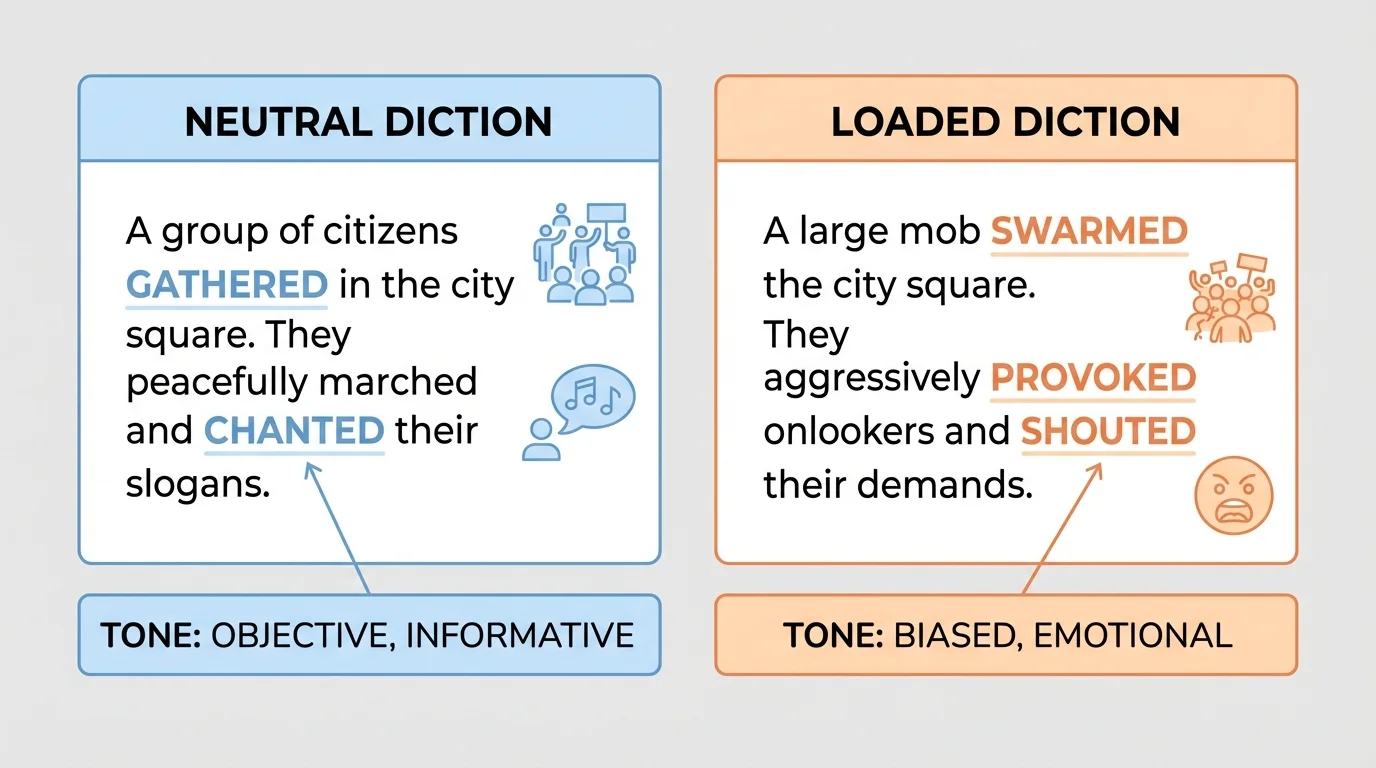
This is why strong analysis often moves from individual words to patterns. You may begin by noticing one verb, but then you should ask what larger pattern it belongs to. Are the adjectives mostly harsh? Are the images violent? Are the repeated words legal, religious, military, or scientific? Patterns reveal tone and purpose more clearly than isolated examples.
In literature, cumulative diction can reveal a speaker's outlook or a narrator's reliability. In argumentative writing, it can expose bias. In informational writing, it can signal whether the author aims for neutrality or persuasion. The more words work in the same direction, the stronger the tonal effect becomes.
Genre strongly shapes language. A court opinion and a newspaper article may discuss the same event, but they usually do so with different goals, audiences, and standards. Because of that, their diction, sentence structure, and tone differ sharply.
[Figure 3] A court opinion often uses formal, technical, and highly precise language. It may include terms such as precedent, jurisdiction, petitioner, statute, and majority opinion. Its sentences may be long because they define terms carefully, distinguish between cases, and state legal reasoning. The tone is typically authoritative, restrained, and analytical.
A newspaper article, by contrast, usually aims to inform a broad public quickly and clearly. It often uses shorter sentences, more accessible vocabulary, and a structure that highlights essential facts first. The tone may still be formal, but it is usually less specialized. Journalists often translate complex legal or political language into terms general readers can follow.
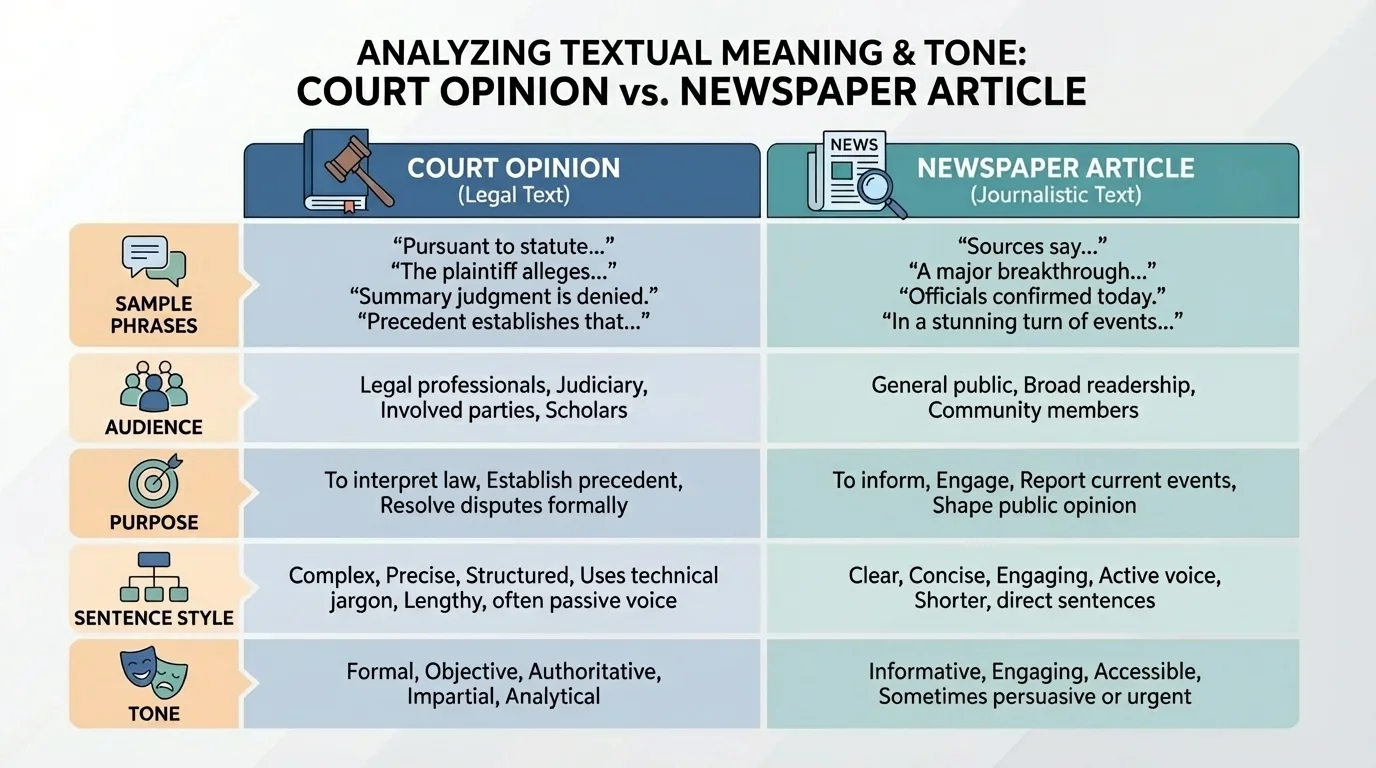
Consider this contrast. A court opinion might state, "The appellant failed to demonstrate that the search violated established constitutional protections under existing precedent." A newspaper article might report, "The court ruled that police did not break the law during the search." The second sentence is shorter and more direct, but it leaves out some technical precision. The first sentence sounds narrower, more formal, and more specialized.
The difference is not just vocabulary. It is also about purpose. Legal writing must document reasoning carefully because decisions carry institutional consequences. Journalism must communicate efficiently to readers who may not know legal terminology. When you compare text types, ask how audience and purpose influence word choice.
The same principle applies beyond law and journalism. A scientific paper sounds different from a magazine feature. A poem sounds different from a textbook chapter. A memoir sounds different from a police report. Each genre develops its own conventions of diction and tone, and readers should recognize those patterns.
One effective strategy is to annotate key words while reading. Circle or highlight verbs, adjectives, and repeated phrases. Then ask what they have in common. If a passage describing a city keeps using words like fractured, rusted, hollow, and fading, the pattern suggests decline or disillusionment.
A second strategy is to classify meaning. Ask whether a word is being used literally, figuratively, connotatively, or technically. Sometimes a single phrase does more than one of these at once. A word may be technically accurate and still emotionally charged.
A third strategy is to connect diction to tone with a precise explanation. Instead of writing, "The author uses strong words," write something like, "The author's repeated use of militaristic verbs such as attacked, defended, and targeted creates a combative tone." Specific analysis is always stronger than vague praise.
Close-reading example from nonfiction
Suppose an article describes a new technology with the words disruptive, revolutionary, accelerating, and transformative.
Step 1: Notice repeated connotations.
All four words suggest rapid change and major impact.
Step 2: Infer tone.
The diction creates an excited, forward-looking, and somewhat promotional tone.
Step 3: Evaluate effect.
The language encourages readers to see the technology as powerful and inevitable, rather than uncertain or limited.
This analysis explains not only what the words mean but also how they work together.
You should also pay attention to what is missing. If a text avoids emotional language, that absence can itself be meaningful. A deliberately neutral tone can signal professionalism, objectivity, or emotional suppression, depending on context.
Analyzing word choice is not only an English-class skill. It matters in civic life, media literacy, and professional communication. Public arguments often depend on framing. Whether a policy is described as relief, spending, investment, or burden can influence public reaction before readers even examine evidence. Recognizing diction helps you think independently rather than simply absorbing a writer's attitude.
In literature, this skill allows you to move beyond plot summary into interpretation. You begin to see how writers construct a voice, how they guide sympathy, and how they shape themes through language. A character may never say "I am afraid," yet fearful diction can make that clear. A poem may never define hope, yet bright, upward-moving language can create it.
In academic and professional settings, attention to word choice also improves your own writing. If you understand how diction affects tone, you can choose whether to sound analytical, persuasive, formal, skeptical, or reflective. Good readers often become better writers because they learn to hear the effect of language.
Ultimately, close attention to words trains you to notice how texts work at the sentence level and across the whole piece. Meaning is built word by word, phrase by phrase, pattern by pattern. That is what makes reading both demanding and powerful.
