A single speech can start a movement, damage a reputation, or change a nation's policy. That is the power of rhetoric. When you read a speech, editorial, essay, open letter, or even a carefully crafted social media post, you are not just receiving information. You are encountering a set of choices. The writer chooses what to emphasize, what to leave out, what emotions to stir, and what pattern of ideas will lead an audience toward a conclusion. To read well at the high school level, you must be able to determine what the author thinks or wants and explain how the text is built to achieve that goal.
Determining an author's point of view or purpose means looking beyond the topic. Two texts may both discuss climate policy, education, artificial intelligence, or public health, yet one may warn, another persuade, another celebrate, and another call readers to action. A strong reader asks: What is the author trying to accomplish? and How does the language help accomplish it? Those questions are central to analysis in literature, history, journalism, and civic life.
Every serious text is shaped by a perspective. An author may write as a critic, advocate, eyewitness, expert, reformer, storyteller, or satirist. That perspective influences not only what the author says but also how the author says it. If you miss the point of view, you may misunderstand the entire text. If you miss the purpose, you may confuse a warning for a celebration or mistake irony for sincerity.
These skills matter outside school too. Political speeches, product campaigns, documentaries, opinion columns, and public statements all try to direct attention and influence judgment. The more complex the text, the more important it becomes to track how the author organizes ideas and uses rhetoric. Critical reading is not distrust for its own sake; it is disciplined attention to how meaning is constructed.
Point of view is the author's perspective, attitude, or position on a subject. Purpose is the author's reason for writing, such as to inform, persuade, entertain, criticize, inspire, warn, or call to action. Rhetoric is the strategic use of language and structure to achieve a purpose with a particular audience.
An author's purpose is often more specific than a general label like "to persuade." For example, an editorial might aim to persuade readers that schools should start later in the morning because sleep affects learning. A reform speech might aim to convince citizens that moral urgency requires immediate action. A memoir passage may aim to help readers understand lived experience. Strong analysis names the specific purpose, not just the broad category.
When analyzing a text, it helps to separate several closely related ideas. A claim is the main assertion the author wants readers to accept. The audience is the group the author addresses or hopes to influence. Tone is the author's attitude toward the subject or audience, revealed through language. A counterclaim is an opposing viewpoint the author may acknowledge and answer. A rhetorical strategy is a deliberate method, such as repetition or analogy, used to influence readers.
These ideas work together. Suppose a writer's claim is that public libraries deserve more funding. The writer's audience might be taxpayers or local officials. The tone might be urgent but respectful. The purpose might be to persuade the community that libraries are essential civic institutions. The rhetoric would include the methods used to make that case convincing.
Remember that identifying the topic is only the starting point. "School lunches," "space exploration," or "freedom" names a subject, not an argument. Analysis begins when you identify what the author believes, values, or wants readers to do about that subject.
Point of view and purpose can be explicit or implicit. Sometimes an author states a thesis directly: "We must act now." Sometimes the purpose emerges through examples, tone, and structure. Satire is a good example. A satirical writer may appear to praise something while actually exposing its absurdity. In such cases, literal statements alone do not reveal the real point of view. You must notice the gap between what is said and what is meant.
Strong readers follow the logical progression of a text. Authors rarely place ideas randomly. They arrange them so that each part prepares for the next. In an argument, a writer may begin with a problem, introduce a claim, develop reasons, supply evidence, address objections, and end with a conclusion or call to action. Understanding this sequence helps you see how rhetoric works across the whole text, not just in isolated sentences.
[Figure 1] Look for signal moves. Does the introduction create urgency? Does the second paragraph define the issue? Do later paragraphs add proof, historical context, or emotional impact? Does the conclusion widen the issue into a moral or civic question? When you notice progression, you can explain why a certain paragraph appears where it does. That is a major part of analyzing craft and structure.
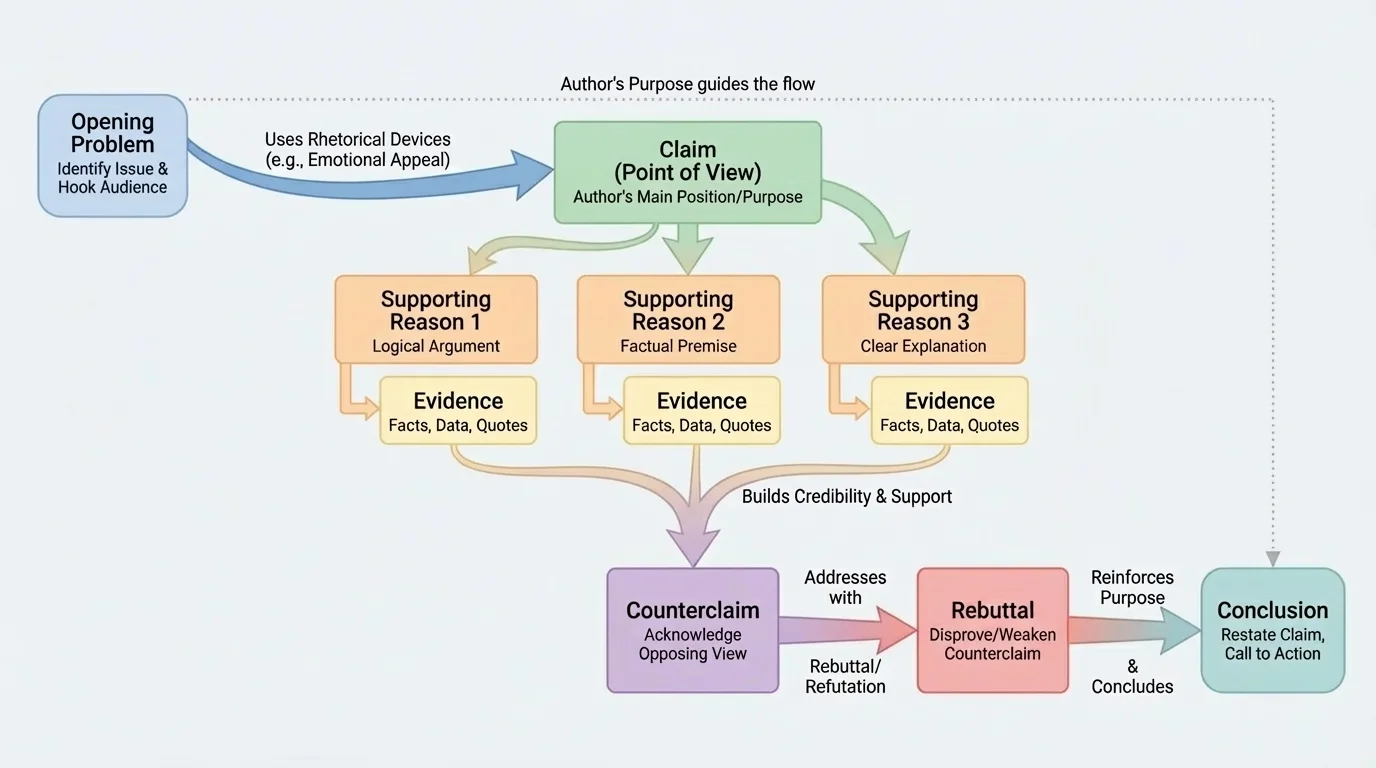
Consider a speech arguing that a city should expand public transportation. The author might open with traffic frustration that many listeners know firsthand. Next comes the claim that expanded transit benefits workers, students, and the environment. Then the author presents statistics, expert testimony, and cost comparisons. After that, the speech answers the objection that such projects are too expensive. Finally, it closes by framing transportation as an issue of fairness and opportunity. The order matters. It moves the audience from recognition to agreement.
Authors also use comparison, contrast, cause and effect, problem and solution, chronology, or question and answer structures. A historical essay may proceed chronologically to show how an idea developed over time. An opinion piece may use problem and solution to move readers from concern to support. A literary nonfiction text may alternate personal anecdote with analysis so readers feel both emotion and reflection. As you saw in [Figure 1], understanding where a text begins and where it intends to lead the reader makes purpose much easier to identify.
Structure shapes persuasion. The arrangement of ideas is not separate from meaning. An author who delays a key claim may be building suspense or preparing readers emotionally. An author who places a counterargument near the end may be trying to appear fair-minded while keeping the final emphasis on the original position. Organization itself is rhetorical.
When analyzing progression, ask not only what comes next but why it comes next. A paragraph of statistics after an emotional anecdote may strengthen credibility. A brief sentence after a long explanation may sharpen urgency. A final image or repeated phrase may leave the audience with a memorable emotional response.
One of the most useful ways to analyze rhetoric is to identify the appeals the author uses. The three classic appeals are ethos, pathos, and logos. These appeals often work together rather than separately.
[Figure 2] Ethos is appeal through credibility, character, or trustworthiness. An author may build ethos by showing expertise, fairness, experience, or moral seriousness. A doctor writing about vaccination may cite medical experience. A reformer may build ethos by acknowledging complexity rather than oversimplifying.
Pathos is appeal through emotion. This does not mean "manipulation" by definition. Emotion is part of human judgment. An author may use vivid imagery, personal stories, charged diction, or powerful examples to create sympathy, fear, pride, outrage, or hope.
Logos is appeal through reason, evidence, and logic. This includes facts, examples, statistics, definitions, cause-and-effect reasoning, and clear explanation. A strong logical appeal often depends on whether the evidence is relevant, sufficient, and well interpreted.
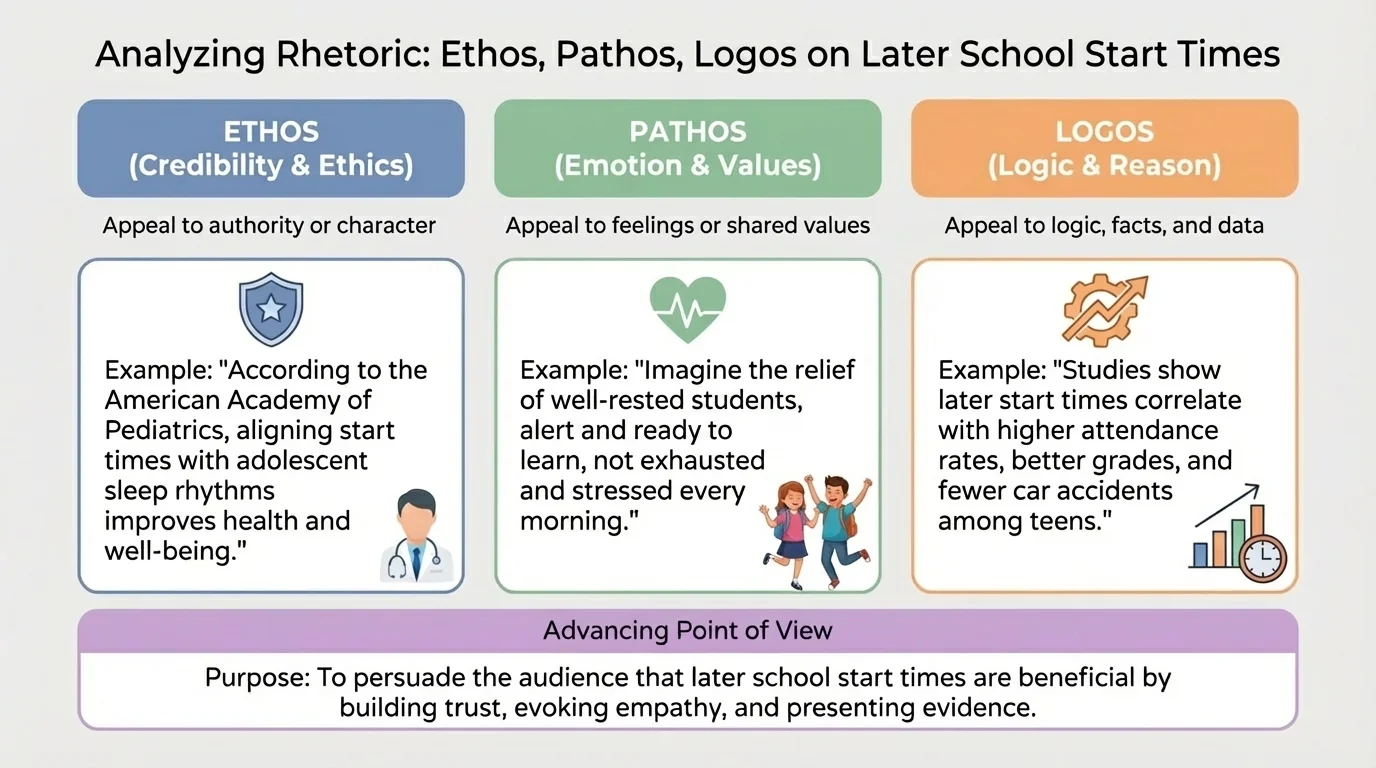
Take an argument for later school start times. An ethos appeal might mention pediatric sleep researchers and school administrators with successful results. A pathos appeal might describe a teenager falling asleep over homework at midnight and waking before sunrise. A logos appeal might present evidence connecting sleep to memory, reaction time, and academic performance. The author's purpose is advanced most powerfully when these appeals reinforce one another.
Rhetorical analysis also includes specific devices. Repetition emphasizes an idea and makes it memorable. Parallelism creates balance and rhythm. Analogy explains one idea by comparing it to another. Rhetorical questions guide readers toward a conclusion without requiring an answer. Allusion connects a text to a shared cultural, historical, or literary reference. Loaded diction uses words with strong positive or negative associations. Irony creates meaning through contrast between appearance and reality.
For example, a speaker might say, "We waited through warnings, we waited through losses, we waited through excuses." The repetition of "we waited" builds rhythm and frustration. If the speaker then asks, "How much longer should a community wait for clean water?" the question intensifies pressure on the audience. Later, if the speaker cites documented contamination levels, logos joins pathos. The text becomes persuasive not because of a single trick but because multiple choices work together.
The terms ethos, pathos, and logos come from ancient Greek rhetorical study, but the ideas remain central in modern media analysis. Advertisements, campaign speeches, and advocacy videos still rely on the same basic appeals.
Be careful, however, not to label devices mechanically. Saying "the author uses pathos" is only a start. Effective analysis explains how the pathos works, why it appears at that moment, and what effect it has on the intended audience.
Rhetorical effect often becomes most visible at the sentence level through repeated phrasing, emotional diction, and sentence length. A writer's diction includes the specific words chosen, and those choices matter. Calling a group "citizens" feels different from calling them "consumers." Calling an event a "tragedy," a "setback," or a "challenge" signals different attitudes and purposes.
[Figure 3] Syntax, or sentence structure, also shapes impact. Long, layered sentences can sound thoughtful, formal, or complex. Short sentences can feel urgent, blunt, or dramatic. Fragments, when used intentionally, can create emphasis. A writer may shift from careful explanation to sharp directness to signal that a key point has arrived.
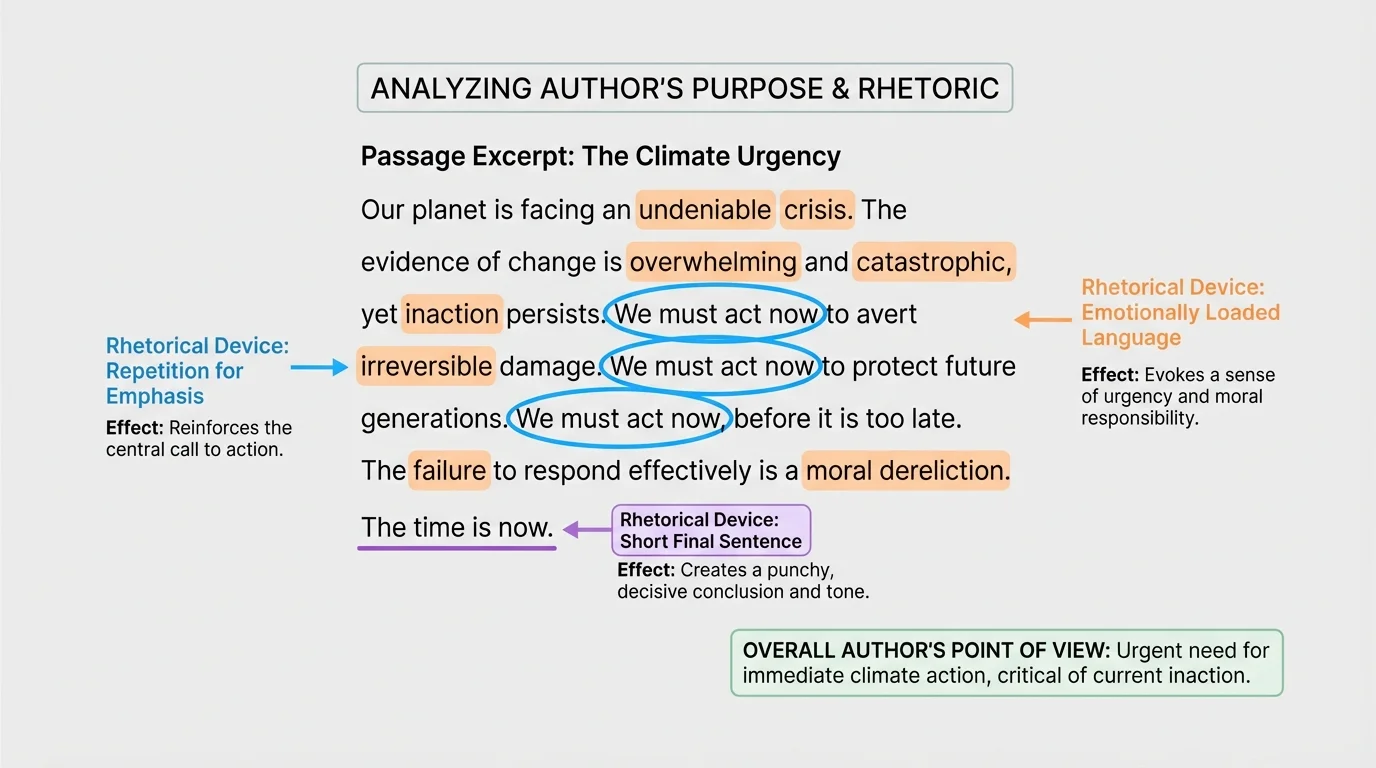
Tone emerges from these choices. A text can be admiring, skeptical, mournful, bitter, hopeful, sarcastic, reflective, defiant, or restrained. Tone is not just an emotion word chosen at random; it must be supported by evidence from language. If a speech repeatedly uses words like "duty," "sacrifice," and "honor," the tone may be solemn and patriotic. If an essay uses understatement and dry wit to expose hypocrisy, the tone may be ironic or satirical.
Writers also shape purpose through what they include first and last. Openings can establish urgency, credibility, or curiosity. Conclusions can broaden the issue, intensify feeling, or issue a direct call to act. Transitional phrases such as "however," "more importantly," "by contrast," and "therefore" guide readers through relationships among ideas. As shown earlier in [Figure 3], even a simple repeated phrase can unify a passage and turn a general point into a memorable argument.
| Text Feature | What to Notice | Possible Effect on Purpose |
|---|---|---|
| Diction | Formal, emotional, technical, neutral, loaded | Shapes attitude and influences reader response |
| Syntax | Short, long, varied, repetitive, parallel | Creates pace, emphasis, and tone |
| Imagery | Sensory details and vivid descriptions | Makes ideas concrete and emotionally vivid |
| Repetition | Repeated words, phrases, or patterns | Emphasizes central ideas and improves memorability |
| Structure | Order of claims, evidence, and counterclaims | Guides reasoning and builds persuasion |
Table 1. Major text features that help authors advance point of view and purpose.
In literary nonfiction and speeches, figurative language can also carry argument. A metaphor may transform an issue into a vivid image readers can grasp instantly. If a speaker calls injustice "a wall built stone by stone," the metaphor suggests difficulty, history, and the need for collective effort. Figurative language is not decoration alone; it can compress a full argument into a memorable phrase.
Different genres use rhetoric differently. In a speech, delivery and rhythm often matter, even when you read only the transcript. Repetition, parallel structure, and strategic pauses can create momentum. In an editorial, evidence, counterargument, and concise reasoning may matter more. In an advertisement, visual cues and slogans may compress ethos, pathos, and logos into a few seconds. In a historical document, word choice may reveal the values and assumptions of a particular time.
Suppose you read a wartime speech urging national sacrifice. The point of view may be that collective action is necessary and honorable. The purpose may be to unite citizens and justify difficult choices. Rhetoric might include patriotic diction, shared pronouns such as "we," references to duty, and elevated tone. Now compare that with a modern investigative article on government waste. Its point of view may be skeptical. Its purpose may be to expose failures and demand accountability. Its rhetoric may rely more heavily on documented evidence, interview excerpts, and careful contrast between promise and reality.
Case study: analyzing a reform speech
Consider this invented line from a speech: "A school without books is not only underfunded; it is a promise broken in public."
Step 1: Determine point of view
The speaker clearly believes that inadequate school funding is a serious injustice, not a minor budget issue.
Step 2: Determine purpose
The purpose is to persuade listeners that funding education is a moral and civic responsibility.
Step 3: Analyze rhetoric
The phrase "promise broken in public" uses emotionally charged language and metaphor. It shifts the issue from accounting to ethics, increasing urgency and accountability.
This analysis goes beyond paraphrase because it explains how the language advances the speaker's goal.
In literary essays and memoirs, authors may blend narrative and argument. A personal story can establish ethos by showing lived experience. A reflective passage can reveal values. A sudden shift in tone can signal the deeper purpose of the narrative. A memoir about migration, for instance, may not merely recount events; it may seek to challenge stereotypes, preserve memory, or argue for empathy.
A strong analytical response usually begins with a focused claim about purpose or point of view. Then it uses evidence from the text and explains how that evidence functions rhetorically. Notice the difference between weak and strong analysis.
Weak: "The author uses rhetoric to persuade the audience."
Stronger: "The author argues that public neglect of local rivers is both environmentally dangerous and morally irresponsible, using vivid imagery of polluted water, expert testimony, and repeated appeals to community duty to turn concern into civic urgency."
The stronger version names the specific point of view, the specific purpose, and the rhetorical methods. It also hints at effect.
Model analytical paragraph
An author writing about food insecurity might begin with statistics, but if the conclusion shifts to a story about a student hiding hunger at school, the structure itself becomes persuasive. The early numbers establish logos and credibility, while the later anecdote activates pathos. This progression leads readers from abstract scale to human reality, strengthening the author's purpose of convincing the audience that hunger is not a distant issue but an immediate local responsibility.
When you analyze, quote or paraphrase carefully. Choose evidence that reveals strategy, not just subject matter. Then explain the connection between that evidence and the author's purpose. Useful sentence patterns include: "The author's use of ___ suggests ___." "By placing ___ after ___, the author ___." "The repeated phrase ___ emphasizes ___ and encourages the audience to ___." "The shift from ___ tone to ___ tone reveals ___."
It also helps to consider audience response. A text aimed at voters may use a different strategy than one aimed at experts. A youth audience may respond differently from a professional audience. The same rhetorical device can have different effects depending on context. A highly emotional appeal may inspire one audience and alienate another. That is why strong analysis often includes the phrase "for the intended audience."
"Words are, of course, the most powerful drug used by mankind."
— Rudyard Kipling
Evidence-based analysis means grounding every claim in the text. Do not assume intention without support. Instead of saying "the author wants to trick readers," point to exaggeration, omission, or emotionally loaded comparisons and explain their likely effect. Academic analysis remains careful, specific, and fair.
One common mistake is confusing summary with analysis. Summary tells what the text says. Analysis explains how the text works. If you write, "The article discusses pollution and gives examples," you have summarized. If you write, "The article begins with local examples of pollution to create immediacy, then expands to national statistics to argue that the problem is systemic," you have analyzed structure and rhetoric.
Another mistake is confusing topic with purpose. "The text is about voting" is not enough. Ask what the author wants readers to think, feel, or do about voting. Also avoid reducing rhetoric to a checklist. A text does not become fully understood just because you identified ethos, pathos, and logos once each. The real work is explaining why those choices matter in context.
A final mistake is ignoring complexity. Some authors have multiple purposes. A documentary narration may inform and persuade at the same time. A speech may honor the past while also urging future action. A satirical essay may entertain while criticizing. Mature reading allows for layered purpose, mixed tone, and tension within the text.
When you read attentively, you begin to see that rhetoric is not only in famous speeches. It appears in op-eds, campaign videos, open letters, investigative reports, memoirs, and arguments shared online every day. The ability to identify point of view, define purpose, trace logical progression, and analyze rhetorical choices gives you power as a reader. It helps you understand not just what texts say, but how they attempt to shape thought itself.
