A gripping story is rarely gripping because of a single dramatic moment. It works because one moment leads to the next. A missed text message turns into an argument. The argument leads to a risky decision. That decision reveals a secret. In strong narrative writing, events do not sit beside one another like disconnected snapshots; they connect like links in a chain. When writers sequence events effectively, readers feel that the story is moving with purpose, even when the plot becomes complex.
Sequencing is more than putting events in order. It is the art of arranging experiences so that each event develops character, deepens conflict, and prepares the reader for what comes next. This matters in realistic fiction, memoir, personal narrative, and even highly imaginative stories. Whether a writer tells one plot line or several, the sequence must feel deliberate. If readers cannot tell why something happened, when it happened, or how it connects to the larger story, the narrative begins to lose power.
A coherent narrative feels unified. Readers understand not only what happens but also why it happens in that order. Good sequencing creates clarity, but it also creates suspense, surprise, and emotional force. A writer may choose to reveal an event immediately, delay it, or return to it later. Each choice changes the reader's experience.
Consider two versions of the same situation. In one, a student storms out of a classroom, and only afterward does the reader learn that the student has just seen a message announcing a family emergency. In another, the reader sees the message first and then watches the student leave. The facts are almost identical, but the sequence changes the effect. The first version creates mystery; the second creates immediate sympathy. Sequence is therefore not just structure. It is meaning.
Event sequence is the order in which actions, decisions, and experiences are presented in a narrative.
Coherence is the quality of making a piece of writing feel logically connected and easy to follow.
Pacing is the speed at which a narrative moves through events.
At the high school level, strong sequencing also shows control. A writer is not simply recording everything that happened. A writer is selecting, arranging, and emphasizing. That control becomes especially important in narratives with shifting time frames, multiple characters, or intersecting conflicts.
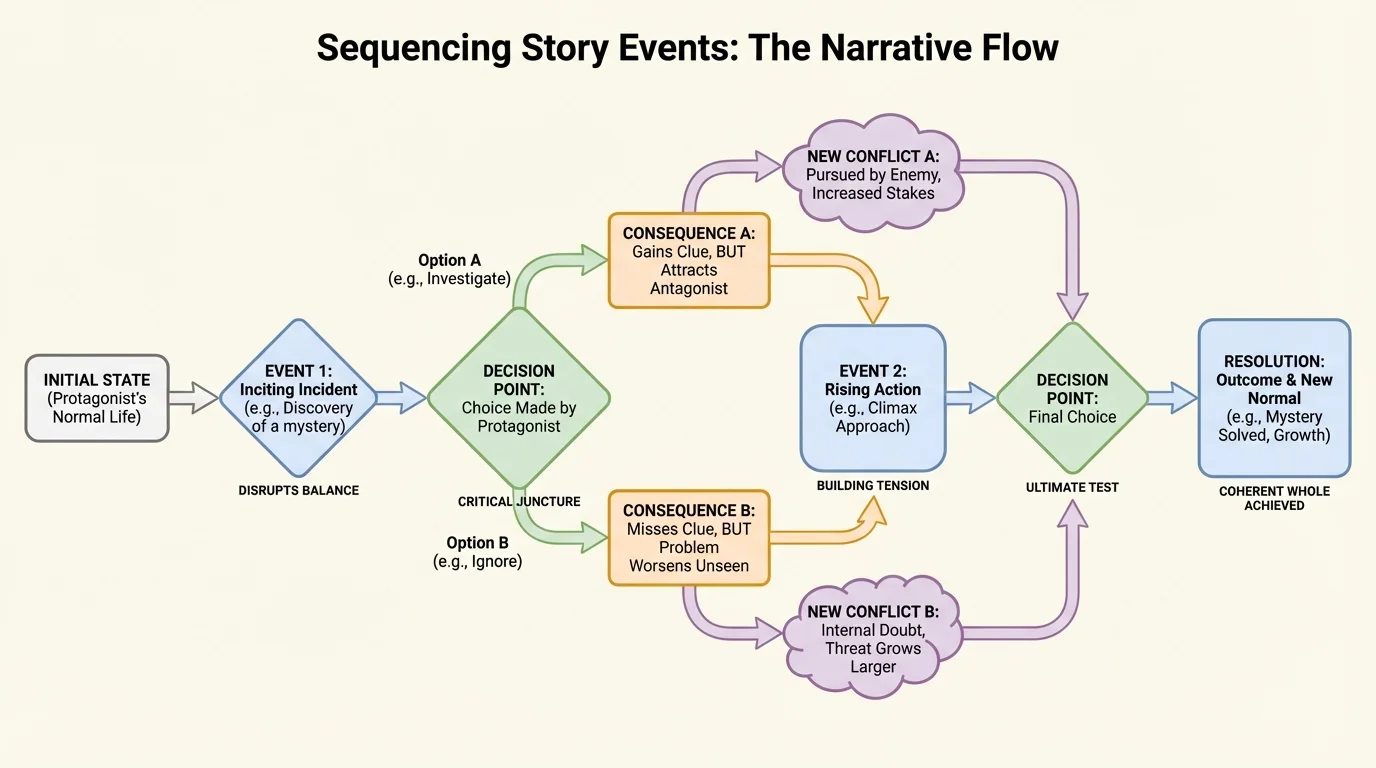
Coherence depends on connection. In a well-structured story, events are tied together by cause and effect, as [Figure 1] illustrates through a chain of action, consequence, and new conflict. One event changes the situation, and that change creates the conditions for the next event. Readers should be able to trace the logic: because this happened, that became possible or necessary.
Motivation is part of that logic. If a character suddenly makes a major decision, the narrative should provide enough context for the decision to feel believable. The character does not need to behave perfectly or wisely, but the behavior should make sense in relation to earlier events, emotions, and pressures.
Time relationships matter too. Readers need cues that tell them whether events are happening immediately, hours later, months later, or in memory. Without those cues, a narrative can feel scrambled even when the ideas themselves are interesting. Sequence is coherent when the reader can orient themselves in the story's timeline without constant confusion.
Another element is significance. Not every event deserves equal space. Important scenes should be developed enough to show their impact, while less important material can be compressed. If a story spends two long paragraphs on breakfast but only one sentence on the argument that changes everything, the sequence may technically be correct but artistically unbalanced.
Think of narrative sequence as architecture. The reader should feel that the story stands because its parts support one another. Random detail weakens that structure. Carefully arranged events strengthen it.
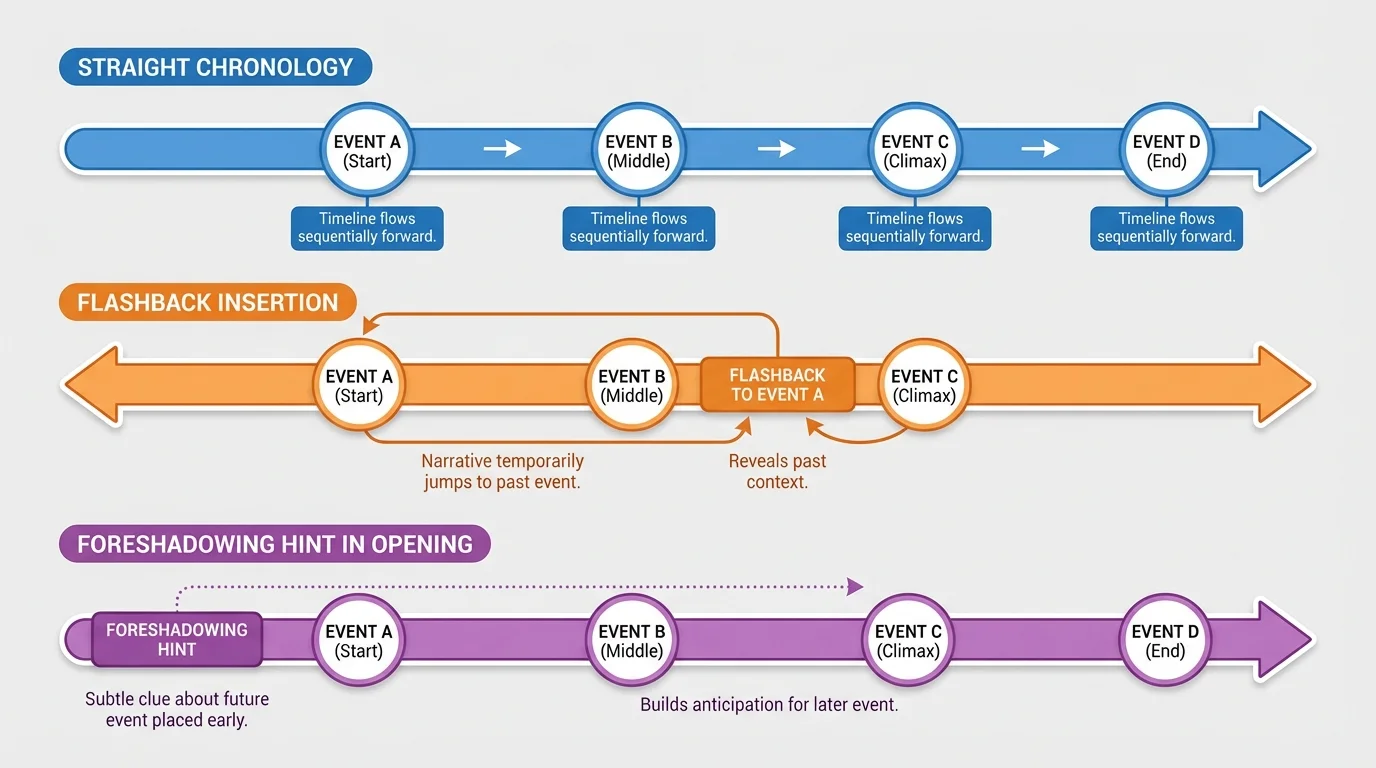
Writers use several techniques to arrange events, and the best choice depends on what effect they want. The same set of events can be organized in different ways, as [Figure 2] shows through a comparison of straight chronology, flashback, and foreshadowing. Effective technique does not mean complexity for its own sake. It means choosing a sequence that best serves the story.
Chronological order is the most direct method. Events are presented in the order they happen. This works well when the narrative depends on steady development, such as a competition, a journey, a relationship, or a day in which each decision leads naturally to the next.
Flashback interrupts the present action to reveal an earlier event. This technique can deepen character, explain motivation, or reframe what the reader thinks they understand. A flashback works best when it has a clear purpose. If it appears without a strong reason, it can feel like an interruption rather than an insight.
Foreshadowing hints at what will happen later. It prepares the reader without giving everything away. A small image, a nervous comment, or a detail that seems minor at first can gain importance later. Foreshadowing helps events build because it creates expectation.
In medias res begins a story in the middle of action, then fills in earlier events later. This can create immediate energy. However, the writer must eventually provide enough context for readers to understand what is happening and why it matters.
Scene and summary are also sequencing tools. A scene slows down time and presents events in detail, often with dialogue and sensory description. A summary moves quickly over a longer period. Skilled writers alternate between them so that the narrative does not feel rushed or overloaded.
Strategic withholding means delaying certain information until the right moment. This can build suspense, but it must be fair. Readers should feel curious, not manipulated. If essential information is hidden too long without purpose, confusion replaces tension.
Technique and purpose
A sequencing technique is successful only when it helps the reader understand the story more deeply. A flashback should reveal something important. Foreshadowing should sharpen anticipation. A time jump should move the narrative efficiently without leaving the reader lost. Structure is not decoration; it is part of storytelling itself.
For example, suppose a story ends with a runner collapsing just before the finish line. If the narrative opens with that collapse and then returns to the weeks of pressure, injury, and family expectation that led there, the event gains emotional weight. If the story simply moves from practice to race in strict order, the effect may be steadier but less startling. Neither sequence is automatically better. The writer's purpose determines the strongest choice.
A coherent sequence does more than avoid confusion. It creates momentum. Each event should leave the story in a different state than before. The conflict may intensify, relationships may shift, or the stakes may rise. If an event changes nothing, it may not belong in the narrative.
One helpful question is: What does this event cause? If a scene introduces a problem, the next scene might show the attempt to solve it. If that attempt fails, the failure should produce a new complication. This pattern of pressure and response makes a narrative feel alive.
Notice how consequence shapes momentum. A character lies to protect a friend. The lie forces the character to hide evidence. Hiding the evidence makes another character suspicious. Suspicion leads to confrontation. The sequence is effective because each event grows from the one before it. This is the same logic shown earlier in [Figure 1]: action produces consequence, and consequence creates fresh conflict.
Writers also build momentum by controlling what the reader knows. If the reader knows more than the character, the sequence may create dramatic irony. If the character knows more than the reader, the sequence may create mystery. If both learn together, the sequence may create discovery. The order of information matters as much as the order of action.
Case study: weak sequence vs. strong sequence
A student is preparing for a debate championship.
Step 1: Weak sequence
The narrative shows the student eating lunch, then remembering a childhood pet, then arriving at the debate, then suddenly arguing with a teammate, then mentioning that the team nearly got disqualified last week. The events may all be interesting, but they do not build clearly.
Step 2: Stronger sequence
The story begins with news that the team may be disqualified because a teammate failed to submit evidence correctly. The main character blames the teammate, tension rises during practice, and that conflict carries into the championship round. During the debate, the main character must decide whether to trust the same teammate's risky strategy.
Step 3: Why the second sequence works
Each event creates pressure for the next one. The argument is not random; it grows from the disqualification threat. The final decision matters because the earlier events established mistrust.
Momentum does not always mean constant action. A quiet scene can still build on earlier events if it changes the reader's understanding or pushes a character toward a new decision. The key is progression, not noise.
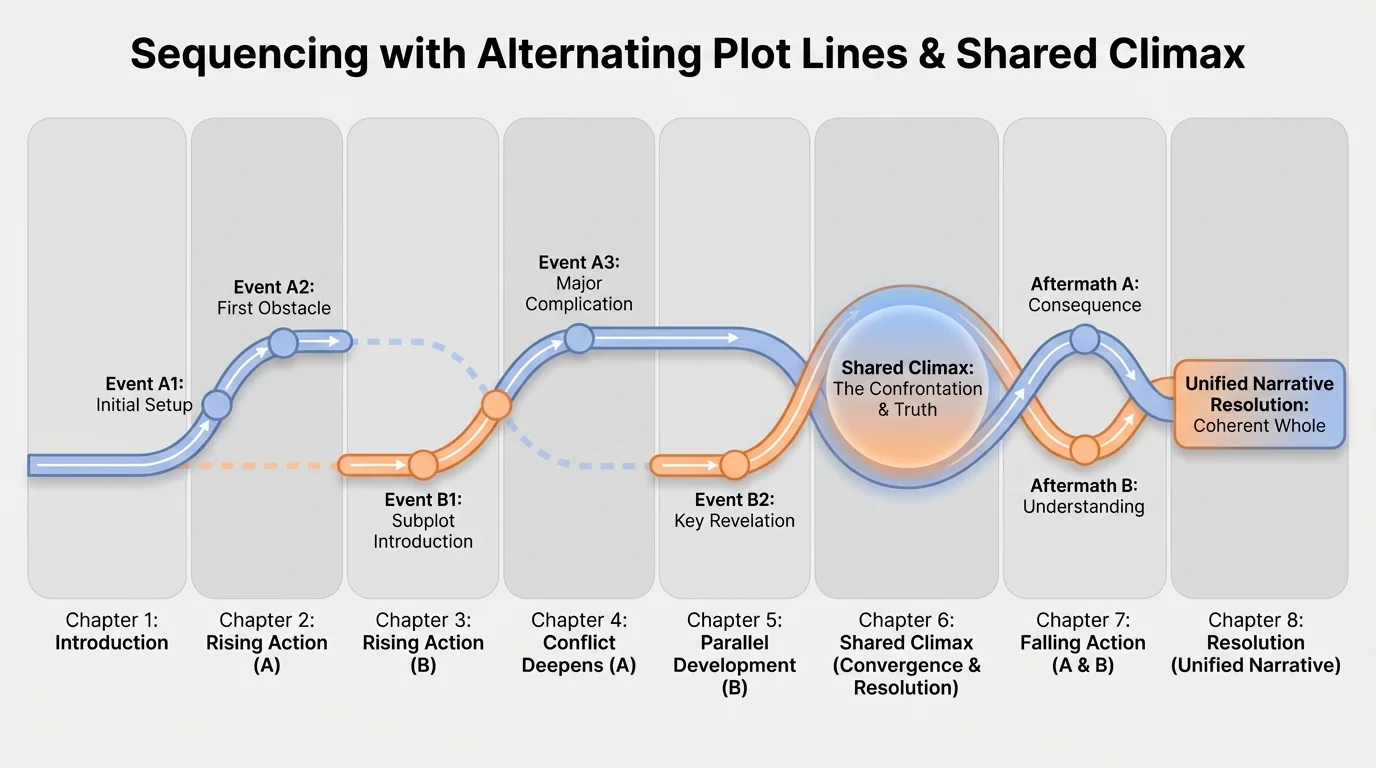
Some narratives follow more than one conflict or more than one character. In these cases, parallel plot lines must be arranged in a pattern readers can track, as [Figure 3] demonstrates with alternating strands that meet at important points. A subplot should not feel like a detour with no connection to the main story. Instead, it should echo, contrast with, or complicate the central conflict.
Writers often braid plot lines by alternating scenes. For instance, one chapter may follow a musician preparing for an audition, while another follows the musician's brother trying to hide a family financial crisis. These plot lines remain separate at first, but eventually they intersect when the audition fee becomes impossible to pay. The intersection makes the structure feel purposeful.
Clear anchors are essential. Readers need to know whose perspective they are following, where the action is taking place, and how much time has passed since the previous section. Repeating a structural pattern can help. If a story consistently alternates between Plot Line A and Plot Line B, the reader learns how to move through it.
Balance matters as well. If one plot line is far more developed than another, the weaker one may feel unnecessary. Each line should contribute distinct tension or insight. In many strong narratives, subplots test the same theme from another angle. A story about trust, for example, might include one plot line about friendship and another about family loyalty.
When multiple plot lines converge, the convergence should feel earned. The reader should be able to look back and see how the structure prepared for that meeting point. Random convergence feels convenient; prepared convergence feels satisfying.
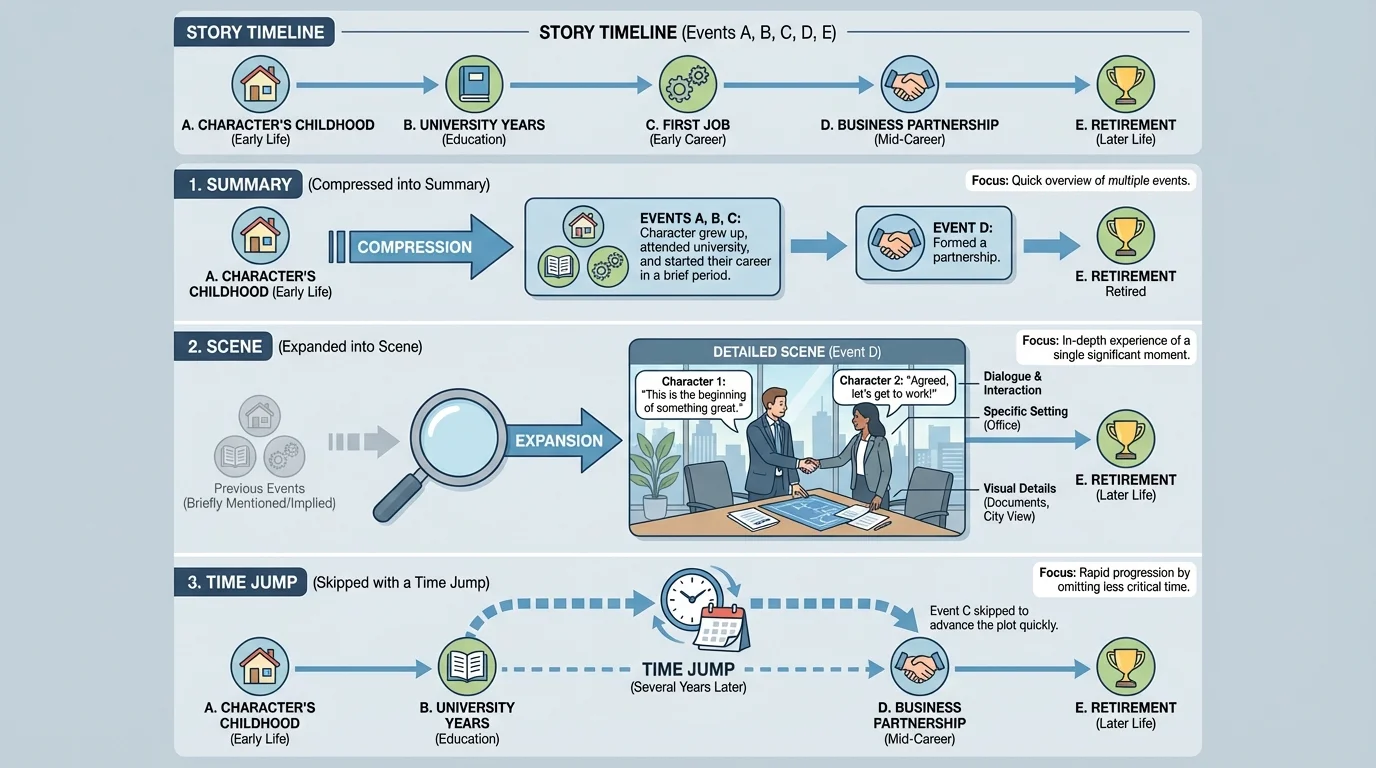
Writers do not merely report time; they shape it. Narrative time can stretch, compress, pause, or leap forward, and [Figure 4] shows how the same period can be told as a detailed scene, a brief summary, or a jump across time. This control allows writers to emphasize what matters most.
A scene often covers a short span of time in detail. Dialogue, gesture, and sensory detail make the moment immediate. A summary covers a longer stretch quickly: days of training, weeks of silence, or months of recovery can pass in a few sentences. A time jump skips ahead entirely. Each choice affects pacing.
Writers sometimes use a time marker to orient readers. Phrases such as three days later, by winter, or that same evening can anchor a shift. More subtle markers also work, such as seasonal change, graduation, a healed injury, or a phone battery that has dropped from full charge to nearly dead during a single tense afternoon.
Compression and expansion should match importance. A decisive confrontation usually deserves a scene. A routine commute usually does not, unless something crucial happens during it. Writers who treat every minute with equal attention often create narratives that feel flat. Variation in pacing helps readers sense where the true pressure points lie.
Later in a narrative, readers often depend on time control to understand emotional development. A sentence like For two months, he avoided the court can reveal more than a long, repetitive description of every day of avoidance. Then, when the character finally returns, the narrative can slow down again. That contrast gives the return significance, just as the pacing shifts shown in [Figure 4] make emphasis visible.
Many films tell stories out of order, but viewers still follow them because directors use the same tools writers do: visual cues, repeated motifs, clear transitions, and carefully timed revelations.
Strong narratives are rarely tied to one speed. They accelerate and decelerate according to meaning.
Even the best event order can fail if transitions are weak. A transition is any word, phrase, sentence, or structural move that helps the reader travel from one moment to the next. Some transitions signal time: meanwhile, later that night, at dawn. Others signal contrast or consequence: however, because of that, as a result.
Transitions can also be embedded in imagery or repeated details. A story may move from one scene to another through the sound of a siren, a recurring phrase from a voicemail, or the sight of a torn team jacket that appears in different contexts. These repeated elements can make shifts feel smoother and more intentional.
Paragraphing helps too. A new paragraph can highlight a change in focus, pace, or action. A scene break can signal a larger shift in time, place, or perspective. The important thing is that the writer gives the reader enough guidance to follow those moves without confusion.
| Sequencing Tool | Main Purpose | Typical Effect on the Reader |
|---|---|---|
| Chronological order | Show events in chronological order | Clarity and steady development |
| Flashback | Reveal earlier information | Depth, explanation, re-interpretation |
| Foreshadowing | Hint at later events | Anticipation and tension |
| Scene | Expand important moments | Immediacy and emotional intensity |
| Summary | Compress less important time | Efficiency and forward movement |
| Time jump | Skip ahead | Focus on major changes |
| Alternating plot lines | Develop multiple conflicts | Complexity with pattern |
Table 1. Major sequencing tools and their common effects in narrative writing.
One common problem is the subplot that disappears. A writer introduces a side conflict, then forgets to develop or resolve it. This weakens coherence because readers have been taught to expect significance from what the narrative emphasizes.
Another problem is the random scene: an event that may be vivid on its own but does not change the story. Writers sometimes keep such scenes because they contain strong description or dialogue. However, if the event does not deepen character, shift conflict, or prepare a later development, it may interrupt the sequence rather than strengthen it.
Unclear time shifts also cause trouble. If a flashback begins without a signal, readers may briefly think the earlier event is happening in the present timeline. If too many major events happen without transition, the narrative may feel rushed. If too little happens for too long, the pacing drags.
A subtler problem is repetition without escalation. A character can argue with a parent in several scenes, but those scenes should not all perform the same job. Each one should reveal something new, increase pressure, or alter the relationship. Repeated events need progression.
Readers do not need every detail from a writer's imagination or memory. They need the details that help them follow the sequence, understand the stakes, and interpret the characters' choices.
Strong sequencing often depends on what the writer leaves out. Selection is part of structure.
Consider this short example: At 6:10, Mara sees her brother's bike still in the driveway. By 6:12, the storm siren has started. At 6:15, she realizes he never made it home from practice. She runs toward the field. This sequence works because each detail increases urgency. The bike matters because it signals absence. The siren matters because it raises the danger. The realization matters because it changes Mara from observer to actor.
Now consider a more layered example with altered time: When Theo unlocks the storage unit, he already knows what he will find: the trumpet case, the old uniform, the unopened letter. Only later does the reader learn that he quit the band after his father collapsed during the state finals two years earlier. Here, the narrative withholds the full past at first. The present scene creates mystery, and the later revelation adds emotional depth. The sequence is coherent because the delayed information answers a question the story has already raised.
Model passage analysis
Janelle hears the voicemail before sunrise. She deletes it without listening to the end. At school, she learns that the robotics team captain quit overnight. By lunch, she understands that the unfinished design on her laptop is now the team's only chance to compete. That evening, she reopens the voicemail and hears her mother say, "Call me when you're ready to stop running."
Step 1: Opening disturbance
The voicemail introduces tension before the main school conflict appears.
Step 2: Escalation
The captain's exit raises the external stakes and connects personal pressure to public responsibility.
Step 3: Return and deepening
The final event circles back to the voicemail, linking the two conflicts and suggesting that Janelle's emotional avoidance affects her leadership.
This kind of sequencing is powerful because it creates echoes across the narrative. Events do not simply happen once and vanish. They return with increased meaning.
Writers often discover the best sequence during revision rather than during the first draft. One useful strategy is to list the major events in plain language. Then ask: Which event starts the real conflict? Which event changes the stakes? Which event belongs earlier or later for greater clarity or impact?
Another strategy is to test the links between events. After each major moment, write a quick note beginning with therefore or but. For example: She missed the train; therefore she arrived late to the interview. Or: He apologized; but the apology exposed another lie. If those links are weak, the sequence may need reworking.
Writers should also track each plot line separately. This is especially helpful when working with multiple characters or a subplot. By mapping where each thread begins, develops, and resolves, a writer can see whether one thread disappears for too long or returns without preparation. The braided structure in [Figure 3] offers a useful model: alternating strands need pattern and payoff.
Finally, read for reader orientation. Are time shifts signaled? Are motivations clear? Does each important event receive enough space? Do the final events feel prepared by what came before? Revision is not just correction. It is arrangement.
"The order of the telling controls the order of understanding."
— Narrative principle
When event sequence is strong, readers move through the narrative with trust. They may be surprised, unsettled, or even temporarily disoriented in a purposeful way, but they are not abandoned. The story feels shaped. That sense of design is one of the clearest signs of mature narrative writing.
