A powerful presentation can change how people think, vote, study, or act. A student speaking for five minutes in class may be doing something not so different from a scientist presenting research, a lawyer making an argument, or a community leader proposing a solution. In every case, the speaker must do more than speak. The speaker must guide listeners through ideas in a way that is clear, convincing, responsible, and worth paying attention to.
Speaking is one of the most visible forms of thinking. When you present information aloud, your audience can hear not only what you believe, but also how you reached that belief. That is why strong oral communication matters in school, the workplace, and public life. Whether you are giving a classroom presentation on climate policy, leading a team update, explaining lab results, or making a speech at a school board meeting, listeners need to follow your reasoning without getting lost.
Good speaking is not just about confidence or personality. It depends on choices: what information to include, how to organize it, what evidence to trust, how to acknowledge other views, and what tone best fits the moment. A speaker who has excellent facts but poor organization may confuse the audience. A speaker who sounds polished but uses weak evidence may sound persuasive without actually being reliable.
Perspective is the clear point of view, position, or angle a speaker brings to a topic. Line of reasoning is the logical path that connects the speaker's claim, evidence, and conclusions. Supporting evidence includes facts, examples, data, quotations, observations, and explanations that make a point believable. Audience awareness means adjusting content and style based on who is listening and what they need.
Strong presentations combine all of these elements. They do not overwhelm listeners with unrelated facts. Instead, they select information purposefully so that each part supports the whole.
A strong presentation has a clear purpose. Sometimes the purpose is to inform, such as explaining how renewable energy storage works. Sometimes it is to argue, such as defending a policy proposal. Sometimes it is to analyze, such as comparing two historical interpretations. Whatever the goal, the audience should understand it early.
A strong presentation also makes the speaker's thinking visible. Listeners should be able to answer three questions: What is the main point? Why does the speaker believe it? What evidence supports that belief? If a listener cannot answer those questions, the presentation needs stronger focus.
Another essential feature is development. A presentation should not stay at the level of vague claims like "this matters a lot" or "many people agree." It should develop ideas with specifics: examples, data, explanation, and context. Development is what turns an opinion into an argument and a topic into a meaningful presentation.
Every effective presentation begins with a clear central focus. That focus may be a thesis, a claim, a research finding, or a key message. Without it, the presentation becomes a list instead of an argument. A list may contain information, but it does not guide an audience toward understanding.
In the main body of a spoken presentation, a claim is the speaker's main assertion. It should be specific enough to defend and clear enough to remember. Compare these two versions: "Social media affects teens" and "Schools should teach media literacy because social media algorithms shape what teens believe, buy, and share." The second statement gives listeners direction. It identifies a position and hints at the reasoning that will follow.
A clear perspective also includes the speaker's angle on the topic. Two students might present on artificial intelligence, but one may focus on job automation while another focuses on ethics in medicine. Both are valid, but each presentation becomes stronger when the audience knows the angle from the start.
A focused perspective helps listeners organize information. When the audience understands the speaker's central position early, every later detail has a place. Facts, examples, and visuals stop feeling random because they connect back to the same core idea. This is especially important in longer presentations, where listeners cannot reread a paragraph the way they can in an essay.
A speaker should also make sure the perspective is supportable. If the claim is too broad, proving it becomes difficult. Saying "technology is dangerous" is much harder to defend effectively than saying "schools should create clear policies for generative AI because it can support learning but also create problems with accuracy and academic honesty." Precision gives a presentation strength.
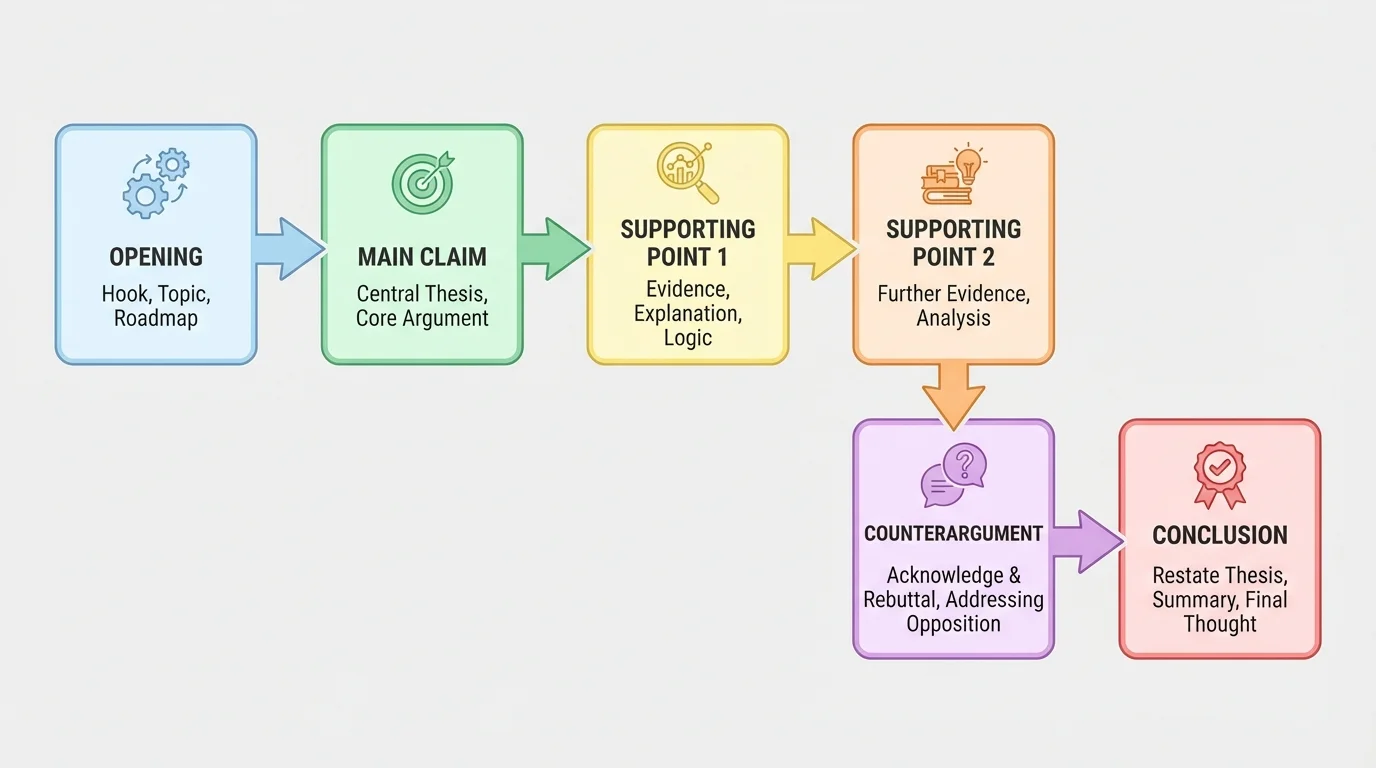
Organization is what turns separate ideas into a meaningful sequence. A listener should be able to move through the presentation step by step, as [Figure 1] shows, without wondering why one point comes after another. This is the heart of a strong line of reasoning: each part connects logically to the next.
Most effective presentations include an introduction, a body, and a conclusion, but that simple structure is not enough by itself. The introduction should establish the topic, purpose, and perspective. The body should develop major points in a useful order. The conclusion should leave the audience with the significance of the ideas, not merely repeat the first sentence.
There are several common ways to organize spoken information. A problem-solution structure works well when proposing action. A cause-effect structure works well when explaining why something happens. A compare-contrast structure helps when analyzing alternatives. A chronological structure fits historical developments or processes over time. The strongest speakers choose the structure that matches the purpose.
Transitions are another major part of organization. A transition is more than a phrase like "next" or "another point." It explains the relationship between ideas. For example: "While cost is one concern, the larger issue is long-term access." That sentence does not merely move forward; it signals comparison and priority. Such cues help listeners track your thinking in real time.
Chunking information also matters. If a speaker includes seven small points with no categories, the audience may remember almost none of them. If those same points are grouped into three major ideas, the audience can follow more easily. Spoken language must be structured for listening, not just for writing.
Later, when a presentation becomes more complex, the same structure from [Figure 1] remains useful: central claim, well-ordered support, fair response to other views, and a conclusion that grows naturally from the evidence.
Persuasive speaking depends on support. A speaker may sound confident, but confidence is not proof. Strong presentations use evidence from reliable sources and present it in forms that fit the audience's needs, as [Figure 2] illustrates through source and media choices.
Credible evidence often comes from expert interviews, academic journals, government reports, respected news organizations, historical documents, and carefully conducted studies. Not every source is equally strong. A random post, an unsourced graphic, or a sensational claim repeated online may attract attention but does not automatically deserve trust. Credibility depends on authority, accuracy, currency, and relevance.
Evidence should also be accurate in the way it is used. A speaker must avoid quoting out of context, misrepresenting a statistic, or presenting a single example as if it proves a universal truth. Ethical speakers do not bend evidence to fit a claim. They test their claim against the evidence.
Media choices matter too. A graph may help listeners understand a trend faster than spoken numbers alone. A brief quotation may add authority. A photograph may make a real-world issue concrete. A short audio clip or video clip may be effective if it directly supports the point and does not distract from it. The medium should serve the message, not compete with it.
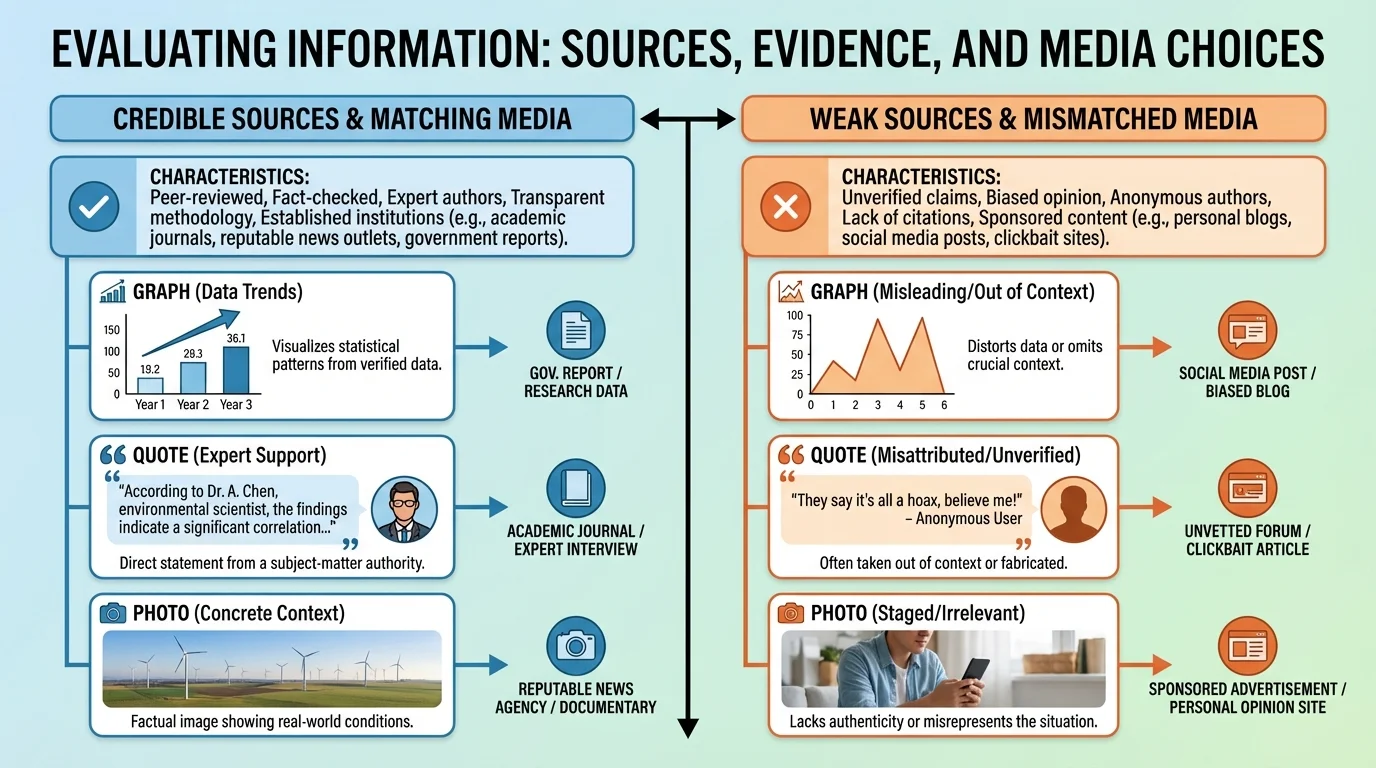
To choose the best format, ask what your audience needs most. If they need to compare data, use a clear visual or concise numerical explanation. If they need emotional and human context, use a well-chosen example or firsthand account. If they need technical clarity, define specialized terms and avoid cluttered slides. Good speakers do not dump every source into a slideshow; they curate information.
For instance, if a student presents findings about sleep and academic performance, a useful support set might include one study from a medical journal, one school survey, and a simple visual showing average sleep duration by grade. That is more effective than ten crowded slides filled with paragraphs. The source selection and the media choice should work together.
Case study: turning research into presentation evidence
A student is presenting on whether later school start times improve learning.
Step 1: State a focused claim
The student says, "Schools should consider later start times because adolescent sleep patterns make early schedules less effective for learning."
Step 2: Choose strong evidence
The student uses a pediatric sleep study, attendance data from a school district, and a short student survey. Each source speaks to a different part of the issue.
Step 3: Match the evidence to the medium
The medical study is summarized in one sentence, the attendance data is shown in a simple graph, and the survey results are explained through two short percentages instead of a dense spreadsheet.
Step 4: Explain the evidence
The student connects each source back to the claim instead of assuming the audience will do that work alone.
The result is a presentation that is both informative and easier to follow.
When evaluating evidence, speakers should also watch for common weaknesses: outdated data, emotionally loaded anecdotes standing in for research, sources with clear conflicts of interest, and visuals that exaggerate differences. Credibility is not only about where information comes from, but also about how honestly it is presented.
Strong speakers do not pretend the other side does not exist. They recognize that many important issues involve disagreement, competing priorities, or unanswered questions. Addressing other perspectives does not weaken your point. In many cases, it strengthens it because it shows seriousness, fairness, and intellectual control.
An counterargument is a reasonable opposing view that challenges your claim. To address it well, first state it accurately. A weak speaker might distort the opposing side into an easy target. A strong speaker represents it fairly and then responds with evidence and reasoning.
Suppose a student argues that schools should limit phone use during instructional time. An opposing perspective might say that phones can support safety and quick research. A strong response would acknowledge those benefits, then explain why structured access may still be better than unrestricted use during class. The point is not to eliminate complexity, but to handle it responsibly.
Reasoning becomes stronger when you distinguish between disagreement and confusion. A listener may oppose your claim, or the listener may simply not understand how one point connects to the next. Clear organization, fair acknowledgment of other views, and specific evidence help with both problems.
Addressing opposition can happen in several ways. You might include a brief concession, such as "Although this policy may increase short-term costs, it reduces long-term waste." You might compare values, such as freedom versus safety, or speed versus accuracy. You might also show that a proposed solution is not perfect but is still better than the alternatives. Real arguments often work that way.
This habit is especially important in discussions of public policy, ethics, science, and history. Complex issues rarely have only one serious side. Recognizing that complexity helps build credibility with an audience that expects mature thinking.
Even a well-researched presentation can fail if the delivery works against the message. Effective speaking depends on style and delivery choices that fit the purpose and audience.
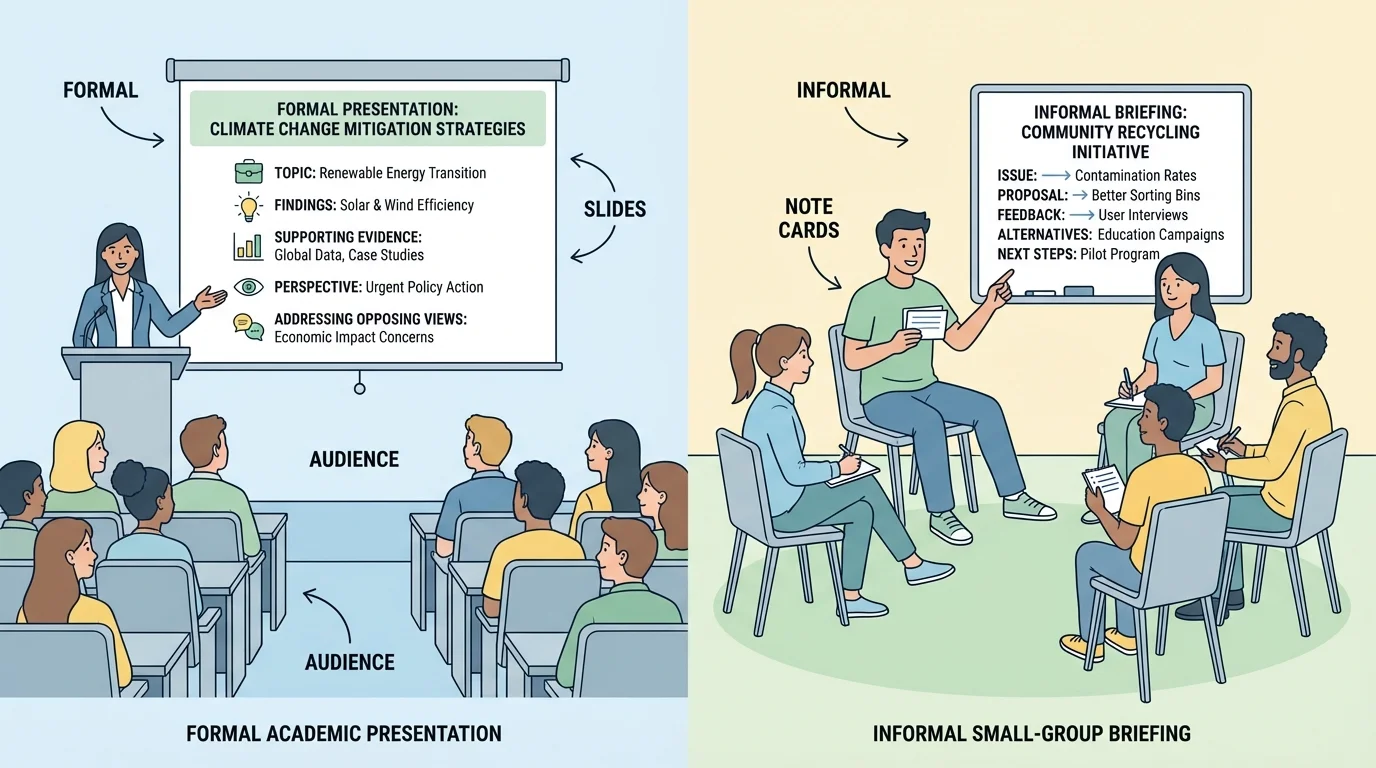
As [Figure 3] shows through differences between formal and informal speaking contexts, tone is the speaker's attitude as expressed through word choice and voice. A serious topic such as public health requires a different tone from a celebratory speech at an awards ceremony. If the tone is too casual for the subject, the speaker may seem careless. If it is too stiff for the setting, the speaker may lose connection with the audience.
Style includes sentence length, level of formality, and the balance between precise vocabulary and accessibility. In a classroom seminar, specialized terms may be appropriate if they are explained clearly. In a community presentation, simpler language may be more effective. Good speakers do not try to sound impressive at the cost of being understood.
Delivery includes pacing, volume, emphasis, pronunciation, eye contact, and body language. Speaking too quickly can make strong ideas disappear. Speaking too softly can make even excellent evidence unusable. Reading every word from slides usually weakens audience engagement because it suggests the speaker is not really guiding the presentation.
Effective speakers also use strategic emphasis. A pause before a key point can matter more than a louder voice. A change in pace can signal importance. Eye contact can build trust if it feels natural rather than forced. Gestures can clarify points when they are purposeful rather than distracting.
This contrast reminds us that delivery is not one fixed performance style. A formal presentation to teachers, a debate round, and a project update to classmates may all require different levels of polish, note use, and posture. What stays constant is clarity, control, and respect for the audience.
Listeners often remember a speaker's organizational clarity more than individual facts. That is one reason transitions, emphasis, and purposeful repetition matter so much in oral communication.
Another important part of style is avoiding filler that weakens authority. Repeated phrases like "kind of," "like," or "you know" can distract listeners if they become constant. This does not mean a speaker must sound robotic. Natural speech should still sound natural. The goal is to remove habits that interfere with meaning.
Not all speaking situations demand the same structure. A formal research presentation usually requires a polished introduction, clearly labeled points, documented evidence, and a professional tone. A debate demands concise claims, rapid response to opposition, and precise use of evidence. An informal group briefing may be shorter, more direct, and more conversational while still needing structure and credibility.
The task shapes the substance. In a ceremonial speech, emotional resonance may matter more than data. In a science presentation, method and evidence may matter most. In a civic proposal, the audience may need both statistics and practical consequences. Skilled speakers adapt rather than using one template for everything.
| Task | Main Goal | Useful Features | Typical Tone |
|---|---|---|---|
| Research presentation | Inform or explain findings | Clear structure, source-based evidence, visuals | Formal and precise |
| Argument speech | Persuade audience of a position | Claim, reasons, counterargument, call to action | Confident and reasoned |
| Debate | Defend position under challenge | Fast reasoning, rebuttal, concise evidence | Assertive but controlled |
| Briefing | Update or inform efficiently | Priority points, direct language, minimal clutter | Professional and concise |
| Informal discussion lead | Guide conversation | Questions, summaries, flexible examples | Conversational but focused |
Table 1. Comparison of common speaking tasks, their goals, and the style choices they often require.
This is why audience analysis matters before speaking. Ask who the audience is, what they already know, what they care about, what they might resist, and what action or understanding you want from them. The same evidence may need to be framed differently for a biology class, a parent audience, or a student council committee.
Many weak presentations suffer from predictable problems. One is information overload: too many details, too fast, with no clear hierarchy. Another is unsupported claims: strong opinions with little credible backing. A third is weak organization: good points arranged in an order that makes little sense to listeners.
Another problem is using media badly. Slides overloaded with text encourage reading instead of speaking. Tiny graphs, hard-to-see colors, and decorative images can all reduce clarity. If a visual does not help the audience understand a point better or faster, it probably does not belong.
Bias can also damage a presentation. This happens when a speaker ignores inconvenient evidence, mocks opposing views, or chooses only sources that confirm what the speaker already believes. Intellectual honesty matters. Audiences, especially mature ones, often notice when a presentation feels one-sided in an unfair way.
Finally, delivery problems can undercut content. Monotone speech, lack of eye contact, unclear pronunciation, and dependence on notes may make even well-prepared content harder to absorb. Preparation helps solve most of these issues. Speakers improve by revising both ideas and delivery, not one without the other.
Consider a student presenting to a school committee about reducing food waste in the cafeteria. The speaker begins with a clear claim: the school should redesign lunch disposal and donation systems because current waste levels cost money and increase environmental impact. That claim gives the audience a direction immediately.
The student then organizes the talk into three parts: the scale of the problem, the causes, and realistic solutions. Evidence includes cafeteria waste measurements, district cost estimates, and a comparison to another school that reduced waste successfully. The speaker includes one simple chart rather than several crowded visuals and explains what the numbers mean rather than just displaying them.
The presentation also addresses opposing concerns. Some committee members may worry that changes will require staff time or added cost. The student acknowledges those concerns and responds with a phased plan that begins with low-cost changes. That response makes the presentation more credible because it shows practical thinking rather than idealism alone.
"The aim of argument, or of discussion, should not be victory, but progress."
— Joseph Joubert
Notice what makes this presentation strong: a clear perspective, logical sequence, credible support, suitable media, fair treatment of opposition, and a style appropriate to a semi-formal decision-making setting. These are the same principles that apply whether the topic is environmental policy, literature, history, or science.
Excellent speakers do not merely transfer information from their notes into the air. They shape information for listening. That means selecting what matters, arranging it logically, explaining why it matters, and speaking in a way that respects the audience's time and attention.
When preparing a presentation, ask: What is my purpose? What is my clearest claim or finding? What evidence best supports it? What does my audience need in order to follow me? What reasonable opposition should I address? What style and level of formality fit this situation? These questions are not extras. They are the core of effective speaking.
At the highest level, presenting well is a form of responsibility. If your evidence is careless, your organization confusing, or your tone inappropriate, the audience cannot fully understand your ideas. But when perspective, reasoning, evidence, and delivery work together, a presentation becomes more than a requirement. It becomes a meaningful act of communication.
