Two people can look at the same event, read the same article, and still come away with different conclusions. That does not always mean one person is careless or dishonest. Often, it means people notice different evidence, value different outcomes, or define the problem in different ways. In classrooms, communities, and public debates, the most powerful thinkers are not the loudest voices. They are the ones who can listen carefully, compare ideas fairly, and respond in a way that moves understanding forward.
Every serious issue has more than one angle. Questions about school rules, social media, public health, climate policy, artificial intelligence, or community safety involve competing priorities. One person may focus on freedom, another on fairness, another on cost, and another on long-term consequences. If you respond only to the part you already disagree with, you miss the real complexity of the issue.
Thoughtful response is a skill for academic success, but it is also a life skill. In class discussions, seminars, group projects, and presentations, you are expected to engage with others' ideas, not just wait for your turn to speak. In civic life, thoughtful discussion helps people make better decisions. In personal life, it helps prevent conflict from turning into confusion or disrespect.
Perspective is a particular way of seeing or interpreting an issue, shaped by experience, values, and knowledge. A claim is a statement that argues something is true or should be done. Evidence is the information used to support a claim, such as facts, data, examples, or expert testimony. A counterclaim is a response that challenges or qualifies another claim. Synthesis is the process of combining ideas from multiple sources or speakers into a more complete understanding.
When you participate in discussion, your goal is not simply to defeat another person's view. A stronger goal is to understand the full conversation, identify where ideas connect or conflict, and decide what conclusion is most justified by the available evidence.
A thoughtful response begins with accuracy. Before disagreeing, you should be able to restate another person's idea fairly. This is sometimes called representing a view in its strongest reasonable form. If someone argues that a later school start time improves learning because teenagers need more sleep, a weak response would be, "So you just want school to be easier." A thoughtful response would be, "You are arguing that sleep affects attention, memory, and health, so start time should reflect adolescent biology."
Thoughtful response also requires intellectual humility. That means recognizing that your first reaction may be incomplete. You may have strong beliefs, but strong beliefs are not an excuse for weak listening. In collaborative discussion, mature speakers remain open to revision when stronger evidence appears.
Another key part of thoughtful response is distinction. Not every statement does the same job. Some comments offer facts. Some express values. Some tell personal experiences. Some define terms. Some propose solutions. If you mix these together carelessly, discussion becomes messy. If you separate them, discussion becomes clearer.
[Figure 1] To hear a complete conversation, you need to notice who is speaking, who is not speaking, and what kinds of positions are present. On an issue such as a school phone policy, several stakeholders may have valid concerns: students may care about communication and convenience, teachers about attention, parents about safety, and administrators about consistency and enforcement.
Good collaborative discussion follows clear norms: listen actively, avoid interrupting, ask clarifying questions, refer to ideas rather than attacking people, and make room for quieter voices. These guidelines do not make discussion less rigorous. They make it more rigorous by increasing the chance that important evidence actually gets heard.
Listening for a full range of positions also means resisting the urge to sort every issue into only two camps. Many issues have more than two meaningful views. For example, on homework, one group may want less homework, another may want current levels, and a third may support homework only when it has a clear academic purpose. Reducing this to a simple pro-or-con debate hides important differences.
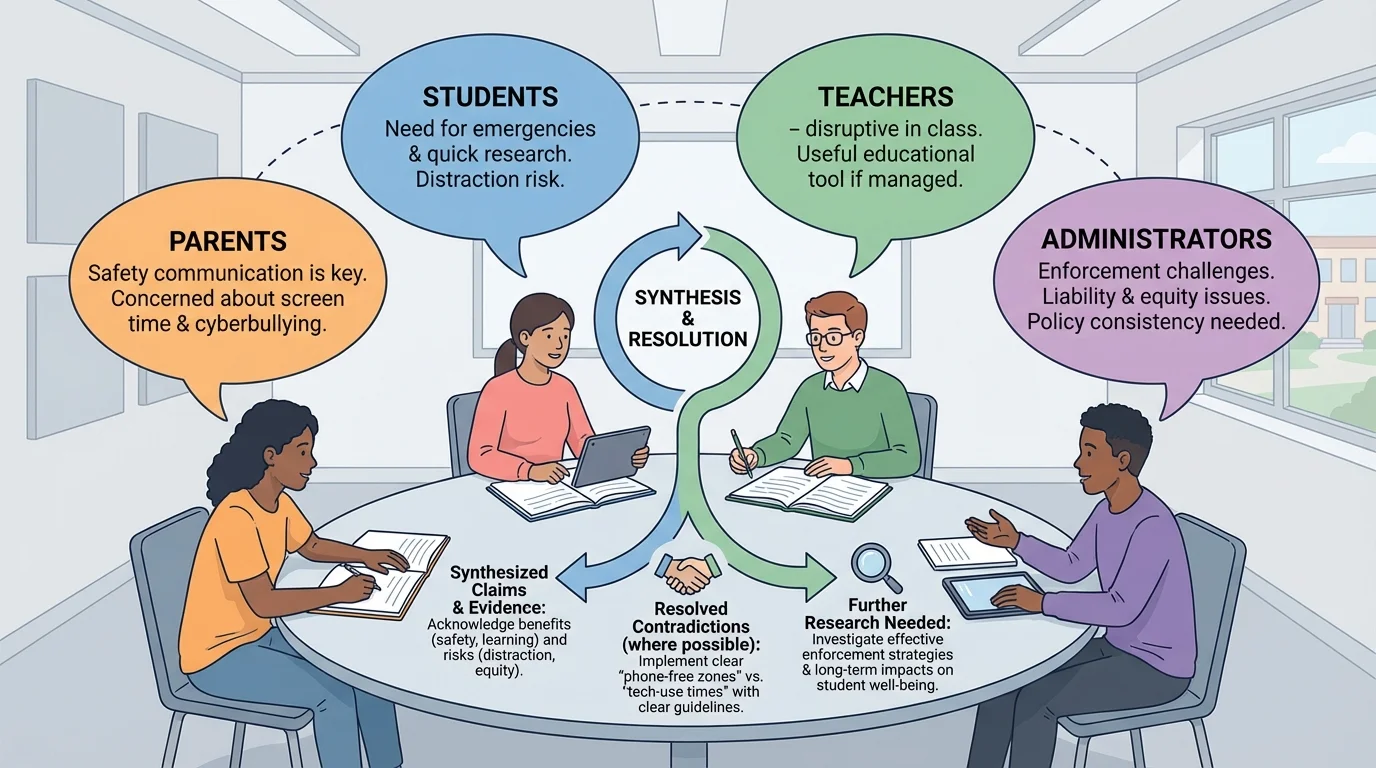
In strong discussions, students build on one another's ideas with phrases such as, "I want to extend that point," "I see the concern, but the evidence suggests something different," or "That argument makes sense under one condition, but not under another." These moves show that discussion is a shared investigation, not a competition for airtime.
Researchers who study group decision-making have found that groups often make worse choices when members rush toward agreement too quickly. Hearing disagreement can actually improve the quality of thinking when people examine it carefully.
Just as important, hearing a full range of positions includes attending to perspectives that may be affected by the issue even if they are not present in the room. A discussion about public transportation, for example, should consider workers, students, elderly riders, people with disabilities, city planners, and taxpayers. Missing perspectives can lead to weak conclusions.
Once different perspectives are on the table, the next step is analysis. This means examining what each speaker actually says and what support they provide. A useful set of questions includes: What is the main claim? What evidence supports it? Is the evidence current, relevant, and reliable? Does the speaker make assumptions that need to be examined?
Suppose one student says, "Phones should be allowed in class because students need them for emergencies." Another says, "Phones should be banned because they destroy concentration." Both statements make claims, but neither is complete without evidence. How often do emergencies occur during class? What kind of distraction data exists? Are there differences between having phones silenced, visible, or actively used?
Evidence can take several forms. Statistical evidence uses data and measurable trends. Anecdotal evidence uses personal experience or individual examples. Expert evidence draws on trained authority. Textual evidence relies on quotations and details from a source. Each kind can be useful, but they do not all carry equal weight in every situation. A personal story may be emotionally powerful, but it does not automatically prove a general rule.
Careful listeners also distinguish between relevant evidence and impressive-sounding evidence. A graph or statistic is not persuasive just because it looks scientific. If the data is outdated, based on a tiny sample, or unrelated to the exact issue, it may mislead. Strong analysis asks not just, "Is there evidence?" but "Does this evidence actually support the claim being made?"
| Type of statement | What it does | How to respond thoughtfully |
|---|---|---|
| Claim | Argues that something is true or should happen | Ask what reasons or evidence support it |
| Evidence | Supports a claim with facts, examples, or testimony | Check relevance, reliability, and sufficiency |
| Comment | Adds a reaction, observation, or interpretation | Clarify whether it is evidence, opinion, or explanation |
| Counterclaim | Challenges another claim | Compare the competing evidence and assumptions |
Table 1. A comparison of common parts of discussion and how to evaluate them.
When discussion becomes complicated, it helps to take notes in categories: claim, evidence, reasoning, possible bias, and unanswered questions. This keeps you from reacting only to tone or confidence. A confident speaker is not always a credible one.
[Figure 2] Synthesis is more than listing what each side says. It means combining ideas into a clearer whole through organized comparison. A synthesis answers questions such as: Where do the sides agree? Where do they disagree? Which evidence is strongest? Are people using the same words in different ways? What important themes appear across the discussion?
For example, in a discussion about whether schools should begin later in the morning, one side may argue that later start times improve sleep, mental health, and academic performance. Another side may argue that changing the schedule disrupts transportation, sports, jobs, and family routines. A weak response picks one side immediately. A stronger synthesis recognizes that both sides may care about student well-being, but define the practical path differently.
A useful way to synthesize is to sort information into three groups: shared ground, real disagreement, and open questions. Shared ground might be that students need to be alert and healthy. Real disagreement might concern whether later start times create unacceptable logistical problems. Open questions might include cost, transportation data, or whether pilot programs in similar districts succeeded.
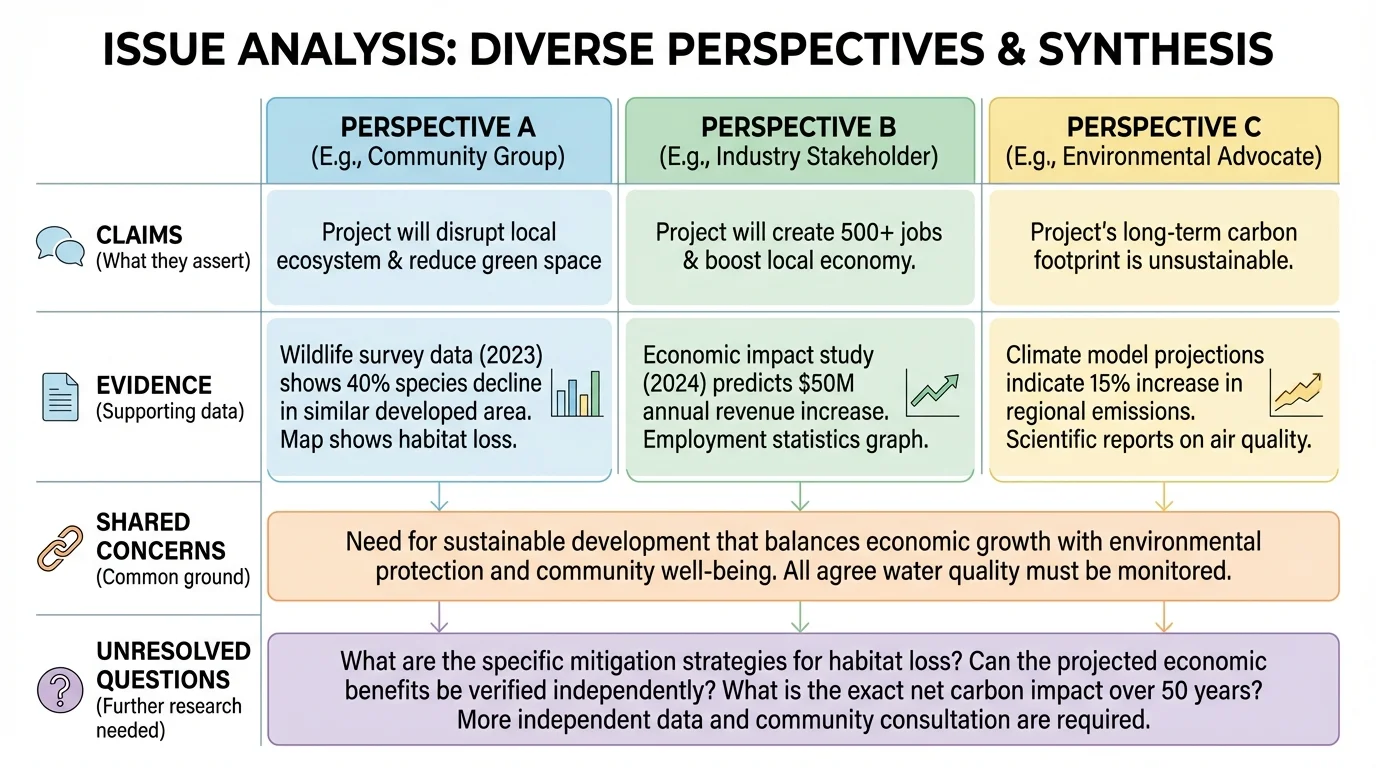
Synthesis also helps you avoid false balance. Not all sides are equally supported just because they are present. If one position relies on multiple strong studies and another relies mostly on rumor, a good synthesis does not pretend they are equally credible. Fairness means representing views accurately, not giving weak evidence the same strength as strong evidence.
Strong synthesis connects, compares, and judges. It connects related ideas across speakers, compares the quality of evidence, and judges where the most reasonable conclusion lies at that moment. It stays open to new information without acting as if every argument is equally convincing.
In class discussion, synthesis often sounds like this: "Several people agree that distraction is a problem, but they disagree about whether a total ban is the best solution. The strongest evidence so far supports limiting active use during instruction, but we still need better information about emergency access." That response moves the conversation forward because it combines ideas instead of repeating them.
A contradiction happens when statements cannot both be true in the same sense at the same time. But many apparent contradictions are not complete contradictions. Sometimes speakers are using different definitions, discussing different situations, or focusing on different time periods. Before deciding two claims conflict, identify exactly where the conflict lies.
Consider these two statements: "Social media helps teenagers stay connected" and "Social media harms teenage mental health." These may sound opposed, but they can both be true under different conditions. Social media may support connection in some contexts while increasing anxiety, comparison, or sleep disruption in others. The contradiction can be partly resolved by refining the claim: social media has mixed effects that depend on how, how much, and why it is used.
Resolving contradictions often requires one of several moves. You may qualify a claim by adding conditions. You may narrow a claim so it applies only in certain cases. You may distinguish categories, such as short-term versus long-term effects or personal freedom versus institutional responsibility. You may also discover that one claim is simply unsupported and should be rejected.
This is where careful note-taking helps. The comparison structure introduced earlier remains useful because contradictions are easier to resolve when claims and evidence are placed side by side. Once ideas are organized, you can see whether the disagreement is factual, definitional, ethical, or practical.
Sometimes contradictions cannot yet be resolved. If two high-quality sources reach different conclusions, the responsible move is not to pretend certainty. It is to explain the conflict honestly and identify what additional information would help settle it.
[Figure 3] Strong thinkers turn confusion into inquiry. When a discussion reaches uncertainty, the next step is to ask what information would clarify the issue through a research path from claim to question. This is where discussion connects directly to investigation.
You may need more information because the existing evidence is too limited, too biased, too old, too vague, or too incomplete. You may also need more voices. An issue involving school discipline, for example, should not be investigated only from the perspective of rule-makers. It also needs the experiences of students affected by the rules and data about outcomes.
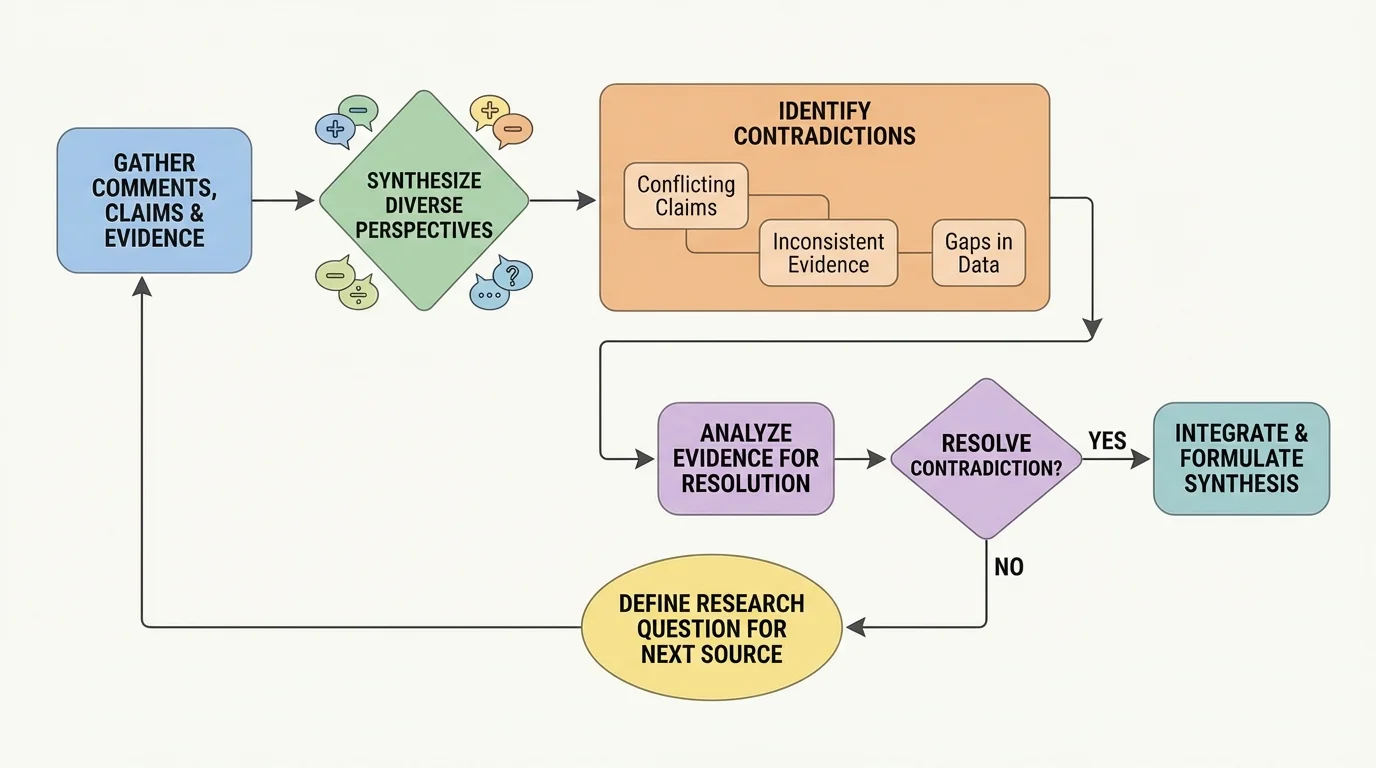
Good follow-up questions are specific. Instead of asking, "Who is right?" ask, "What do distraction studies measure?" "How do different schools define emergency phone access?" "What happens in schools that use locked pouches during class?" "How do students, teachers, and parents describe the policy's effects?" Specific questions lead to useful research. Vague questions usually lead to vague answers.
Additional research may involve reading multiple articles, comparing primary and secondary sources, checking publication dates, reviewing studies, collecting survey data, or interviewing stakeholders. The purpose is not to gather endless information. The purpose is to gather the information most likely to deepen understanding and help complete the task at hand.
When evaluating new information, remember earlier source-analysis skills: consider author expertise, purpose, audience, publication context, evidence quality, and possible bias. Reliable research depends on both what a source says and how it knows it.
Sometimes the missing information is not another fact but a better definition. Debates often become confused because people use words like fair, safe, effective, or successful differently. Clarifying terms can remove a contradiction that looked bigger than it really was.
Responding thoughtfully does not mean staying neutral forever. It means earning your position through listening, analysis, and synthesis. Once you have done that work, you should state your view clearly. A persuasive response usually includes four parts: a fair summary of the discussion, a claim of your own, evidence and reasoning, and acknowledgment of limits or counterarguments.
A clear statement might sound like this: "I agree that students need access to families in urgent situations, but the evidence on classroom distraction is stronger than the evidence for unrestricted phone access. A policy that keeps phones silent and out of sight during instruction, while allowing access in emergencies, addresses both concerns more effectively than either extreme."
Notice what makes that response strong. It does not ignore opposing concerns. It recognizes them and then explains why one conclusion is more justified. It also avoids exaggeration. Persuasive academic speaking depends on precision, not drama.
As the stakeholder map in [Figure 1] makes clear, persuasive discussion becomes stronger when you consider how different groups are affected. A position that sounds convincing from only one point of view may weaken when additional perspectives are included.
Consider a debate over whether a school district should require service-learning hours for graduation. One group argues that service builds responsibility, connects students to communities, and strengthens college or job applications. Another group argues that a requirement may unfairly burden students who work jobs, care for siblings, or lack transportation. A third group supports service-learning but wants flexible options, such as school-based projects or paid community internships that count toward the requirement.
Case study: moving from debate to reasoned conclusion
Step 1: Identify the main positions.
Position A supports a required number of hours because service promotes civic growth. Position B opposes a requirement because equal expectations may create unequal burdens. Position C supports the goal but proposes multiple pathways.
Step 2: Sort the evidence.
Evidence for Position A may include studies on civic engagement and student reflection. Evidence for Position B may include student schedules, transportation barriers, and family responsibilities. Evidence for Position C may include examples from districts that offer flexible service options.
Step 3: Find agreements and contradictions.
Most sides may agree that community connection matters. The contradiction concerns whether a single required model is fair and practical for all students.
Step 4: Determine what more information is needed.
The district may need data on student work hours, transportation access, community partnerships, and how similar policies affect graduation rates or student stress.
Step 5: Form a reasoned response.
A strong conclusion might support service-learning as a graduation expectation only if students can meet it through flexible, accessible pathways that account for real differences in time, transportation, and family obligations.
This example shows that thoughtful response is not passive. It is active, organized, and evidence-based. The goal is not merely to collect opinions, but to build a conclusion that is more informed than any single first reaction.
One common mistake is the straw man: oversimplifying an opposing view so it is easier to attack. Another is relying only on personal experience when broader evidence is needed. Another is confusing volume with strength, as if saying something forcefully makes it more credible.
A better move is to ask a clarifying question before disagreeing. Another better move is to identify the strongest evidence on each side before deciding. Another is to say, "That point changes my thinking," when new information genuinely improves your understanding. Changing your mind for good reasons is not weakness. It is evidence of serious thinking.
There is also a difference between respectful disagreement and empty politeness. Respect does not mean avoiding challenge. It means challenging ideas with accuracy, evidence, and fairness. In advanced discussion, the best participants are often the ones who disagree carefully rather than agree automatically.
"The test of a first-rate intelligence is the ability to hold two opposed ideas in mind at the same time and still retain the ability to function."
— F. Scott Fitzgerald
That idea matters in discussion because mature thinkers can hold tension without rushing into simplistic answers. They can examine two strong but competing ideas, test them against evidence, and keep investigating until the issue becomes clearer.
Whether you are discussing a novel, a scientific controversy, a policy issue, or a classroom problem, the process remains similar: listen carefully, identify claims, evaluate evidence, synthesize ideas, resolve contradictions when possible, and ask for the next information that would make understanding deeper and judgment stronger.
